This website contains affiliate links, and some products are gifted by the brand to test. As an Amazon Associate, I earn from qualified purchases. Some of the content on this website was researched and created with the assistance of AI technology.
Key Takeaways
- Keep the handrail clear. Every flower goes on the room side of the balusters, and nothing should poke much more than 4.5 inches into the stairway.
- Compact carnation clusters on slim greenery beat a fat, continuous garland.
- Hidden water tubes with rubber caps keep the flowers fresh and your steps dry.
- Match the color plan to the stairs: a burgundy-to-blush fade for long straight runs, ivory with red for curves, white with birch for tight or open rails.
- Carnations wilt early around ethylene (ripening fruit is a common source), and the ASPCA lists them as mildly toxic to dogs, cats and horses.
- Three decorated spots on an open rail often look better than dressing the entire rail.
Creating a Christmas carnation garland for your entryway staircase rail sounds like an easy weekend project, and it mostly is, except that the stairs are the one part of the house where people grab things without looking, usually with a laundry basket in one arm and a coffee in the other. Easy? Sort of.
I’ve botched this before. One garland was so fat that it brushed my sleeve on every single trip, and by day three I couldn’t stand it, so I cut the whole thing off the rail with kitchen scissors and started over. Everything below comes from that mess: small flower groups, hidden water, a thin line of greenery, and a handrail nobody has to hunt for. You’ll find eight setups, from classic red to a pale Scandinavian look, plus the safety numbers I checked before I wrote a word.
Choosing a Christmas carnation garland for an entryway staircase should be exciting, not overwhelming. Compare five practical design styles by appearance, materials, flower care, and installation needs. Discover which approach fits your railing while keeping the handhold accessible and stairs clear, so your holiday flowers look beautiful without creating hazards.
Which Carnation Garland Fits Your Entryway Staircase?
Choosing a Christmas carnation garland for an entryway staircase should be exciting, not overwhelming. Compare five practical design styles by appearance, materials, flower care, and installation needs. Discover which approach fits your railing while keeping the handhold accessible and stairs clear, so your holiday flowers look beautiful without creating hazards.
| Garland Style | Best Look | Flowers and Materials | Installation and Care |
|---|---|---|---|
|
Classic Holiday
Classic Red Sweep
Traditional and full-looking.
|
Traditional Christmas greenery and red accents. | Red carnations, evergreen support, removable water holders. Choose low-profile, secure attachments. | Keep every flower outside the handhold. Inspect water compartments daily. |
|
Light and Fresh
White Floral Rhythm
Small repeated flower groups.
|
Airy white blooms against natural greenery. | Mini white carnations, short green sections, protected ties. Keep every section individually removable. | Space the flowers evenly. Replace one fading group at a time. |
|
Color Focused
Burgundy Blush Gradient
A softer contemporary design.
|
Gradual color transition from burgundy to pale pink. | Burgundy carnations, blush carnations, slim evergreen support. Sort flowers before assembly. | Group similar shades together. Keep the upper rail and stairs clear. |
|
Easy to Refresh
Modular Flower Pods
A practical design for fresh flowers.
|
Defined floral accents along a slim supporting garland. | Short floral inserts, reusable cord, protected attachments. Each flower group lifts out separately. | Replace only the section that needs attention. Check the support for shifting or drips. |
|
Small Space
Minimalist Open Rail
Subtle Christmas color.
|
Three isolated carnation groupings with open space. | White carnations, slim support cord, small removable flower holders. Decorate only a suitable short area. | Leave most of the railing unadorned. Use the design only where full handrail access remains. |
Resources:
- How to Harvest, Condition, and Care for Cut Flowers | Yard and Garden
- Making Cut Flowers Last Longer
- Home – Cutting and Conditioning Flowers – Research Guides at New York Botanical Garden
How to Create a Classic Red Carnation Garland Along an Entryway Staircase Rail
Red is the obvious pick, and I’m fine with obvious here.
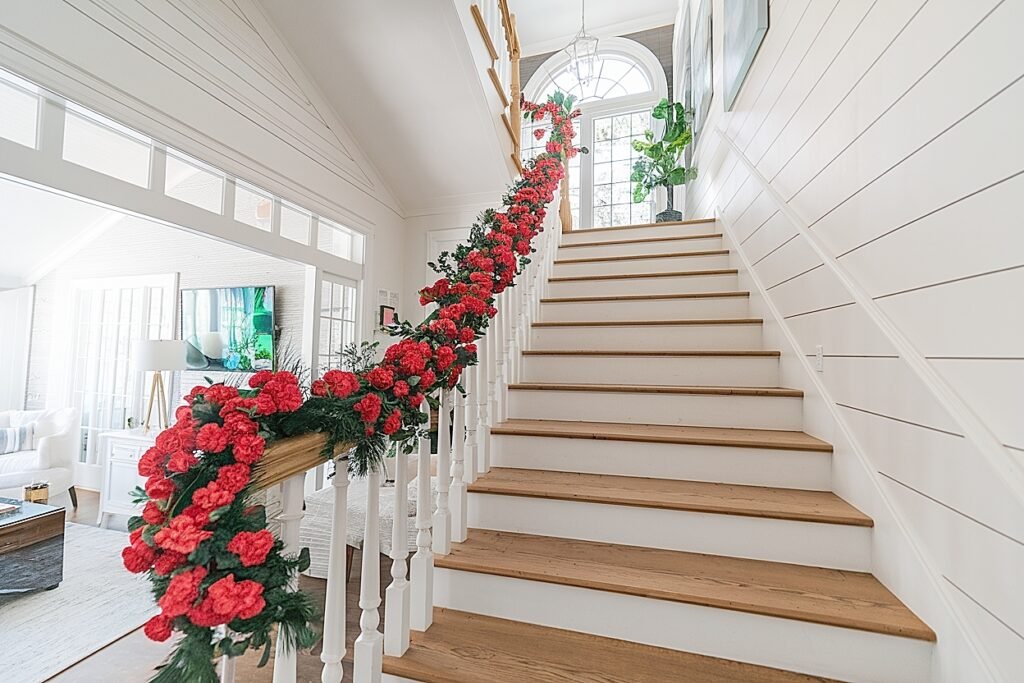
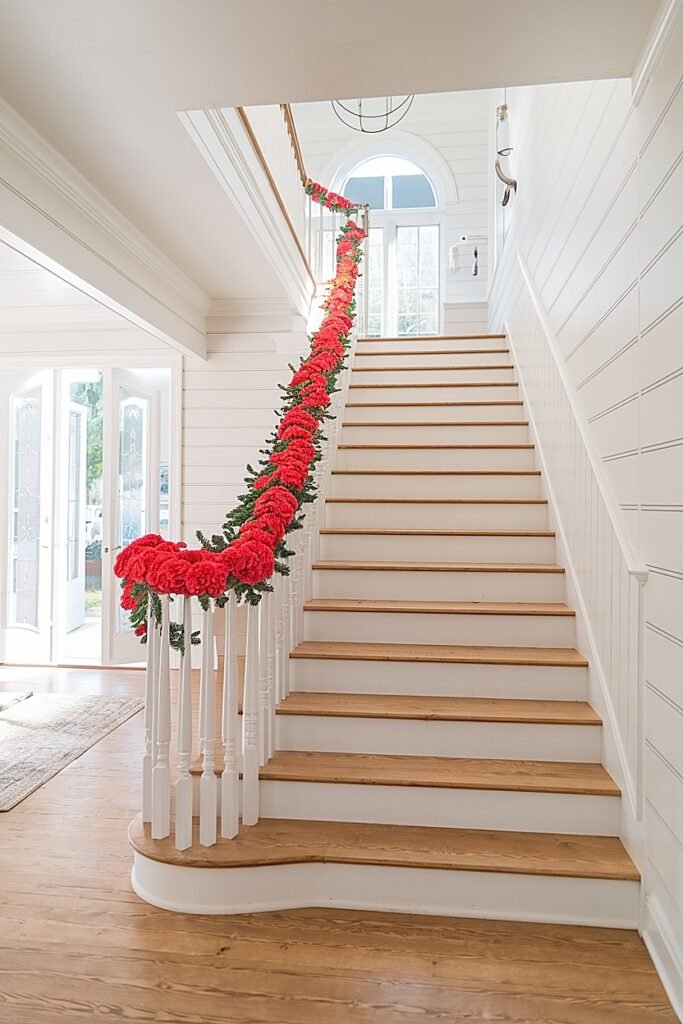
Deep red carnations keep their color well, they don’t shower your entry floor with petals the way some roses do, and a handful of stems goes a long way on a rail because every bloom is full and ruffled. The tricky part is structure. A stair rail is a working piece of your house, so the garland has to live around it, and that one rule shapes everything else in this post, including the parts where I ignored it myself, like the garland that looked great from the sidewalk and awful from the third step, which tells you roughly how much time I spent testing it from the stairs themselves.
Hands get the top of the rail. Decoration gets the outside face of the balustrade, the side looking away from the steps. Before any wire touches the wood I stick tape marks about a foot apart, step back, and fix the spacing, because moving a tape mark takes two seconds and moving a wired group takes ten minutes and a few words I won’t print.
Carnations are touchy about one thing. UC Davis’s postharvest team describes them as ethylene sensitive, and ethylene exposure makes petals wilt early. Ripening fruit gives off ethylene, so keep the banana bowl off the entry table beside your garland.
My setup:
- Position rich red carnations in small groups of five to seven stems along the outside of the railing, and leave the top and inner edge completely free so your hand has a clean path.
- Attach each group to a concealed water tube (the little vials with a rubber cap) so the flowers can drink without leaking. Wire the tube to the balusters behind the greenery, with a layer of tape under the wire to protect the finish.
- Run a gentle, measured sweep of cedar or fir between the groups. Slim, never bulky, and never pushing out into the staircase.
If you want something for the front door too, my post on mini flower Christmas wreaths for apartment front doors pairs well with this one. And if a friend is wrestling with their own stairs this year, a quick share on social media sends them straight here.
There’s more below, including color plans that change as they climb.
Ideas for a Burgundy and Blush Carnation Garland with Graduated Color
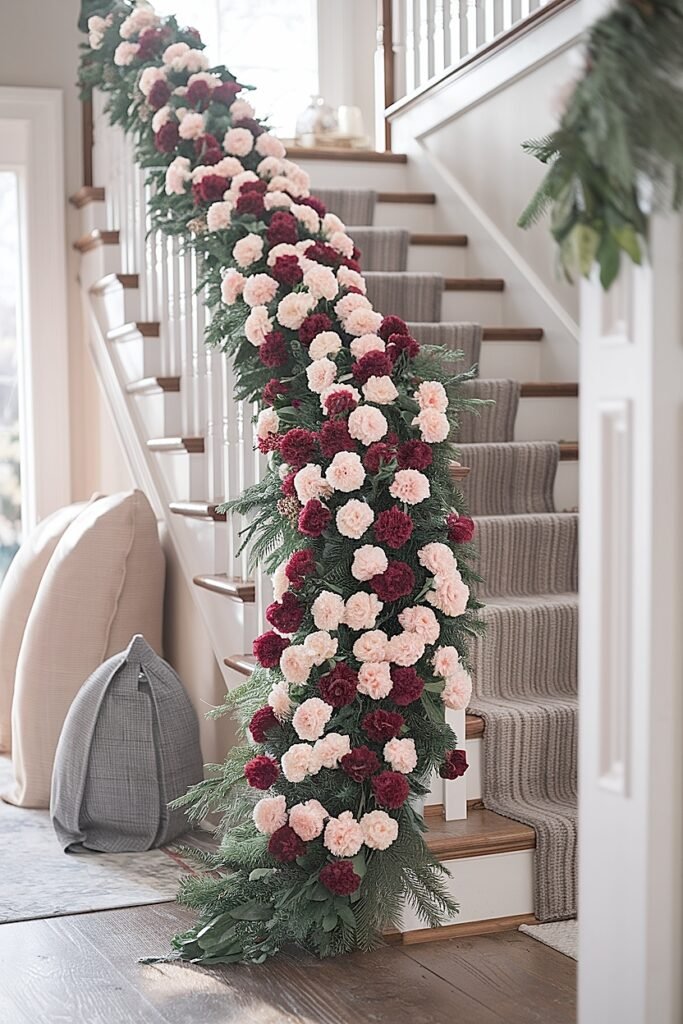
Graduated color is my favorite trick for a long staircase. It works like an ombre sweater, with one shade sliding into the next while your eye follows it all the way up the flight, and when it’s done well people can’t tell you exactly why the garland looks so good. They just say it does, and then they ask where you bought it.
These two shades get along. Same family.
Planning matters here.
You can’t eyeball a color fade halfway up the stairs, because the shades bunch together and start to look random, and by then you’re standing on step seven with wire in your teeth and a bunch of burgundy in the wrong place. Count your groups first. Divide your stems by color before you cut a single piece of wire. In my experience both shades are easy to find at florists and grocery stores, so buy one extra bunch of each (somebody always gets crushed on the car ride home).
- Bottom-to-top fade (Best Overall). Start with all-burgundy groups at the base and add one blush stem per group as you climb, until the top groups are mostly blush. By the last group the color has fully flipped, and the whole garland looks planned instead of lucky. This is the one I’d try first.
- Three color zones. Split the rail into three even sections: burgundy, a mixed middle, then blush. It’s simpler than a slow fade and way more forgiving if your carnations aren’t perfectly matched.
- Repeating mixed groups. Same blend in every group, with one extra burgundy stem lengthening toward the bottom. You get a soft shift without counting anything.
Curves are harder than straight runs.
Easy Ideas for a Red and Ivory Carnation Garland on a Curved Staircase
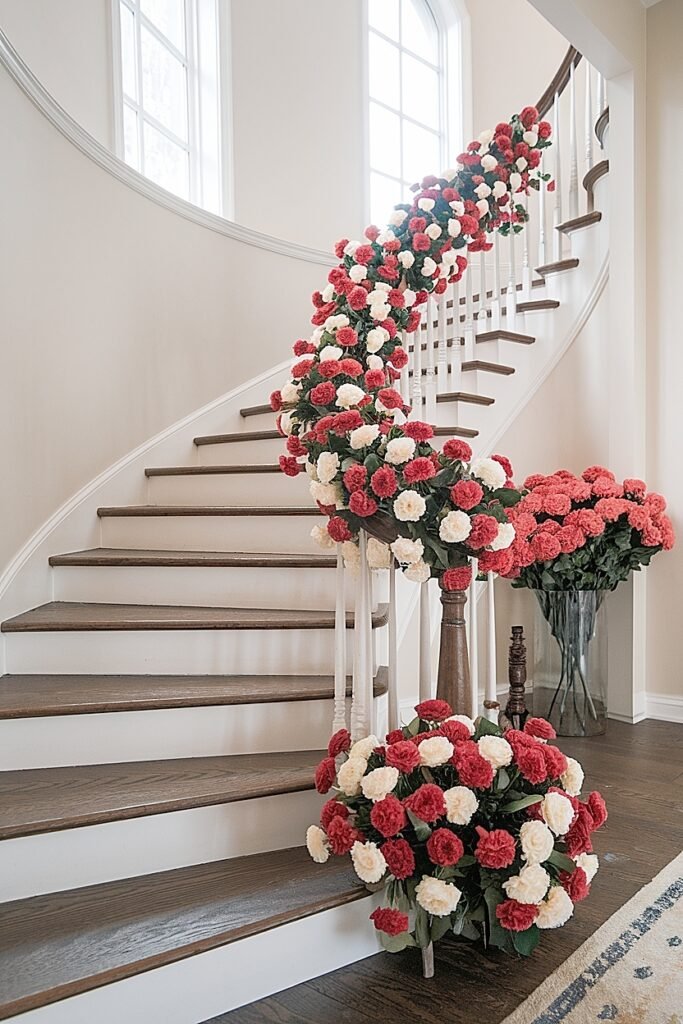
Curves are a pain.
A garland wants to run in a straight line, and your rail is doing the opposite, which means every stiff store-bought swag you’ve ever seen on a curve ends up either hovering off the rail or kinking at the bend, and no amount of fluffing fixes it once it’s wired in place. Ivory carnations show up well in a dim entryway, and the red keeps the palette from going washed out, so this pairing forgives mistakes the stairs won’t.
Let the greenery bend. Keep the flowers still. Greenery follows the rail on flexible wire, and each carnation group sits in its own short, straight spot.
Spacing matters more than usual, since groups crowd together on the inside of a tight turn and spread apart on the outside, and I’d rather shift each group a few inches than force an even look that fights the curve.
- Mark the curve first (Start Here). Put a small tape mark where the curve starts and where it ends, then place your groups relative to those marks. Spacing in the straight parts can be wide, and the groups on the curve can sit a bit closer, which keeps the turn from looking sparse.
- Alternate red and ivory. One red group, one ivory, all the way up. The steady beat hides small spacing mistakes.
- Use a bendable base. Wrap floral wire around a slim rope of cedar so it follows the curve without kinking, and cut the greenery in short sections if the turn is tight.
- Go smaller along the tight edge. Three or four stems fit where seven would poke into the walking path. Save the big groups for the straight stretches.
- Tie one bow at the turn. A single wired ribbon bow right where the stairs begin to bend gives your eye a place to land, and it covers any lumpy gaps in the arc.
The tightest stairs are next, so if yours feels like a hallway, don’t skip it.
How to Make a One-Sided Christmas Carnation Garland for a Narrow Staircase
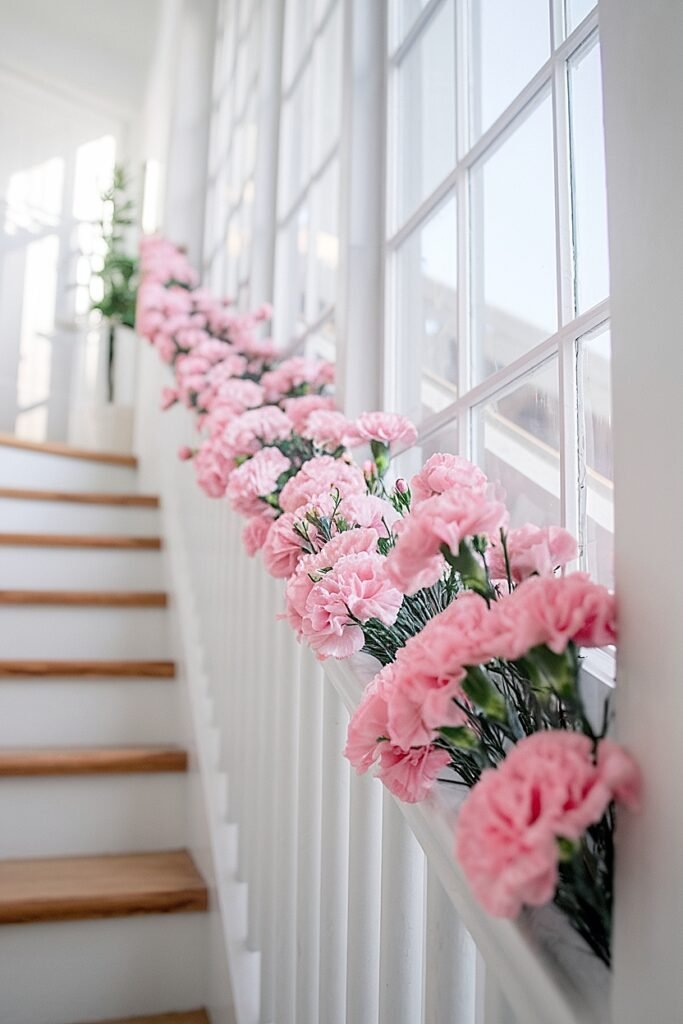
Narrow stairs are where decorating gets honest, because every inch you add to the rail is an inch you take away from your feet, and nobody has inches to spare on a staircase already tight enough to turn carrying a couch into a team sport.
So I looked up the numbers.
Residential code summaries from This Old House and a California permit office list a 36 inch minimum stair width, handrail height between 34 and 38 inches, and a limit of 4.5 inches on how far a handrail can stick out into the stairway. That 36 inch width is measured above the handrail. Those limits apply to the handrail, not to decorations, and local rules vary, so ask your building department if you’re unsure, but I use 4.5 inches as my own ceiling for anything I hang, and staying under it beats arguing about it from a ladder. I’m a flower guy, not an inspector, and nothing in this post replaces a call to the people who are.
One-sided means exactly that. The flowers live on the room side of the balusters, away from the steps, and nowhere else. Flat is the goal: spray carnations (the kind with several little blooms on one stem) and a thin line of greenery keep the depth down, while big standard carnations bulge out sooner than you’d think.
- Use the outer face of the balustrade for all the flowers and greenery, wired snug so nothing hangs loose.
- Choose small spray carnations and thin greenery to keep the display’s depth down. I check it by eye from the top step.
- Never let flowers cut into walking clearance or cover a required handrail. It’s what you grab when you slip, often without looking, and a thick garland can hide where it is. That’s a real trip hazard, and I’d skip the flowers before I’d risk it.
Pinecones are next.
Ways to Layer a Christmas Carnation Garland with Natural Pinecones
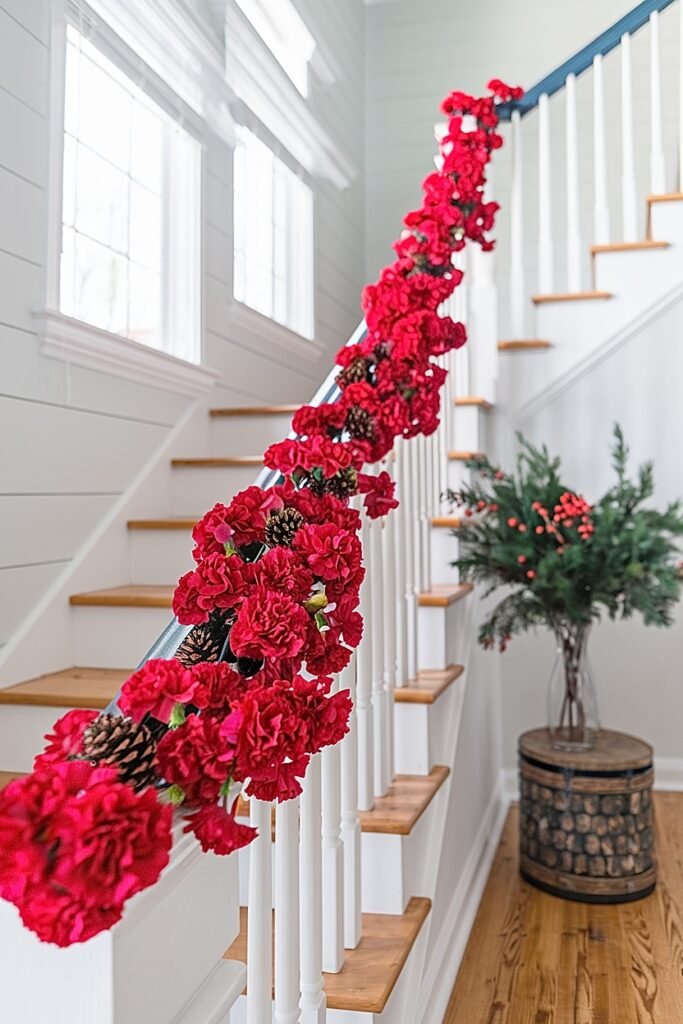
Carnations are soft.
A dark, chunky rail wants something with edges, and natural pinecones do that job nicely, which is why I reach for them whenever the flowers start looking a little too delicate for the wood.
Layering means building in stages: greenery first, cones second, flowers last. Do it in that order and the cones hide your wire and your water tubes, which is half the battle. Cones come in a wide range of sizes, and mixing two or three looks better than one uniform batch, so grab them off the ground or buy a bag at a craft store (look them over for sap and bugs before they come inside). Skip the glittery ones, because glitter lives in the carpet until roughly February, and no one has ever once been glad to find it there.
Weight sneaks up on you. Ten cones plus water tubes add up, so use real wire instead of tape and wrap it twice. If a group’s going to sag, you’ll know within an hour.
- Wire cones to the greenery first (Best Overall). Twist a length of wire around the base of each cone and attach it to the base before any flowers go in. That locks the cones down and gives every flower cluster a rough, natural bed to sit in.
- Tuck cones under the flower heads. A cone or two just below each group hides the water tube, and the group looks grounded.
- Fill gaps with small cones. Tiny ones cover bare spots where the greenery runs thin, and they add texture without adding depth.
- Anchor the ends with big cones. Wire one or two large cones at the newel posts, where the rail starts and stops. The ends take the most bumps, so wire these extra tight.
- Mix open and closed cones. Open ones add width and closed ones add height, so a few of each look more natural than a pile of matching cones.
Next comes a staircase with an odd layout, and a few quirks to match.
Simple Ways to Create a Carnation Garland for a Split-Level Entry Stair
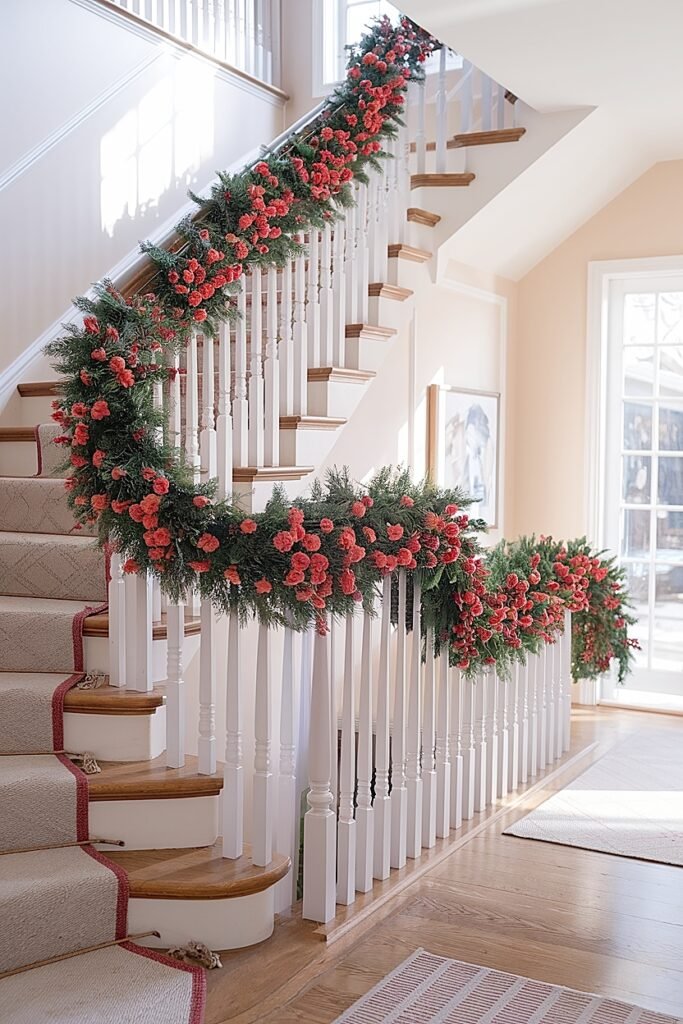
Split-level entries are weird. You walk in and you’re instantly standing between one short flight up and another down, with a short rail and nowhere obvious to hang anything.
Good news, actually.
Less rail means fewer stems, and fewer stems means a smaller bill. Most of them have a rail on the up side, the down side, or both. Pick one as the star.
Pets deserve a mention here, since that entry is exactly where dogs and cats come barreling through, often at full speed and with zero respect for your decorating plans, so it’s worth deciding before you hang anything whether the flowers will be in reach. The ASPCA lists carnations as toxic to dogs, cats and horses, with mild stomach upset and skin irritation as the signs. If your pets chew on things, keep the flowers high on the rail or skip them. The ASPCA poison hotline is (888) 426-4435, and a consultation fee may apply.
- One swag on the longer flight (Best Overall). Hang a single garland with five or six groups on whichever rail is longer. You get the full staircase look without covering both flights, and the shorter rail stays clean.
- One big cluster at the landing. Skip the garland and make a single large grouping where the rail turns. It’s the fastest of the three, and it works if you only have a bunch or two of carnations.
- Matching mini garlands. A short garland of three groups on each rail, kept identical, since both rails are in view at once.
The minimalist version might be my favorite.
How to Style a Minimalist Carnation Garland with Open Stair Rail Sections
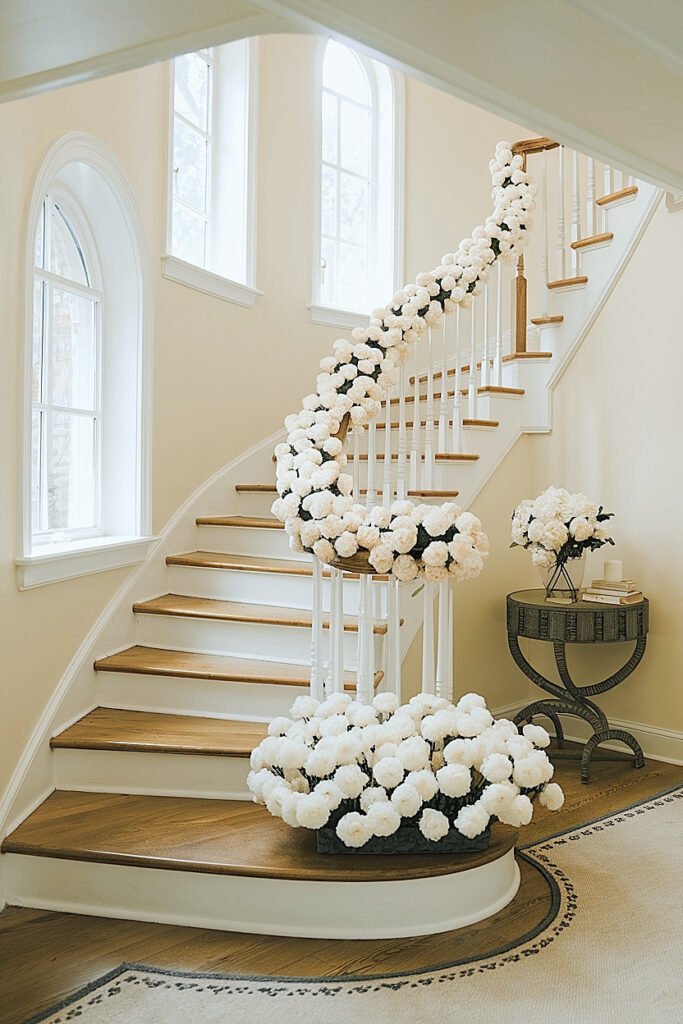
Sometimes the best garland is barely a garland.
Open rails, the kind with wide gaps between slim balusters, already look airy, and covering them from top to bottom kills that, so I pick three spots and leave everything else alone. It’s less work and less money, and it looks like somebody with taste did it, even when the somebody is me at 9 p.m. on a Tuesday with a pair of wire cutters.
Three spots usually means the base near the newel post, the middle (a landing or a turn), then the last stretch near the top. The gaps between them matter, because that empty rail is part of the design.
White carnations stand out against the open space behind them. A thin green stem, like a single strand of cedar or plain green wire wrapped in tape, keeps each cluster from looking naked. Quick project. About one good podcast episode.
- Decorate only three selected locations, such as the base, the midpoint and the top, instead of covering the entire staircase.
- Choose white carnations and a slim green support for a restrained finish. Five stems per spot is plenty.
- Use open space to create a polished look while protecting everyday stair use. Nobody has to squeeze past anything, and the rail stays easy to grab the whole way up.
One more setup is left, and it’s a calm one.
Ideas for a Scandinavian White Carnation Garland with Birch Accents
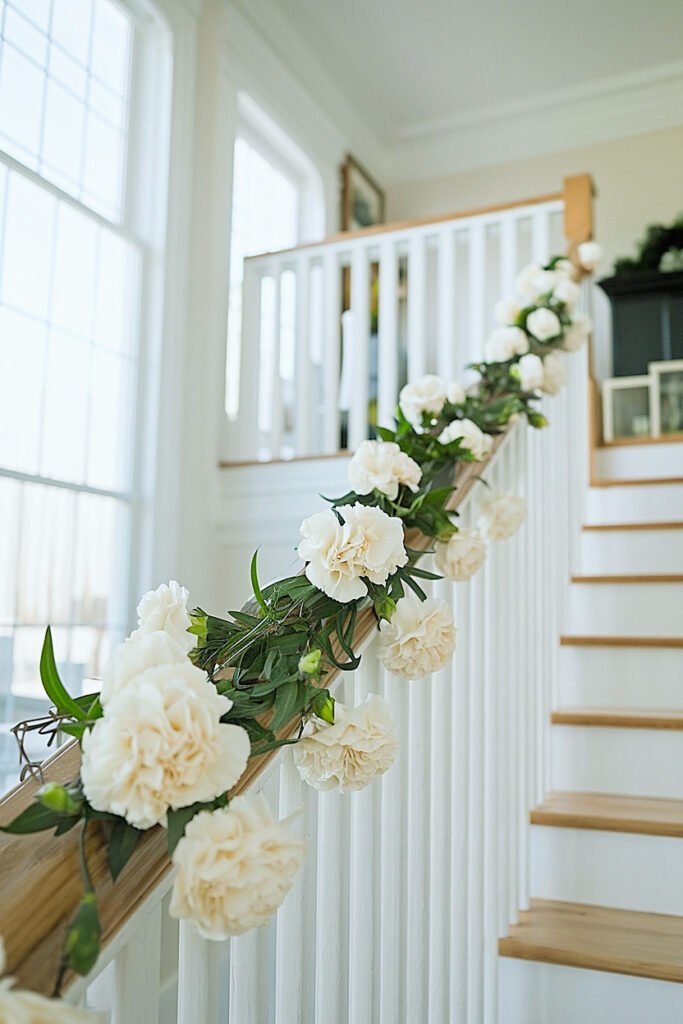
Scandinavian style comes down to white, wood and not much else, and birch fits right in because the bark is pale and a little papery, while the bare white branches look like winter without trying very hard.
White carnations take the same approach.
Pair them with birch and you get a garland that looks calm, and in my opinion a bit more grown-up than most Christmas flowers. Birch twigs are easy to find at craft stores (usually sold in bundles), and if you cut your own, make sure the tree is yours or you have permission.
Keep the palette to white, cream and natural wood. One green sprig is fine. A red ribbon would wreck it.
- Birch twig base (Best Overall). Bundle thin birch twigs along the rail with floral wire and wire the carnation groups on top. The twigs replace greenery completely, which gives you that bare winter look without a single needle to sweep up.
- Bark wraps for the water tubes. Peel thin strips of bark (or buy craft birch bark) and wrap them around each tube. It hides the vial and ties the flowers to the branches.
- Twine-tied bundles. Wrap natural linen twine around the twig base every few inches. It adds a handmade feel and holds the bundles together.
The conclusion pulls the safety points into one place, so read that before you start wiring.
Conclusion
Pick one style and commit.
For most stairs I’d start with the classic red setup, wired low and thin, then adjust from there. Before you call it done, walk the stairs once with a laundry basket or an armful of bags, the way you’d actually use them on a bad morning, and see whether anything snags or your hand has to search for the rail. If it does, pull the flowers back. The stairs come first and the garland comes second.
Carnations also do better in cool spots, so a chilly entry is on your side. Just keep them away from the fruit bowl.
This website contains affiliate links, and some products are gifted by the brand to test. As an Amazon Associate, I earn from qualified purchases. Some of the content on this website was researched and created with the assistance of AI technology.