This website contains affiliate links, and some products are gifted by the brand to test. As an Amazon Associate, I earn from qualified purchases. Some of the content on this website was researched and created with the assistance of AI technology.
Key Takeaways
- Baby’s breath costs $5-7 per bunch but creates instant designer aesthetic when paired with grocery store flowers
- The airy white cloud effect fills gaps and adds romantic texture that elevates cheap tulips or carnations
- Wrapping baby’s breath around focal flowers creates professional “cloud base” technique florists charge $80+ for
- Kitchen island arrangements require narrow width preserving prep lanes, baby’s breath adds fullness without claiming space
- Keeping baby’s breath stems cut to 5-6 inches maintains low sightline-safe profiles for dining tables
- White or cream baby’s breath creates clean neutral backdrop making any spring flower color appear more expensive
- Pairing baby’s breath with eucalyptus or leather leaf fern creates sophisticated multi-textural arrangements under $20
Using Baby’s Breath to make grocery store spring flowers look designer completely changed how I approach budget flower arranging after years of feeling embarrassed by my sparse-looking attempts. I’d buy tulips or carnations from the grocery store, stick them in vases, and end up with arrangements that screamed “I spent $12” rather than suggesting any actual skill or sophistication. The flowers sat there looking exactly like what they were, cheap stems awkwardly grouped together without cohesion, texture, or that elusive quality that separates amateur attempts from professional results.
Then I watched a florist create a wedding centerpiece and noticed she wasn’t using exotic expensive flowers, just standard roses and carnations identical to grocery store options. The difference? She’d surrounded everything with masses of baby’s breath creating these romantic clouds that transformed ordinary flowers into something genuinely beautiful. That single observation unlocked the secret I’d been missing: baby’s breath acts as the great equalizer, the affordable element that makes budget flowers look like they came from actual designers who understand texture, volume, and negative space. One $6 bunch of baby’s breath can transform $12 worth of grocery store tulips into an arrangement people assume cost $60 from a florist.
Baby’s Breath is the quickest “designer finish” for grocery Spring Flowers. This cheat sheet shows where it works best (tables, counters, islands, trays), the right low containers, and the easy steps to hide gaps without adding height. Tap the mobile cards and copy the checklist/shopping list.
Baby’s Breath + Grocery Spring Flowers: Designer Finish Cheat Sheet
Built for low bowls + soft “cloud edges” that hide gaps and make grocery Spring Flowers look polished.
| Home Surface | Best Container Mix | Baby’s Breath + Spring Flowers Formula | Do This / Avoid This |
|---|---|---|---|
|
Dining table centerpiece baby’s breath finishgrocery bouquetlow + wide |
Shallow matte bowl (main) + optional mini bud cup (side)
Goal: wide footprint, low height, “cloud edge” finish.
|
Cluster tulips (3s) + 1–2 focal blooms + weave Baby’s Breath low to hide gaps
Pro: edges look floral-shop smooth.
|
Do: keep Baby’s Breath low; fill gaps last. Avoid: tall sprigs that puff upward. |
|
Kitchen island (prep lane) prep-friendlysoft edge |
Low oval bowl placed off-center (prep lane stays open) | Compact clusters + Baby’s Breath tucked between pockets (low only) | Do: keep off-center; keep height down. Avoid: center placement. |
|
Coffee table (drink space) compactgap hiding |
Low tray (non-slip) + tiny dish (optional) | 1–2 focal blooms + Baby’s Breath “cloud ring” to hide gaps | Do: leave coaster zone open. Avoid: wide sprawl. |
|
Sideboard / buffet budgetrunner feel |
Low trough (elongated) + 1 mini bud cup on end | Repeat clusters; connect sections with low Baby’s Breath bands | Do: keep serve lane clear. Avoid: tall pieces hiding labels. |
|
Entry console welcomingsoft edge |
Small shallow bowl off-center + keys tray nearby | Baby’s Breath tucked low around clusters for a clean “finished” look | Do: keep away from edges. Avoid: top-heavy containers. |
Dining table (Designer finish from grocery stems)
Kitchen island (Prep lane stays open)
Coffee table (Full look, still drink space)
Sideboard / buffet (Serve lane stays clear)
Entry console (Welcoming, still functional)
How to Use Baby’s Breath to Make Grocery Store Spring Flowers Look Designer
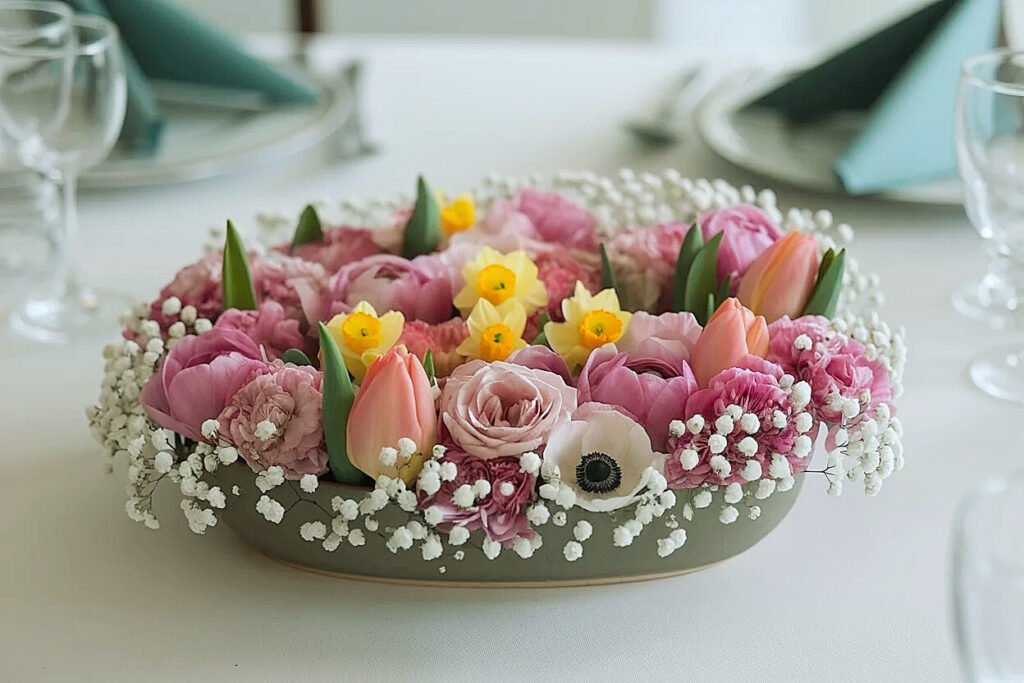
Baby’s breath works designer magic through three simultaneous mechanisms: it fills visual gaps eliminating sparseness, adds textural complexity suggesting sophistication, and creates that airy romantic quality associated with high-end floral work. Most grocery store flowers fail aesthetically not because they’re inherently ugly but because they sit there obviously alone without supporting elements creating context and fullness.
I now approach every grocery store flower purchase with the automatic assumption I’ll also buy baby’s breath regardless of what else I’m getting. That one constant transforms everything else. Whether I’m buying $10 tulips, $8 carnations, or $12 alstroemeria, I grab baby’s breath knowing it’ll elevate whatever cheap flowers I’ve chosen into something genuinely impressive.
The integration technique matters enormously. I don’t just stick baby’s breath randomly into arrangements hoping for the best. I build deliberately, focal flowers go in first establishing structure and color, then baby’s breath gets systematically inserted filling every gap and extending beyond bowl edges creating that signature cloud effect. The baby’s breath should feel generous rather than sparse; I use entire bunches rather than trying to stretch them across multiple arrangements.
The visual transformation happens immediately. Those tulips that looked embarrassingly basic suddenly appear nestled in romantic clouds of tiny white blooms. The carnations people dismiss as cheap funeral flowers suddenly read as elegant when surrounded by airy baby’s breath masses. The transformation doesn’t require expensive vessels or complicated techniques, just the willingness to add this one affordable element that professionals have understood for decades, and for additional budget strategies that create designer results from affordable materials, there’s comprehensive guidance on using other filler flowers like muscari to maximize fullness, share this with anyone trying to fake designer credentials on grocery store budgets!
The fundamental transformation establishes baby’s breath’s value, and the wrapping techniques ahead show specific methods for achieving professional-looking results.
Ways to Wrap Baby’s Breath Around Spring Flowers to Hide Gaps and Look Fuller for Less
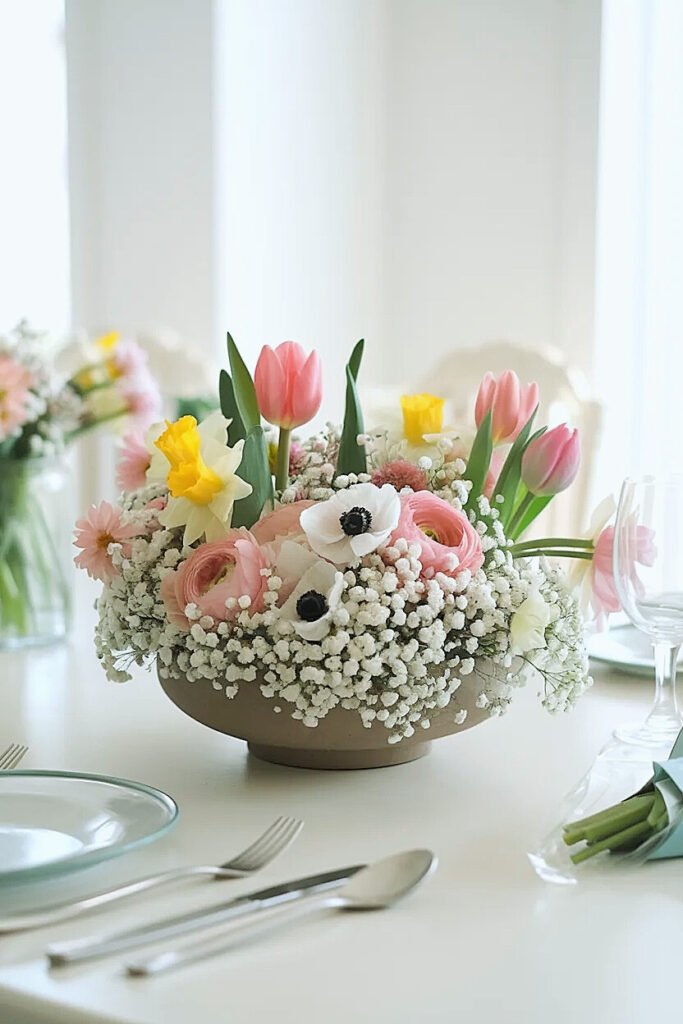
The wrapping technique creates that professional “cloud base” effect where baby’s breath forms a continuous supportive layer around and under focal flowers rather than just being randomly stuck between stems. This deliberate positioning makes the difference between arrangements that look thoughtful versus accidental.
I learned wrapping by studying florist Instagram posts and noticing how baby’s breath always seemed to surround rather than merely accompany other flowers, creating foundations, halos, and clouds rather than just filling random spaces.
1. Perimeter Cloud Ring Technique
Position baby’s breath exclusively around arrangement’s outer perimeter creating continuous ring encircling focal flowers, angling stems outward so blooms extend beyond bowl rim forming cloud collar. Use 8-10 baby’s breath stems creating generous perimeter coverage. This wrapping technique frames central focal flowers making them appear more important and expensive through the baby’s breath halo effect. The outward angling extends visual boundaries beyond vessel itself. Works brilliantly in 10-14 inch bowls where perimeter treatment creates substantial presence.
2. Base Layer Foundation Wrapping
Fill bowl bottom with baby’s breath stems cut to 4-5 inches creating lower foundation layer, then insert focal flowers at 7-9 inches rising from this white cloud base. Use 6-8 baby’s breath stems creating dense base coverage. The tiered height relationship makes focal flowers appear elevated and special emerging from supportive clouds below. This technique particularly suits glass vessels where the layering shows through transparent walls creating dimensional interest. The base wrapping costs under $7 but creates $50+ appearance.
3. Asymmetric Cascade Wrapping
Position baby’s breath heavily on one arrangement side creating asymmetric cascade effect, with minimal baby’s breath opposite side emphasizing the dramatic one-sided cloud. Use 8-10 stems all angled toward the cascade side creating deliberate imbalance that feels modern and intentional. Insert focal flowers throughout the arrangement with the baby’s breath cascade providing dramatic counterweight. This technique suits console tables or sideboards positioned against walls where the cascade can drape forward creating depth and movement.
4. Interwoven Throughout Method
Rather than concentrating baby’s breath in specific zones, weave individual stems throughout entire arrangement creating continuous integration where every focal flower gets surrounded by supportive baby’s breath clouds. Use 10-12 baby’s breath stems distributed evenly creating seamless blending. This technique prevents baby’s breath from reading as separate element instead making it intrinsic to the composition. The complete integration creates cohesive designer aesthetic where all elements feel deliberately coordinated rather than randomly assembled.
5. Graduated Height Wrapping
Position baby’s breath at three distinct heights, some cut to 4 inches at bowl base, others at 6 inches mid-level, tallest at 8 inches near focal flowers, creating dimensional depth through height variation within the baby’s breath itself. Use 10-12 stems distributed across height zones. This advanced wrapping creates textural layers suggesting professional skill. The varied heights prevent flat appearance while maintaining overall low profile appropriate for dining tables. The dimensional wrapping elevates perceived sophistication substantially.
The wrapping techniques create professional effects, and the coffee table tray applications ahead address functional surfaces with spatial constraints.
How to Use Baby’s Breath in Low Trays for Coffee Tables (Full Look, Drink Space)
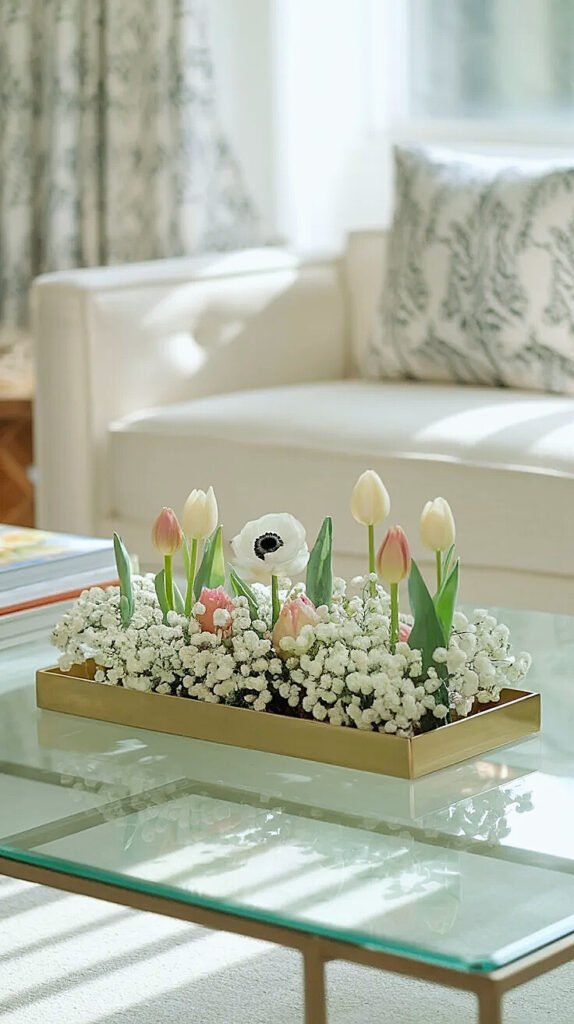
Coffee tables demand arrangements that look full and beautiful while preserving the surface’s actual function, holding drinks, remotes, books, and phones. Baby’s breath excels here through its ability to create visual abundance in shallow vessels without claiming vertical or horizontal space people need.
I use rectangular trays measuring 14×8 inches with 2-3 inch depths positioning them at coffee table’s back edge against sofas or sectionals. This placement creates floral presence visible from seating while the entire front two-thirds of the coffee table remains clear for functional use.
The baby’s breath positioning within trays creates the fullness illusion. I position stems around tray perimeters angling outward creating cloud effect that extends beyond tray boundaries, then add 5-7 focal flowers, maybe tulips or carnations, rising from this baby’s breath foundation. The perimeter baby’s breath creates horizontal spread while focal flowers provide vertical interest, both staying under 8 inches total height appropriate for low coffee table viewing.
The key insight: baby’s breath doesn’t need density to create fullness perception, its airy branching structure creates visual volume with relatively few stems. Six baby’s breath stems positioned strategically around tray edges can make the entire tray appear lush and full, while the same six tulips without baby’s breath would look sparse and insufficient.
I also appreciate baby’s breath’s neutral white color for coffee table contexts where arrangements need coordinating with various throw pillows, blankets, and decor that change seasonally. The white works universally without clashing, making baby’s breath the safe consistent choice regardless of what focal flower colors you’re working with.
The coffee table approach balances function and beauty, and the grocery store pairing guidance ahead identifies which specific flowers create the most impressive results when combined with baby’s breath.
What are the Best Grocery Store Spring Flowers to Pair with Baby’s Breath for a Designer Look?
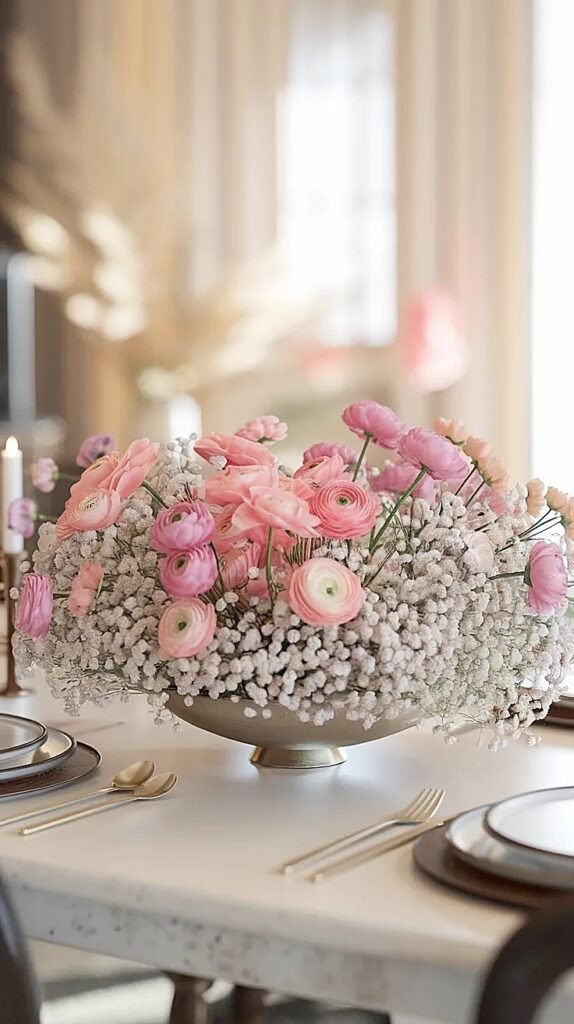
Not all grocery store flowers benefit equally from baby’s breath pairing, some partnerships create genuine designer aesthetic while others just look like you added baby’s breath to cheap flowers. The winning combinations feature flowers whose colors, forms, or textures create deliberate contrast or complement with baby’s breath’s delicate white clouds.
I’ve tested every grocery store flower option available over multiple seasons, and these five consistently deliver the most impressive designer-quality results.
1. Pink or Coral Carnations for Romantic Sophistication
Carnations get dismissed as cheap but paired with baby’s breath they create surprisingly sophisticated romantic arrangements. The ruffled carnation blooms contrast baby’s breath’s tiny delicate flowers creating pleasing textural variation. Buy carnation bunch ($6-8) and baby’s breath ($5-7) totaling under $15. Use 10-12 carnations with one full baby’s breath bunch creating lush composition. Choose single-color carnations, soft pink or coral, rather than mixed bunches. The baby’s breath elevates carnations from “cheap” to “intentionally vintage-romantic.”
2. White Tulips for Clean Modern Elegance
White tulips paired with baby’s breath create sophisticated monochromatic white-on-white arrangements suggesting expensive minimalist design aesthetic. The simple tulip cups contrast baby’s breath’s complex branching structure creating textural interest within unified color palette. Buy white tulip bunch ($10-12) and baby’s breath ($5-7) totaling under $20. Use 8-10 tulips surrounded by generous baby’s breath creating cloud effect. The all-white combination photographs beautifully and works universally with any décor. The understated palette reads as expensive restraint.
3. Purple or Lavender Alstroemeria for Contrasting Color
Purple or lavender alstroemeria’s rich color creates beautiful contrast with baby’s breath’s pure white, while the lily-like bloom forms provide scale variation. Buy alstroemeria bunch ($8-10) providing multiple blooms per stem, paired with baby’s breath ($5-7) totaling under $17. The purple-white combination creates classic elegant color scheme. Each alstroemeria stem provides 4-6 blooms creating substantial flower count. The baby’s breath prevents the purple from feeling too heavy or dark by lightening the overall composition.
4. Yellow Daffodils for Classic Spring Energy
Daffodils’ cheerful yellow combined with baby’s breath’s white creates quintessential spring palette suggesting deliberate seasonal styling. The trumpet daffodil forms contrast baby’s breath’s tiny clustered blooms creating bold-versus-delicate contrast. Buy daffodil bunch ($8-10) and baby’s breath ($5-7) totaling under $17. Use 8-10 daffodils nestled in baby’s breath clouds. The yellow-white combination feels fresh and optimistic. The pairing works indoors or outdoors through both flowers’ sturdy weather-resistant nature.
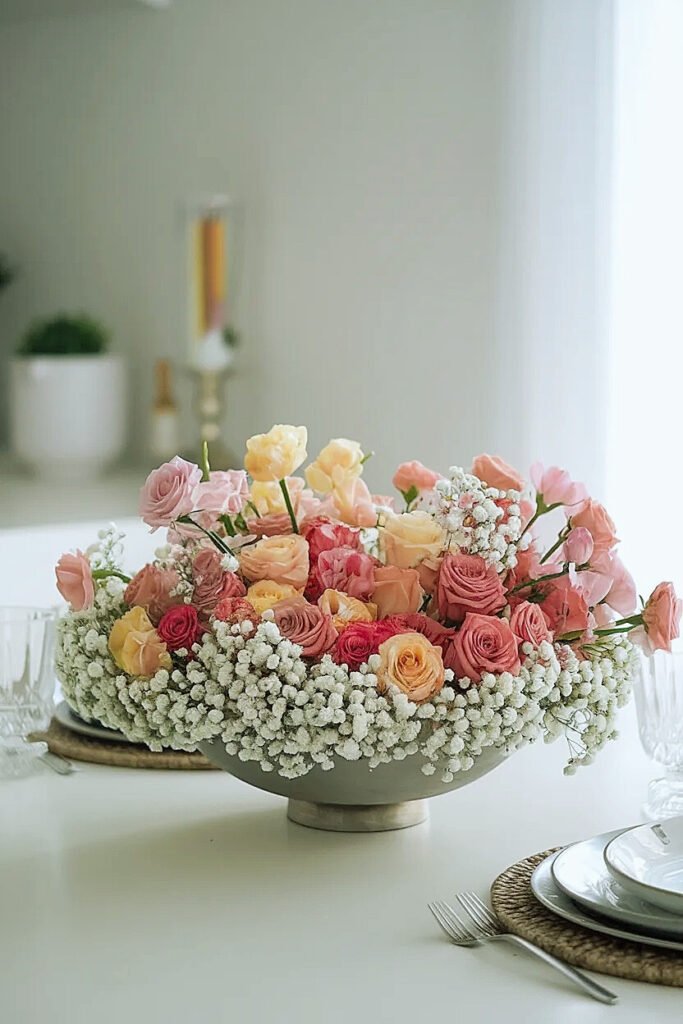
5. Peach or Coral Roses for Upscale Romance
Grocery store roses in peach or coral tones paired with baby’s breath create arrangements indistinguishable from expensive florist work. The classic rose-and-baby’s-breath pairing has designer pedigree making it inherently sophisticated. Buy rose bunch ($12-15) and baby’s breath ($5-7) totaling under $25, still cheaper than florist equivalent at $60+. Use 10-12 roses completely surrounded by baby’s breath. The combination creates timeless romantic aesthetic. The baby’s breath makes grocery store roses look like premium garden varieties.
These pairings prove baby’s breath transforms even budget flowers, and the kitchen island applications ahead address functional surfaces with workflow demands.
Ideas for Baby’s Breath Spring Flowers Centerpieces on Kitchen Islands That Leave a Prep Lane
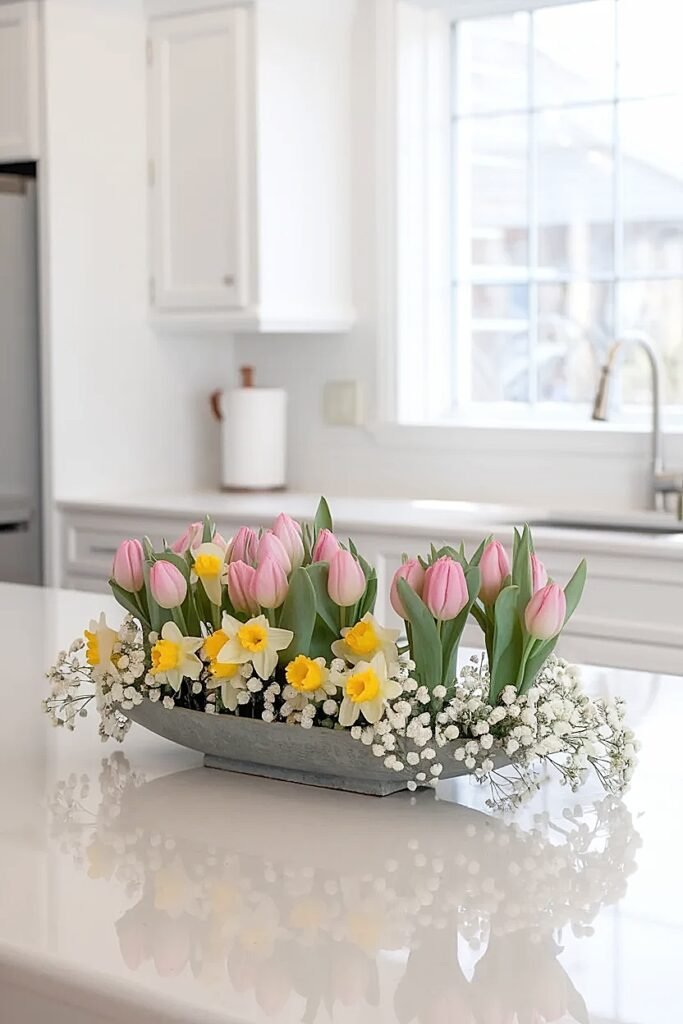
Kitchen islands serve as primary food preparation surfaces requiring flowers that add beauty without interfering with cooking workflow. Baby’s breath creates visual interest while its delicate branching structure occupies minimal actual space, making it ideal for these functional contexts.
Maximum width for island centerpieces: 8 inches preserving adequate prep lanes. Baby’s breath achieves fullness perception within this constraint through its airy structure creating volume without mass.
1. Narrow Trough with Baby’s Breath Cloud Base
Position 16×6 inch trough along island’s back edge filled with baby’s breath base layer supporting 6-8 focal flowers creating linear installation preserving front prep space. Use half bunch baby’s breath creating generous foundation with tulips or carnations rising above. The narrow 6-inch width claims minimal island depth while 16-inch length creates meaningful presence. The baby’s breath extends arrangement’s perceived width through outward branching while actual vessel stays compact. Total cost under $18.
2. Dual Mini Bowls with Baby’s Breath Wrapping
Position two 6-inch bowls at island’s opposite ends, each wrapped heavily with baby’s breath surrounding 4-5 focal flowers creating matched bookend arrangements. Use one baby’s breath bunch split between both bowls plus focal flowers totaling under $20. The dual placement distributes visual interest while end positions preserve central prep lane completely. The baby’s breath wrapping creates substantial presence making small bowls appear generous and intentional.
3. Single Corner Bowl with Asymmetric Baby’s Breath
Place one 8-inch bowl in island’s back corner filled with baby’s breath positioned asymmetrically creating dramatic cascade toward island center while 5-7 focal flowers provide color accents. Use half baby’s breath bunch creating one-sided cloud effect. The corner location uses underutilized space while asymmetric baby’s breath adds contemporary edge. The focal flowers distributed throughout prevent arrangement from feeling too delicate. Cost under $15 total.
The island strategies preserve functionality, and the sightline techniques ahead ensure arrangements work for dining contexts.
How to Keep Baby’s Breath Low So Spring Flowers Centerpieces Stay Sightline-Safe
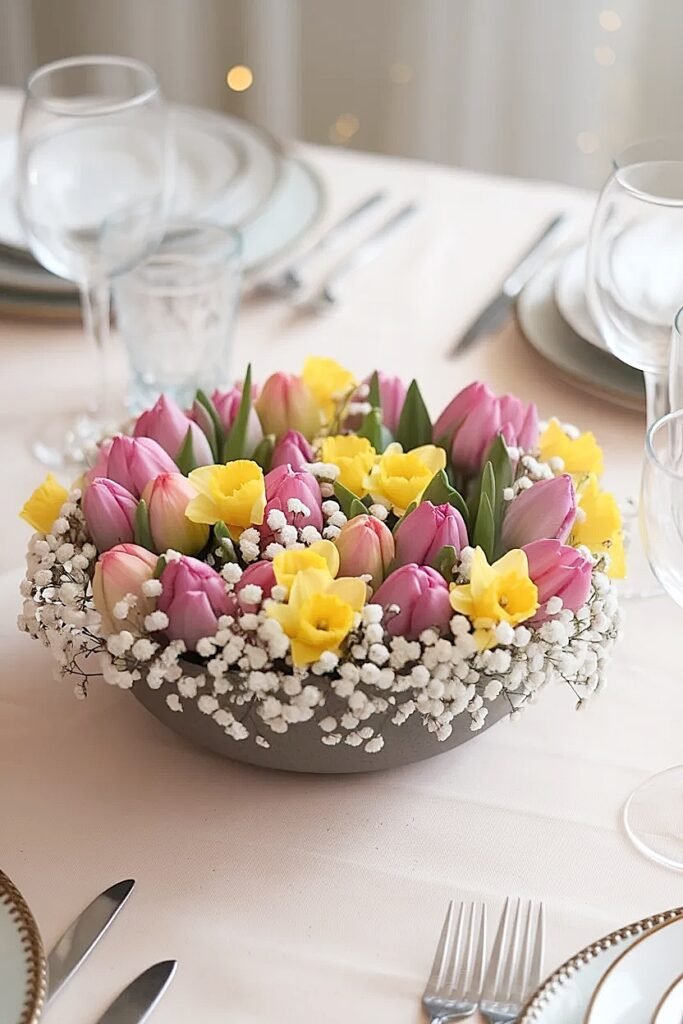
Dining table centerpieces must stay under 12 inches total height preserving conversation sightlines across tables. Baby’s breath naturally wants to spread outward on branching stems, making it perfect for low work if you control stem heights deliberately.
I cut all baby’s breath stems to 5-6 inches before inserting into arrangements, forcing the branching to spread horizontally rather than vertically. This creates wide low clouds rather than tall airy masses that would block views.
The cutting feels wasteful initially, those stems come maybe 18-20 inches long and trimming away 12+ inches seems like discarding value. But that’s exactly wrong thinking. The value comes from the bloom-covered branching at stem tops, not the bare stem length. Cutting short concentrates the visual impact at appropriate heights for dining table use.
I also position baby’s breath around arrangement perimeters rather than centrally, creating ring effects where branching extends outward from bowl edges. This horizontal emphasis keeps everything low while the outward spread creates the fullness perception that makes arrangements look generous and deliberate.
The focal flowers can rise slightly higher, maybe 8-9 inches, creating gentle height variation, but the baby’s breath foundation staying at 5-6 inches creates the base layer that defines the arrangement’s primary profile as appropriately low.
Testing matters. I physically sit at my dining table viewing arrangements from normal seated positions before finalizing them, ensuring nothing blocks my sightline across the table. If baby’s breath stems extend too high creating visual barriers, I recut them even shorter. The 5-6 inch target works for most dining contexts but some tables with particularly tall chairs might require even lower profiles.
The sightline control ensures functionality, and the sideboard styling ahead demonstrates how to use baby’s breath in food-service contexts.
Ways to Use Baby’s Breath on Sideboards to Make Spring Flowers Look Styled (Clear Serve Lane)
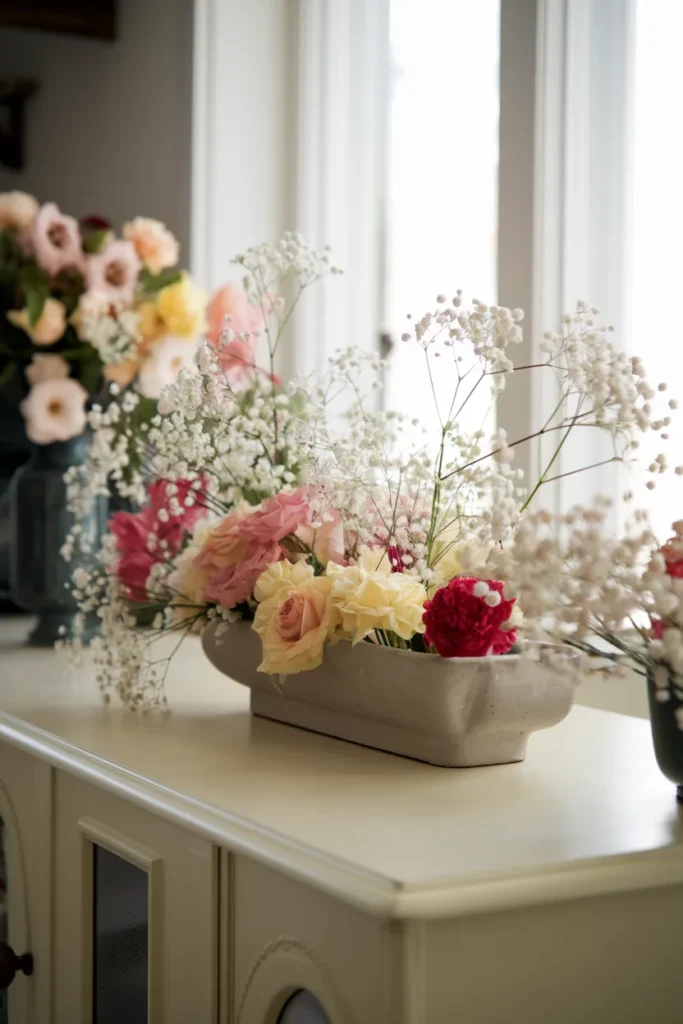
Sideboards serve buffets and food presentation requiring flowers that enhance without interfering with serving logistics. Baby’s breath creates sophisticated styling while strategic positioning preserves functional serving lanes.
The key: using baby’s breath to create visual boundaries and texture without claiming the prime central surface area needed for serving dishes.
1. Back-Edge Baby’s Breath Foundation with Focal Flower Accents
Position baby’s breath exclusively along sideboard’s back edge against any wall creating continuous foundation layer, then add 8-10 focal flowers rising from this base while front surface stays completely clear. Use one full baby’s breath bunch creating generous back coverage. The baby’s breath creates styled backdrop visible behind serving dishes without interfering with functional front area. The white cloud frames food presentation beautifully. Insert focal flowers distributed throughout baby’s breath adding color accents. Cost under $18 creating professional buffet styling.
2. End-Cap Baby’s Breath Bookends Framing Serving Zone
Position baby’s breath heavily at both sideboard ends creating floral bookends that frame central clear serving area, adding just 3-4 focal flowers to each end’s baby’s breath mass. Use one baby’s breath bunch split between both ends creating symmetrical framing. The end positioning signals clear serving lane through the center while floral presence at edges creates styled intentional aesthetic. The baby’s breath makes focal flowers look more expensive through generous cloud support. Total cost under $20.
3. Elevated Baby’s Breath Platform Behind Serving Height
Mount baby’s breath arrangement on 6-8 inch platform or risers positioned at sideboard back, elevating flowers above typical serving dish height creating visible presence without surface occupation. Use half baby’s breath bunch with 5-6 focal flowers on elevated platform. The elevation ensures floral visibility behind taller serving pieces while the platform approach liberates sideboard surface for food. The baby’s breath creates cloud backdrop enhancing overall presentation. Platform can be overturned crate or purpose-built riser.
4. Linear Baby’s Breath Runner with Strategic Focal Flower Islands
Create continuous baby’s breath runner along sideboard back third with 6-8 focal flowers distributed as “islands” emerging from the white base, leaving front two-thirds clear. Use one full baby’s breath bunch creating generous runner foundation. The continuous baby’s breath creates cohesive linear installation while focal flower islands add color variety preventing monotony. The front clearance preserves serving functionality. The runner approach creates professional catering-style aesthetic under $20.
5. Corner Concentration Baby’s Breath with Diagonal Focal Flowers
Pack baby’s breath densely in one sideboard corner creating concentrated cloud, then position 6-8 focal flowers diagonally across remaining surface creating dynamic asymmetric composition. Use half baby’s breath bunch concentrated in corner mass. The corner concentration creates visual anchor while diagonal flower placement adds contemporary edge. The asymmetry feels modern rather than traditional symmetric buffet styling. Central area stays clear for serving. Cost under $18.
The sideboard strategies balance service and style, and the budget greens guidance ahead shows how to amplify results through complementary foliage.
What are the Best Budget Greens to Mix with Baby’s Breath for a Clean Designer Finish?
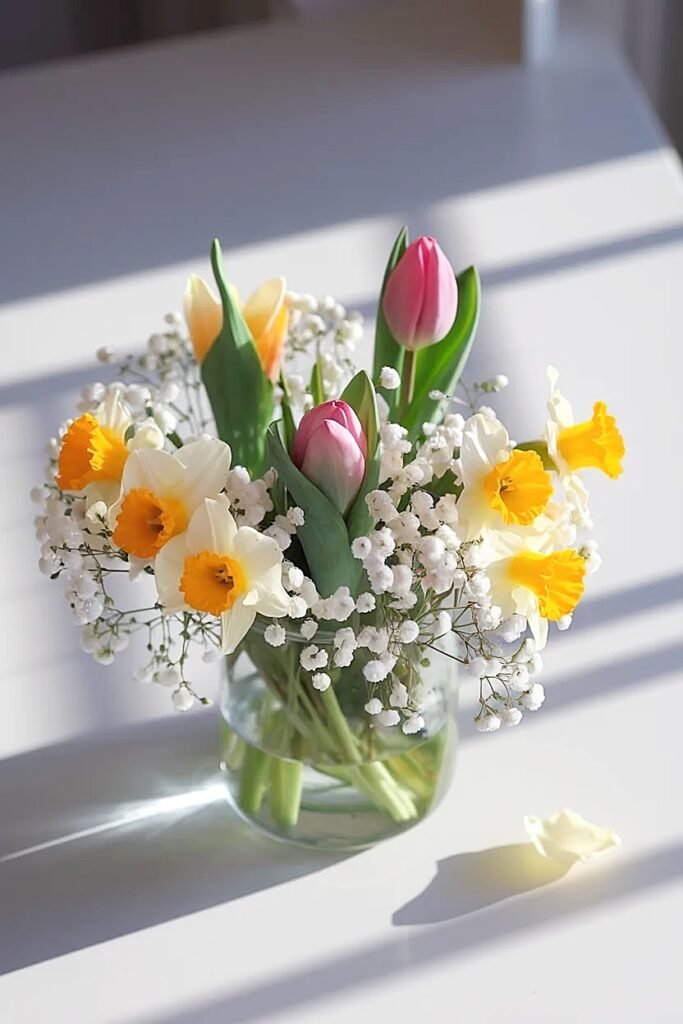
Greens add structural definition and color contrast, and certain budget varieties pair exceptionally well with baby’s breath creating polished designer aesthetic rather than chaotic “threw everything together” appearance.
The best pairings complement baby’s breath’s delicate airy quality without overwhelming it.
1. Eucalyptus for Silvery Sophistication
Seeded eucalyptus costs $6-8 per bunch providing silvery-green foliage that creates beautiful color harmony with baby’s breath’s pure white. The eucalyptus’ branching structure complements baby’s breath’s delicate form creating textural kinship rather than jarring contrast. Position eucalyptus creating structural framework around arrangement edges, then fill interior spaces with baby’s breath and focal flowers. The silver-green and white combination reads as deliberately coordinated sophisticated palette. Eucalyptus’ pleasant scent adds sensory dimension beyond visual appeal. Combined cost with baby’s breath under $15 creating arrangements appearing significantly more expensive.
2. Leather Leaf Fern for Architectural Structure
Grocery store leather leaf fern bunches cost $4-6 providing sturdy dark green fronds creating defined architectural structure contrasting baby’s breath’s soft airy quality. The waxy fern leaves provide visual weight anchoring arrangements while baby’s breath adds lightness preventing heavy appearance. Position fern fronds around arrangement perimeters creating structural definition, then fill central areas with baby’s breath clouds supporting focal flowers. The dark green-white contrast creates clean graphic aesthetic. The fern’s durability means it lasts 10-14 days matching baby’s breath’s longevity. Total cost under $13.
3. Salal for Dense Neutral Foundation
Salal (lemon leaf) costs $5-7 per bunch providing densely branched medium-green foliage creating substantial foundation layer. The rounded leaves provide gentle backdrop for baby’s breath’s delicate texture without competing visually. Position salal creating lower green base layer, then build baby’s breath and focal flowers above creating tiered composition. The salal anchors arrangements providing visual weight while baby’s breath adds ethereal lightness creating balanced aesthetic. The glossy leaves contrast baby’s breath’s matte texture. Combined cost under $14 creating lush sophisticated arrangements suggesting professional design skill.
Conclusion
Using baby’s breath to make grocery store spring flowers look designer requires understanding this humble filler’s transformative power, $6 bunches create instant sophistication through airy white clouds that fill gaps, add romantic texture, and elevate cheap carnations or tulips into arrangements guests assume came from actual florists.
The wrapping techniques position baby’s breath as supportive clouds around focal flowers rather than random fill, while strategic trimming to 5-6 inch heights maintain dining-table-appropriate low profiles. Pair baby’s breath with pink carnations, white tulips, or coral roses creating color combinations suggesting deliberate design coordination and consider adding eucalyptus or leather leaf fern for multi-textural sophistication under $20 total.
The coffee table trays, kitchen island narrow vessels, and sideboard back-edge positioning all demonstrate how baby’s breath creates fullness without claiming functional space. These techniques prove that designer aesthetic doesn’t require designer budgets, just understanding which affordable elements professionals have used for decades to transform ordinary flowers into something genuinely beautiful.
This website contains affiliate links, and some products are gifted by the brand to test. As an Amazon Associate, I earn from qualified purchases. Some of the content on this website was researched and created with the assistance of AI technology.