
This website contains affiliate links, and some products are gifted by the brand to test. As an Amazon Associate, I earn from qualified purchases. Some of the content on this website was researched and created with the assistance of AI technology.
Key Takeaways
- Build in sections, not in one unwieldy strand: modular rose garland lengths (24–36 inches) connect cleanly and make installs, edits, and storage simple.
- Keep profiles low and intentional: below eye line on mantels and buffet tables; stair rails get fullness on the outside curve and restraint on the hand side.
- Protect finishes first: use fabric-covered ties, clear command hooks, and felt or pewter “feet” under heavy points so wood and paint stay pristine.
- Control scent and shine: lightly scented roses, unscented candles, brushed or antiqued metals, and one ribbon vocabulary for cohesion.
- Edit before guests arrive: remove one flourish, confirm serving lanes, wipe reflective surfaces, and dim to a warm 30–40% for flattering, photo-ready glow.
Creating Christmas rose garlands for stair rails, mantels, and buffet tables demand equal parts craft and restraint. I want the romance of roses under candlelight without elbowing plates, snagging sleeves, or scuffing woodwork. The secret isn’t more greenery or bigger blooms; it’s structure, sections that carry weight evenly, hardware that protects surfaces, and a palette that whispers winter rather than shouting it.
I learned this the cold way on a tight stairwell with an overstuffed garland that looked great until kids needed the handrail. Now I build spines that respect traffic, I tuck roses at angles that look fluid from across the room, and I keep shine matte so the camera doesn’t fight glare. Let’s walk through the exact builds, materials, and tricks that make rose garlands feel farmhouse-authentic and holiday-capable.
Christmas Rose Garland Planning at a Glance
Use this quick planner to design Christmas rose garlands for stair rails, mantels, buffet tables, and seating areas. Scan by stage, then tap “Copy checklist” on mobile to take your plan with you.
| Design Stage | Where to Focus | Quick Checklist | Best Use Cases |
|---|---|---|---|
|
Preparation Map out where rose garlands will go before building anything. |
Stair rails, mantels, buffet tables, window ledges, sideboards. |
|
First planning pass for the entire house, making sure garlands feel cohesive from room to room and match your rustic farmhouse palette. |
|
Layering Build the greenery base, then tuck roses and fillers on top. |
Evergreen bases, slim window garlands, compact mantel and buffet runs. |
|
When building garlands that must stay slim for windows, narrow mantels, and buffet edges while still feeling full and farmhouse-rich. |
|
Furniture Placement Decide how garlands sit on stair rails, mantels, buffet tables. |
Stair rails, mantels, sideboards, console tables near seating. |
|
Perfect for placing garlands where people walk, sit, and serve food, so décor looks rich but never gets in the way. |
|
Texture & Expansion Enrich with seasonal add-ons and natural farmhouse texture. |
Sideboards, feature mantels, stair curves, statement surfaces. |
|
Best when you want one or two key garlands to feel extra special, textured, and intentionally rustic without becoming bulky. |
|
Flow & Guest Comfort Keep pathways open and seating comfortable during gatherings. |
Dining tables, buffet lines, room transitions, seating areas. |
|
Ideal for busy holiday parties where guests move between dining, buffet, and living spaces and décor must feel inviting, not cramped. |
Where to focus: stair rails, mantels, buffet tables, window ledges, sideboards.
- Measure rails, mantels, and buffet runs.
- Commit to a red & cream rose palette everywhere.
- Gather greenery, pinecones, dried fillers, and jute ties.
Best use: your very first planning pass so every garland feels consistent and farmhouse-cozy from one room to the next.
Where to focus: evergreen bases, slim window garlands, narrow mantels, buffet edges.
- Keep greenery low and streamlined.
- Place red & cream roses in small, spaced clusters.
- Add pinecones, dried pods, and branches for depth.
Best use: when you want garlands to feel full and layered but still neat enough for everyday surfaces and ledges.
Where to focus: stair rails, mantels, sideboards, consoles near seating areas.
- Keep the front of buffets open for dishes and trays.
- Let stair and mantel garlands drape in gentle arcs.
- Secure with soft ties that won’t scratch or mark.
Best use: when you’re setting up for a party and need décor that looks rich but stays out of the way of hands and feet.
Where to focus: feature mantels, standout stair curves, main sideboards.
- Layer in pinecones for earthy weight and interest.
- Use eucalyptus to soften edges and transitions.
- Extend select garlands with extra seasonal accents.
Best use: when one or two key garlands should feel extra special and richly textured without becoming visually heavy.
Where to focus: dining tables, buffet lines, room transitions, living-room seating areas.
- Keep garlands low and away from plates and glasses.
- Place fuller garlands off to the side, not in walkways.
- Repeat the same rose and greenery mix in each zone.
Best use: on busy party days when guests move between eating, serving, and relaxing, and décor must feel inviting, not cramped.
How to Build a Full, Farmhouse-Style Rose Garland for Christmas Stair Rails

I start with a thin green spine: a flexible olive or cedar rope garland as the base. It bends easily along turns and provides texture without bulk. I pre-cut the run into 24–36-inch modules and label the back with painter’s tape (“lower flight 1,” “landing,” “upper flight 2”). Each module gets its own tie points so I’m never wrestling the entire staircase at once.
For roses, I wire micro-clusters: three blooms each in a 2:1 ratio of cream to red for farmhouse calm. Stems sit in water tubes if using fresh; if you prefer long wear, use high-quality faux heads mixed with a few dried rosebuds for realism. I seat clusters at a consistent 30–45° angle, all leaning with the stair rise so the line reads like cursive. I add olive tips or seeded eucalyptus behind each cluster to soften edges, then weave in brushed silver ribbon at crossing points, not all along the run.
Anchor a slim evergreen rope, add angled rose clusters in repeatable modules, and let one ribbon finish do the talking. For tabletop-scale styling that pairs beautifully with this look, see Romantic Christmas Tablescapes Using Red and Cream Roses, and if this guide helps, share it with a friend who loves a calm, handcrafted Christmas. There’s more attachment strategy ahead; keep reading for finish-safe installs.
How to Secure Rose Garlands to Stair Rails Without Damaging the Finish
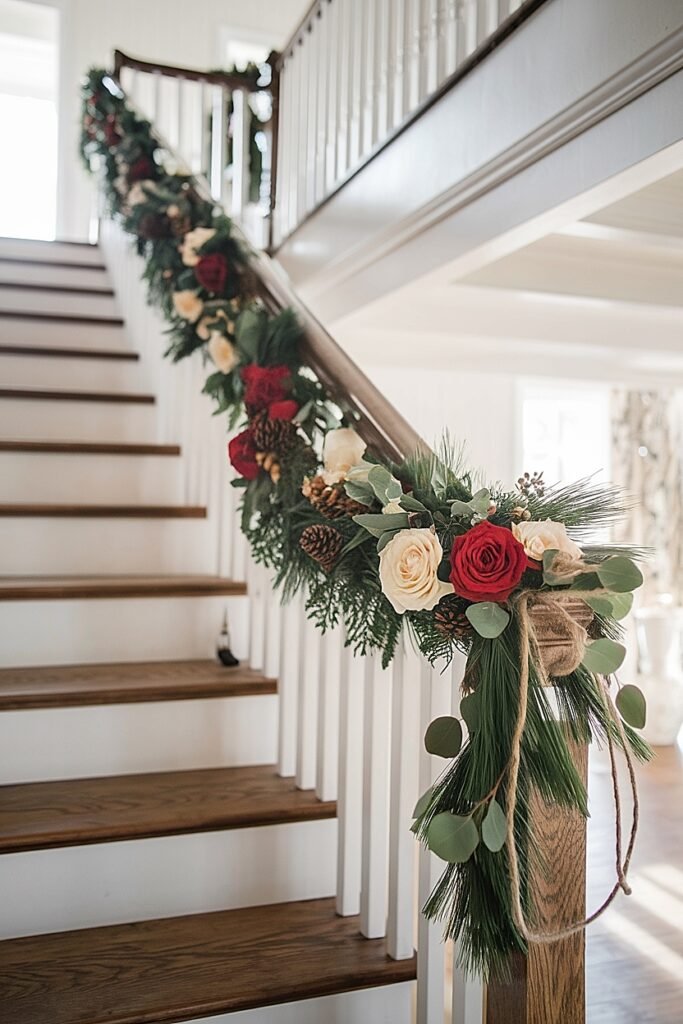
Stair rails take a beating, so I protect first and decorate second. I place clear, removable command hooks on the underside of the rail or on the newel sides where they hide in shadow. Where hooks won’t work, I thread 1/2-inch cotton twill tape or velvet ribbon under the rail and tie with a square knot on the baluster side, cushioned by a felt tab. No plastic zip ties against wood, ever.
I distribute weight across support points every 18–24 inches, tightening only until the garland sits snug without compressing foliage. For metal spindles, I use silicone-coated twist ties that won’t slide, then wrap those in ribbon to blend. Heavy turns get a pewter “foot” or coaster resting on the stair return to carry load. After install, I run my hand along the rail to make sure nothing snags fingers.
Removable hooks in shadow lines, soft ties with felt buffers, and load sharing every two feet. There’s more layering ahead, keep reading to integrate cream and red roses into evergreen mantels without visual noise.
Ways to Layer Red & Cream Roses into Evergreen Mantel Christmas Garlands
- Rule-of-Thirds Cluster Map:
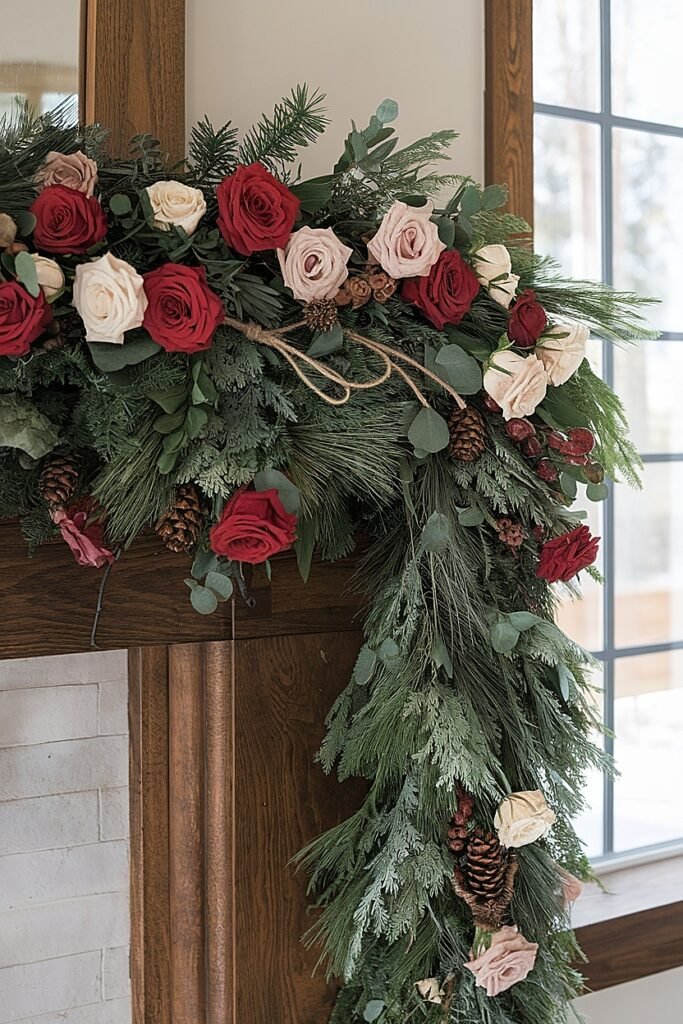
Divide the mantel into thirds and place small rose clusters at each junction, two cream, one red per cluster. Backfill with olive sprigs for motion and tuck a single brushed-metal snowflake or bell where clusters meet. The thirds create rhythm and keep the eye traveling without creating a hedge. - Low Center Spine + Asymmetric Ends:
Build a low cedar spine across the mantel and bank fuller rose clusters toward one end. The opposing end gets only singles and buds. This asymmetry feels editorial while leaving room for stockings or taper candles. Keep blooms angled slightly forward so petals catch candlelight. - Cream Field with Red Accents:
Lead with cream roses every 8–10 inches, then drop smaller red roselets in between as “beats.” Add seeded eucalyptus sparsely to echo berry texture without turning busy. The cream dominance reads quiet on camera; the reds wink rather than shout. - Color Block Left/Right:
Group red roses on one half and cream on the other, blending the transition with two mixed clusters in the center. This reads modern while remaining rustic when you use matte foliage and bone linen stocking cuffs nearby. A single ribbon color unifies both sides. - Bud Run Above, Blooms Below:
Seat open blooms along the front lip and wire a subtle line of buds along the top back edge. The double horizon adds depth without height chaos. Use warm micro-lights tucked under foliage, never on top, to avoid glare.
Choose one layering logic and repeat it room-wide. There’s more surface strategy next, keep reading to land a garland on sideboards without blocking trays and bowls.
How to Style Christmas Rose Garlands Across Sideboards While Leaving Room for Decorative Bowls and Trays

Sideboards do double duty: pretty in photos, practical during dinner. I keep the garland flush to the back edge, riding the wall. The front 14–18 inches becomes the serving lane. I build a slim olive/cedar rope, then seat rose micro-clusters at the sideboard’s thirds, giving each cluster a pewter saucer “platform” so petals never touch wood.
To integrate trays and bowls, I set them first, then thread the garland around their footprints. I add height only at the ends, short lanterns or hammered bowls, leaving the center low for platters. If the room drafts, I use glass sleeves over candles so petals don’t toast. Before the event, I lift the entire garland in one move by sliding my fingers under the rope; if it snags, I’ve added too many touch points and I edit.
Push the garland back, elevate clusters on protective saucers, and map serving zones before greenery. There’s buffet-specific choreography ahead, keep reading for crowd-friendly layouts that don’t jam the line.
Ideas for Creating Christmas Rose Garlands for Buffet Tables Without Overcrowding the Surface
- Back-Rail Ribbon Spine:
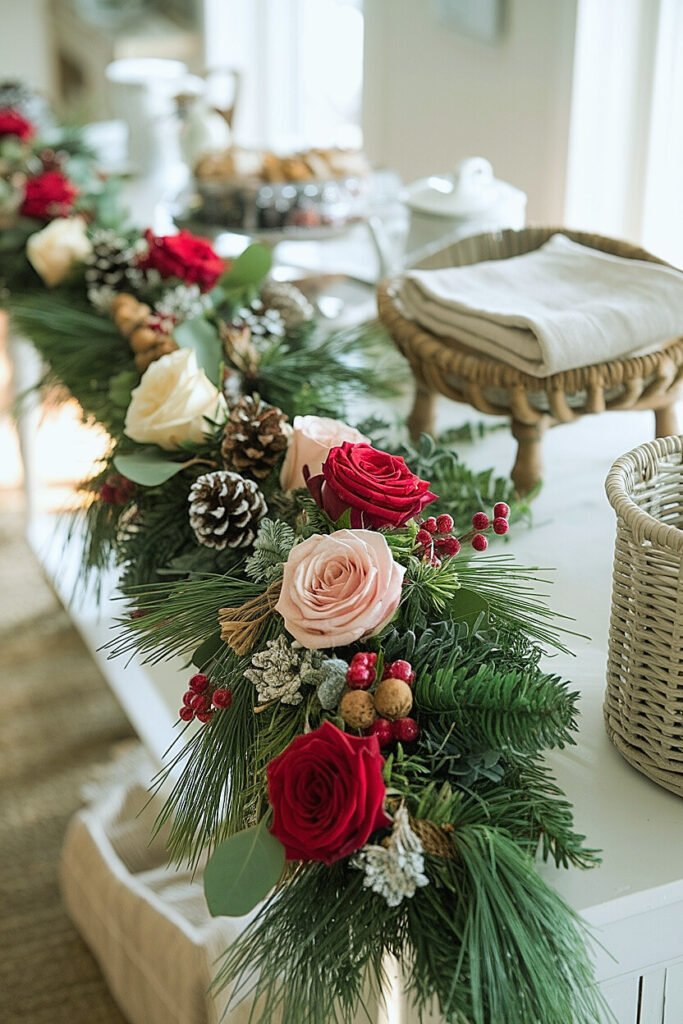
Run a narrow linen runner along the back third of the buffet and build the garland on top of it. Add rose clusters only at runner ends and center, leaving open bays for chafers or boards. The runner defines the garland’s lane and makes clean-up one lift. - Island Corners Only:
Anchor two compact garland modules at opposite corners with roses and cedar, leaving the middle entirely open. Guests move in a U-shape, and the corners still photograph lush. Add small pewter bells or hammered bowls within the clusters for glint. - Elevated Brackets:
Seat the garland on two walnut risers so it floats above the surface by an inch. Trays slide beneath the overhang. I keep roses forward-facing, so petals don’t brush handles. This trick saves space on narrow buffets. - Cloche-and-Cluster Rhythm:
Alternate a short cloche with a single rose under glass, then a small greenery cluster. Repeat across the back edge. The negative space between cloches becomes your utensil and napkin zone, while the garland ties the sequence together. - Removable Tray Garlands:
Build micro-garlands directly onto narrow trays or pewter platters using floral tape and wire. Stage them on the buffet pre-guest, then lift and relocate when hot dishes arrive. Zero scramble, full impact.
Pick one buffet choreography and stick to it through the season. There’s material wisdom next, keep reading to mix roses with honest textures that read farmhouse, not formal.
What Are the Best Natural Materials to Mix with Roses in Rustic Christmas Garlands?
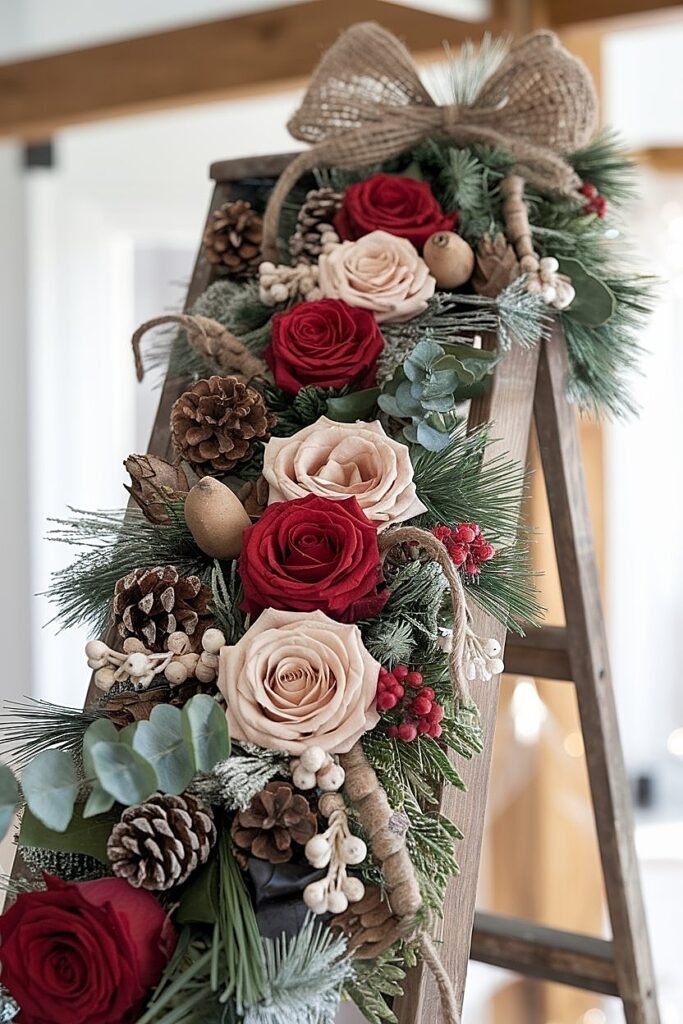
- Cedar Tips:
Flexible, aromatic, and camera-friendly. Cedar’s flat sprays give a soft backdrop that keeps roses from looking bridal. It also tolerates warm interiors without dropping needles fast. - Olive Sprigs:
Silvery leaves echo winter light and pair beautifully with cream and blush roses. Olive adds movement and quiets shiny metals, especially pewter. - Seeded Eucalyptus:
Bead-like pods bring texture that plays against petal smoothness. Use sparingly; it can dominate visually. Great for connecting rose clusters. - Pinecones (Small/Medium):
Matte, weighty, and draft-proof. Cones add woodland silhouette and stabilize modules on mantels and sideboards. Prefer untreated, un-glittered for dining areas. - Walnut Slices/Blocks:
A natural “pedestal” that warms the palette and protects wood when you need lift. Walnut photographs beautifully with candlelight. - Dried Lavender Micro-Sprigs:
A subtle herbal note that doesn’t bulldoze food aromas. Tuck low and short; they behave in drafts and add fine-line texture. - Moss (Preserved Sheet or Reindeer):
Softens mechanics and hides water tubes. Use in pockets, not blankets, to avoid moisture issues on wood.
Mix two greens max with one or two dry textures for discipline. There’s scale management ahead, keep reading to build long stair runs that feel airy, not overbearing.
How to Build Long, Continuous Christmas Rose Garlands for Stair Rails Without Looking Overwhelming

Long runs beg for editing. I lead with a thin base garland and place rose clusters only at rhythm points, every third baluster or at each newel/turn. Between those points, I keep foliage lean so the handrail reads as architecture, not jungle. I also limit bloom size: standard roses for newels, spray roses for in-between.
Transitions matter. At landings, I reduce density by half for 12–18 inches, then rebuild post-turn so the eye rests. Light placement follows the same logic: warm micro-lights tucked under foliage at cluster points only, never continuous, to avoid a “runway strip” effect. One ribbon tone weaves through and surfaces briefly at clusters, then disappears.
Sparse between beats, fuller at architectural moments, and scaled blooms to match spacing. There’s a quick-win section next, keep reading to bulk up a ready-made garland the smart way.
Ideas for Adding Mini Rose Clusters to Existing Evergreen Christmas Garlands for a Fuller Farmhouse Look

- Cluster-on-Pin:
Create 3-rose minis on 26–28 gauge wire; wrap the stems with floral tape; then stab the cluster like a boutonniere into the garland spine. It’s fast, removable, and won’t crush the base. - Magnet Pairs for Metal Rails:
Glue small craft magnets to the back of faux rose heads and pair them with a matching magnet tucked under foliage on metal rails. Instant, reversible fullness where hooks aren’t allowed. - Ribbon Cinch Points:
Every 18 inches, cinch the garland with a 3/8-inch brushed ribbon and slip a mini cluster under the knot. The repeat adds cadence and hides mechanics while tying your palette together. - Cone-and-Rose Pods:
Wire a tiny cone to a spray rose and olive tip to make a pod. Tuck pods in odd numbers along the top edge. The cone weight helps them sit securely. - Cloche Accents at Newels:
Instead of more greenery, add a mini cloche with a single rose at each newel. The glass adds shine, the rose adds focus, and the base garland stays breathable.
Pick one mini method and repeat it consistently for unity. There’s texture layering ahead, keep reading to fold in branches and cones for honest farmhouse character.
Ways to Add Pinecones and Dried Branches to Christmas Rose Garlands for Extra Farmhouse Texture
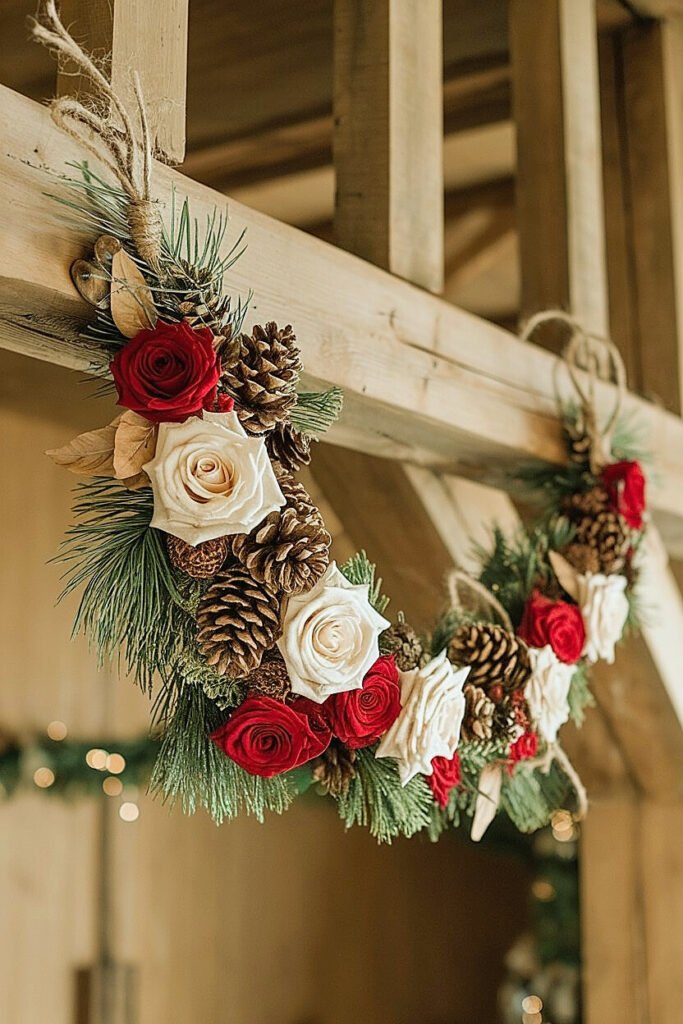
I seat cones on pewter saucers at mantle lips and sideboard turns to stop “walkabouts” and to protect finishes. On stair rails, I wire small cones in trios and anchor them at newels and turns only. Cones become visual commas, pauses that keep the eye from racing.
For branches, I love birch twigs or grapevine cut short. I weave them under the green spine so they peek, not poke. The trick is negative space: branches should draw thin shadow lines that make roses pop, not create a thicket. One or two accents per module is enough. If a branch catches a sleeve in your test walk, it’s out.
Cone clusters as anchors, short twigs under the spine, and ruthless snag testing. There’s small-space guidance next, keep reading for compact builds that respect narrow mantels and tight furniture.
How to Build Compact Christmas Rose Garlands for Smaller Farmhouse Mantels and Narrow Furniture Surfaces

On narrow mantels, height kills conversation and depth. I run a pencil-thin olive rope and pin two micro-clusters of roses slightly off-center left and right. Between them, I place a single mercury votive and a walnut block with one cone. The breath between elements becomes luxury.
For skinny consoles, I build on a narrow bone linen runner. I keep blooms to spray roses and buds, never full-size heads, and I anchor mechanics with discreet command strips so nothing slides when someone sets keys down. If I need more presence, I add a cloche or a framed winter print above, vertical composition instead of horizontal clutter.
Mini clusters, micro-votives, and negative space as design. There’s a final, ready-to-buy checklist next, keep reading to stock the right tools and textures fast.
Christmas Rose Garland Shopping List:
- Cedar or Olive Base Garland (Flexible, 6–9 ft):
Choose a bendable, non-plastic-looking strand as your spine. It should drape without fighting you and tolerate micro-lights tucked underneath. A realistic base makes fewer roses feel like more. - Fresh or High-Quality Faux Roses (Red + Cream, Standard & Spray):
Mix sizes for depth, standard for focal points, spray for fill. If fresh, add water tubes; if faux, select matte petals with subtle veining. Keep colorways disciplined. - 26–28 Gauge Floral Wire + Green Floral Tape:
Wire lets you build mini clusters quickly; tape hides mechanics and adds grip. Stock extra so you can adjust on-site without a store run. - Brushed Silver or Pewter Ribbon (3/8–1/2 inch):
One ribbon vocabulary unifies stairs, mantel, and buffet. Brushed finishes photograph softly and won’t glare under candles or lamps. - Command Hooks (Clear) + Felt Pads + Silicone-Coated Twist Ties:
Finish-safe attachment kit. Hooks in shadow lines, felt under pressure points, and silicone ties for quick, non-scratch cinching on metal rails. - Warm White Micro-Lights with Thin Green Wire:
Thread under foliage for a soft, internal glow. Battery packs should clip or Velcro to hidden risers or sit in small pewter bowls for easy access. - Small/Medium Natural Pinecones + Water Tubes + Preserved Moss:
Cones weigh and ground modules; water tubes keep fresh roses alive; moss hides mechanics and softens edges around clusters and candles.
Christmas Rose Garland Shopping Checklist
A fast, Amazon-ready shopping guide for building rose garlands across stair rails, mantels, buffet tables, and window ledges. Tap to expand on mobile.
| Category | Items to Buy | Notes | Quick Copy |
|---|---|---|---|
| Base Greens |
• Evergreen garlands (plain) • Artificial cedar rope • Artificial pine strands • Soft eucalyptus runners |
Choose bendable, flexible greenery for shaping stair rails and mantels. | |
| Rose Florals |
• Red artificial rose bundles • Cream rose heads • Mixed rose picks • Mini clusters for tight spaces |
Stick to cohesive color themes for clean farmhouse styling. | |
| Fillers & Textures |
• Natural pinecones • Dried pods & seed heads • Faux eucalyptus leaves • Cedar sprigs for depth |
Add rustic dimension without making garlands bulky. | |
| Fasteners |
• Jute twine • Soft, scratch-free ties • Green floral wire • Removable adhesive hooks |
Essential for attaching garlands to rails, mantels, and windows. | |
| Enhancements |
• Neutral ribbon rolls • Seasonal decorative picks • Metallic mini ornaments • Faux berries or branches |
Helps elevate simple greenery into a full Christmas feature. |
- Evergreen garlands (plain)
- Artificial cedar rope
- Artificial pine strands
- Soft eucalyptus runners
- Red artificial rose bundles
- Cream faux roses
- Mixed rose picks
- Mini rose clusters
- Pinecones
- Dried pods / seed heads
- Faux eucalyptus leaves
- Cedar sprigs
- Jute twine
- Soft scratch-free ties
- Green floral wire
- Removable adhesive hooks
- Ribbon rolls
- Seasonal decorative picks
- Mini ornaments
- Faux berries
Conclusion
Roses in Christmas garlands can look refined without going formal, and rustic without looking rough. Build in modules so installs are calm and edits are fast. Anchor a thin green spine, cluster roses at rhythm points, and let pewter, walnut, and cones add farmhouse weight. Protect surfaces, test sightlines and sleeves, and keep the serving lanes clear on mantels and buffets. Before guests arrive, remove one flourish, wipe the metals, and set the dimmer to a warm glow. Do all that, and your stair rails, mantels, and buffet tables will carry a quiet winter story, rose-scented, wood-grounded, and ready for real living.
This website contains affiliate links, and some products are gifted by the brand to test. As an Amazon Associate, I earn from qualified purchases. Some of the content on this website was researched and created with the assistance of AI technology.