This website contains affiliate links, and some products are gifted by the brand to test. As an Amazon Associate, I earn from qualified purchases. Some of the content on this website was researched and created with the assistance of AI technology.
Key Takeaways
- Muscari costs $3-5 per bunch but provides 15-25 individual stems creating incredible value per dollar
- Grape hyacinth’s tiny-clustered blooms fill visual gaps that expensive focal flowers leave exposed
- Base layer technique positions muscari below larger blooms creating depth and perceived abundance
- The purple-blue color bridges warm and cool spring flowers creating cohesive multi-flower arrangements
- Muscari’s naturally compact 6-8 inch height works perfectly in low centerpieces without trimming
- Grocery store tulips paired with muscari suddenly look like $50 florist arrangements for under $15
- The sturdy stems and long vase life (10-14 days) maximize budget investment over time
- Outdoor arrangements benefit from muscari’s wind-resistant compact structure
Using Muscari to make spring flowers centerpieces look fuller requires discovering what took me three wasteful years to learn: the most expensive flowers aren’t what create impressive arrangements, strategic filler flowers are. I used to buy premium roses and tulips, arrange them carefully, then step back feeling vaguely disappointed by how sparse everything looked despite spending $40-50. The arrangements screamed “I tried hard” rather than “this looks abundant and effortless.” Then I discovered muscari, those humble grape hyacinth stems selling for maybe $4 a bunch at grocery stores, and everything changed overnight.
Muscari transforms arrangements through sheer multiplication. One bunch contains maybe 15-25 individual stems of those tiny clustered blooms, versus 10 tulips in a $12 bunch. The math alone makes muscari compelling, but the real magic happens visually: those delicate purple or white spikes fill every gap between your focal flowers, creating density that makes 8 tulips look like 20. The compact height, naturally 6-8 inches, means they work in low centerpieces without any trimming waste. And the purple-blue color somehow bridges everything, making random grocery store flowers suddenly look like they were chosen by an actual designer who understands color theory.
Muscari can be the cheapest “fullness button” for Spring Flowers centerpieces. This guide shows where Muscari works best (tables, counters, islands, trays), how to layer it for dense width, and which blooms to pair with it for the biggest impact. Tap on mobile and copy the checklist.
Muscari Fullness Cheat Sheet: Make Spring Flowers Look Fuller for Less
Built for low, wide centerpieces using Muscari as the cheap “gap filler” + “base layer” across tables, counters, kitchen islands, and more.
| Home Surface | Best Container Mix | Muscari + Spring Flowers Formula | Do This / Avoid This |
|---|---|---|---|
|
Dining table centerpiece muscari fillerbudget-friendlylow + wide |
Shallow matte bowl (main) + optional mini bud cup (side)
Goal: wide footprint, low height (sightline-safe).
|
Cluster 3 tulip heads + pack Muscari into every gap
Pro: Muscari erases “thin spots” fast.
|
Do: fill gaps last; leave plate space. Avoid: tall greens that block faces. |
|
Kitchen island (prep lane) prep-friendlydense base |
Low oval bowl placed off-center (prep lane stays open) |
Muscari “blanket” + 2–3 focal blooms (short-cut)
Pro: looks full without taking workspace.
|
Do: keep away from heat; top up water. Avoid: center placement that steals prep space. |
|
Coffee table (drink space) compactgap filler |
Low tray (non-slip) + tiny dish (optional) |
1–2 focal blooms + Muscari packed tight for width
Pro: small tray looks lush, not cluttered.
|
Do: leave coaster zone open. Avoid: wide sprawl that kills usability. |
|
Sideboard / buffet budgetrepeat pockets |
Low trough (elongated) + 1 mini bud cup on end |
Repeat: focal cluster → Muscari pocket → focal cluster
Pro: reads “designer runner” for less.
|
Do: keep serve lane clear. Avoid: tall pieces that block labels/plates. |
|
Entry console welcomingdense fill |
Small shallow bowl (off-center) + keys tray nearby |
Muscari base + 1–2 focal blooms near the front edge
Pro: looks full, still leaves keys/mail space.
|
Do: keep away from edges. Avoid: top-heavy containers. |
Dining table (Gap-fill to look full fast)
Kitchen island (Prep lane stays open)
Coffee table (Full look, still drink space)
Sideboard / buffet (Runner feel for less)
Entry console (Welcoming, still functional)
How to Use Muscari to Fill Gaps and Make Spring Flowers Centerpieces Look Fuller for Less
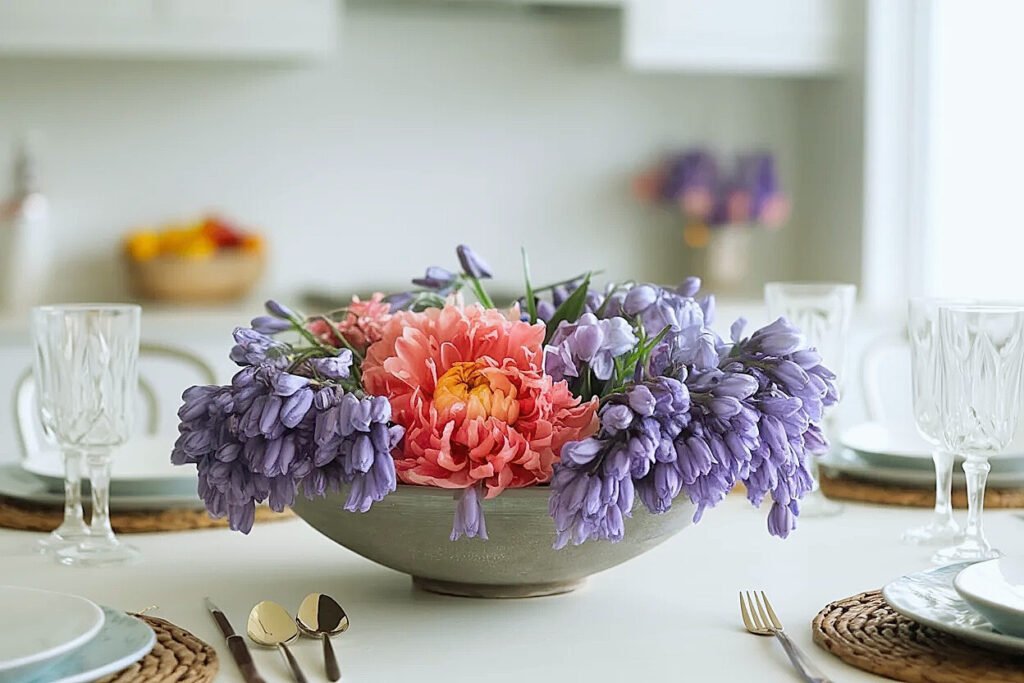
Gap-filling sounds mundane until you realize it’s the difference between arrangements that look professionally abundant versus amateur sparse. When you position focal flowers, tulips, daffodils, whatever, they create the arrangement’s structure and color statement. But between those larger blooms sit empty spaces revealing bowl interiors, floral foam, or just awkward nothingness that undermines the whole composition.
Muscari exists to annihilate those gaps. I buy one bunch of focal flowers ($10-12) and one bunch of muscari ($4-5), giving me maybe 10 primary stems and 20 muscari stems. I position the focal flowers first establishing structure, then systematically insert muscari into every visible gap. Those tiny grape hyacinth spikes nestle perfectly into spaces that larger stems can’t occupy, creating a seamless carpet of bloom.
The insertion technique matters. I angle muscari stems slightly outward from bowl center rather than straight vertical, creating dome shapes that extend beyond the bowl rim. This outward angling maximizes coverage, 20 muscari stems angled properly can fill what would otherwise require 40 vertical stems. The compact clustered blooms on each muscari stem create substantial visual mass despite the delicate scale.
The color impact deserves emphasis. That purple-blue somehow works with everything, coral tulips, yellow daffodils, white anemones, pink ranunculus. I’ve never found a spring flower that muscari clashes with. The blue-purple reads as neutral bridge color rather than competing hue, creating cohesion in mixed-flower arrangements that would otherwise look randomly assembled, and for comprehensive strategies on creating fuller spring centerpieces on tight budgets, there are detailed techniques covering multiple flower types, definitely share this with anyone stretching floral budgets!
The gap-filling foundation establishes muscari’s primary value, and the base layer techniques ahead show how to maximize this effect systematically.
Ways to Build a Wide Muscari “Base Layer” Under Spring Flowers in Low Bowls
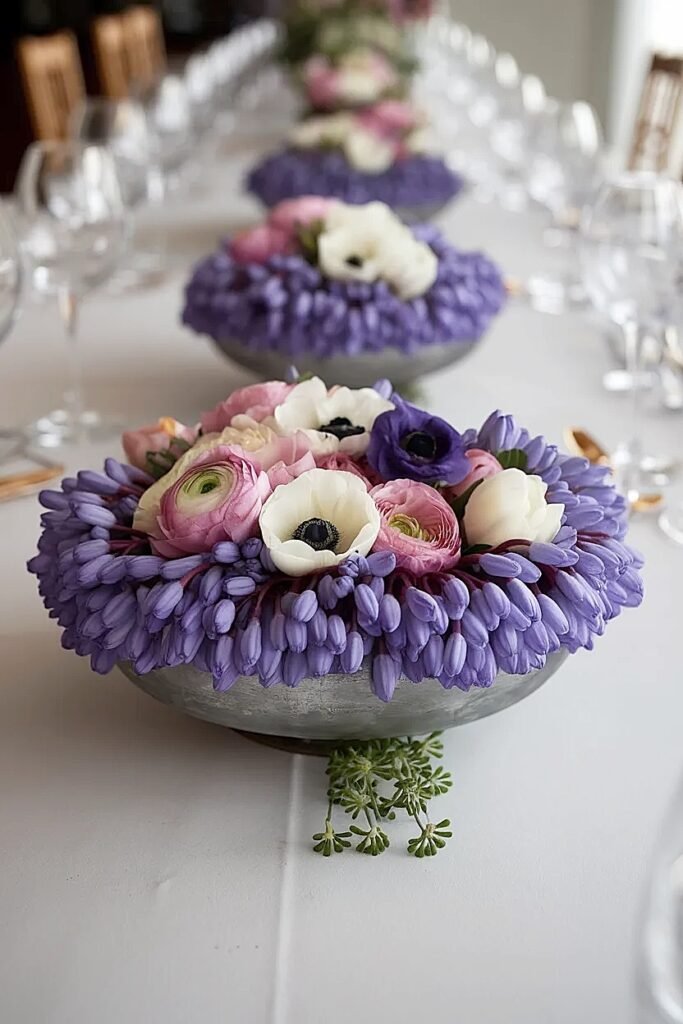
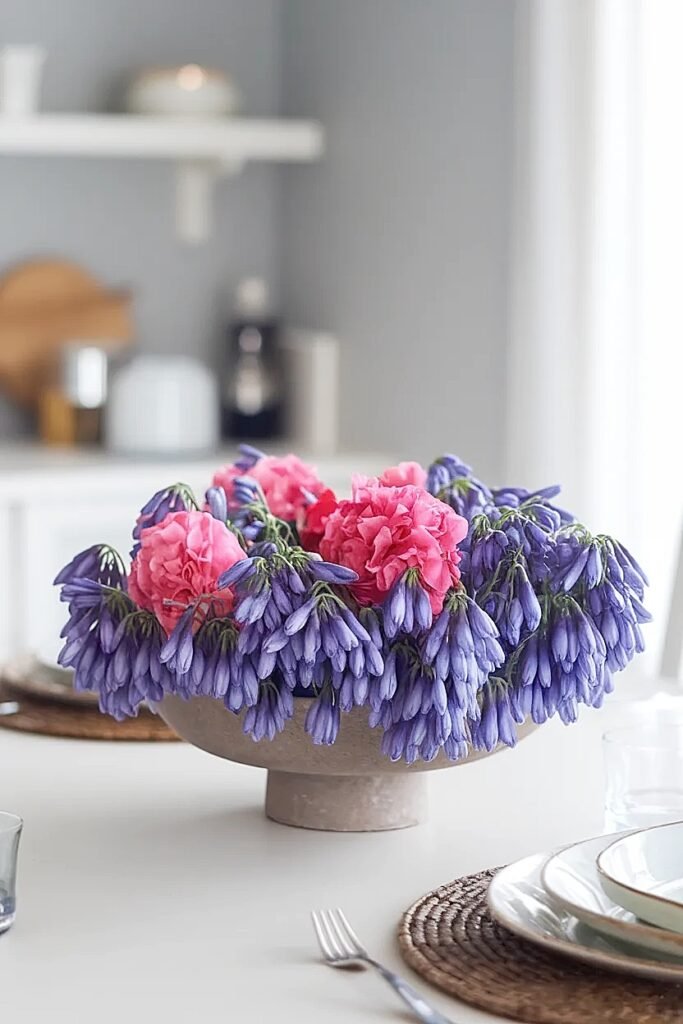
The base layer technique creates perceived fullness through strategic vertical positioning, muscari occupies the lower level while taller focal flowers rise above, creating tiered depth that reads as abundant even when total stem counts stay modest.
I discovered this watching a florist arrange flowers at a wedding. She built arrangements in distinct layers rather than randomly inserting stems, and the results looked exponentially fuller than my usual approach.
1. Perimeter Ring Foundation
Position 15-20 muscari stems in continuous ring around bowl’s outer edge, angling slightly outward creating base perimeter. Then insert focal flowers centrally rising above the muscari base. The ring creates defined lower layer framing taller elements. The outward angle extends arrangement diameter beyond bowl boundaries. This technique works brilliantly in 10-14 inch wide bowls where perimeter positioning creates substantial coverage while central area holds focal blooms.
2. Carpet Coverage with Focal Flower Islands
Fill bowl entirely with muscari positioned at equal heights creating purple carpet effect, then insert 5-7 taller focal flowers rising from this base like islands. The muscari carpet provides continuous lower-level coverage while focal flowers create vertical interest. Cut muscari to 4-5 inches and focal flowers to 8-10 inches creating clear height differentiation. This works when you have abundant muscari but fewer expensive focal blooms.
3. Graduated Height Progression
Position muscari at bowl edges cut to 5-6 inches, then add medium-height flowers mid-bowl at 7-8 inches, finally placing tallest focal flowers centrally at 9-10 inches. This creates gradual height progression from edges inward. The muscari base anchors the composition while successive layers build upward. The graduated approach feels natural rather than the abrupt height jumps that flat-then-tall arrangements create.
4. Quadrant Section Base
Divide bowl mentally into quarters, filling two opposite quadrants entirely with muscari while other two hold focal flowers. The alternating pattern creates rhythm while muscari sections provide fullness base. This works with color blocking, maybe purple muscari quadrants alternating with coral tulip quadrants. The sectioned approach creates modern graphic aesthetic while muscari fills what would otherwise be empty bowl areas.
5. Dense Central Cluster with Surrounding Muscari
Pack muscari densely in bowl center creating substantial base cluster, then position focal flowers around this central mass at bowl edges. This inverts typical arrangement structure creating unexpected interest. The central muscari mass anchors composition while focal flowers at edges create dynamic energy. Cut central muscari to 4-5 inches and edge flowers to 7-8 inches creating inverted dome shape.
The base layer strategies create systematic fullness, and the color bridge concept ahead explores muscari’s unique ability to unify disparate flowers.
How to Use Muscari as a Color “Bridge” to Make Spring Flowers Centerpieces Look Fuller
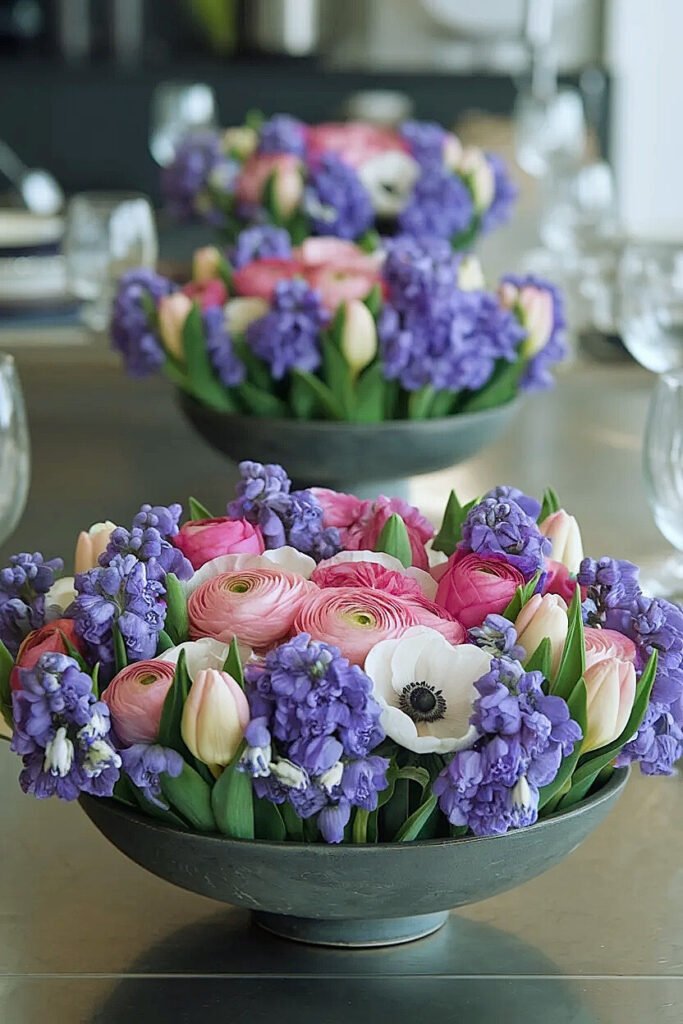
Color bridging means using a transitional hue that connects otherwise unrelated colors, creating cohesive arrangements from flowers that might clash without the mediating shade. Muscari’s purple-blue occupies perfect bridge territory between warm and cool spring palettes.
I learned this lesson arranging coral tulips with yellow daffodils, both beautiful individually but together they fought visually, creating jarring contrast rather than harmonious composition. Adding muscari between them suddenly unified everything. The blue-purple contained enough blue to cool the warm coral and enough purple (which contains red) to warm the yellow, creating visual path between the two.
The bridging works scientifically through color theory. Complementary colors, those opposite on color wheels, create vibrant tension but can overwhelm without mediation. Muscari’s blue-purple sits adjacent to both warm (via purple’s red component) and cool (via blue) territories, making it genuinely versatile mediator.
Practical application: when combining spring flowers in different color families, position muscari between them physically in the arrangement. If you’re mixing pink ranunculus with yellow tulips, don’t let them touch directly, nestle muscari stems between creating visual buffer. The grape hyacinth acts like grout between tiles, defining each color zone while preventing jarring direct contact.
This bridging effect makes random grocery store flower combinations suddenly look intentional. Buy whatever’s on sale regardless of color coordination, add muscari throughout, and the blue-purple magically creates cohesion suggesting you planned the palette deliberately rather than just grabbed what was cheap.
The color bridge creates sophisticated cohesion, and the pairing guidance ahead identifies specific flowers that work especially well with muscari.
What are the Best Spring Flowers to Pair with Muscari for Cheap Fullness on Dining Tables?
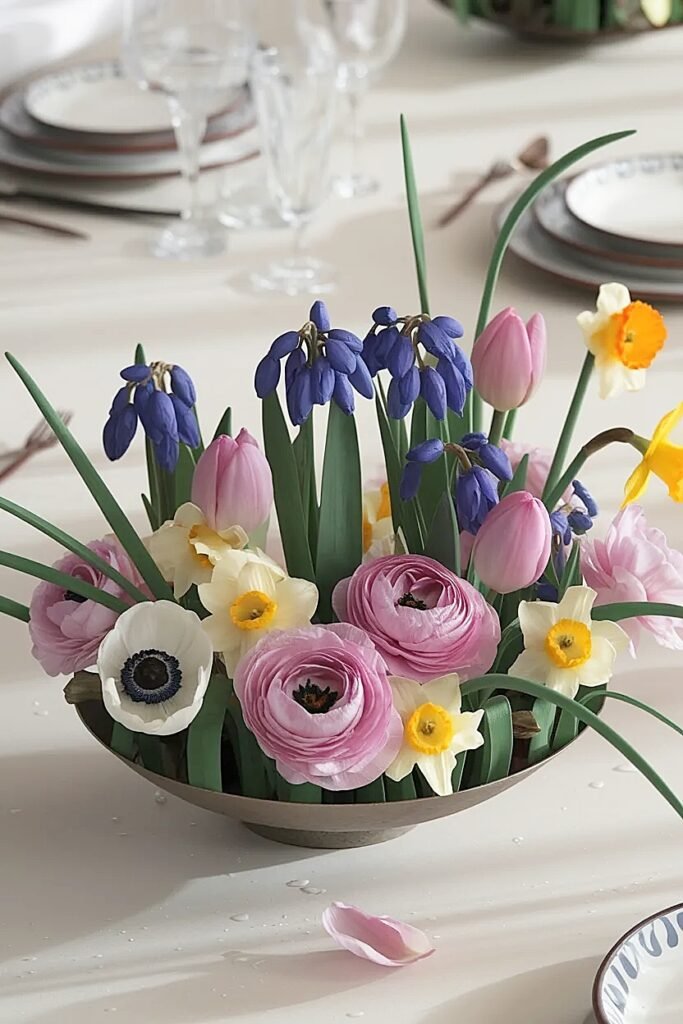
Not all spring flowers work equally well with muscari, some partnerships create magic while others waste muscari’s potential. The best pairings complement muscari’s scale and color while maximizing budget impact through strategic contrast.
I’ve tested dozens of combinations over five years, and these five consistently deliver exceptional results at minimal cost.
1. Grocery Store Tulips for Classic Elegance
Tulips pair beautifully with muscari through complementary scale, tulips’ bold cup-shaped blooms contrast muscari’s tiny clustered spikes creating pleasing size variation. Buy one tulip bunch ($10-12) and one muscari bunch ($4-5) for under $20 total. Use 8-10 tulips as focal flowers with 15-20 muscari filling gaps. The combination looks sophisticated and abundant. Tulips’ smooth petals contrast muscari’s textured clusters. Choose any tulip color, the blue-purple bridges everything.
2. Daffodils for Cheerful Spring Energy
Daffodils’ trumpet forms create bold statements while muscari adds delicate counterpoint preventing arrangements from feeling too heavy or obvious. The yellow-and-purple combination screams “spring” through classic color pairing. Buy daffodil bunch ($8-10) and muscari bunch ($4-5) totaling under $15. Use 8-10 daffodils with 15 muscari. The sturdy stems of both flowers create stable long-lasting arrangements. The combination works indoors or outdoors through weather-resistant qualities.
3. Grocery Store Carnations for Budget Abundance
Carnations get dismissed as cheap but paired with muscari they create surprisingly sophisticated results. The ruffled carnation blooms contrast muscari’s vertical spikes creating textural variety. Buy carnation bunch ($6-8) and muscari ($4-5) for under $15 total. Use 12-15 carnations with 20 muscari creating incredibly full arrangements. Choose single-color carnations rather than mixed, white carnations with purple muscari reads elegant, not cheap.
4. Alstroemeria for Multi-Bloom Value
Alstroemeria bunches provide exceptional stem count, each stem carries multiple blooms, pairing perfectly with muscari’s multiplication effect. The lily-like alstroemeria flowers contrast muscari’s tiny clustered form. Buy alstroemeria bunch ($8-10) and muscari ($4-5) totaling under $15. Use 8-10 alstroemeria stems (providing 30-40 individual blooms) with 15 muscari. The combination creates arrangements appearing to contain 60+ individual flowers despite modest investment.
5. Hyacinths for Fragrant Textural Pairing
Hyacinths’ dense flower spikes create textural kinship with muscari’s clustered form while the larger scale creates pleasing variation. Both are fragrant spring bulbs creating sensory cohesion. Buy hyacinth bunch ($10-12) and muscari ($4-5) totaling under $20. Use 5-7 hyacinth spikes with 15 muscari. The shared vertical spike structure creates unified aesthetic while scale differences prevent monotony. The combined fragrance enhances arrangements beyond visual appeal.
These pairings prove muscari elevates even cheap flowers, and the kitchen island ideas ahead address functional surfaces with height restrictions.
Ideas for Muscari-Heavy Spring Flowers Centerpieces on Kitchen Islands That Stay Low
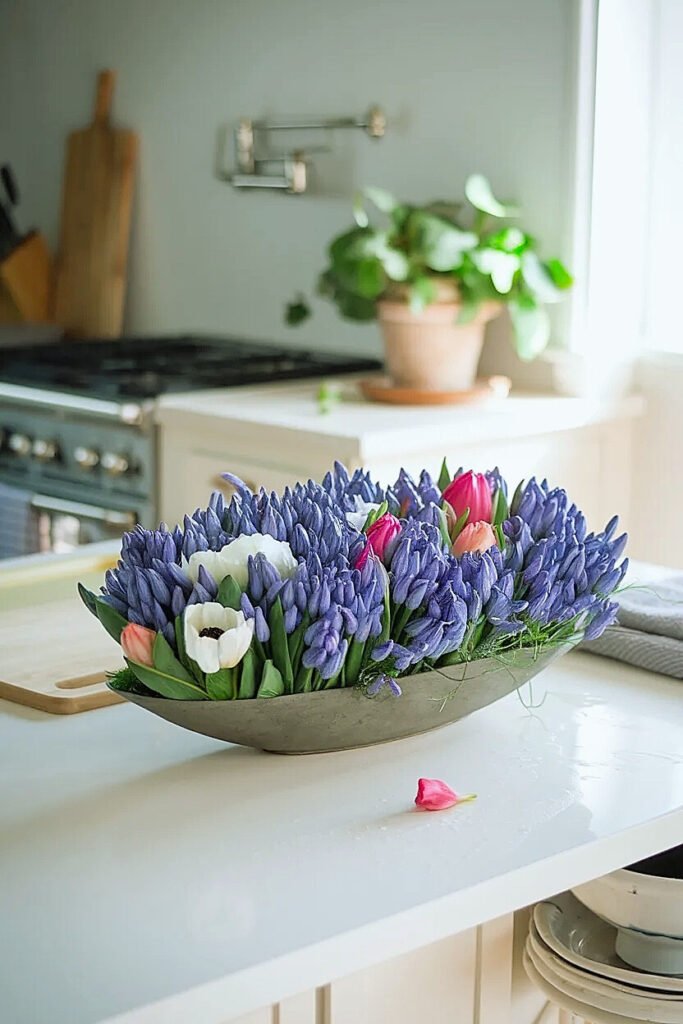
Kitchen islands demand low arrangements preserving sightlines and work surfaces, making muscari’s naturally compact 6-8 inch height perfect for these functional spaces where taller flowers would interfere with cooking and conversation.
Muscari-heavy arrangements emphasize the grape hyacinth as primary element rather than mere filler, creating blue-purple focal installations supplemented by accent flowers.
1. Pure Muscari Carpet in Wide Shallow Bowl
Fill 12-14 inch wide shallow bowl entirely with 30-40 muscari stems creating dense purple carpet. The mono-flower approach creates modern minimalist aesthetic while the quantity delivers impressive fullness. Cut all stems to uniform 5-6 inch height creating even surface. Position bowl at island center or back edge. The low profile preserves prep space and sightlines. Cost under $10 using two muscari bunches creating arrangement appearing far more expensive.
2. Muscari Majority with White Tulip Accents
Use 25 muscari stems as primary element with just 5 white tulips as accent creating purple-dominant composition with bright white punctuation. The heavy muscari ratio keeps costs down while white tulips provide crisp contrast. Position muscari throughout bowl with white tulips distributed evenly creating rhythm. The purple-white combination reads clean and fresh. Total cost under $18 creating substantial island centerpiece.
3. Muscari and Daffodil Alternating Sections
Create half-bowl muscari and half-bowl daffodil sections in color-blocked arrangement. Use 15 muscari stems in one half, 6-8 daffodils in other half. The purple-yellow combination creates vibrant energy appropriate for kitchen spaces. The blocked organization feels intentional rather than random. Position in rectangular vessel emphasizing the divided sections. Cost under $15 total.
4. Layered Muscari Base with Ranunculus Peaks
Build base layer using 20 muscari stems cut to 5 inches, then insert 6-8 ranunculus stems cut to 7-8 inches creating peaks rising from purple base. The layered approach maximizes perceived fullness while keeping total height under 9 inches. The ranunculus’ ruffled texture contrasts muscari’s vertical clusters. Choose coral or pink ranunculus creating warm-cool color play.
5. Linear Muscari Row in Narrow Trough
Position 20-25 muscari stems in narrow trough (16×4 inches) running island length, creating linear installation rather than rounded arrangement. The row format emphasizes island’s linear nature while narrow width preserves prep space. Cut stems to uniform 6-inch height. The continuous purple line creates modern graphic aesthetic. Add 3-4 white tulips spaced evenly for accent. Cost under $16.
The island applications show muscari’s versatility, and the grocery store transformation technique ahead reveals how to fake designer credentials.
How to Use Muscari to Make Grocery Store Spring Flowers Look Designer
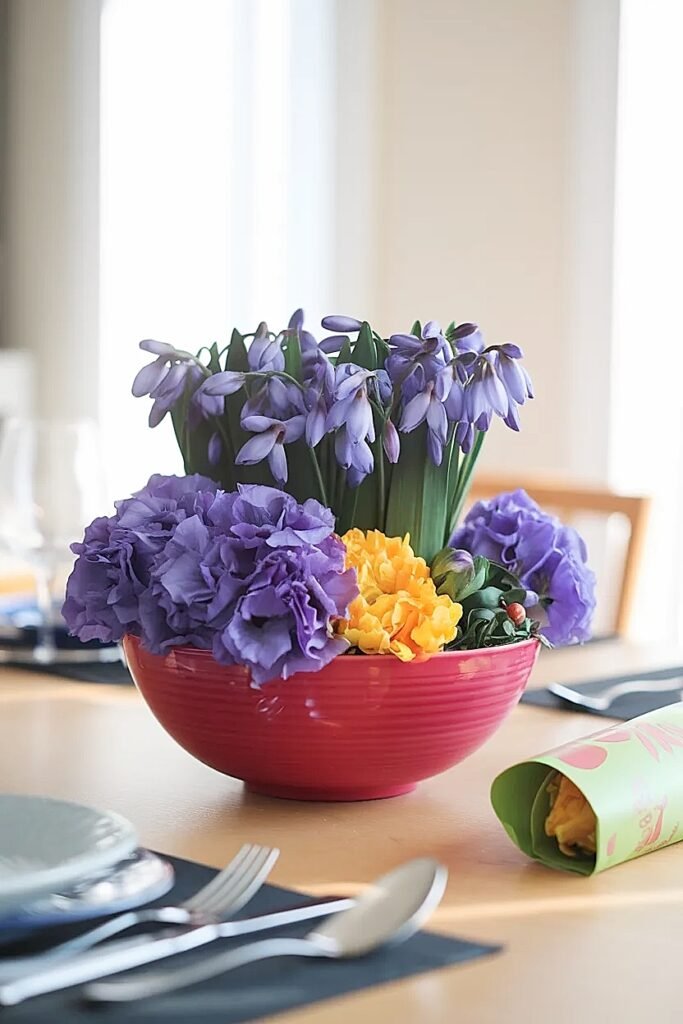
Grocery store flowers betray their origins through sparse arrangements, random color mixing, and that overall “I grabbed what was cheap” aesthetic. Muscari acts as the designer’s secret weapon transforming budget bouquets into arrangements guests assume came from actual florists.
The transformation happens through three mechanisms: filling gaps eliminating sparseness, bridging colors creating cohesion, and adding textural complexity suggesting sophistication.
I buy whatever grocery store flowers are on sale, maybe tulips one week, carnations next week, alstroemeria the following week. Doesn’t matter. I also buy two bunches of muscari regardless of what else I’m getting. Those muscari bunches become my constant, the element that unifies everything else.
The integration technique: I strip away any grocery store wrapping and greenery, then rebuild arrangements from scratch in my own vessels. I start by positioning focal flowers, maybe 8 tulips, establishing basic structure. Then I systematically insert muscari everywhere, using 20-30 stems filling every visible gap. This creates seamless dense appearance that screams “professional” rather than “amateur.”
The color cohesion muscari provides is crucial. Random grocery store flowers might include pink carnations, yellow tulips, and white alstroemeria, colors that don’t naturally harmonize. But muscari’s blue-purple somehow unifies them, creating visual thread suggesting intentional palette selection. The arrangement stops looking like “I bought whatever was on sale” and starts reading as “I deliberately chose complementary spring colors.”
The textural layer matters too. Grocery store flowers tend toward simple forms, tulips, carnations, basic stuff. Muscari adds architectural interest through those vertical clustered spikes contrasting smooth petals. The textural variation suggests thoughtful design consideration beyond just color and quantity.
The designer illusion proves muscari’s value exceeds its price, and the budget greens guidance ahead shows how to amplify results further.
What are the Best Budget Greens to Mix with Muscari for Fuller Spring Flowers Centerpieces?
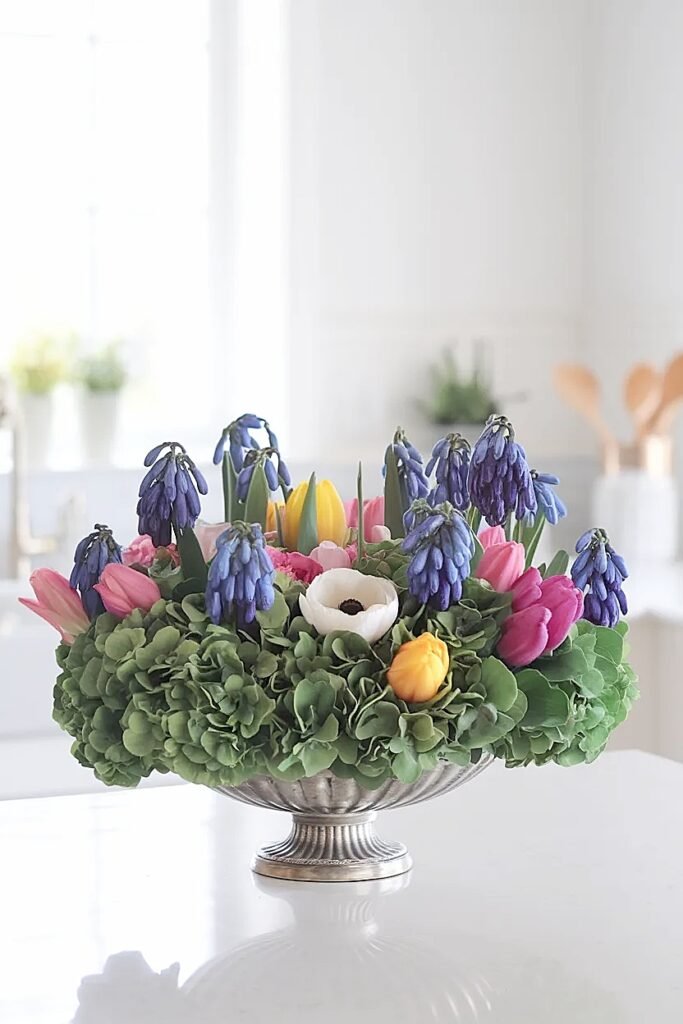
Greens provide structural framework and additional volume, and certain budget varieties pair exceptionally well with muscari creating lush arrangements for minimal additional investment.
The best pairings complement muscari’s delicate vertical form without overwhelming it.
1. Leather Leaf Fern for Architectural Structure
Grocery store leather leaf fern costs $4-6 per bunch providing 15-20 sturdy fronds creating substantial framework. The waxy dark green leaves create perfect backdrop for muscari’s purple-blue spikes. Position fern fronds around bowl perimeter angling outward, then fill interior with muscari and focal flowers. The fern extends visual boundaries while providing structural definition. The combination of fern’s broad leaves with muscari’s tiny clustered blooms creates pleasing scale variation. One fern bunch plus one muscari bunch costs under $12 creating impressive fullness.
2. Salal for Dense Filler Volume
Salal (lemon leaf) bunches run $5-7 providing densely branched greenery perfect for filling arrangement bases. The rounded leaves create lush foundation under muscari’s vertical spikes. Position salal creating lower green layer, then insert muscari stems rising above. The combination creates tiered depth suggesting professional arranging. Salal’s glossy leaves contrast muscari’s matte textured blooms. The branching structure of salal provides substantial volume inexpensively. Total cost under $12 for both creating arrangements appearing to contain $30+ of materials.
3. Eucalyptus for Silvery Sophistication
Seeded eucalyptus costs $6-8 per bunch providing silvery-green color that complements muscari’s purple-blue beautifully. The branching eucalyptus creates airy texture contrasting muscari’s dense clustered form. Position eucalyptus around arrangement edges creating light framework, then pack muscari more densely centrally. The silver-green and purple-blue combination reads as sophisticated color coordination. Eucalyptus’ pleasant scent adds sensory dimension. The combination costs under $14 total creating designer-quality results.
4. Pittosporum for Delicate Branching
Pittosporum provides delicate branching with small rounded leaves creating fine-textured greenery complementing muscari’s scale. Grocery stores sell bunches for $5-7. The subtle green doesn’t dominate but provides gentle structural definition. Position pittosporum creating branching framework throughout arrangement, then intersperse muscari. The similar delicate scales create cohesive aesthetic. The branching naturally fills gaps while light texture prevents heavy appearance. Combined cost under $12.
5. Israeli Ruscus for Linear Architectural Interest
Israeli ruscus features linear branching with flattened leaf-like structures creating architectural interest. Bunches cost $5-7. The linear forms create geometric framework contrasting muscari’s organic clustered spikes. Position ruscus creating structural lines throughout arrangement, then fill between with muscari. The combination of geometric ruscus and organic muscari creates sophisticated textural play. The ruscus’ sturdy branches support arrangement structure. Total cost under $12.
The greens amplify muscari’s impact, and the outdoor patio applications ahead address weather-resistant arrangements.
What are the Best Muscari Spring Flowers Centerpieces for Outdoor Patio Tables (Stable + Low)?
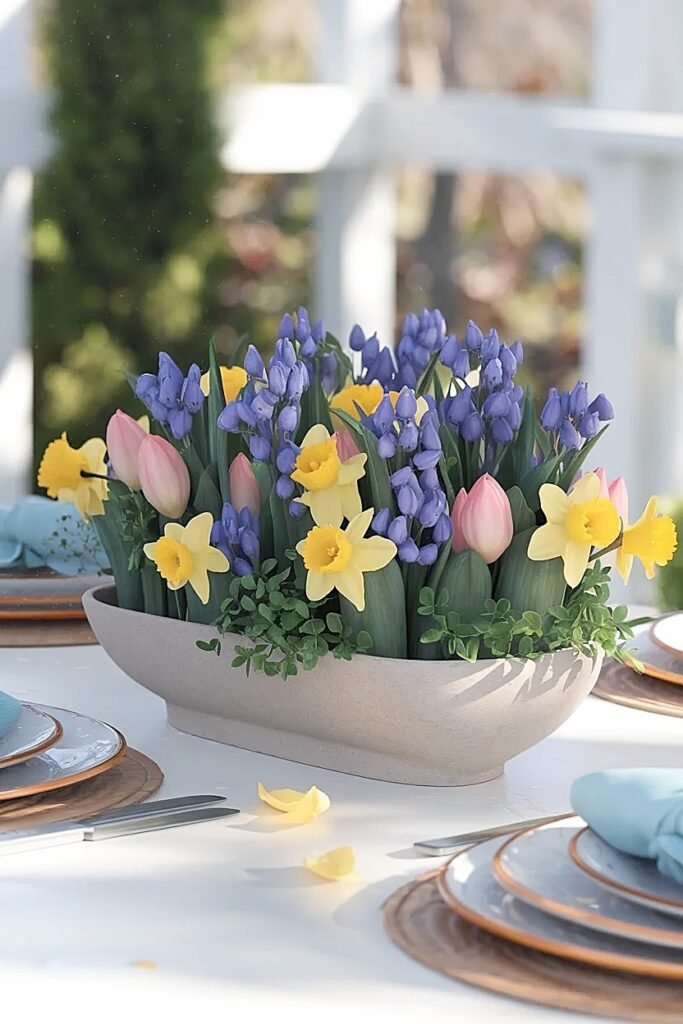
Outdoor patio arrangements face wind, temperature fluctuations, and sun exposure, making muscari’s compact sturdy structure ideal while its low height resists wind damage that destroys taller flowers.
These three approaches maximize muscari’s outdoor advantages.
1. Pure Muscari Mass in Weighted Concrete Bowl
Fill substantial concrete bowl (10-12 inches diameter, 8-10 pounds) entirely with 40-50 muscari stems creating dense purple installation. The concrete weight resists wind while muscari’s compact form withstands breezes that would shred taller flowers. Cut all stems to uniform 6 inches creating even surface barely rising above bowl rim. The low profile prevents wind catch while the quantity creates impressive presence. The all-muscari approach costs under $15 using two bunches creating arrangement lasting 10-14 days outdoors. The sturdy stems don’t require floral foam, just water in the bowl.
2. Muscari and Daffodil Combination for Wind Resistance
Combine muscari’s compact form with daffodils’ naturally sturdy stems creating wind-resistant outdoor arrangement. Use weighted vessel (minimum 5 pounds) with 15 muscari stems and 8-10 daffodils. Both flowers evolved for outdoor garden conditions making them inherently weather-resistant. The combination creates color interest while the sturdy construction withstands outdoor exposure. Position in terra cotta or concrete bowl. The yellow-purple combination creates cheerful outdoor aesthetic. Total cost under $15. The arrangement survives moderate wind and temperature swings that would destroy delicate indoor flowers.
3. Muscari Base Layer with Low Hyacinth Accents
Build arrangement using 25 muscari stems as base layer with 5-6 hyacinth spikes as accents, both being outdoor-hardy spring bulbs naturally suited to weather exposure. Position in wide shallow bowl (12-14 inches diameter) with substantial weight. The layered structure creates dimension while low profile resists wind. Both flowers handle outdoor conditions through evolved adaptations. The fragrant combination enhances outdoor dining through natural aromatherapy. Cut muscari to 5-6 inches and hyacinths to 7-8 inches creating tiered effect under 9 inches total height. Cost under $18 creating substantial outdoor centerpiece lasting up to two weeks.
Conclusion
Using muscari to make spring flower centerpieces look fuller for less money leverages this humble grape hyacinth’s exceptional value proposition: $4-5 per bunch delivers 15-25 individual stems creating gap-filling density that transforms sparse arrangements into abundant compositions. The naturally compact 6-8 inch height works perfectly in low centerpieces without trimming waste, while the purple-blue color bridges disparate spring flowers creating cohesive designer-quality results from random grocery store purchases. Build muscari base layers under focal flowers, use it to fill visual gaps between larger blooms, and combine it with budget greens like leather leaf fern or eucalyptus doubling perceived volume for under $12 total investment. These techniques prove that impressive spring centerpieces don’t require expensive florist flowers, they require understanding how strategic filler flowers like muscari create perceived abundance through smart mechanics rather than simple spending.
This website contains affiliate links, and some products are gifted by the brand to test. As an Amazon Associate, I earn from qualified purchases. Some of the content on this website was researched and created with the assistance of AI technology.