This website contains affiliate links, and some products are gifted by the brand to test. As an Amazon Associate, I earn from qualified purchases. Some of the content on this website was researched and created with the assistance of AI technology.
Key Takeaways
- Treating green as hint rather than foundation creates sophisticated dining centerpieces adults appreciate
- Emerald roses scattered sparingly among cream blooms deliver Irish atmosphere without color overwhelm
- Specific color ratios, like 80/20 cream to green, provide reliable formulas for balanced arrangements
- Single green elements communicate St. Patrick’s intent as effectively as saturated schemes
- Low centerpieces under six inches preserve conversation across dining tables
- Centerpiece shape should match table geometry: rounds for round tables, runners for rectangles
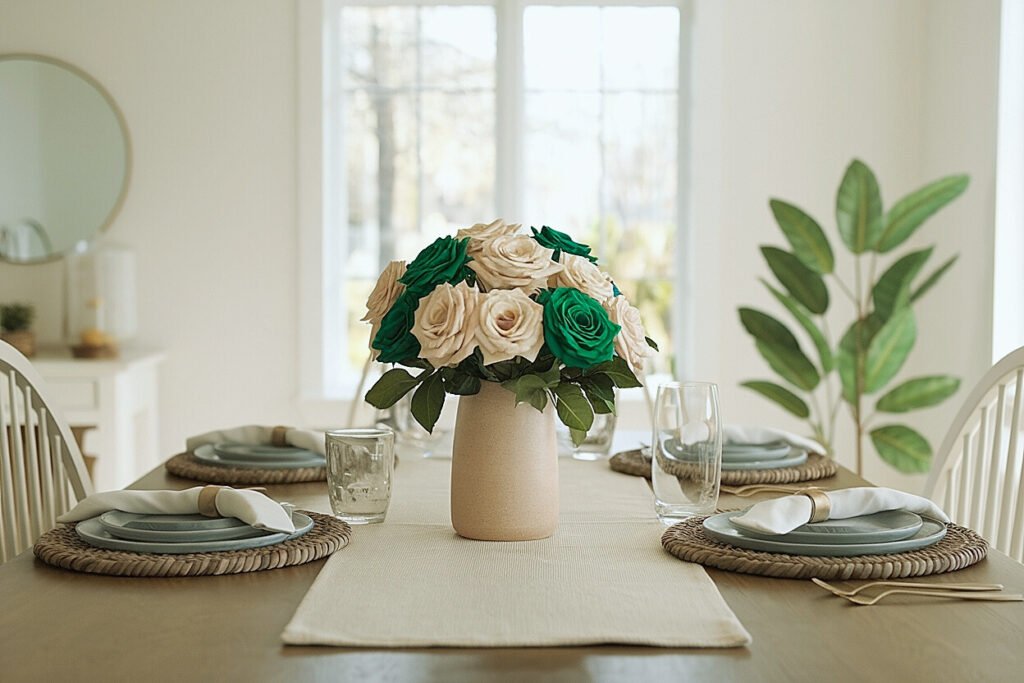
Styling Saint Patrick’s Day dining table rose centerpieces with minimal green challenges the assumption that Irish celebration requires emerald saturation. I hosted my first St. Patrick’s dinner party with a centerpiece so aggressively green that guests squinted at their plates. The overwhelming color competed with food presentation, distracted from conversation, and photographed terribly. Corned beef looked gray beside that much green. Wine glasses reflected shamrock hues. The dining experience suffered from decorating enthusiasm that forgot the table’s actual purpose: hosting a meal.
The correction came through realizing that dining tables operate differently than mantels or coffee tables. People sit at them. Food appears on them. Conversation flows across them. Centerpieces must enhance these activities rather than dominating them. Minimal green approaches acknowledge St. Patrick’s Day without hijacking the dinner party. Roses in soft colors create beauty that complements rather than competes. These techniques produce centerpieces guests actually notice favorably, subtle enough to enhance, intentional enough to communicate Irish celebration.
Use this picker to build a Saint Patrick’s Day dining table rose centerpiece that stays cream-forward and dinner-ready. Choose your table type, match it to the right container, follow the minimal-green rose recipe, then apply the “real dinner” checks so your table stays functional and polished.
Saint Patrick’s Day Dining Table Roses (Minimal Green) — Centerpiece Picker
Desktop shows a full table. On phones, tap a row to expand.
| Table Setup | Best Container | Rose + Green Recipe | Dinner-Ready Checks |
|---|---|---|---|
| Everyday Dinner (4 seats) Keep it compact + calm |
Medium matte vase Wide base, stable |
10 cream roses + 2 emerald roses + foliage at base only |
Low sightlines Leaves room for serving No loose small items |
| Hosting Night (6–8 seats) More coverage, still low |
Long matte trough Low profile |
12–16 cream roses + 2–3 emerald roses + tiny green bridges |
Keep height under faces Clear platter zones Green stays 10–20% |
| Long Table Even spacing matters |
3 low bud vases Matching ceramics |
Per vase: 4 cream roses + 1 emerald rose + minimal foliage |
Space vases evenly Don’t block dishes Repeat the same recipe |
| Small Round Table Don’t crowd plates |
Low wide bowl Heavy base |
6–8 cream roses + 1 emerald rose + base greenery only |
Center it Keep edges clear Short stems = stable |
| Minimalist Look One green element only |
Simple matte vase Neutral tone |
8–10 cream roses Choose one: 2 emerald roses OR 1 leaf bundle |
No extra green objects Let neutrals lead Keep foliage tight |
| Modern Dark Accent Ground emerald |
Charcoal/black vase Matte finish |
8–10 cream roses + 2 emerald roses + very minimal foliage |
Use 1 dark anchor only Avoid busy tablescapes Clean spacing wins |
| Family-Friendly Kids/pets around |
Low heavy bowl Widest base |
Short stems Mostly cream + 1 emerald Foliage tucked low |
Away from edges No loose décor Stable + wipeable zone |
| Open-Concept Match Dining + kitchen |
Matte vase + bud Same material family |
Table: cream + 2 emerald Counter: 1 cream + 1 leaf |
Repeat once only Keep counters clear Same palette, less clutter |
Everyday Dinner (4 seats)
Compact + calm • cream-forward • tap to expand
⌄
Table Setup
Everyday Dinner (4 seats)
Keep it compact + calm
Best Container
Medium matte vase
Wide base, stable
Rose + Green Recipe
10 cream roses
+ 2 emerald roses
+ foliage at base only
Dinner-Ready Checks
Low sightlines
Leaves room for serving
No loose small items
Hosting Night (6–8 seats)
Low trough • subtle emerald • tap to expand
⌄
Table Setup
Hosting Night (6–8 seats)
More coverage, still low
Best Container
Long matte trough
Low profile
Rose + Green Recipe
12–16 cream roses
+ 2–3 emerald roses
+ tiny green bridges
Dinner-Ready Checks
Keep height under faces
Clear platter zones
Green stays 10–20%
Small Round Table
Low heavy bowl • short stems • tap to expand
⌄
Table Setup
Small Round Table
Don’t crowd plates
Best Container
Low wide bowl
Heavy base
Rose + Green Recipe
6–8 cream roses
+ 1 emerald rose
+ base greenery only
Dinner-Ready Checks
Center it
Keep edges clear
Short stems = stable
Quick tip: If it feels “too green,” remove foliage first—not roses.
How to Style a Saint Patrick’s Day Dining Table Rose Centerpiece With “Green as a Hint”
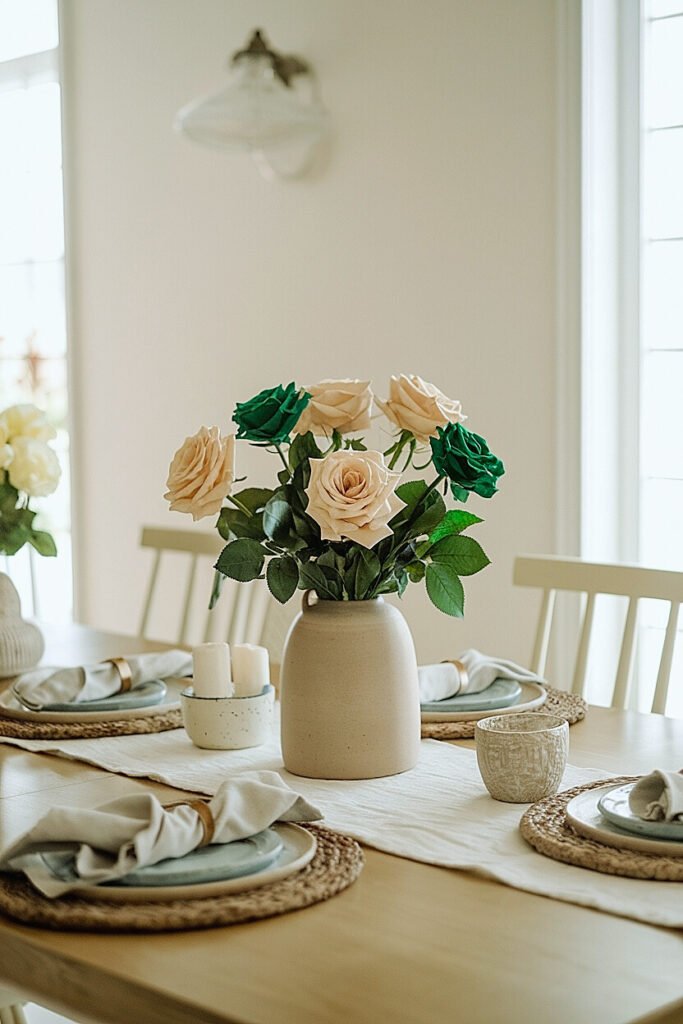
The “green as hint” philosophy treats Irish color as whisper rather than shout. Your centerpiece communicates St. Patrick’s Day through suggestion, a single green vessel, a few emerald-tinted roses among cream, one sage candle beside abundant neutral blooms. The hint registers without demanding attention. Guests understand the seasonal reference without being overwhelmed by it.
This restraint suits dining environments where other priorities, food, conversation, shared experience, deserve primacy.
Start by creating a centerpiece you’d be proud to display any time of year. Beautiful roses in cream, white, or blush tones. An elegant vessel. Proper proportions for your table size. Only after achieving this baseline should you introduce your green hint. The sequence matters: building from neutral foundation prevents green from becoming structural.
Select your hint element carefully. Options: one green candle positioned beside the arrangement. A sage-toned ribbon wrapped around a neutral vessel. Three emerald roses scattered among a dozen cream blooms. A subtle green runner beneath everything. Whatever you choose, limit yourself to one green element. The moment you add a second, you’ve promoted green from hint to theme. Resist. The single touch communicates sufficiently while maintaining elegant restraint your dinner guests will appreciate. For similar minimal-green approaches on mantels, explore these Saint Patrick’s Day mantel rose display ideas without overdoing green that apply identical principles. Found this refreshing? Share with friends hosting St. Patrick’s dinners!
Continue reading for techniques incorporating actual green roses as subtle accents.
Ways to Use Saint Patrick’s Day Emerald Roses as Accent Blooms in a Mostly Cream Centerpiece
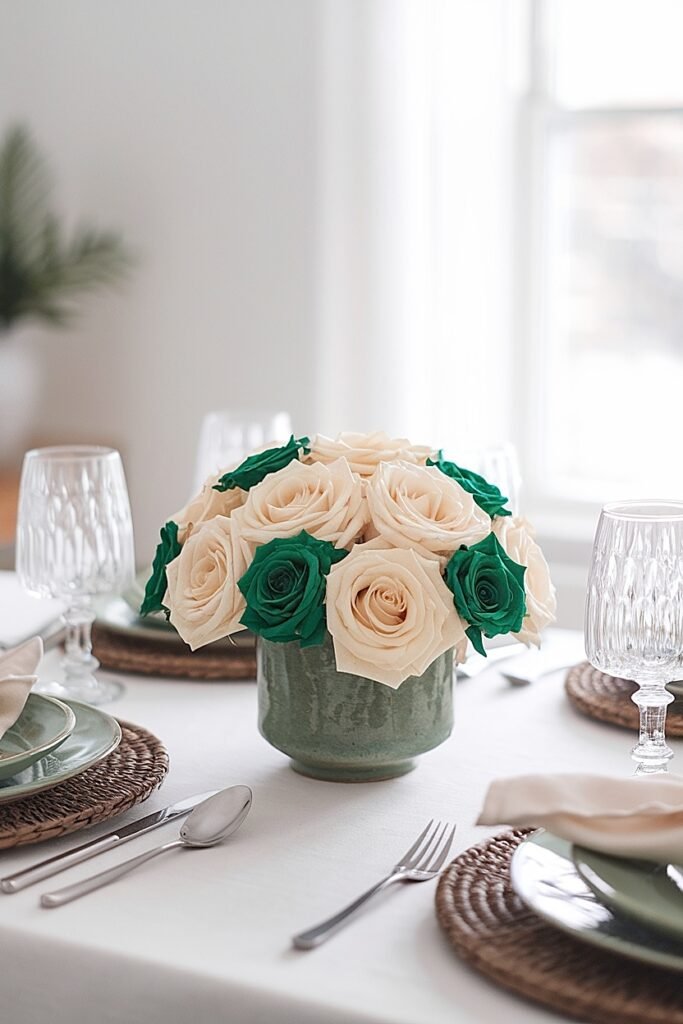
Green roses, whether naturally pale sage varieties or florist-tinted emerald blooms, can contribute beautifully when treated as accents rather than arrangement dominants. Scattered sparingly among cream roses, these green touches communicate Irish intent without converting your centerpiece into monochromatic green statement.
1. The Strategic Scatter Method
Position one green rose for every four or five cream blooms, spacing green stems irregularly throughout the arrangement. The scattered placement prevents green clustering that would create dominant zones. Each green rose becomes discovered accent rather than obvious color block.
2. The Perimeter Frame Technique
Place green roses exclusively at arrangement edges, keeping the center entirely cream. The green perimeter creates subtle frame effect while neutral tones command central attention. Eyes land on cream; green registers as supporting border.
3. The Single Focal Bloom
Include exactly one emerald rose at your arrangement’s heart, the spot eyes naturally find first. The singular green among uniform cream creates intentional statement rather than color scheme. The isolation amplifies that one bloom’s Irish significance.
4. The Graduated Fade Approach
Cluster green roses at one arrangement end, transitioning to pure cream at the opposite end. The gradient creates visual flow while limiting green to minority presence. The fade suggests intentional design rather than random mixing.
5. The Height Variation Strategy
Position green roses slightly lower than surrounding cream blooms. The recessed placement makes green supporting rather than featured. Eyes catch cream at the arrangement’s crown; green fills underneath.
Read on for specific color ratios that reliably produce balanced results.
What Are the Best Saint Patrick’s Day Rose Color Ratios for Dining Table Centerpieces?
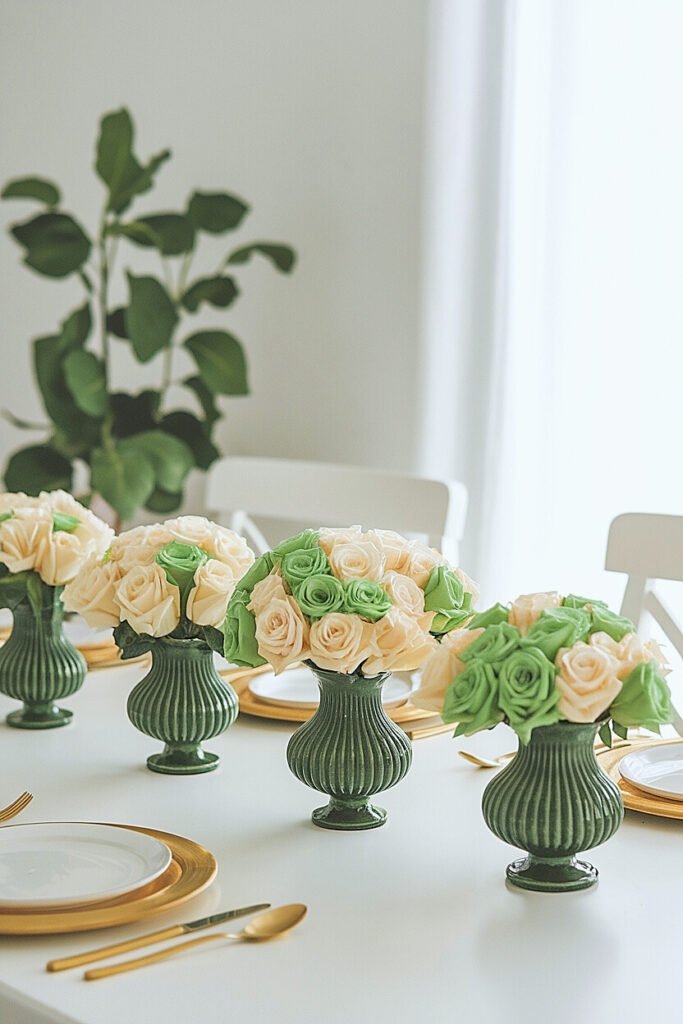
Ratios provide reliable formulas when intuition fails. Rather than guessing at balance, these specific proportions create consistently sophisticated results that communicate St. Patrick’s without green dominance.
1. The 80/20 Classic Split
Eighty percent cream or white roses, twenty percent green-tinted blooms. This ratio ensures clear neutral dominance while green presence remains unmistakable. In a fifteen-rose arrangement, that means twelve cream and three green, enough Irish reference without overwhelming.
2. The 90/10 Whisper Ratio
Ninety percent neutral roses with just ten percent green accents. For arrangements of ten roses, that’s a single green bloom among nine cream. The extreme restraint suits minimalist aesthetics and sophisticated palettes where even subtle green feels sufficient.
3. The 70/30 Statement Split
Seventy percent cream with thirty percent green creates noticeable St. Patrick’s presence without surrendering neutral dominance. This ratio suits hosts wanting clear holiday acknowledgment while maintaining elegant foundation. The green registers immediately but doesn’t overwhelm.
The following section demonstrates single-element approaches to green incorporation.
Ideas for Saint Patrick’s Day Dining Table Roses Using Only One Green Element
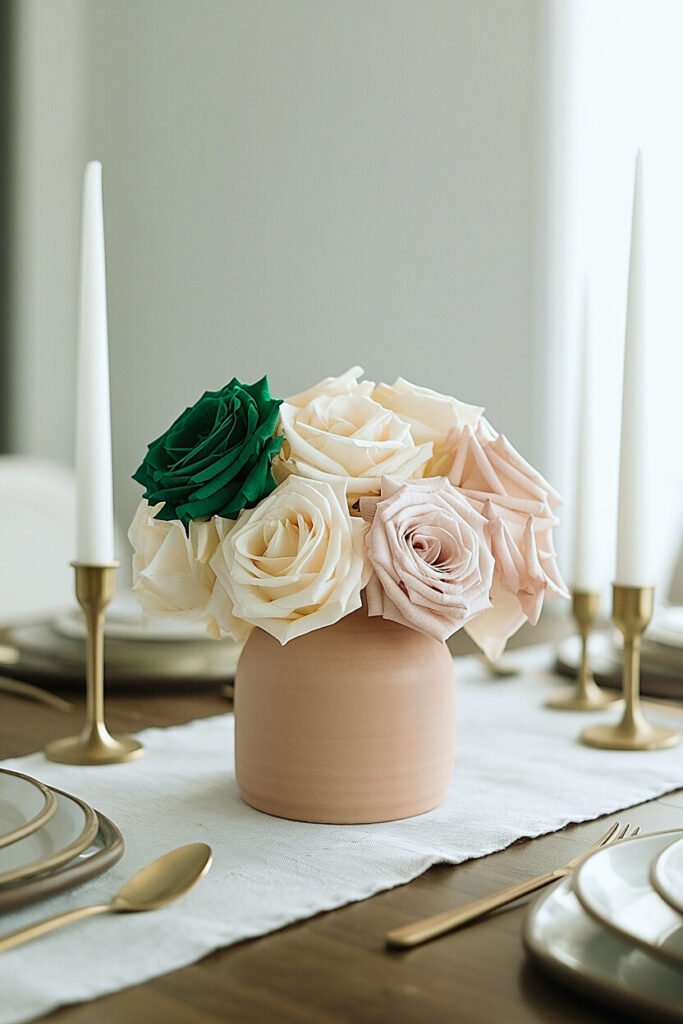
Single green elements carry the entire Irish burden, freeing everything else from green obligation. The one-element approach creates clean, intentional displays where that singular green touch registers distinctly against neutral surroundings.
1. The Green Vessel Foundation
Use one emerald or sage ceramic vessel filled entirely with cream roses. The container provides St. Patrick’s reference while blooms stay neutral. The green sits beneath everything, foundational rather than featured.
2. The Green Candle Companion
Position cream roses in a neutral vessel, then add one substantial green pillar candle beside the arrangement. The candle communicates Irish intent without affecting the roses themselves.
3. The Green Ribbon Accent
Wrap one sage or emerald ribbon around a neutral vessel holding cream roses. The thin green stripe provides holiday hint without dominating surface area.
4. The Green Runner Foundation
Place a soft green textile runner beneath entirely neutral rose arrangements. The green sits underneath, visible around arrangement edges, establishing Irish foundation while flowers and vessels remain cream and white.
5. The Single Green Rose Statement
Include exactly one emerald rose in an otherwise cream arrangement. The singular green bloom becomes focal discovery rather than color theme, enough Irish reference through extreme minimalism.
Continue reading for height considerations critical to dining table success.
How to Keep a Saint Patrick’s Day Dining Table Centerpiece Low So People Can Talk
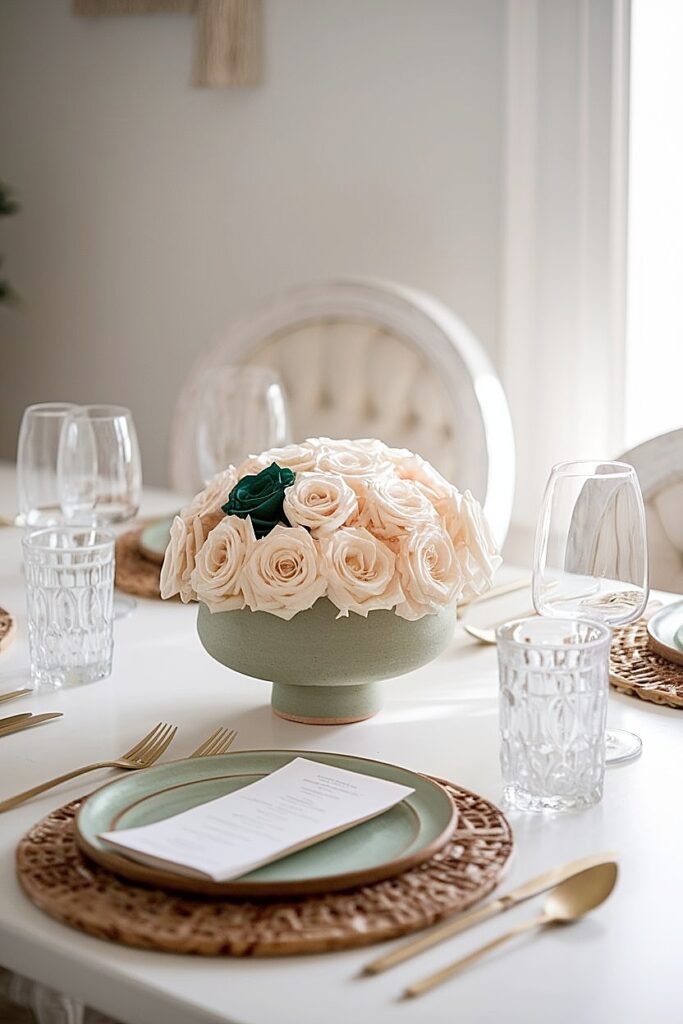
Height determines whether your centerpiece enhances or ruins the dining experience. Arrangements exceeding six inches force guests to crane around flowers, peer over blooms, or simply give up on cross-table conversation. St. Patrick’s celebration means nothing if guests can’t comfortably share the meal.
Low centerpieces require intentional construction that fights the natural tendency to build upward.
Select containers no taller than four inches. This height limit ensures even fully built arrangements stay within conversational clearance. Wide, shallow vessels work better than tall, narrow ones, they encourage horizontal spreading rather than vertical building.
Cut all rose stems to graduated short lengths before arranging. Center roses stay longest, perhaps five inches total from container bottom. Outer roses cut progressively shorter, with perimeter blooms nearly horizontal. This dome construction concentrates visual impact within modest height. The arrangement reads as lush and intentional rather than stunted. Test your final height by sitting at the table in your actual dining position, if any roses obstruct your view of someone seated opposite, the arrangement is too tall. Trim until sightlines clear completely.
Below, discover approaches designed specifically for longer dining tables.
Ways to Create Saint Patrick’s Day Dining Table Rose Centerpieces for Long Tables
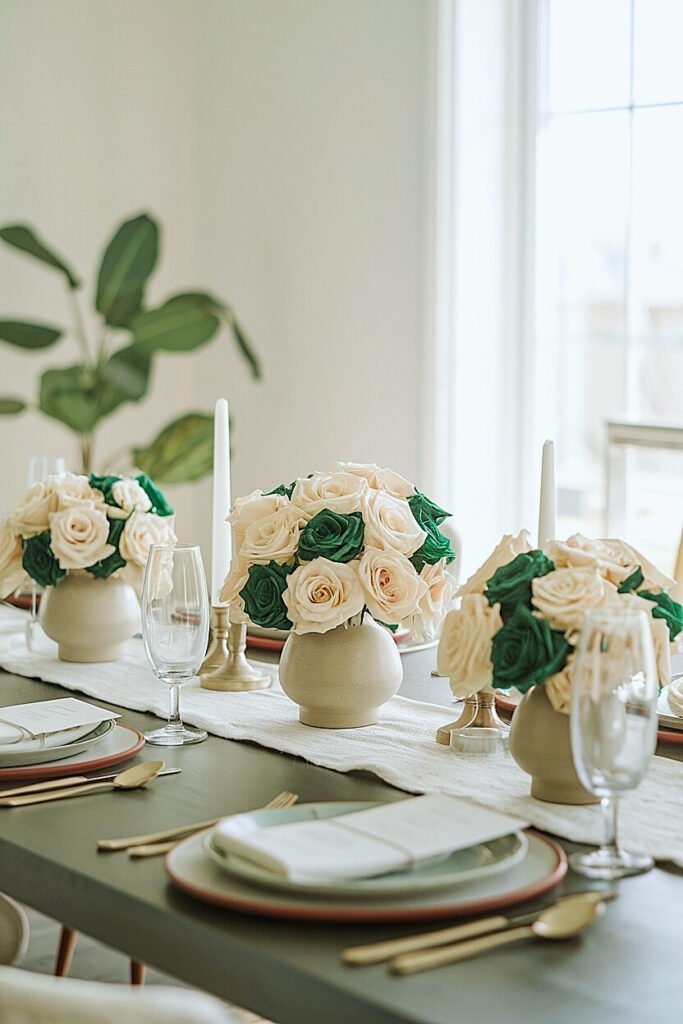
Long tables, the six-seaters, the extended dining surfaces, the banquet-style setups, demand different centerpiece thinking than compact rounds. Single arrangements look lost; proportions require horizontal emphasis that matches table geometry.
1. The Runner-Style Linear Arrangement
Build one long, narrow arrangement following your table’s central axis. Use a trough-style container or series of connected vessels spanning eighteen to thirty-six inches depending on table length. Fill with roses arranged low and continuous, creating a rose river down the table’s center. Maintain four-inch maximum height throughout.
2. The Triple Vessel Progression
Position three matching vessels in a row along table center. Fill each with identical arrangements, same roses, same heights, same styling. The repeated elements create rhythm while distributed placement ensures no guest sits far from flowers. Space vessels evenly for visual balance.
3. The Graduated Bookend Approach
Place larger arrangements at table ends, smaller arrangement at center. The bookend positioning frames the dining experience while center clearance remains maximum where most conversation crosses. This approach acknowledges table length without creating continuous obstruction.
4. The Scattered Individual Method
Distribute five to seven tiny arrangements, single roses in small vessels, along the table’s length. The scattered placement creates comprehensive coverage without any single obstruction point. Each guest sits near flowers while sightlines remain clear between pieces.
5. The Garland-With-Accents Technique
Run a low greenery garland along table center, positioning small rose clusters at intervals within the greenery. The garland provides continuous green, your St. Patrick’s reference, while roses at intervals add color punctuation. Keep overall height under three inches for this approach.
Read on for family-friendly approaches that survive real household conditions.
How to Make a Saint Patrick’s Day Dining Table Rose Centerpiece That’s Kid-and-Pet Friendly
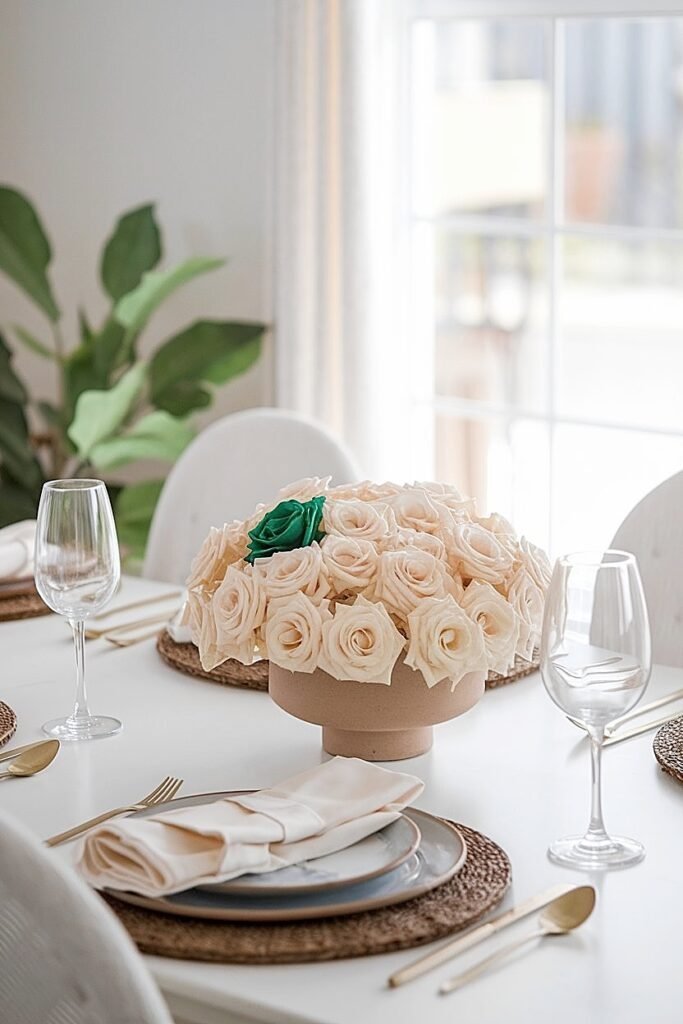
Families with children and pets require centerpiece approaches that survive reality, reaching hands, wagging tails, accidental bumps, general chaos. Elegant arrangements mean nothing if they spend St. Patrick’s dinner on the floor surrounded by broken glass and scattered petals.
Stability and durability trump fragility and delicacy in family environments.
Select heavy vessels with low centers of gravity. Wide bases resist tipping; substantial weight requires deliberate effort to move. Ceramic crocks outperform glass vases. Stoneware beats crystal. Add river rocks to vessel bottoms before water and flowers for additional ballast.
Position arrangements at table zones with minimal traffic, center works better than edges where reaching arms and passing serving dishes create collision opportunities. Keep arrangements compact with nothing extending beyond vessel edges, no trailing ribbons, no dangling greenery, no elements inviting curious hands. Consider using faux roses for the meal duration if real flowers create too much anxiety about water spills around children. Quality artificial blooms in appropriate colors achieve the same visual effect without liquid disaster potential.
The final section addresses shape selection for different table geometries.
What Are the Best Saint Patrick’s Day Dining Table Centerpiece Shapes: Round vs Long?
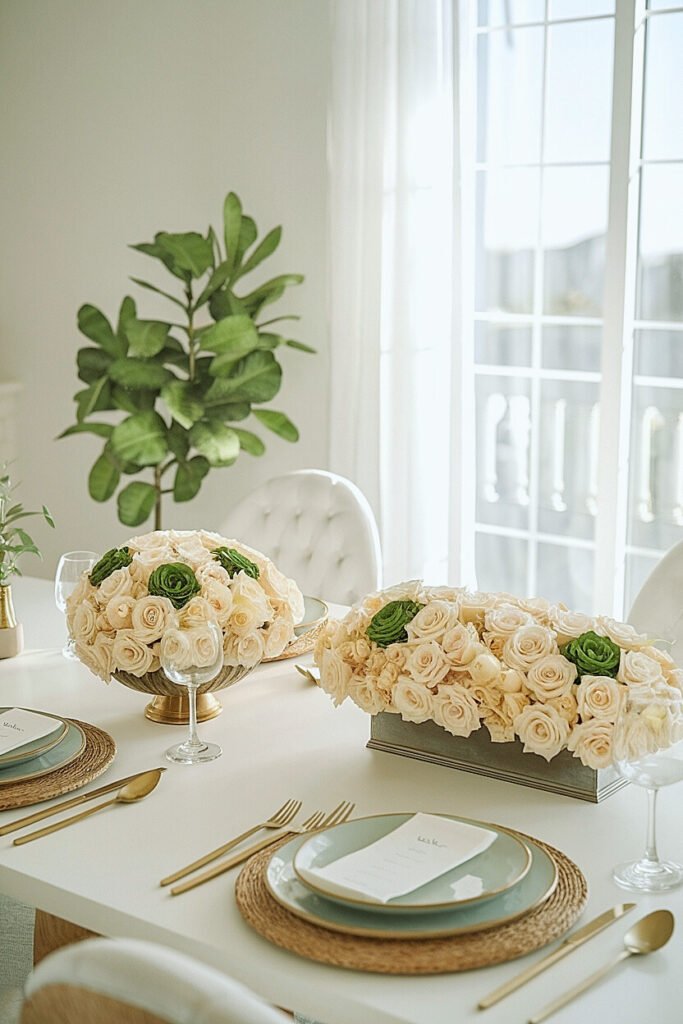
Centerpiece shape should respond to table shape. Mismatched geometries create visual tension that undermines otherwise beautiful arrangements. Understanding these relationships helps you select appropriate proportions before purchasing vessels or cutting stems.
1. Round Tables with Round Arrangements
Round tables suit round or dome-shaped centerpieces positioned at exact center. The matching geometry creates visual harmony, circular table, circular arrangement, eyes drawn naturally to the center. A low dome of cream roses in a round vessel achieves this perfectly.
2. Round Tables with Square Arrangements
Occasionally, square or rectangular arrangements on round tables create interesting contrast, but the shapes must be intentional and proportioned carefully. The geometric tension can read as sophisticated or awkward depending on scale. When in doubt, match round to round.
3. Long Tables with Linear Arrangements
Rectangular and oval tables benefit from elongated centerpiece shapes that follow table geometry. Runner-style arrangements, trough vessels, or multiple pieces arranged in a row honor the table’s horizontal emphasis. The matching proportions create visual flow along the table’s axis.
4. Long Tables with Clustered Rounds
Multiple round arrangements positioned along a long table’s center creates rhythm through repetition. Three identical domes spaced evenly combine round-arrangement beauty with long-table coverage. This approach bridges geometries successfully.
5. Square Tables with Contained Squares
Square tables, the four-person standards, suit compact arrangements that leave maximum surface for place settings. Small square vessels or tight round arrangements work equally well. The key is proportional restraint that acknowledges limited real estate.
Conclusion
Dining table centerpieces operate under constraints other surfaces don’t face. Food must share the table. Conversation must cross it. Guests must comfortably use it. St. Patrick’s rose displays that ignore these realities become beautiful obstacles rather than enhancements.
The minimal-green approaches throughout this guide, green as hint, emerald accents among cream, single green elements, proper height limits, shape matching, all serve the dining table’s true purpose: hosting shared meals where people connect. Your St. Patrick’s centerpiece succeeds when guests appreciate both the flowers and their dinner companions across the table. The restraint creates space for everything else to happen.
This website contains affiliate links, and some products are gifted by the brand to test. As an Amazon Associate, I earn from qualified purchases. Some of the content on this website was researched and created with the assistance of AI technology.