This website contains affiliate links, and some products are gifted by the brand to test. As an Amazon Associate, I earn from qualified purchases. Some of the content on this website was researched and created with the assistance of AI technology.
Key Takeaways
- Treating green as supporting accent rather than dominant color creates sophisticated St. Patrick’s displays
- Green roses work best as scattered accents among cream and white blooms, not as arrangement stars
- Gradient color blending from cream through soft emerald achieves holiday theme with elegant subtlety
- One intentional green textile establishes Irish connection without overwhelming neutral foundations
- Matte black and charcoal accents ground green touches, preventing the candy-colored effect of all-green schemes
- Single focal vases eliminate visual competition and create cleaner, more intentional mantel compositions
Styling Saint Patrick’s Day mantel rose display without overdoing green means unlearning everything the holiday retail aisle teaches. Walk through any store in early March and you’ll encounter assault-level green saturation, shamrock garlands, emerald banners, Kelly green everything screaming “Irish!” at maximum volume. I decorated my first St. Patrick’s mantels this way, layering green upon green until the fireplace looked like it was hosting a chlorophyll convention. Guests smiled politely. Nobody complimented. The display photographed poorly. Something was fundamentally wrong.
The correction came through observing genuinely elegant St. Patrick’s displays, the kind featured in design magazines rather than party supply catalogs. These sophisticated approaches used green sparingly, as accent rather than foundation. Roses in soft colors dominated; green appeared as whisper rather than shout. The Irish reference was unmistakable yet understated. These techniques create mantels that adults actually want in their living rooms, seasonal celebration without seasonal assault. Your fireplace deserves better than leprechaun-level decorating.
Not sure how to style your Saint Patrick’s Day mantel roses without going too green? Use this quick picker. Choose a base style, follow the rose-and-green recipe, add a simple room repeat on a table or counter, then run the safety and balance checks. It’s fast, realistic, and looks polished.
Saint Patrick’s Day Mantel Roses (Not Too Green) — Quick Style Picker
Desktop shows a full table. On phones, tap a row to expand.
| Mantel Base Style | Rose + Green Recipe | Room Repeat (Tables/Counters/Furniture) | Balance + Safety Checks |
|---|---|---|---|
| Neutral Anchor Calm, everyday look Best for most homes |
10–12 cream roses + 2 emerald roses + compact deep green foliage |
Coffee table: bud vase (2 cream roses) Sideboard: neutral tray + pottery bowl |
Keep greenery low Leave mantel edges clear Use a stable matte vase |
| Modern Dark Accent Black/charcoal grounding |
8–10 cream roses + 2 emerald roses + minimal foliage |
Console: black coaster + bud vase Counter: 1 cream rose in ceramic |
Limit green to 10–20% Use 1–2 dark anchors Keep spacing clean |
| White + Cream Bright, airy, soft |
10–14 cream roses + 1–2 emerald roses + tiny greenery sprigs |
Dining table: single bud vase Counter: small neutral tray only |
Don’t add extra green objects Let texture do the work Keep stems short |
| Two-Green Rule Controlled palette |
9–12 cream/blush roses + emerald roses only + one leaf type only |
Side table: 1 cream rose + 1 leaf Cart: neutral tray + pottery |
Avoid mixing greens Keep foliage consistent Edit anything “extra” |
| Texture-First Woven + stone depth |
10–12 cream roses + 2 emerald roses + very minimal foliage |
Coffee table: woven tray + bud vase Counter: stone bowl (neutral) |
Texture replaces “more color” Keep objects 3–5 total Maintain open space |
| Brass Warmth Softens emerald |
9–11 cream roses + 2 emerald roses + compact greenery |
Console: brass-toned coaster + bud vase Table: neutral bowl repeat |
Avoid shiny glare items Keep brass minimal Use matte containers |
| Small Mantel Compact + tidy |
6–8 cream roses + 1 emerald rose + tiny foliage only |
Side table: one bud vase Counter: nothing extra |
Short stems No crowding Keep functional surfaces clear |
| Family-Friendly Kid/pet practical |
Low, wide vase Short stems Mostly cream + 1 emerald |
Coffee table: tray only + small bud vase Sideboard: | Heavy base vase Pieces away from edges Nothing tiny + loose |
Neutral Anchor
Cream-forward roses • minimal emerald • tap to expand
⌄
Mantel Base Style
Neutral Anchor
Calm, everyday look
Best for most homes
Rose + Green Recipe
10–12 cream roses
+ 2 emerald roses
+ compact deep green foliage
Room Repeat
Coffee table: bud vase (2 cream roses)
Sideboard: neutral tray + pottery bowl
Balance + Safety
Keep greenery low
Leave edges clear
Use a stable matte vase
Modern Dark Accent
Black/charcoal anchors • controlled emerald • tap to expand
⌄
Mantel Base Style
Modern Dark Accent
Black/charcoal grounding
Rose + Green Recipe
8–10 cream roses
+ 2 emerald roses
+ minimal foliage
Room Repeat
Console: black coaster + bud vase
Counter: 1 cream rose in ceramic
Balance + Safety
Limit green to 10–20%
Use 1–2 dark anchors
Keep spacing clean
Two-Green Rule
Emerald + one leaf type only • tap to expand
⌄
Mantel Base Style
Two-Green Rule
Controlled palette
Rose + Green Recipe
9–12 cream/blush roses
+ emerald roses only
+ one leaf type only
Room Repeat
Side table: 1 cream rose + 1 leaf
Cart: neutral tray + pottery
Balance + Safety
Avoid mixing greens
Keep foliage consistent
Edit anything “extra”
Quick tip: If it starts feeling “too green,” remove foliage first—not roses.
How to Style a Saint Patrick’s Day Mantel Rose Display With “Green as a Side Note”
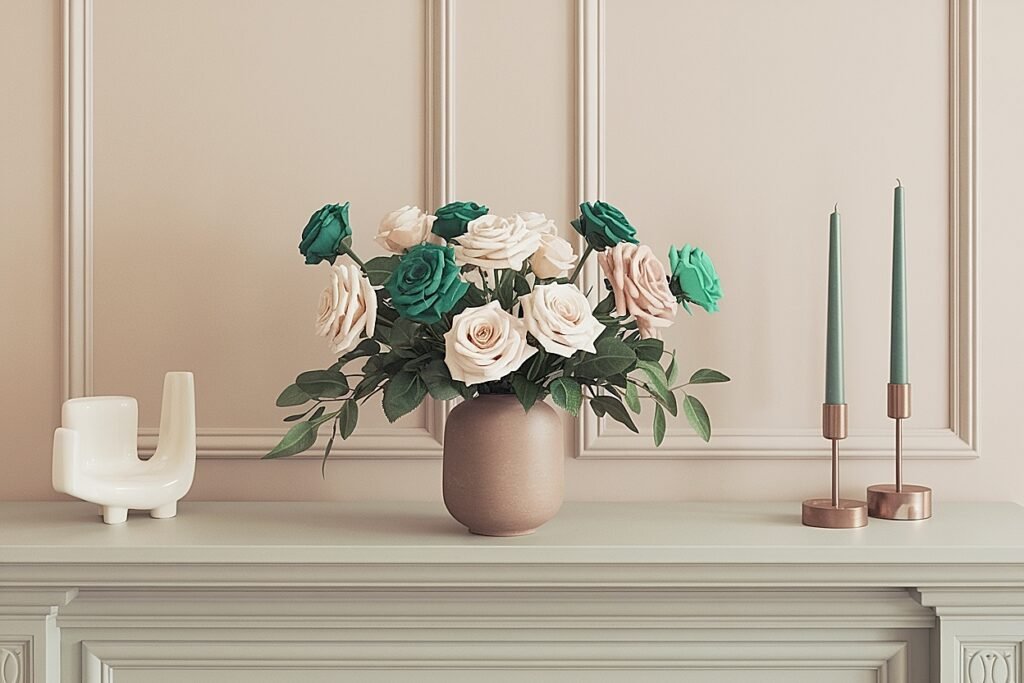
The “green as side note” philosophy treats Irish color as supporting player rather than leading role. Your roses carry the visual weight. Your neutral elements establish foundation. Green appears strategically, one vessel, one candle, one textile, communicating holiday intent without dominating the composition. This restraint feels confident rather than timid: you know one green touch suffices because the overall design works.
The approach requires intentionally limiting green inclusion rather than accidentally accumulating it.
Begin by styling your mantel as you would for any elegant occasion, neutral vessels, beautiful roses, coordinated candles, proportioned spacing. Create a display you genuinely admire regardless of holiday context. Only after achieving this baseline should you introduce your single green element. This sequence prevents green from becoming foundational; it remains additive.
Select your green side note carefully. One option: a sage-toned candle positioned beside your rose arrangement. Another: a small green decorative object at the mantel’s far end. A third: a subtle green ribbon wrapped around your neutral vessel. Whatever you choose, make it singular. The moment you add a second green element, you’ve promoted green from side note to supporting cast. Resist. The single touch communicates St. Patrick’s sufficiently while maintaining the sophisticated neutrality you established. For similar restraint principles applied elsewhere, explore these Saint Patrick’s Day stair landing decor ideas with roses that demonstrate green-as-accent throughout a home. Found this perspective refreshing? Share with friends battling green overload!
Continue reading for techniques using actual green roses as subtle accents.
Ways to Use Saint Patrick’s Day Green Roses as Accent Blooms, Not the Main Event
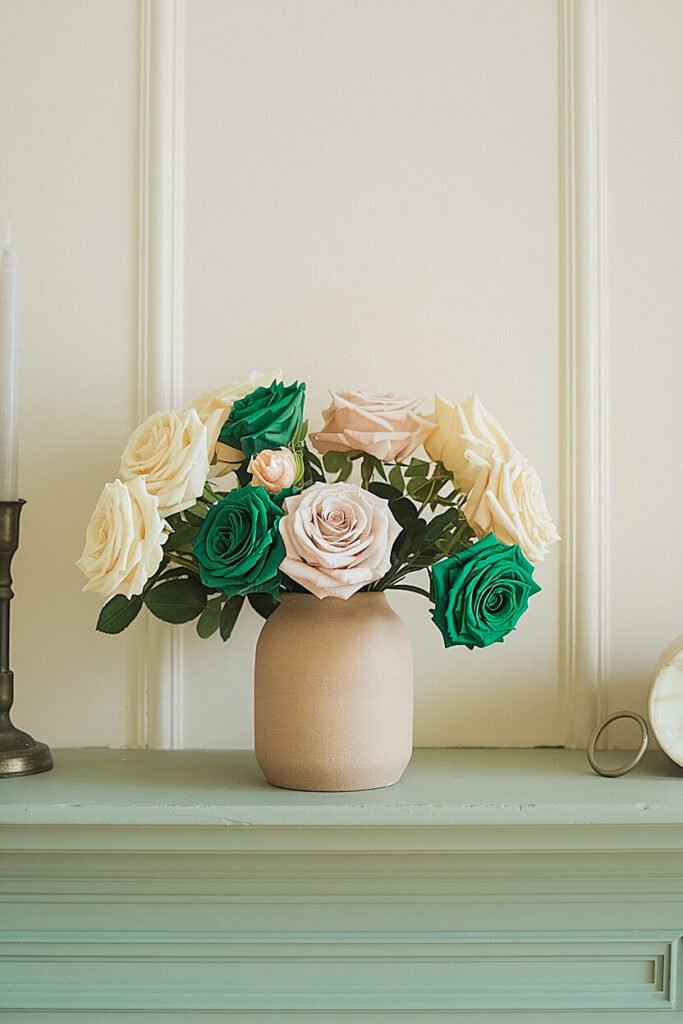
Green roses exist, pale sage varieties, chartreuse-tinged blooms, even florist-dyed emerald options. These can contribute to St. Patrick’s mantels beautifully when used as accents among other colors rather than as arrangement dominants. The key: scattering green roses sparingly throughout cream or white arrangements, treating them as punctuation rather than sentences.
1. The One-in-Five Ratio
For every five roses in your arrangement, include one green-toned bloom. This ratio ensures green presence without green dominance. The single green rose among four neutral companions reads as intentional accent rather than failed color matching. Position green blooms at varied heights throughout the arrangement.
2. The Perimeter Position
Place green roses exclusively at your arrangement’s outer edges, keeping the center and focal zones entirely cream or white. The peripheral green creates subtle frame effect while neutral roses command primary attention. Eyes land on cream; green registers as supporting detail.
3. The Graduated Cluster Approach
Group three green roses together at one arrangement section rather than scattering individually. The concentrated cluster creates intentional-looking color moment while remaining minority presence. Position the cluster off-center for asymmetrical interest.
4. The Single Statement Stem
Include exactly one green rose in an otherwise uniform cream arrangement. The singular green bloom becomes discovered treasure rather than color scheme, unexpected, delightful, subtly Irish without announcement.
5. The Bud Vase Separation
Rather than mixing green roses into your main arrangement, position one green rose in a separate small bud vase beside the primary display. The physical separation emphasizes the accent relationship while allowing green its own moment.
Read on for gradient color blending techniques that transition elegantly toward green.
Ideas for a Saint Patrick’s Day Mantel Rose Color Blend from Cream to Soft Emerald
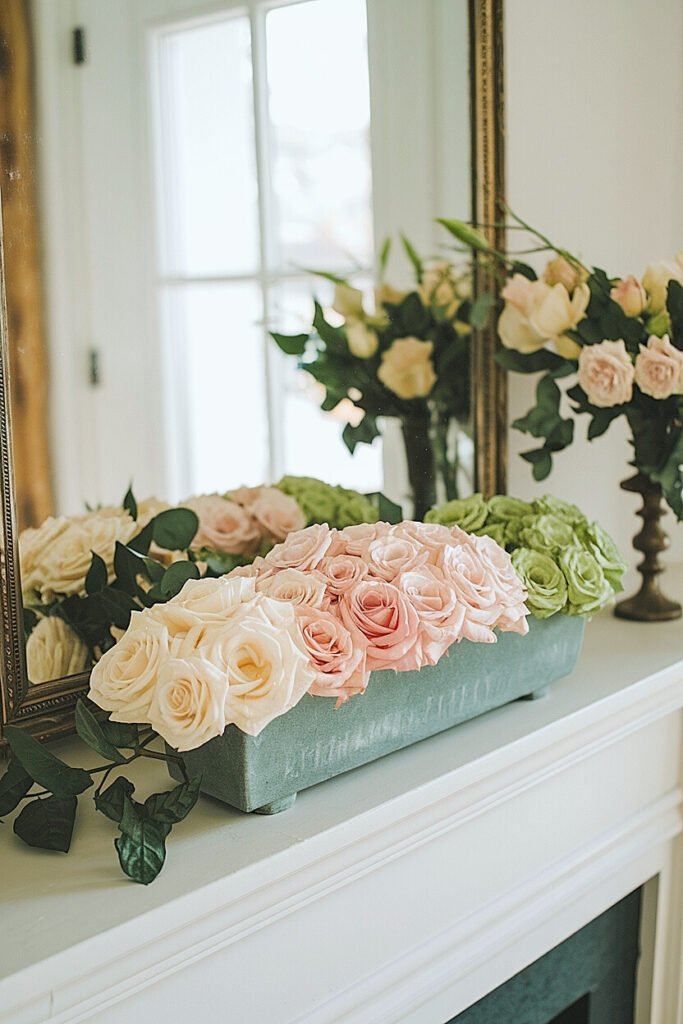
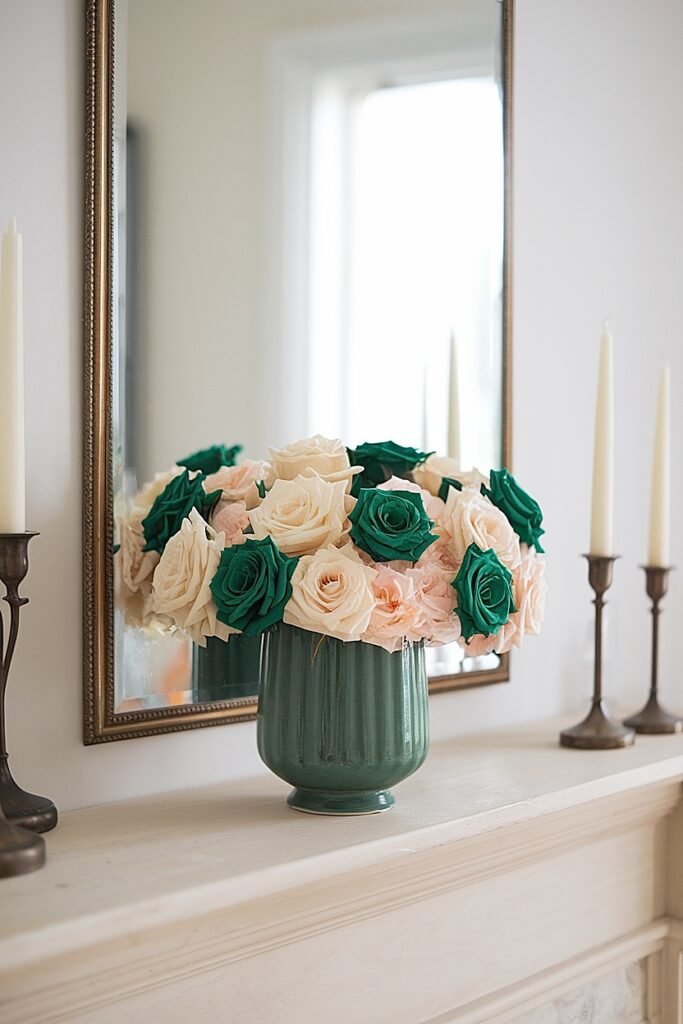
Gradient arrangements, transitioning smoothly from one color to another, create sophisticated displays that incorporate green without green dominance. Starting from cream and moving gradually toward soft emerald allows Irish color to appear as natural progression rather than interruption.
1. The Left-to-Right Gradient Flow
Arrange roses across your mantel so color transitions horizontally, pure cream at left, cream-with-hints-of-green at center, soft emerald at right. The flowing progression creates visual movement while each color zone remains distinct yet connected.
2. The Center-Out Radiation
Position your greenest roses at arrangement center, transitioning to cream at all edges. The green core surrounded by neutral creates focal point effect, eyes drawn to the Irish center, softened by cream perimeter.
3. The Multiple Vessel Progression
Use three vessels across your mantel, each holding progressively greener roses. Leftmost vessel: pure cream. Center vessel: cream mixed with pale green. Rightmost vessel: soft emerald dominant. The separated vessels make gradient more readable than single-container blending.
4. The Vertical Gradient Stack
In tall arrangements, position greenest roses at bottom, transitioning to cream at top. The grounded green rising toward neutral cream creates interesting visual weight, earthy base, airy crown.
5. The Subtle Undertone Approach
Select cream roses with slight green undertones rather than pure white or yellow-cream. The inherent green suggestion throughout creates cohesive St. Patrick’s reference without any strongly green blooms. The subtlety requires close inspection to appreciate.
The following section demonstrates single-textile approaches to green incorporation.
Ways to Style a Saint Patrick’s Day Mantel Rose Display with One Green Textile Only
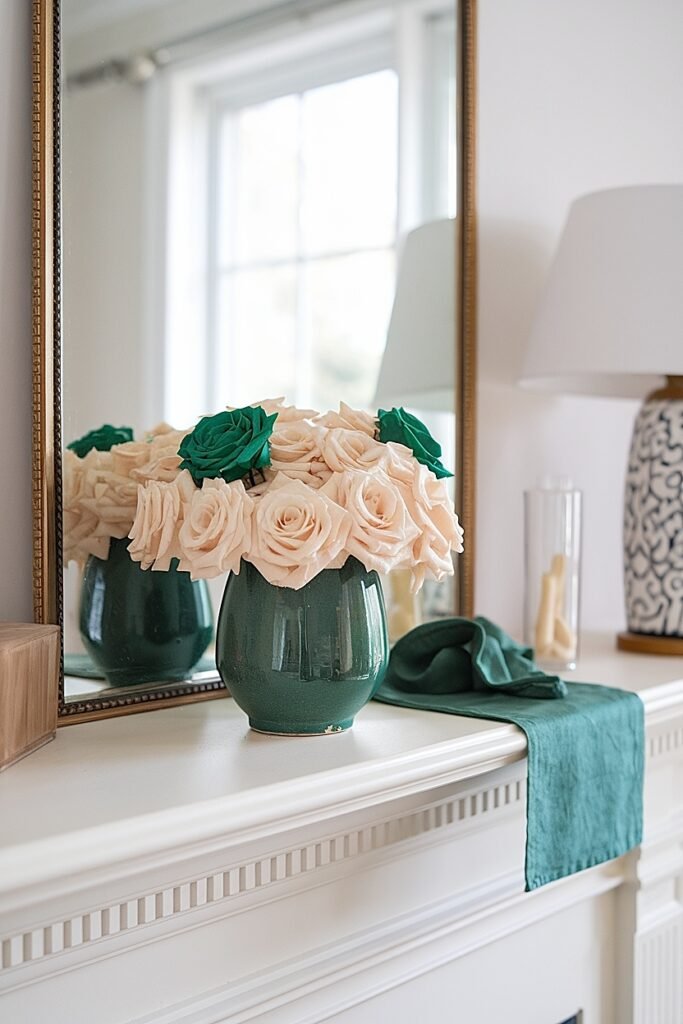
Textiles establish color foundation before any arrangements are placed. One green textile, a runner, a cloth, a ribbon, communicates Irish intent while allowing roses and accessories to remain entirely neutral. The single textile carries the full holiday burden, freeing everything else from green obligation.
1. The Runner Foundation Method
Place a soft green linen runner across your mantel’s center section. Position neutral rose arrangements and cream candles atop this green foundation. The textile beneath everything establishes St. Patrick’s context while items sitting on it remain elegantly neutral. The green shows around arrangement edges, framing without competing.
2. The Vessel Wrap Technique
Wrap one neutral vessel with green ribbon, leaving other elements untouched. The wrapped vessel becomes the sole green carrier while roses inside and accessories beside stay cream, white, or natural tones. The contained green feels intentional rather than scattered.
3. The Backdrop Drape Approach
Drape soft green fabric behind your mantel arrangement, hanging from the wall or leaning against the backdrop. The green sits behind everything, visible but recessed. Roses and accessories in front remain neutral while the green backdrop establishes atmospheric context.
Continue reading for techniques balancing roses with darker accent colors.
How to Balance Saint Patrick’s Day Mantel Roses with Matte Black or Charcoal Decor
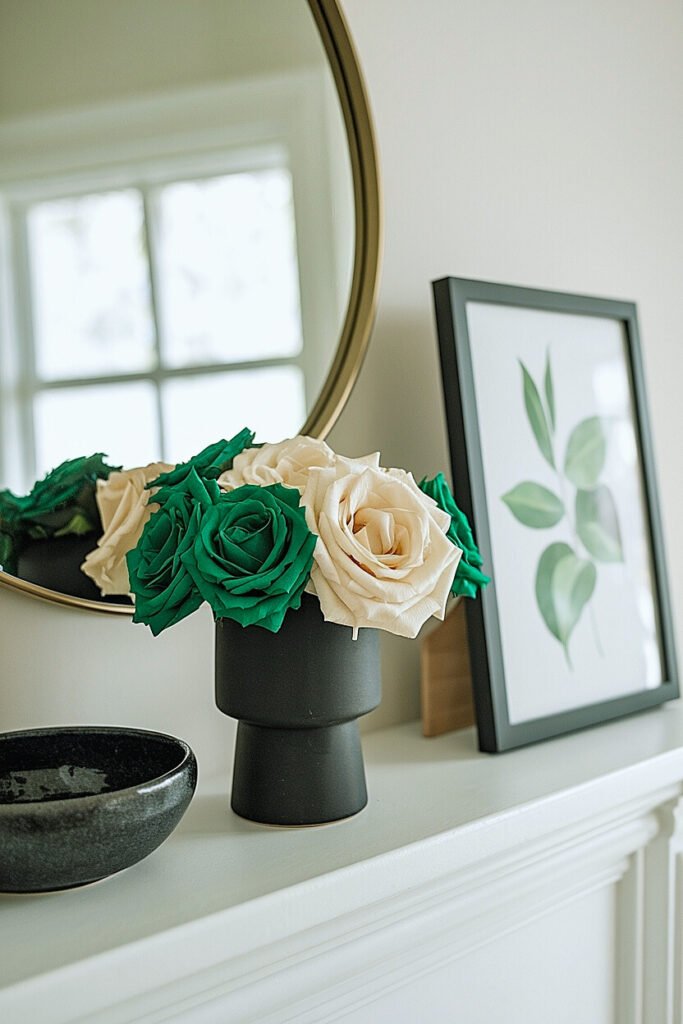
Dark neutrals, matte black, charcoal gray, deep bronze, provide sophisticated grounding that prevents St. Patrick’s displays from feeling candy-colored or juvenile. The darkness absorbs and anchors green touches, creating contrast that elevates rather than competes. This approach suits modern and traditional mantels alike.
Dark accents create visual weight that light-only palettes lack.
Without darker elements, cream roses and green accents can float together indistinctly, everything pale, nothing grounded. Introducing matte black candleholders, charcoal frames, or bronze vessels provides anchoring contrast. The dark elements don’t compete with green; they complement it through opposition, making both colors more visible and intentional.
Position dark accents strategically rather than uniformly. A pair of matte black candleholders flanking your rose arrangement. A charcoal frame at one mantel end. A bronze vessel holding greenery opposite the roses. The dark elements create visual punctuation, stopping points that organize the eye’s journey across your mantel. The green and cream elements between dark anchors feel contained and composed rather than randomly scattered. The sophistication comes from this organizational contrast, not from any single element alone.
Below, discover approaches using predominantly white and cream palettes.
Ideas for a Saint Patrick’s Day Mantel Rose Display Using Mostly White + Cream Decor
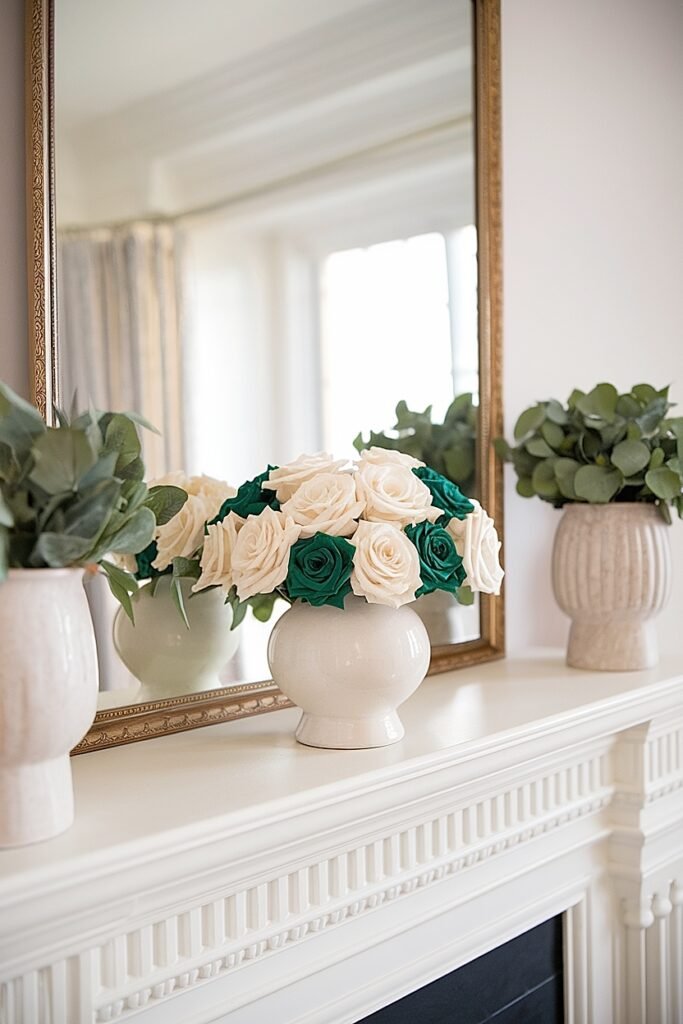
White and cream dominance creates serene mantels where any green, however minimal, registers distinctly. The pale foundation functions like blank canvas, allowing one green touch to communicate St. Patrick’s intent without visual competition. This approach suits homeowners who want holiday acknowledgment without seasonal disruption to existing neutral décor.
1. The All-White-Plus-One Approach
Style your entire mantel in white and cream, white roses, cream candles, ivory frames, pale vessels, then add exactly one green element. A single sage candle. One emerald vase. A small green decorative object. The solitary green against uniform paleness commands appropriate attention without effort. The contrast does the work.
2. The Textured Whites Foundation
Build visual interest through white texture variety rather than color variety. Combine glossy white ceramics with matte cream stoneware with woven white baskets. The textural richness prevents monotony while maintaining pale palette. Add green as minimal accent, perhaps just greenery in your rose arrangement, against this textured white foundation.
3. The Cream Gradient with Green Whisper
Use multiple cream shades, ivory, ecru, champagne, warm white, creating subtle gradient effect. Position these variations thoughtfully across your mantel. Add one barely-green element: a sage-tinted candle, a celadon vessel, roses with green undertones. The green whisper against cream gradient creates sophisticated St. Patrick’s reference.
Read on for single-vase focal point techniques that simplify mantel composition.
How to Build a Saint Patrick’s Day Mantel Rose Display Around a Single Focal Vase
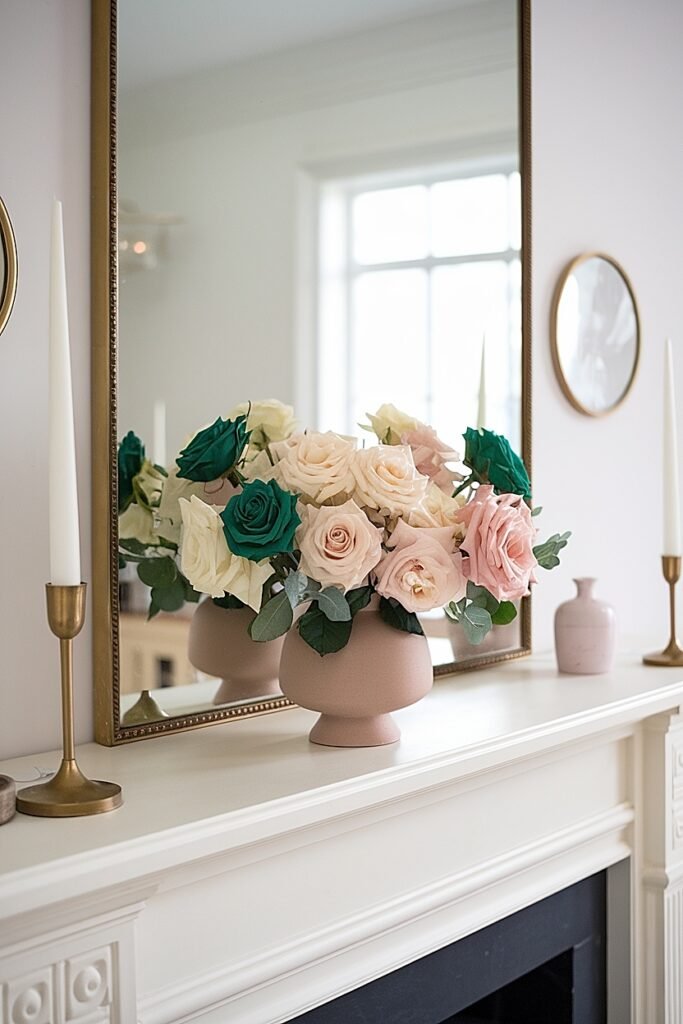
Single-vase displays eliminate the complexity that multi-element arrangements introduce. One substantial vessel, one generous arrangement, positioned intentionally, this focused approach often outperforms scattered collections of smaller pieces. The confidence of singular statement reads as sophistication rather than minimalism.
The single-vase approach requires selecting that vase with particular care.
Choose a vessel substantial enough to justify solitary status. Twelve inches tall minimum for most mantel proportions. The material and color should relate to your St. Patrick’s intent without overwhelming: a sage ceramic, a neutral stoneware with green undertones, a cream vessel that will hold green-accented roses. Avoid bright Kelly green, the single vase becomes too demanding. Subtle green or green-complementing neutrals work better.
Position the vase slightly off-center on your mantel for asymmetrical interest. Fill generously with roses, this display succeeds through abundance rather than restraint at the bloom level. Mix cream roses with minimal green accents, or use all-cream roses if the vessel provides sufficient green reference. Add nothing else unless absolutely necessary: perhaps one candle pair, perhaps nothing. The single vase carries the entire mantel, and it can. Trust the simplicity. The negative space around your focal arrangement becomes part of the design.
The final section addresses greenery control for jungle-free results.
Ways to Use Saint Patrick’s Day Greenery Without Turning the Mantel into a Jungle
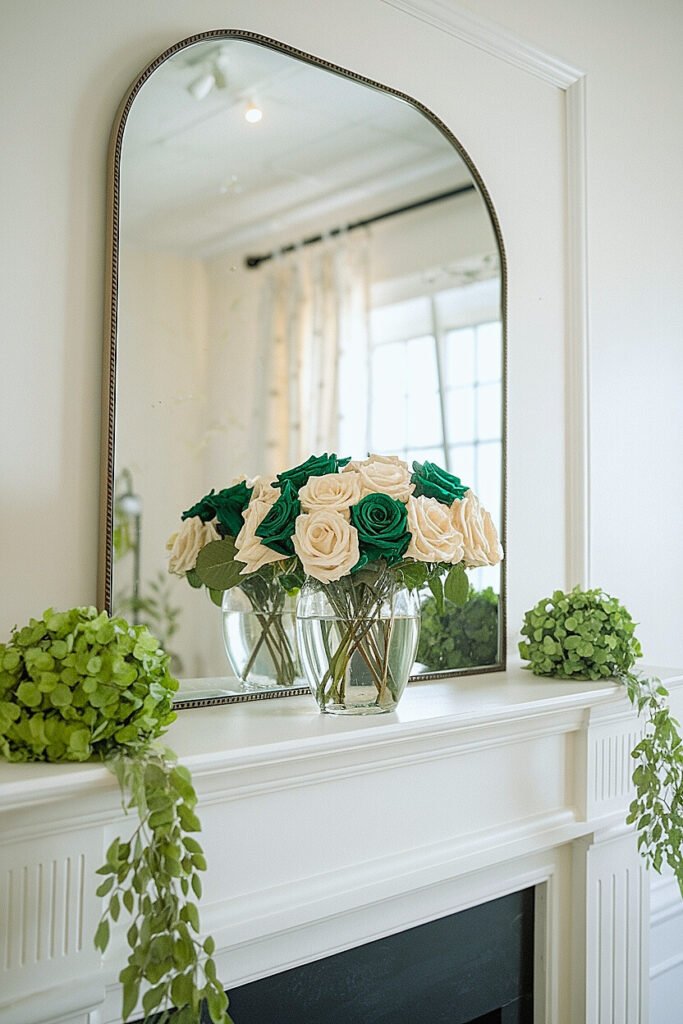
Greenery, eucalyptus, fern, ivy, ruscus, contributes to St. Patrick’s mantels naturally. But greenery enthusiasm easily overwhelms, transforming sophisticated displays into overgrown tangles. Controlled greenery use enhances roses; uncontrolled greenery buries them.
1. The Contained Cascade Method
Allow greenery to cascade from one arrangement section only, keeping other areas clean. The controlled cascade creates movement without chaos. Position trailing elements to flow in one direction, over the mantel’s front edge at one end, perhaps, rather than spilling everywhere indiscriminately. The discipline reads as intentional.
2. The Tucked-Under Technique
Insert greenery beneath and around roses rather than extending beyond them. The greenery provides foundational texture visible between blooms but doesn’t escape arrangement boundaries. The contained approach keeps roses as primary focus while greenery supports invisibly from below.
3. The Single-Species Restriction
Choose one greenery type rather than mixing multiple varieties. Eucalyptus alone. Italian ruscus alone. The single species creates cohesive character that multiple greenery types fragment. The restriction prevents the botanical-garden effect that mixed greenery produces, keeping your mantel feeling curated rather than collected.
Conclusion
St. Patrick’s Day mantel decorating without green overload requires treating Irish color as accent rather than foundation. The techniques throughout this guide, green as side note, accent blooms, textile singles, dark anchors, white dominance, single vases, controlled greenery, all share one philosophy: restraint communicates sophistication that saturation never achieves.
These approaches emerged from correcting my own, green-saturated early attempts. The discovery that one green element suffices. The realization that cream roses need no competition from aggressive color schemes. The understanding that sophisticated holiday displays acknowledge rather than announce. Your St. Patrick’s mantel will stand out precisely because it doesn’t try so hard, the elegant restraint itself becomes the statement worth noticing.
This website contains affiliate links, and some products are gifted by the brand to test. As an Amazon Associate, I earn from qualified purchases. Some of the content on this website was researched and created with the assistance of AI technology.