This website contains affiliate links, and some products are gifted by the brand to test. As an Amazon Associate, I earn from qualified purchases. Some of the content on this website was researched and created with the assistance of AI technology.
Key Takeaways
- Expensive-looking centerpieces come from abundant roses in quality vessels, not complicated techniques
- Bold party tables handle stronger green tones than everyday dining, embrace emerald and chartreuse
- Kitchen island centerpieces must survive heavy traffic while remaining visually impactful from all angles
- Buffet table arrangements need height variation and positioning that doesn’t interfere with food service
- Gold accents work when kept matte, aged, or subtle, shiny bright gold reads as costume jewelry
- Small party tables benefit from compact, heavy arrangements that survive bumping and crowding
Styling Saint Patrick’s Day party rose centerpiece ideas transforms ordinary gatherings into memorable celebrations that guests photograph and discuss for weeks. I’ve hosted enough March 17th parties to recognize the difference between centerpieces that elevate events and those that merely occupy table space. The forgettable arrangements shared common traits: sparse roses, generic containers, obvious store-bought styling. The memorable ones looked abundant, intentional, and somehow more expensive than their actual cost, achieved through techniques that have nothing to do with budget and everything to do with approach.
Party centerpieces operate under different rules than everyday displays. They must photograph well from multiple angles. They must survive hours of activity, bumping, and occasional drink splashes. They must scale appropriately for gathering-sized tables rather than intimate dining. They must look festive without becoming tacky, a particular challenge with St. Patrick’s Day’s inherent kitsch tendencies. These techniques create rose centerpieces that rise above drugstore shamrock territory while genuinely celebrating Irish heritage through beauty rather than cliché.
Not sure what centerpiece fits your party setup? Use this quick picker. Match your surface (table, island, buffet, bar cart) with the best rose + green combo, the right container shape, and simple steps that keep everything low, lush, and guest-friendly.
Pick your surface, follow the steps, and repeat the look with mini versions on counters or side tables for a whole-home party vibe.
How to Build a Saint Patrick’s Day Party Rose Centerpiece That Looks Expensive
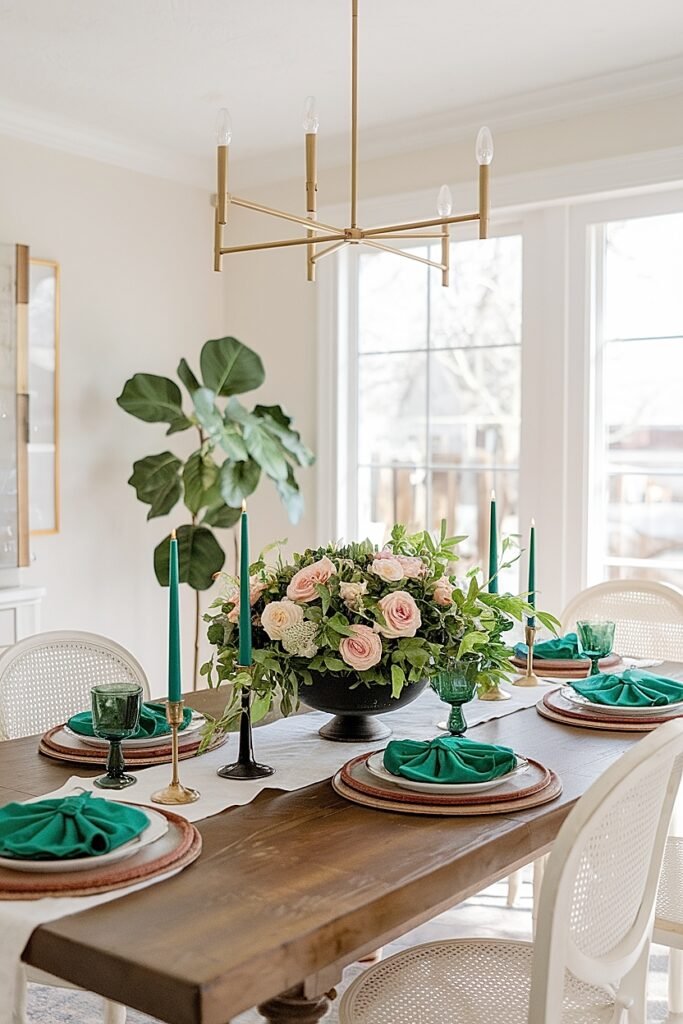
Expensive-looking arrangements share characteristics regardless of actual cost: abundant roses packed tightly, quality vessels with visual weight, intentional color coordination, and confident scale. The inverse, sparse roses, flimsy containers, random colors, timid proportions, reads as budget-constrained regardless of money spent.
The secret lies in concentration rather than elaboration.
Purchase more roses than you think necessary, then pack them tightly rather than spreading thin. Twenty roses in one substantial vessel look more expensive than forty roses scattered across multiple small containers. The density creates perceived luxury that sparseness can never achieve. Buy grocery store roses, quality varies but pricing allows abundance that florist quantities can’t match.
Select one substantial vessel rather than multiple modest ones. A single large ceramic crock, a generous glass cylinder, a weighty metal urn. The vessel’s quality and scale contribute significantly to expensive appearance. Green vessels in emerald or sage tones establish St. Patrick’s connection while avoiding the kelly-green cheapness of party store containers. Fill your chosen vessel completely, roses should touch each other, heads forming continuous coverage without visible gaps or stem exposure. This abundance reads as luxury regardless of actual investment. For apartment-friendly approaches using similar principles at smaller scale, explore these Saint Patrick’s Day small apartment rose decor ideas with tiny green accents that apply the same quality-over-quantity philosophy. Planning your party? Share this post with co-hosts!
Continue reading for color combinations that command attention on bold party tables.
What Are the Best Saint Patrick’s Day Rose Colors for a Bold Party Table?
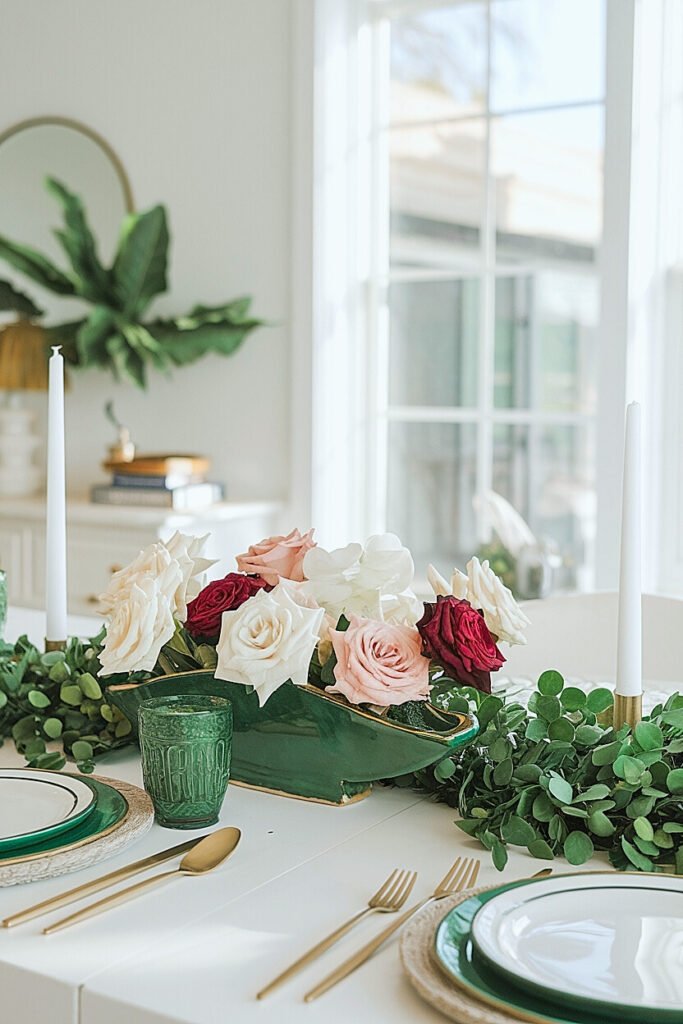
Party tables handle stronger colors than everyday settings. The festive context, the multiple guests, the celebratory atmosphere, all support bolder choices that might overwhelm quiet daily spaces. St. Patrick’s Day specifically invites green tones that calmer occasions wouldn’t accommodate.
1. Deep Emerald Roses
Florist-dyed deep emerald roses make unapologetic St. Patrick’s statements impossible with neutral blooms. The saturated green reads as celebration rather than everyday décor. Combine with cream roses to soften the intensity, or embrace full emerald commitment for maximum party impact.
2. Chartreuse and Cream Combination
Yellow-green chartreuse roses mixed with cream create vibrant energy that photographs beautifully. The unexpected chartreuse tone distinguishes your party from predictable emerald schemes while maintaining clear Irish color connection.
3. White Roses with Green-Edged Petals
Certain rose varieties feature white petals with subtle green edges, natural color variation rather than florist dyeing. These sophisticated blooms provide Irish reference through delicate detail rather than overwhelming saturation.
4. Coral and Cream Warmth
Coral roses mixed with cream create warm energy that complements green serving ware or table runners. The coral provides party-worthy vibrancy while cream roses connect to Irish themes through neutral elegance.
5. Dusty Rose with Sage Greenery
Muted dusty rose tones paired with abundant sage eucalyptus create sophisticated palettes that read as St. Patrick’s through greenery rather than rose color. The combination suits adult parties seeking festive elegance over holiday kitsch.
Read on for kitchen island centerpiece strategies designed for party conditions.
Ideas for a Saint Patrick’s Day Party Rose Centerpiece on a Kitchen Island
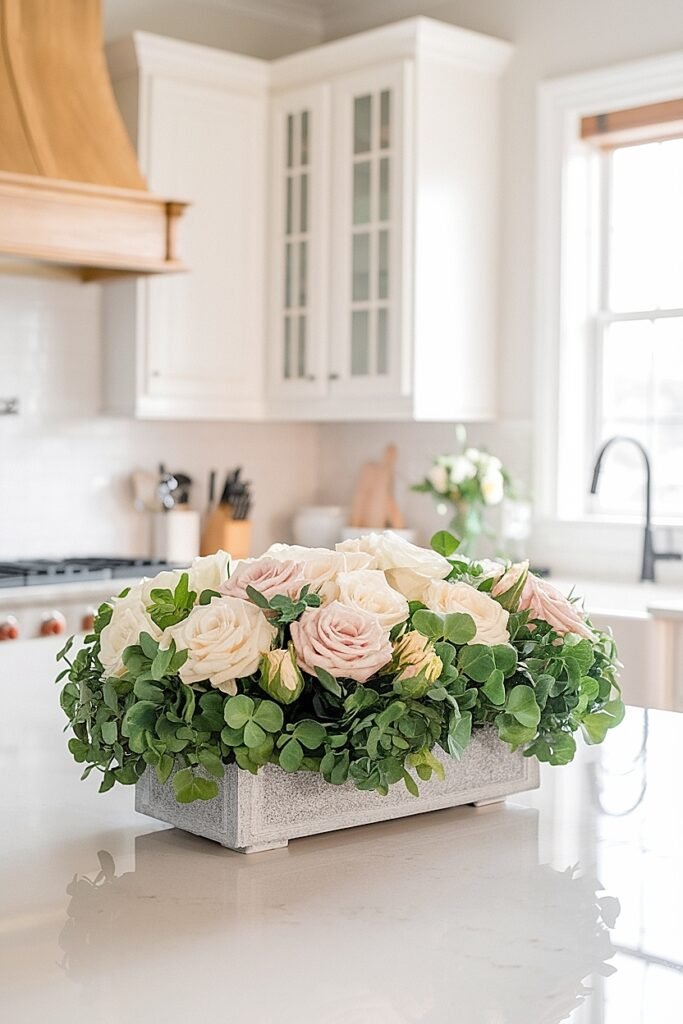
Kitchen islands anchor parties, guests congregate around them, food staging happens there, drink refills occur nearby. Centerpieces must survive this heavy traffic while commanding attention from all approach angles. Island arrangements differ significantly from dining table pieces designed for seated viewing.
1. The 360-Degree Dome
Build a dome-shaped arrangement visible equally from all sides. No front, no back, the island’s central position means guests approach from every direction. The spherical profile ensures beauty regardless of viewing angle.
2. The Elevated Pedestal Display
Position roses on a footed pedestal or cake stand, raising the arrangement above food staging traffic. The elevation creates drama while protecting flowers from serving plate shuffles and appetizer platters.
3. The Linear Runner Style
For rectangular islands, create a long, low runner-style arrangement following the island’s length. The horizontal emphasis honors island geometry while keeping height low enough for conversation across the surface.
4. The Contained Tray Vignette
Build your rose display on a handled tray that can relocate when the island needs full function for food service. The mobility makes ambitious decorating compatible with practical party needs.
5. The Multiple-Vessel Cluster
Group three to five small arrangements in a cluster rather than one large piece. The distribution creates visual interest while individual vessels can shift positions as party needs change.
Continue reading for buffet table approaches that support food service.
Ways to Make a Saint Patrick’s Day Party Rose Centerpiece for a Buffet Table
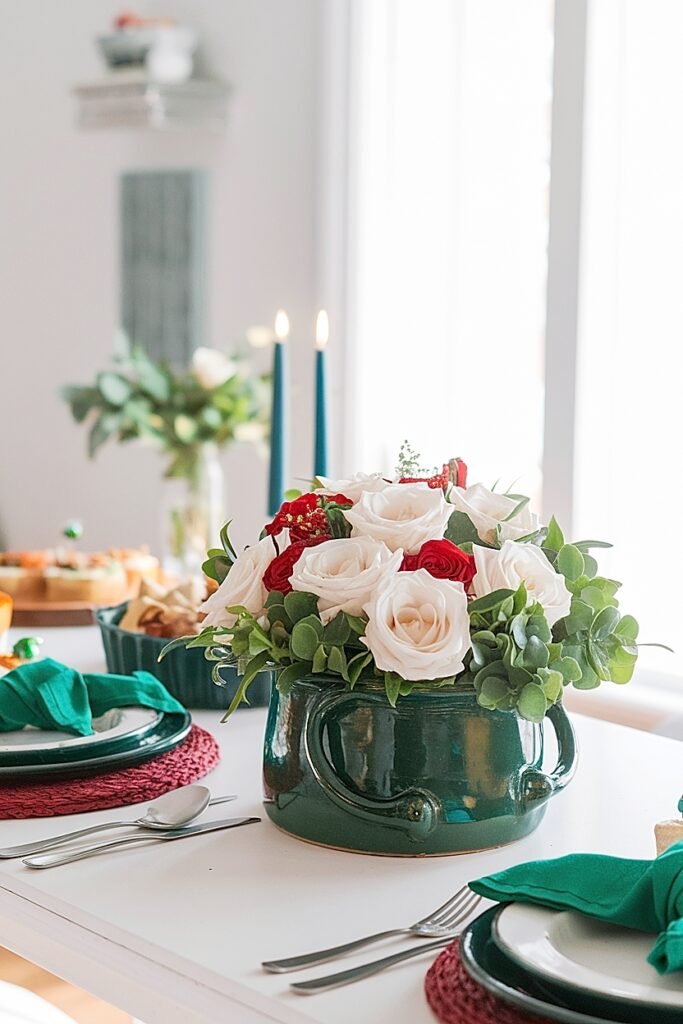
Buffet tables serve food, their primary purpose determines centerpiece positioning, height, and stability requirements. Roses must enhance without interfering with serving, reaching, or plate loading. The centerpiece supports rather than dominates.
1. The End-Table Anchor
Position your arrangement at one buffet end rather than center. The end placement keeps serving areas completely clear while roses anchor the line’s starting or ending point. Guests see the arrangement upon approach; serving pathway stays unobstructed.
2. The Elevated Background Display
Place roses on a tall riser or pedestal at buffet back, behind serving dishes. The elevated position creates dramatic backdrop while keeping table surface available for food. Eyes find the roses; hands find the food without interference.
3. The Floating Above Technique
Suspend or wall-mount arrangements above the buffet rather than competing for table surface. This overhead approach claims no serving real estate while providing substantial visual impact at standing eye level.
4. The Bookend Frame Method
Position matching arrangements at both buffet ends, framing the food spread between them. The paired placement creates visual boundaries while leaving the entire center section for serving dishes.
5. The Integrated Food-and-Flower Runner
Weave low roses among serving dishes along the buffet’s length, integrating flowers into the food presentation rather than separating them. The combined approach requires very low arrangements, under four inches, that don’t interfere with serving access.
The following section addresses conversation-friendly height limits.
How to Keep a Saint Patrick’s Day Party Rose Centerpiece Low for Easy Conversation
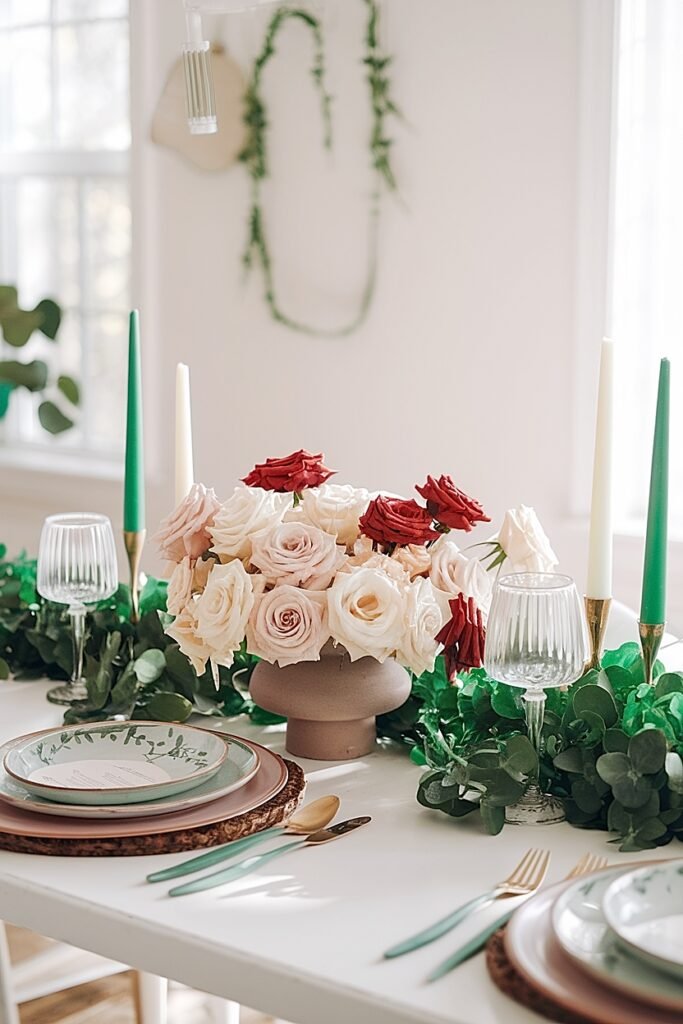
Party conversation happens across tables, and tall centerpieces create barriers between guests. People shouldn’t peer around roses to engage with others, the arrangement must stay below conversational sightlines while maintaining visual presence worth photographing.
Height limits depend on seating arrangements and table purposes.
For seated dinner parties, arrangements must stay under eight inches, ideally under six. This clearance allows seated guests to see each other comfortably across standard table heights. For cocktail parties with standing guests, slightly taller arrangements work since eye levels are higher.
Build low by cutting stems aggressively. Roses cut to four or five inches total create compact domes that concentrate beauty within modest vertical space. Use wide, shallow containers that encourage horizontal spreading rather than vertical building. Test your final arrangement from seated position before the party, if any roses obstruct your view of someone opposite, cut more aggressively. The tight, low construction actually looks more luxurious than sparse tall arrangements. The concentration creates perceived abundance within height constraints guests will appreciate.
Below, discover gold accent techniques that avoid costume-party cheapness.
Ways to Add Gold Accents to a Saint Patrick’s Day Rose Centerpiece (Without Looking Cheesy)
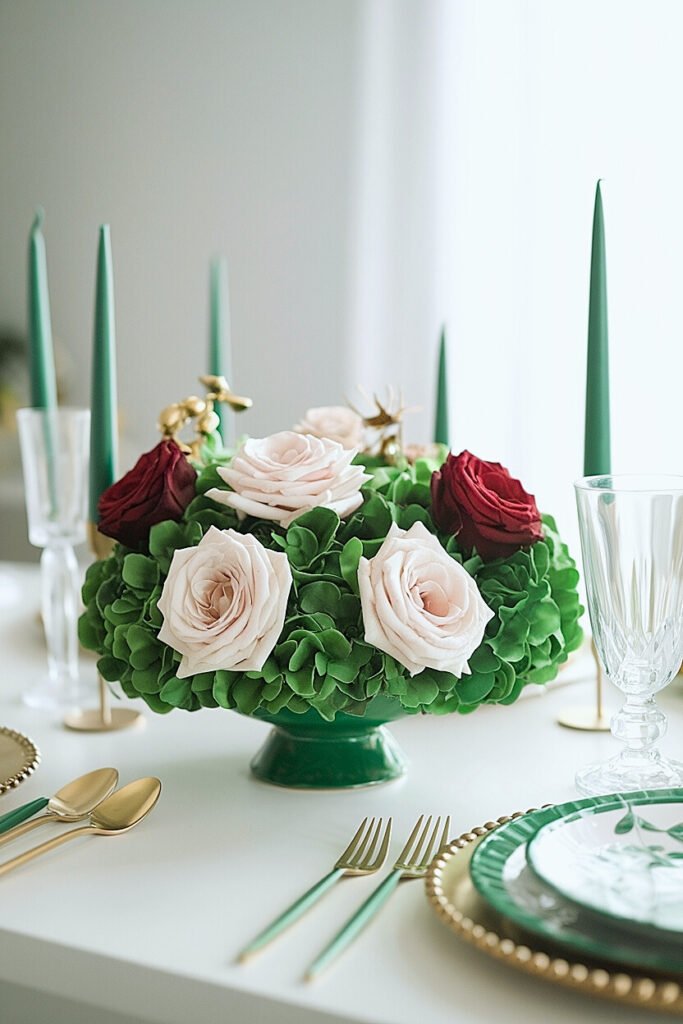
Gold and green connect to St. Patrick’s Day through leprechaun and pot-of-gold associations. This connection makes gold accents risky, too bright, too shiny, or too obvious creates party-store kitsch rather than sophisticated celebration. The key: gold that reads as aged, matte, or subtle rather than glittery.
1. The Aged Brass Vessel Approach
Use containers in aged brass, antique bronze, or patinated gold tones rather than bright shiny gold. The weathered quality adds sophistication that new-looking gold lacks. Vintage brass cachepots, antique bronze urns, or matte gold ceramic all work beautifully. The aged quality suggests heirloom rather than party store.
2. The Gold-Rimmed Glass Technique
Choose glass vessels with subtle gold rims rather than all-over gold finish. The restraint communicates elegance, just enough gold to establish connection without overwhelming. Gold-rimmed hurricane glasses, gold-edged bowls, or subtle gilt detailing all achieve sophisticated holiday reference.
3. The Scattered Gold Accent Method
Add gold through tiny scattered elements rather than primary vessels: gold-painted leaves tucked among roses, small gold decorative objects beside arrangements, gold ribbon as minimal accent. The small scale prevents gold from dominating while Irish associations register clearly.
How to Use Saint Patrick’s Day Roses to Style a Round Dining Table Centerpiece
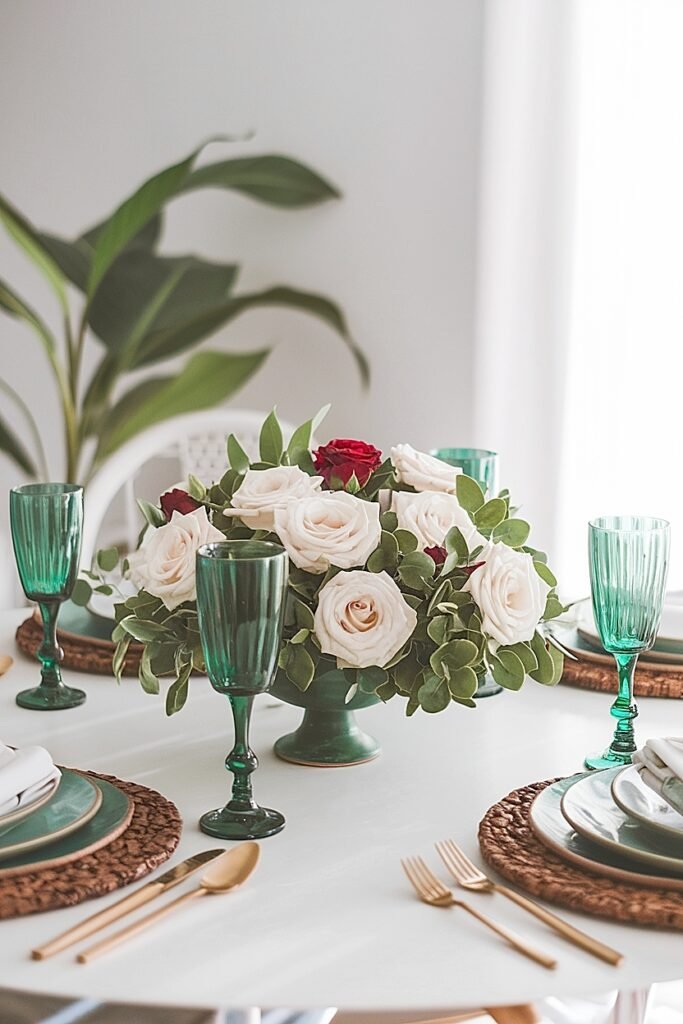
Round tables demand centered arrangements visible equally from every seated position. The table’s geometry eliminates front-and-back thinking, every guest sees the same perspective, requiring symmetrical or dome-shaped designs that perform from all angles.
Round centerpieces benefit from circular symmetry that honors table shape.
Select a round vessel that echoes the table’s geometry. The shape coordination creates visual harmony, circular table, circular container, circular arrangement profile. The matching proportions feel intentional rather than random.
Build your arrangement as a dome or sphere, with roses graduated from center peak to lower perimeter. Work in rotation, turning the arrangement as you build to ensure equal coverage from all angles. Test by walking around the table during construction, each position should reveal approximately equal beauty. Position the completed arrangement at exact table center, equidistant from all place settings. For St. Patrick’s, add one green accent, a green candle beside the roses, a green napkin beneath the vessel, visible equally from all seated positions. The single accent communicates holiday intent; the roses carry the beauty.
The final section addresses small party table challenges.
What Are the Best Saint Patrick’s Day Party Rose Centerpieces for Small Tables?
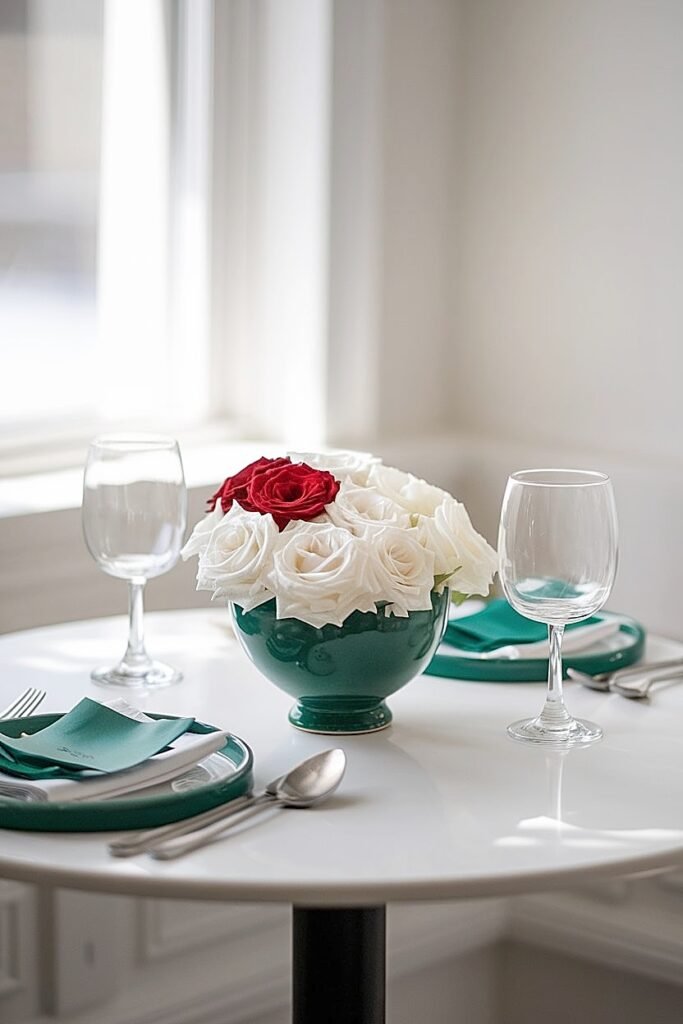
Cocktail tables, card tables, and compact rounds used during parties can’t accommodate standard centerpiece proportions. These surfaces serve drinks and small plates while hosting elbow-to-elbow conversations. Centerpieces must be stable, compact, and positioned to survive bumping and crowding.
1. The Weighted Bud Vase Cluster
Group three small weighted bud vases holding one to two roses each. The cluster creates presence while individual vessels remain stable against accidental contact. Choose heavy glass or ceramic that won’t tip from casual bumps. Position the cluster off-center, leaving surface for guests’ drinks.
2. The Single Low Bowl Statement
One wide, shallow bowl filled with tightly-packed rose heads creates substantial visual impact within minimal footprint. The low profile stays below drink-raising sightlines while the concentrated roses command attention. The bowl’s weight resists tipping from party activity.
3. The Floating Head Display
Float rose heads in a heavy, shallow bowl of water. The horizontal presentation creates beauty within extreme low height, under three inches. Add a floating candle for evening parties. The weight of water plus bowl prevents tipping.
4. The Tiered Mini Approach
Use a small tiered server, typically for desserts, with a tiny rose arrangement on the top tier. The vertical structure claims minimal footprint while achieving presence through height. The heavy base provides stability.
5. The Edge-Mounted Alternative
Attach a small vessel to the table’s outer edge using removable mounting, removing the centerpiece from tabletop surface entirely. The roses remain present but occupy zero functional space. This approach suits the smallest cocktail tables where every inch matters.
Conclusion
St. Patrick’s Day party centerpieces succeed when they photograph well, survive party conditions, and communicate Irish celebration without descending into kitsch. The techniques throughout this guide, abundance over sparseness, strategic positioning, height control, sophisticated color choices, thoughtful gold incorporation, all serve the goal of creating arrangements your guests will remember and compliment.
These approaches emerged from hosting countless March 17th gatherings, learning which centerpieces drew admiration and which merely occupied space. The expensive-looking arrangements weren’t actually expensive, they concentrated resources intentionally rather than spreading thin. Your St. Patrick’s party deserves roses that rise to the occasion.
This website contains affiliate links, and some products are gifted by the brand to test. As an Amazon Associate, I earn from qualified purchases. Some of the content on this website was researched and created with the assistance of AI technology.