This website contains affiliate links, and some products are gifted by the brand to test. As an Amazon Associate, I earn from qualified purchases. Some of the content on this website was researched and created with the assistance of AI technology.
Key Takeaways
- Green grapes function as both edible snacks and natural color accents that complement rose arrangements perfectly
- Strategic grape placement around charcuterie boards creates dimensional borders without interfering with food access
- Individual grapes threaded into rose centerpieces add organic texture and unexpected visual interest
- Grape clusters positioned near rose displays enhance the natural, garden-fresh aesthetic of Saint Patrick’s Day tables
- Entry tables and stair landings benefit from grape and rose pairings that welcome guests with edible elegance
Decorating for Saint Patrick’s Day using roses and green grapes solves a problem I struggled with for years: how do you add natural green color to floral arrangements without just piling on more flowers? Most people default to adding greenery like ferns or eucalyptus, which works fine but feels expected. Grapes—specifically those brilliant green seedless varieties—offer something different entirely. They’re food, they’re decoration, and they create this stunning organic quality that elevates roses from pretty to genuinely interesting.
I stumbled onto this combination by accident three years ago when I’d run out of floral foam and needed something to anchor roses in a shallow bowl. I grabbed a bunch of green grapes from my refrigerator, thinking I’d use them temporarily until I could get proper supplies. Turns out the grapes looked incredible nestled around the rose stems, creating this lush foundation that felt intentional rather than makeshift. Guests kept asking if the grapes were real, then eating them throughout the party. Since then, I’ve refined techniques for incorporating grapes into rose displays in ways that maximize both visual impact and practical function. The grapes stay fresh, they’re completely edible, and they add this sophisticated natural element that photographs beautifully.
This table makes your Saint Patrick’s Day roses + green grapes setup feel clean and planned, not chaotic. Use it to pick the right greens, choose grape placement that won’t roll, and keep snack stations functional. It’s built for fast decisions, quick copying, and real-life tables that still serve food.
Saint Patrick’s Day Roses + Green Grapes: Snack Station Style Guide
Pick the right green tone, keep grapes from rolling, and protect “food-first” space on tables, counters, and outdoor stations.
Rule of thumb: Grapes are either contained for eating or tucked low at the base — never scattered.
| Scenario (Where it goes) | Green Choice (Emerald / Hunter / Kelly) | Grapes Placement (Food-first rules) | Roses + Greens Build (Keep it tidy) |
|---|---|---|---|
|
Snack Station Table Patio snack table, buffet corner, or kitchen island edge
Best for traffic
Copy: Snack checklist
|
Kelly green for lively pop + party vibe Works great with napkins |
Contained bowl only (shallow dish + napkin liner) Optional: one tiny base tuck at centerpiece rim
No-roll method
Never scatter grapes
|
Low bowl, clustered roses, trimmed hunter greens for depth. Leave 40–60% surface open for real food + hands. |
|
Dining Table Center Main table where people sit + talk
Conversation-safe
Keep it low
|
Emerald for classic “Saint Patrick’s Day” look Reads rich in photos |
Base-only tuck between rose clusters (tiny bunches) Or skip grapes entirely if table feels busy
Controlled accent
No fruit on top
|
Garland-style: rose clusters + trimmed greens as connector line. Keep height low and edges clean (no sprawl). |
|
Kitchen Counter Prep area + serving lane
Protect workspace
Easy to repeat
|
Hunter green for depth + calm tone Hides clutter better |
Grapes in a bowl behind the prep zone Optional: one tiny base tuck at crock rim
Food-first
No rolling hazard
|
Compact crock, tight rose cluster, greens trimmed short. Leave a clear “work lane” for boards and plates. |
|
Front Door / Porch Welcome Bench, outdoor console, step-up table
First impression
Indoor-outdoor link
|
Kelly green if you want cheerful curb appeal Pairs well with painted pots |
Grapes only in a contained tray dish (napkin-lined) Optional: tiny base tuck near pot rim
Neat + stable
No loose grapes outdoors
|
Stable terracotta pot, compact shape, greens tight for wind. Repeat a mini inside on an entry console for cohesion. |
Snack Station Table +
Dining Table Center +
Kitchen Counter +
Front Door / Porch Welcome +
How to Style Saint Patrick’s Day Roses with Green Grapes on the Main Party Table
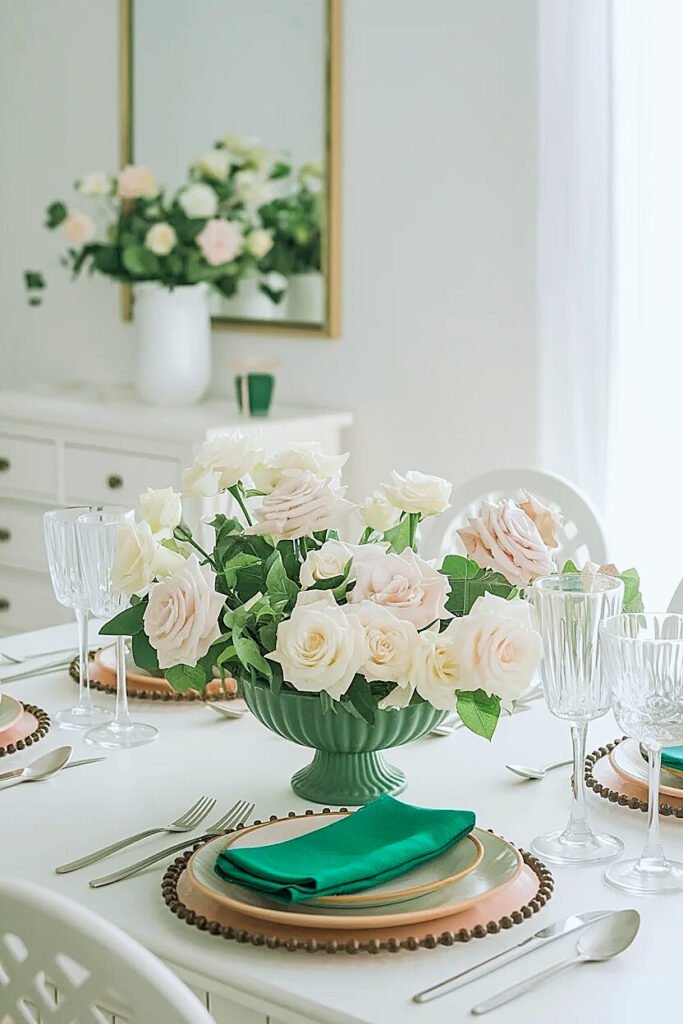
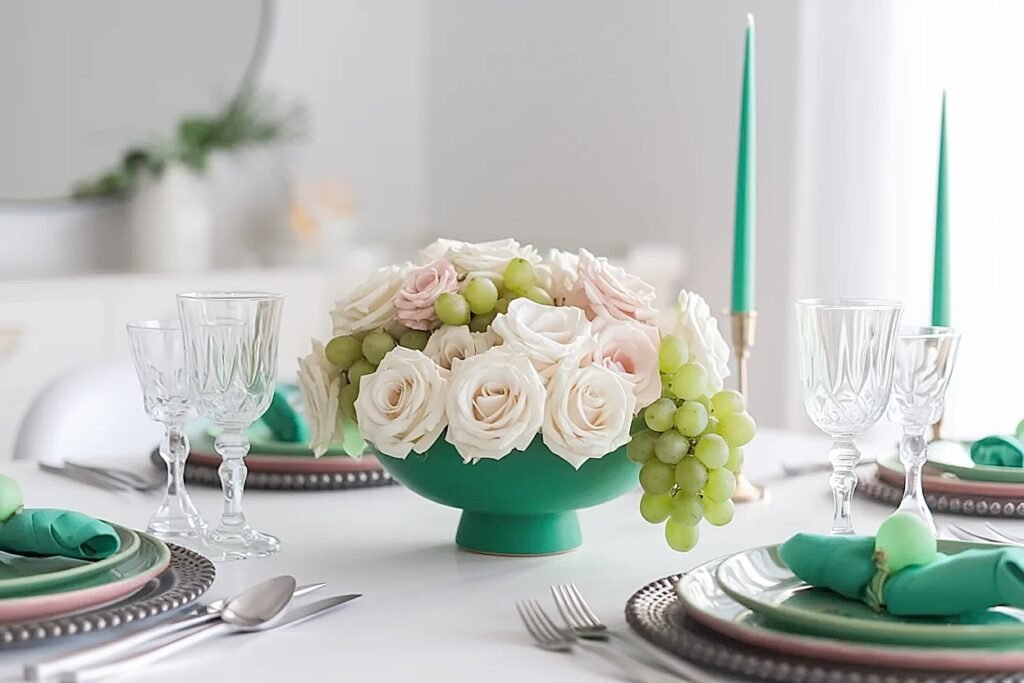
The main party table carries serious responsibility—it’s where eyes land first when guests enter your space, and it sets the tone for your entire celebration. Combining roses with green grapes on this focal surface requires balancing elegance with approachability. You want something impressive enough to warrant the “main table” designation while remaining inviting rather than precious.
I position a substantial rose arrangement at the table’s center, then surround its base with clusters of green grapes that appear to cascade naturally from the vessel. The grapes shouldn’t look carefully placed; they should seem like they simply belong there, as if the arrangement grew that way organically. This casual abundance reads as generous and welcoming rather than fussy.
The vessel choice matters enormously here. I favor wide, shallow bowls over tall vases because they provide stable bases for grape integration. A twelve-inch diameter bowl works beautifully—I fill it with water and floral foam, pack in fifteen to twenty green roses with white accents, then tuck grape clusters around the foam’s perimeter where it meets the bowl edge. The grapes partially obscure the mechanics while adding that verdant color layer.
Here’s a technique that consistently impresses: I thread individual grapes onto floral wire, creating grape “garlands” that weave through the lower portion of my rose arrangement. This elevates grapes from pile-around-the-base to integrated-design-element. I pierce each grape carefully with thin floral wire, stringing six to eight grapes per wire, then insert these wired strands among the rose stems at varying heights. The grapes appear suspended within the arrangement rather than merely surrounding it, which creates dimensional interest.
The beauty of grapes is their dual nature—they’re decoration until someone eats them, then they’re refreshment. I’ve watched guests pluck grapes from my centerpieces throughout parties, and rather than ruining the display, it actually enhances the casual, interactive vibe. If you’re exploring complementary approaches to Saint Patrick’s Day table styling with roses and natural elements, there are some excellent napkin coordination techniques worth trying—share this with anyone planning their celebration!
The main table strategies establish principles that translate across different surfaces and purposes, and the charcuterie board rules ahead address food-specific integration challenges.
What Are the Best Saint Patrick’s Day Rules for Green Grapes Around a Charcuterie Board
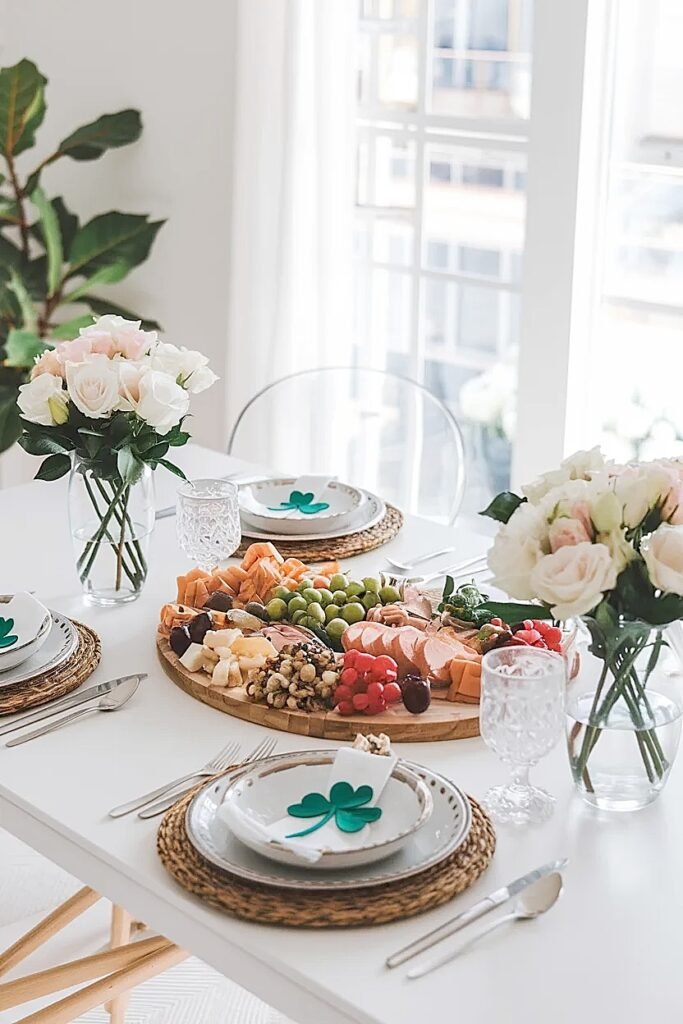
Charcuterie boards present unique opportunities because grapes already belong in that culinary context—they’re expected cheese companions and palate cleansers. Combining them with roses near or around your board requires understanding food presentation hierarchies. The charcuterie itself remains the star; grapes and roses play supporting roles that enhance without overwhelming.
I’ve learned through multiple party iterations that successful grape and rose pairings near food displays follow specific principles. These aren’t arbitrary preferences—they’re solutions to predictable problems like grapes rolling off boards, roses blocking cheese access, or arrangements looking thrown-together rather than curated.
1. The Perimeter Grape Border Rule
Arrange green grapes in a continuous border around your charcuterie board’s outer edge, positioning rose arrangements beyond this grape boundary rather than within it. This creates clear spatial separation between edible elements—grapes that will definitely get eaten—and decorative elements like roses that remain untouched throughout your event. I typically build a two-grape-deep border, using clusters still on the stem for stability rather than individual loose grapes that migrate across surfaces. The grape perimeter defines your board’s footprint while adding that vibrant green Saint Patrick’s Day color directly adjacent to the food. Roses then sit outside this defined zone, framing the entire composition without interfering with cheese knives or cracker access. This boundary approach prevents the chaotic look of grapes scattered randomly around roses and food, establishing intentional zones that guide guest interaction. The visual flow moves from outer roses inward through grape border to the charcuterie center.
2. The Vertical Separation Standard
Keep rose arrangements elevated above charcuterie board level using risers or cake stands, while grapes stay flat on the same plane as the food. This height difference creates visual interest through dimensional variation while maintaining functional separation. I position a rose arrangement on a four to six inch pedestal placed beside or behind the charcuterie board, then arrange grape clusters on the board’s surface itself among the cheeses and meats. The elevated roses command visual attention without physically interfering with food access, while grapes integrate seamlessly into the edible landscape. This prevents cross-contamination concerns—your roses never touch food since they’re operating in different vertical zones. The height contrast also photographs beautifully, creating that layered, professional look that elevates your presentation. I test this by standing at normal viewing height and verifying that roses don’t block sightlines to the charcuterie selections.
3. The Monochromatic Grape Clustering Principle
Group all grapes together in one substantial cluster rather than scattering them in multiple small piles around your charcuterie board and rose display. This concentrated placement creates a bold green statement that doesn’t compete with roses for attention. I position one generous grape cluster—maybe two to three full bunches still connected—at one corner or end of the charcuterie board, then place my rose arrangement at the opposite end. The substantial grape mass establishes its own presence rather than appearing as random filler scattered throughout. This clustering approach also makes grapes easier for guests to identify and access when they want to eat them. The visual rhythm moves from concentrated roses through varied charcuterie elements to concentrated grapes, creating intentional flow across your display. I find this technique prevents the fragmented appearance that happens when grapes appear in small clusters everywhere without clear purpose or pattern.
These charcuterie-specific guidelines ensure food remains accessible while grapes and roses contribute meaningfully to the presentation, and the centerpiece bead technique coming next transforms grapes into unexpected design elements.
How to Use Green Grapes as “Color Beads” in Saint Patrick’s Day Rose Centerpieces
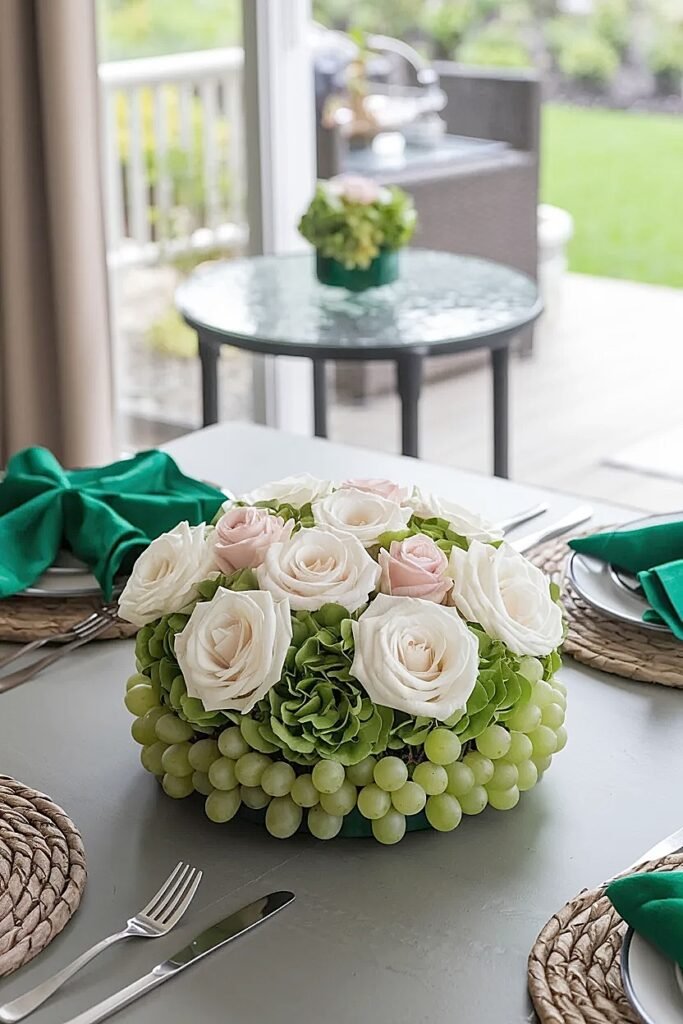
The color bead concept treats individual grapes as dimensional accents distributed throughout a rose arrangement rather than massed at its base. I wire grapes individually and position them at varying heights within the centerpiece, creating the illusion of green spheres floating among the blooms. This requires more effort than simply surrounding a vase with grape clusters, but the sophisticated result justifies the investment.
Threading grapes onto floral wire demands gentle precision—you’re piercing fruit without wanting to split it entirely. I use 22-gauge wire, inserting it through each grape’s center to emerge on the opposite side. The wire gets bent into a U-shape that functions like a hairpin, allowing me to anchor it into floral foam. Each wired grape extends three to four inches from the foam on its wire stem.
I start with my rose arrangement built traditionally—floral foam saturated in water, roses inserted at varying heights creating the basic structure, some white blooms for contrast, maybe trailing ivy or fern fronds. Then I add the grape “beads.” I pierce ten to fifteen grapes, positioning them strategically throughout the arrangement’s mid and lower sections. They nestle between rose blooms, creating surprising pops of spherical form among the flowers’ organic curves.
The effect resembles expensive glass beads or ornamental berries, except these are completely edible and fresh. The grapes catch light differently than roses do—their smooth, taut skins reflect rather than absorb, creating little gleaming moments within the arrangement. As the party progresses and lighting changes from daylight to evening artificial light, the grapes’ reflective quality becomes more pronounced.
This technique scales beautifully from intimate centerpieces to grand statement arrangements. For a small dinner table, maybe eight wired grapes distributed among a dozen roses. For a buffet centerpiece or entry table focal point, I’ll use twenty-plus grapes creating substantial green presence throughout a much larger rose installation. The key is maintaining visual balance—you want enough grapes to register as an intentional design element without overwhelming the roses themselves.
The bead approach proves that familiar materials can function in unexpected ways when you’re willing to experiment with unconventional applications, and the snack station concepts ahead demonstrate practical integration strategies.
Ideas for Saint Patrick’s Day Snack Station Decor with Green Grapes and Roses
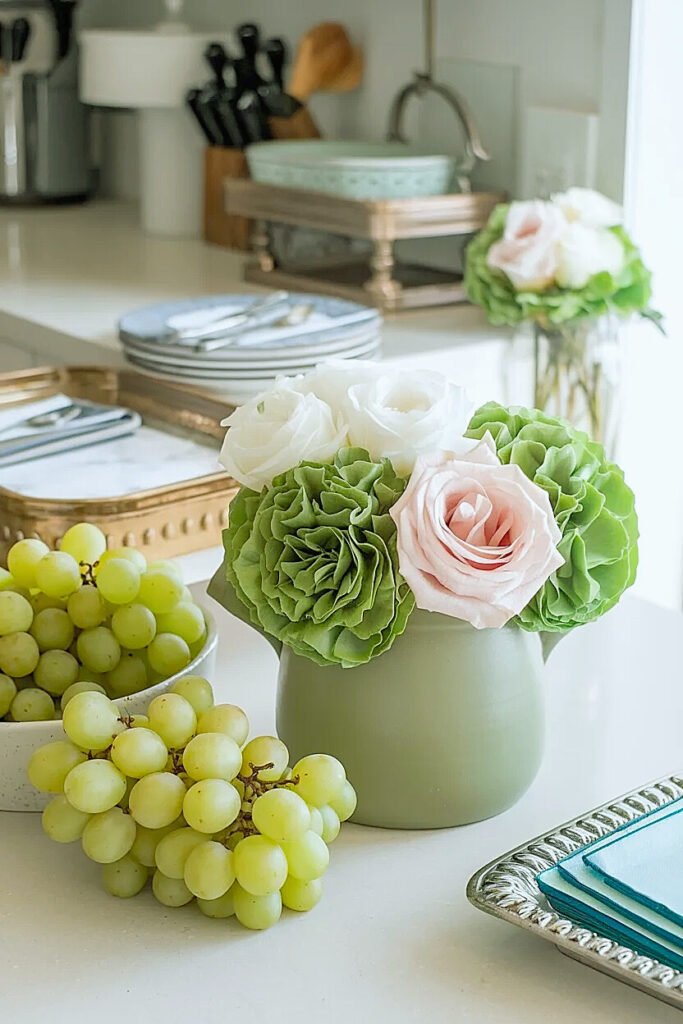
Snack stations blur the line between food display and decorative arrangement since the grapes themselves function as both edible offerings and aesthetic elements. I love this dual-purpose approach because it reduces the number of distinct items competing for limited surface space. Your grape clusters contribute to the visual story while serving the practical purpose of feeding guests.
The casual nature of snacking means people interact repeatedly with your display, so stability becomes crucial. I build snack station grape and rose combinations assuming they’ll get bumped, leaned over, and generally subjected to continuous human traffic.
1. Tiered Stand with Alternating Grape and Rose Levels
Use a three-tier serving stand, placing grape clusters on the bottom tier, rose arrangements on the middle tier, and additional grapes on the top tier. This creates vertical interest through food-flower-food rhythm that feels intentional and abundant. I fill each tier generously—the bottom might hold three large grape bunches, the middle a compact rose arrangement in a low bowl, the top tier more grapes cascading slightly over the edge. The alternating pattern ensures roses get showcased prominently on that eye-level middle tier while grapes bookend the composition with edible options. This works brilliantly for kitchen island snack stations where people approach from all sides.
2. Grape-Lined Serving Tray with Corner Rose Accents
Arrange grape clusters along a rectangular serving tray’s perimeter, positioning small rose arrangements in two opposite corners. The grape border creates a lush frame for whatever snacks occupy the tray’s center—maybe crackers, cheese cubes, or chocolate. I use bunches still on the stem, laying them flat to create that continuous green boundary. The corner roses add floral elegance without claiming center space needed for food. This technique contains the entire presentation within one portable tray, making setup and cleanup dramatically easier. The grapes’ perimeter placement means guests can grab them easily while the corner roses stay safely out of the action zone.
3. Central Rose Bowl Surrounded by Grape Cluster Ring
Position a substantial rose arrangement in a bowl at your snack station’s center, then create a complete ring of grape clusters encircling the bowl’s base. The grape ring might extend eight to ten inches outward from the bowl in all directions, creating a verdant foundation that makes the roses appear to emerge from abundant greenery. I use six to eight grape bunches to create this full ring, positioning them close enough that they touch and overlap slightly. This creates impressive visual impact—the substantial grape mass reads as generous and welcoming—while the roses provide vertical interest and color contrast with white blooms. The ring also defines the arrangement’s footprint clearly, preventing it from visually bleeding into adjacent snack bowls or platters.
These snack station approaches balance aesthetic ambition with practical function, and the entry table concepts ahead leverage first-impression opportunities with strategic grape and rose pairings.
Ideas for Saint Patrick’s Day Entry Table Decor Using Roses and Green Grapes
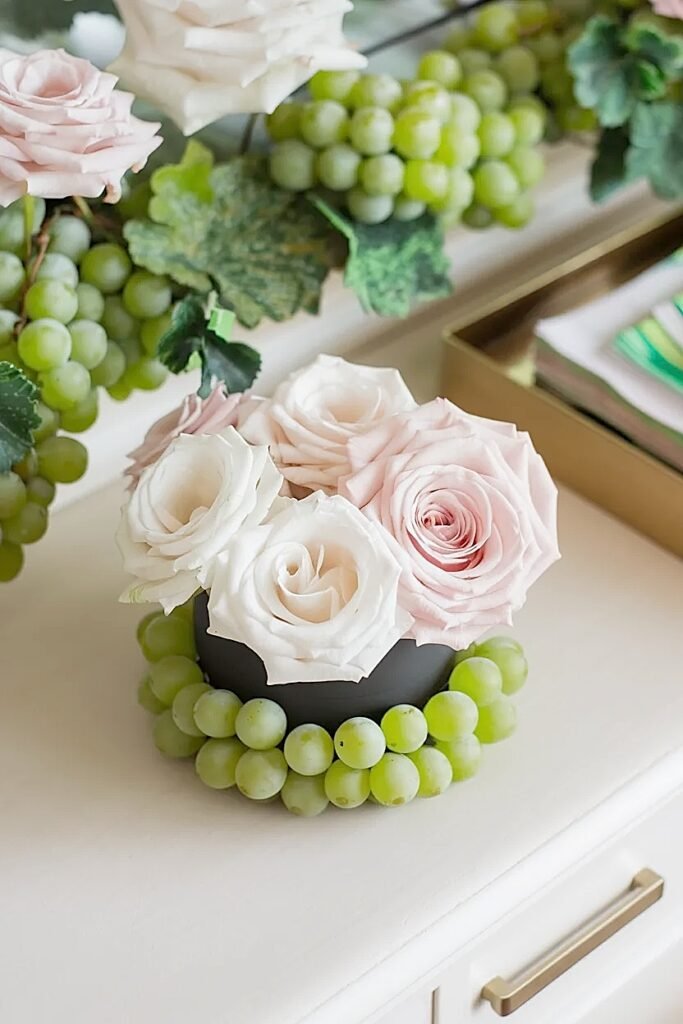
Entry tables capture attention the moment guests walk through your door, making them prime real estate for impressive grape and rose combinations. Unlike dining or snack tables where function constrains design, entry tables exist purely for visual impact. I exploit this freedom by creating arrangements that would be too elaborate or fragile for high-traffic food areas.
The entry table’s greeting function means whatever you place there communicates your hospitality and sets expectations for the celebration ahead. Roses signal elegance and effort, while grapes add approachability and abundance.
1. Cascading Grape and Rose Tower Using Stacked Boxes
Create a stepped display using three decorative boxes of graduated sizes stacked at varying heights on your entry table. Position rose arrangements on the top two levels and drape grape clusters cascading from the highest box down across the lower levels. I wrap boxes in white or cream fabric for clean backgrounds that highlight the green grapes and roses. The highest box—maybe ten inches tall—holds a substantial rose arrangement, the middle box at six inches holds a smaller cluster, and the lowest box at three inches catches the grape cascade. I choose grape bunches with long, flexible stems that drape gracefully rather than sitting stiffly. This creates dramatic vertical movement that draws eyes upward while the cascading grapes provide downward flow, establishing dynamic tension within the composition.
2. Mirror Tray Base with Grape Border and Central Roses
Use a large mirror as your entry table base, creating a grape border around the mirror’s perimeter and positioning your rose arrangement at the mirror’s center. The reflective surface doubles the visual impact of both grapes and roses while adding light and depth to your entry. I choose a mirror approximately eighteen inches square or round, arranging grape clusters in a continuous border that frames the mirror’s edge completely. The central rose arrangement sits in a clear glass or crystal vessel that allows the mirror reflection to show through. This technique creates the illusion of twice the grapes and roses you’ve actually used, maximizing impact from relatively modest materials. The mirror also catches and reflects any natural light from nearby windows or front door glass, adding luminosity to the entire entry area.
3. Vertical Frame Installation with Suspended Grapes and Roses
Mount a decorative frame on the wall above your entry table, weaving grape garlands and rose stems through the frame’s structure to create a living installation. The frame might be vintage wood, ornate metal, or simple modern lines—any style works as long as it’s substantial enough to support fruit and flower weight. I attach water tubes to individual rose stems using floral wire, securing these tubes to the frame at varying points. Grape clusters get wired similarly, draping from top frame edges to create cascading effects. This approach lifts your decoration entirely off the table surface, leaving room for additional elements like a guest book, keys bowl, or Saint Patrick’s Day themed accessories. The vertical installation creates dramatic entry impact that doesn’t require any horizontal entry table space whatsoever.
4. Tiered Cake Stand Display with Alternating Elements
Arrange a three-tier cake stand on your entry table, alternating grape and rose placements across the tiers for rhythmic visual flow. The bottom tier might hold a lush rose arrangement, the middle tier displays generous grape clusters, and the top tier features a smaller rose accent. I build each tier’s content generously—the bottom rose arrangement fills its tier completely, the middle grape clusters spill slightly over edges, the top roses crown the composition. This vertical stacking creates substantial presence from a minimal footprint, perfect for narrow entry tables or small entryway consoles. The tiered structure also allows viewing from multiple angles as guests enter and move past the table toward your home’s interior.
5. Dual Vase Arrangement with Connecting Grape Garland
Position two identical vases containing rose arrangements at opposite ends of your entry table, connecting them with a grape garland that drapes across the table’s length between the vases. The symmetrical vase placement creates bookend anchors, while the connecting grape garland unifies the composition into one cohesive display. I construct the garland using floral wire as foundation, attaching grape clusters at intervals along the wire’s length to create a flowing, organic connection. The garland drapes naturally rather than lying flat, creating gentle curves between the vase endpoints. This technique works beautifully for longer entry tables—sixty inches or more—where a single central arrangement might look lost, but paired elements with connecting garland establish intentional design across the full length.
These entry table concepts demonstrate how freedom from functional constraints allows more experimental and dramatic grape and rose combinations, and the patio snack table scenario ahead reintroduces practical considerations within outdoor contexts.
How to Create Saint Patrick’s Day Patio Snack Table Decor with Roses and Grapes
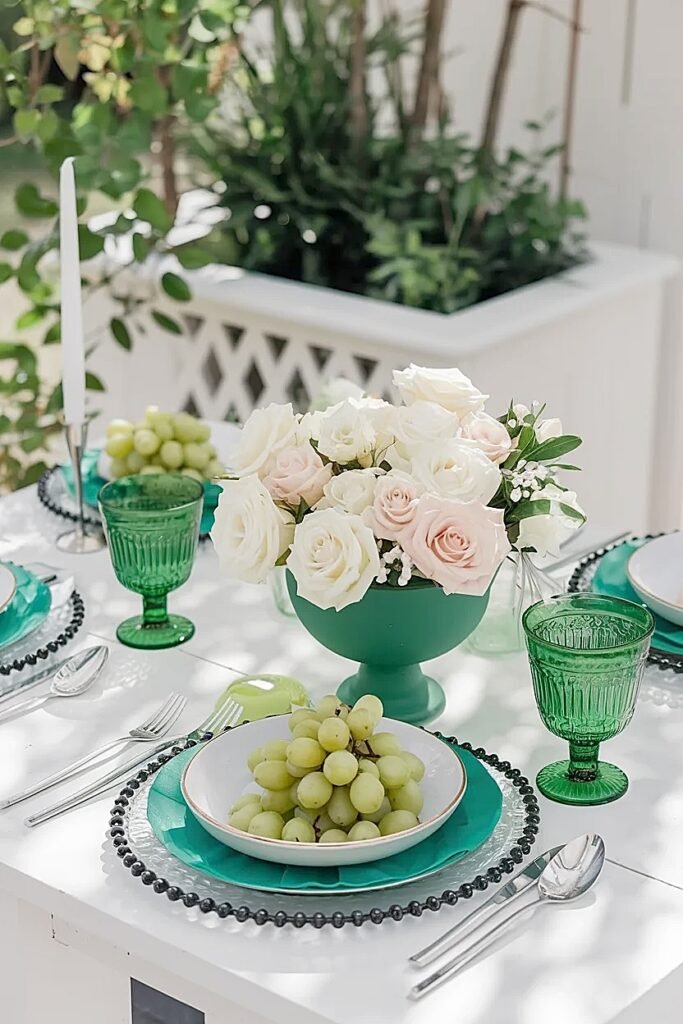
Outdoor patio snack tables introduce variables that don’t exist in climate-controlled indoor environments. Temperature fluctuations affect how long grapes stay crisp and appetizing, wind can scatter loose grapes across your yard, and direct sunlight impacts both grape freshness and rose longevity. I approach patio styling with these environmental factors driving every decision.
The casual outdoor setting actually enhances the grape and rose pairing because both elements feel naturally at home in garden contexts. Grapes evoke vineyards and agricultural abundance, roses bring cultivated garden beauty—together they create an outdoor aesthetic that feels authentic rather than forced.
I favor weighted, low-profile arrangements for patio surfaces since wind becomes your constant adversary. A substantial ceramic or terracotta bowl filled with roses and grape clusters stays stable where lightweight glass vases topple at the first breeze. I build rose arrangements no taller than eight inches for outdoor contexts, compensating for reduced height with increased width and density.
Grape placement on patio tables needs to account for insect attraction. Outdoor entertaining means bees and wasps might investigate your grape clusters, so I position grapes at table edges rather than center locations where guests congregate. This peripheral placement provides visual interest while keeping potential bug attractants away from where people are actively eating and socializing.
For extended outdoor events—say a four-hour afternoon party—I use two sets of grape clusters, swapping fresh ones midway through. The first set might wilt or warm in direct sun, so having backup grapes in my refrigerator means I can refresh the display without guests noticing degraded fruit. This sounds excessive until you’ve watched warm, slightly shriveled grapes undermine an otherwise beautiful presentation.
I incorporate ice elements strategically. For evening patio events, I’ll nestle my rose vessel in a larger bowl filled with ice, surrounding it with grape clusters that stay chilled against the ice. The ice melts slowly, keeping grapes crisp while the roses stay hydrated. The melting ice creates condensation that can look intentional and fresh rather than messy if you’ve chosen appropriate vessels.
The patio’s outdoor nature invites more rustic, abundant styling than indoor formality would permit, and the coffee table scenarios ahead tackle intimate indoor spaces with different spatial and functional requirements.
Ways to Style Saint Patrick’s Day Coffee Table Roses with a Green Grapes Snack Bowl
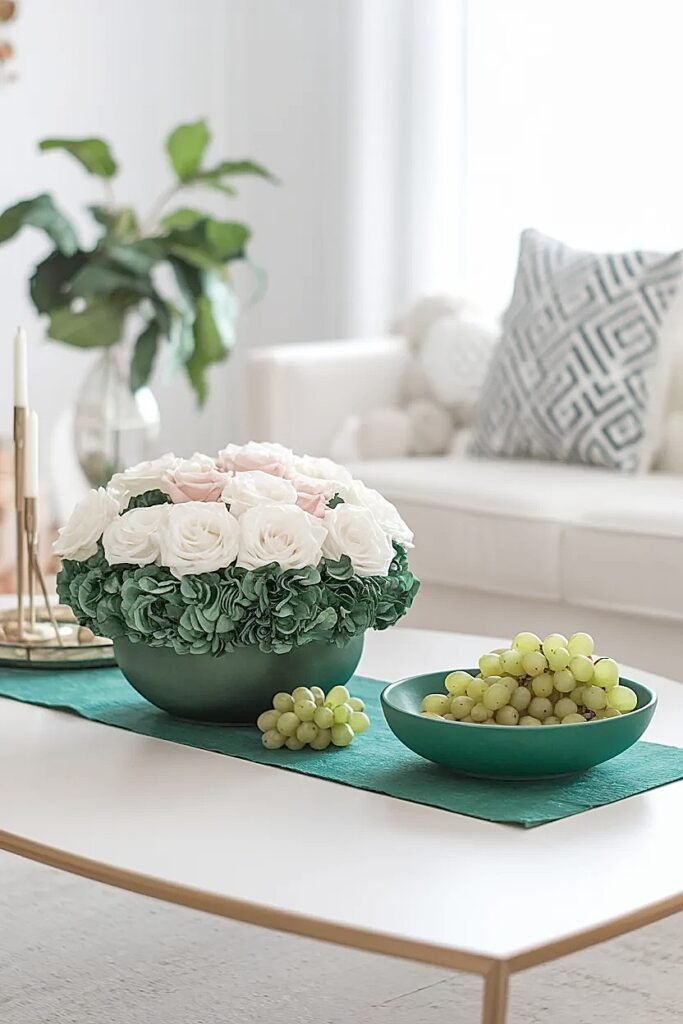
Coffee tables occupy that unique territory between functional surfaces and decorative opportunities. They’re low, which changes viewing angles compared to dining or entry tables. They’re also deeply functional—people set drinks down, put their feet up, lean over them for snacks. Your grape and rose styling needs to tolerate this casual interaction.
Pairing roses with a grape snack bowl on coffee tables creates natural synergy since both elements serve the gathering’s social function. The grapes are there to be eaten, the roses create ambiance—together they transform a simple coffee table into a hospitality hub.
1. Corner Rose Cluster with Adjacent Grape Bowl Pairing
Position a compact rose arrangement in one corner of your coffee table, placing a bowl of green grapes immediately adjacent in the same corner zone. This creates a consolidated decorative and snack area that leaves maximum coffee table surface available for drinks and other items. I use a low, wide rose vessel—maybe six inches tall and eight inches diameter—packed densely with green and white roses. The grape bowl sits touching or nearly touching the rose vessel, creating visual connection between floral and edible elements. This corner consolidation prevents the scattered appearance of items spread across the entire coffee table, while the adjacency makes grapes easy to grab without reaching across other objects.
2. Central Grape Bowl with Surrounding Rose Bud Vases
Place a generous bowl of green grapes at the coffee table’s center, then surround it with four to six small bud vases containing single roses positioned around the bowl’s perimeter. The grape bowl becomes the functional centerpiece—guests reach for it repeatedly—while the surrounding rose bud vases create a floral halo effect. I space the bud vases evenly around the grape bowl at six to eight inches from its edge, using vases about four inches tall so they don’t obstruct views across the table. Each vase holds one perfect rose—alternating green and white for tonal variation. This arrangement scales beautifully to different coffee table sizes by adjusting the number of bud vases while keeping the central grape bowl consistent.
3. Tiered Display with Grapes Below and Roses Above
Use a two-tier serving stand, positioning the grape snack bowl on the lower tier and rose arrangement on the upper tier. This vertical stacking conserves horizontal coffee table space while creating dimensional interest through elevation changes. I fill the lower tier’s bowl generously with grapes—these get eaten, so abundance matters—while the upper tier holds a more compact rose arrangement in a vessel that won’t tip when the stand gets bumped. The tiered approach keeps roses elevated above casual coffee table chaos—spilled drinks, stray coasters, remote controls—while grapes remain easily accessible on that lower level. The vertical structure also means the rose arrangement stays visible even when people are sitting on sofas looking across the coffee table.
4. Linear Grape and Rose Procession Along Table Length
Create a line of alternating elements running the coffee table’s length: grape cluster, rose bud vase, grape cluster, rose bud vase. This rhythmic pattern works especially well for rectangular coffee tables where you want to establish visual flow along the longer dimension. I use small grape clusters—maybe six to eight grapes each—alternating with simple bud vases holding single roses. The procession might include six to eight elements total depending on table length, creating substantial visual presence without claiming excessive space. Guests can grab grapes from any cluster along the line without disturbing the overall pattern, and the linear arrangement naturally guides the eye along the table’s length.
5. Nested Bowl Arrangement with Grape Outer Ring
Position a bowl of grapes inside a larger shallow bowl or tray, then arrange small rose stems and leaves in the space between the two bowl edges. The nested configuration creates defined zones—inner bowl for edible grapes, outer ring for decorative roses—while the dual-bowl structure adds dimensional interest. I choose a grape bowl about six inches diameter, nesting it in a shallow outer bowl or tray about twelve inches across. The two to three inch gap between bowl edges becomes my rose display zone. I fill this gap with short-stemmed roses, individual rose leaves, and perhaps some moss for textural variety. This technique contains everything within one cohesive element that occupies minimal coffee table footprint while providing both snack function and decorative beauty.
These coffee table strategies demonstrate how low viewing angles and high-traffic functionality shape grape and rose integration decisions, and the stair landing concepts ahead address transitional spaces with unique viewing patterns.
Ideas for Saint Patrick’s Day Stair Landing Table Decor with Roses and Grapes
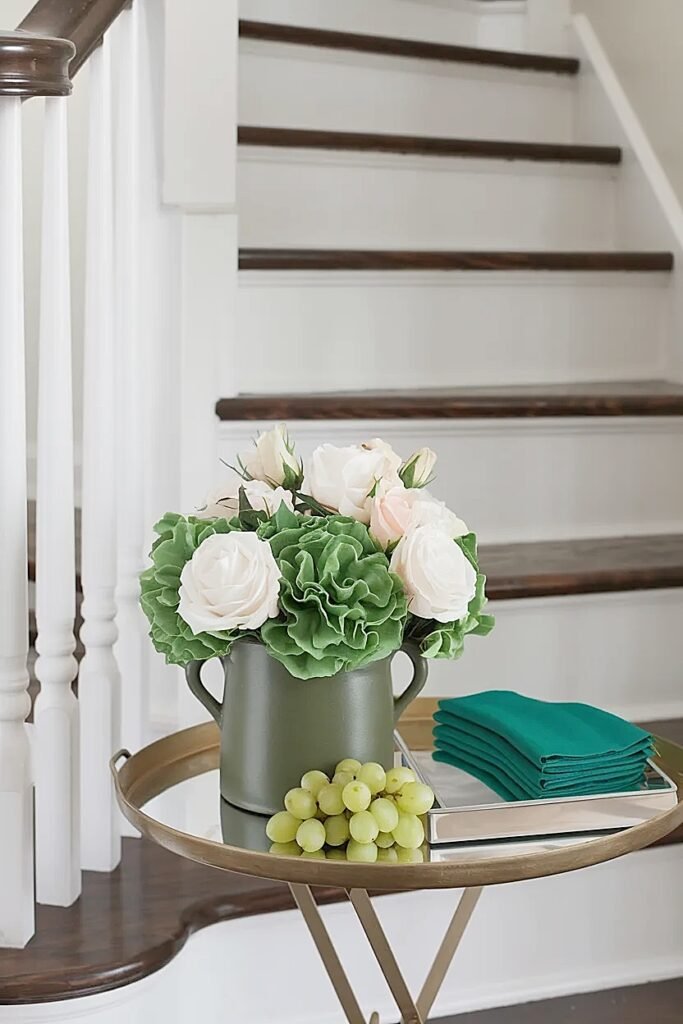
Stair landing tables occupy fascinating liminal spaces—guests pass them going up or down stairs but rarely linger there. This transitional nature means your décor gets viewed briefly from constantly changing angles and elevations. Grape and rose combinations on landing tables need to look compelling from both ascending and descending viewpoints.
The landing’s elevated position—assuming it’s above the main floor—also means your arrangement might be viewed from below, creating opportunities for underbelly perspectives that ground-level tables don’t offer. I exploit this multi-angle viewing by building arrangements that reveal different elements depending on viewer position.
1. Tall Vase Arrangement with Cascading Grape Garland
Use a tall vase—twelve to fifteen inches—filled with long-stemmed roses, draping a grape garland from the vase’s rim to cascade down onto the landing table surface. The height ensures visibility from lower stair positions, while the cascading grapes create downward movement that rewards viewers ascending the stairs. I wire grape clusters onto flexible floral wire, creating a garland approximately twenty inches long that drapes from vase edge to table. The roses establish vertical presence, the grape cascade provides organic flow, and the combination reads beautifully whether you’re approaching from above or below the landing. This technique also creates that luxurious abundance effect—grapes spilling from a rose-filled vessel—without requiring massive quantities of either element.
2. Multi-Level Platform Display with Graduated Heights
Create a stepped platform using books or small risers covered with fabric, arranging grape clusters on lower levels and rose arrangements on higher levels. This builds a miniature landscape on your landing table that reveals different elements as viewers change elevation on the stairs. I might use three levels: bottom at table surface holds grape clusters, middle platform at four inches displays a modest rose arrangement, top platform at eight inches features a taller rose accent. As someone climbs stairs approaching the landing, they first see lower grape clusters, then middle roses come into view, finally the top accent emerges. This sequential revelation creates visual interest that static single-level arrangements can’t match.
3. Mirror Backing with Grape and Rose Reflection
Prop a large mirror against the wall behind your landing table, positioning grape clusters and rose arrangements to maximize reflection visibility. The mirror doubles your visual impact while creating depth that makes the landing area feel more spacious. I arrange rose vessels toward the table’s front edge, then position grape clusters between the roses and mirror backing. This creates layered depth: roses in foreground, grapes in middle ground, mirror reflecting both in background. The reflection means viewers ascending stairs see the arrangement’s front while simultaneously glimpsing its reflected back, creating almost 360-degree viewing from a single approach angle. Choose mirrors with interesting frames—vintage wood or ornate metal—that contribute their own decorative value.
4. Suspended Grape Cluster with Tabletop Rose Base
Hang a substantial grape cluster from the ceiling or landing’s overhead structure directly above your landing table, positioning a rose arrangement on the table surface below the hanging grapes. This creates dramatic vertical connection between ceiling and table elements that pulls the eye upward. I use fishing line to suspend a large grape bunch from an overhead hook, ensuring it hangs at roughly eighteen inches above the table—low enough to register as part of the table display but high enough that it won’t get bumped. The tabletop rose arrangement sits directly beneath, creating visual alignment that suggests intentional relationship. This technique works especially well for landings with high ceilings where vertical space goes unused in typical decorating approaches.
5. Circular Wreath Base with Central Rose and Grape Fill
Create a circular wreath approximately fifteen inches in diameter using grapevine or wire, laying it flat on your landing table as a base element. Position a rose arrangement at the wreath’s center, filling the wreath’s circular channel with grape clusters. The wreath defines clear boundaries while the circular shape reads beautifully from any angle—important for landing tables that might be viewed from multiple staircase approaches. I build a compact rose arrangement in a vessel about six inches diameter, placing it perfectly centered in the wreath’s opening. Then I fill the wreath’s channel with grape clusters, creating a lush green border that frames the central roses. This contained composition works perfectly for small landing tables where space constraints demand efficient design.
These stair landing ideas prove that even transitional spaces benefit from thoughtful grape and rose integration when you consider unique viewing patterns and spatial characteristics.
Conclusion
Green grapes transform Saint Patrick’s Day rose arrangements from purely decorative elements into interactive, multi-sensory experiences. The edible nature of grapes invites guest participation—people pluck them throughout your party, gradually altering the display in organic, unpredictable ways. This living evolution creates a different kind of beauty than static arrangements offer.
Every technique I’ve shared respects grapes’ dual nature as both food and design material. Whether you’re threading them onto wire as centerpiece “beads,” creating perimeter borders around charcuterie, or cascading them from stair landing arrangements, grapes contribute vibrant green color while serving genuine hospitality function. Start with one approach that suits your specific space and comfort level, then experiment with additional techniques as you gain confidence. The grape and rose combination works because it’s rooted in natural authenticity—both elements belong in celebratory contexts, and together they create something more compelling than either achieves alone.
This website contains affiliate links, and some products are gifted by the brand to test. As an Amazon Associate, I earn from qualified purchases. Some of the content on this website was researched and created with the assistance of AI technology.