This website contains affiliate links, and some products are gifted by the brand to test. As an Amazon Associate, I earn from qualified purchases. Some of the content on this website was researched and created with the assistance of AI technology.
Key Takeaways
- Crates provide instant height variation without additional furniture, the single most useful structural tool for entry decor
- Small, tight arrangements in short vessels read better in crate displays than large loose bouquets
- Mix vessel types, ceramic, glass, and terracotta, to add visual depth without adding complexity
- Sunflowers, zinnias, and lisianthus are the top three grocery store picks for birthday entry arrangements
- A stacked crate display beside the entry doorway is the highest-impact setup for the least amount of effort
- Layer heights within each crate level by mixing tall bud vases with low dish arrangements
Creating Summer Flower Birthday entry decor using crates and small arrangements is one of those styling moves that looks like it cost three times what it actually did. I figured this out the hard way at my daughter’s sixteenth birthday: two wooden crates from a craft store, a few short jars, and three grocery store flower bunches, and guests were stopping at the front door before they even made it to the backyard.
Crates change the whole dynamic of entry decor because they give you elevation without expensive furniture or risers. Stack two crates and you have a three-level display in under ten minutes. Set one on its side and it becomes a shelf. Lay one flat and it becomes a tray. The flowers do not have to be elaborate when the structure is doing that much work. Small, tight arrangements in short vessels look intentional and polished placed inside or on top of crates rather than just sitting on a flat surface.
Use this quick guide to choose the best crate size, flower mix, and placement for summer birthday entry decor. It makes planning easier, especially when you want your entry table, bench, counter, or console to feel cheerful, balanced, and welcoming without looking too full, too flat, or hard to use.
| Decor Goal | Crate + Surface | Best Summer Flowers Mix | Best Tip |
|---|---|---|---|
|
Cheerful first look Small entry table |
Two small crates side by side | Daisies, zinnias, small sunflowers | Leave the middle open for a sign or tray |
|
Add height Wide console |
One medium crate plus one low accent | Sunflowers, white daisies, peach zinnias | Keep only one tall floral moment |
|
Kitchen island entry view Open-plan layout |
One shallow crate at the back edge | Compact zinnias, daisies, mini sunflowers | Keep one full side clear for party prep |
|
Cozy bench decor Mudroom or porch bench |
Two uneven crates at one end | Yellow sunflowers, pink zinnias, airy daisies | Keep the flowers to one side |
|
Fix a flat narrow table Hall console |
Three tiny crates in a loose row | Daisies, mini zinnias, yellow focal blooms | Repeat color more than height |
|
Useful side counter Open entry counter |
One medium crate in a far corner | Sunflowers, coral zinnias, white daisies | Leave the center open for cups or snacks |
|
Bright small foyer Tiny corner table |
One small crate only | Daisies, compact zinnias, one sunflower | One strong floral moment works best |
|
Match the main table Entry preview |
Same crate tone, smaller scale | Same sunflower, zinnia, daisy mix | Make it a preview, not a duplicate |
How to Style Summer Flowers on Entry Tables with Crates and Small Arrangements
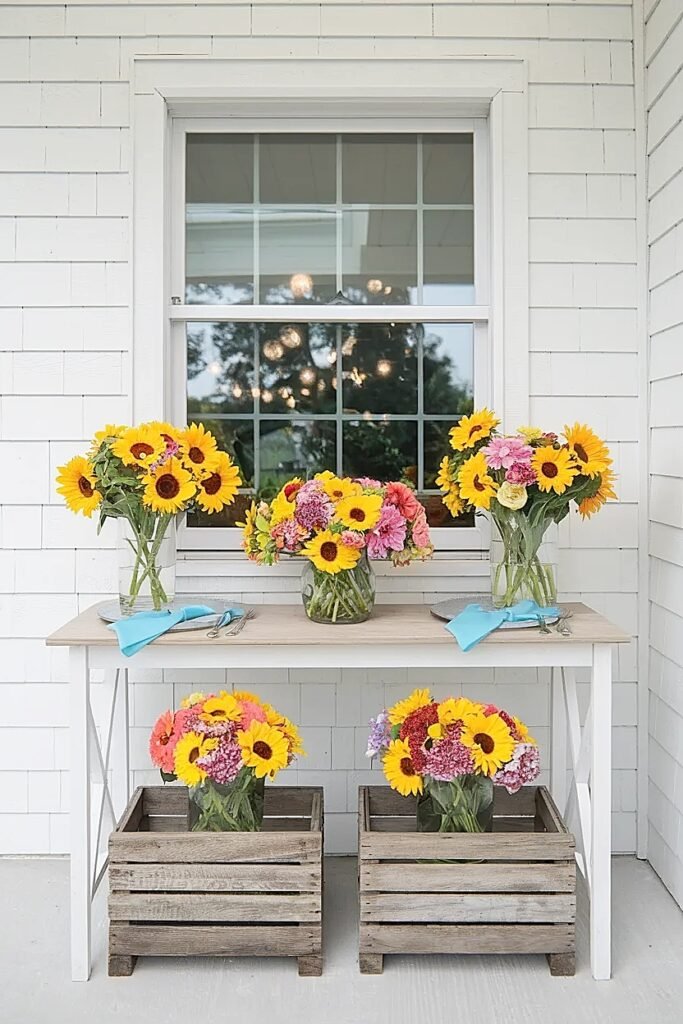
Entry tables set the tone for the entire party before guests see anything else. Get this right and every other surface benefits from that first impression. The problem most people run into is treating the entry table like a shelf, putting one thing down and calling it done.
The crate changes that. A single crate placed on the entry table creates an instant secondary level and gives you three distinct zones to style: the tabletop itself, the inside of the crate, and the top surface of the crate. Fill each zone differently. One low arrangement on the tabletop. One compact cluster inside the crate. One taller grouping on top. The layered levels create visual depth that a flat surface can never achieve.
Small arrangements work better than large ones in entry crate setups for a practical reason: the crate walls frame the flowers. A massive bouquet spilling over the sides of a crate loses the structure the crate is supposed to provide. A tight, compact cluster sitting inside a crate looks like it was designed to be there. The crate is the frame. The flowers are the focal point inside the frame.
Height ratios matter. The arrangement inside the crate should sit at or just below the crate rim. The arrangement on the tabletop flanking the crate should be slightly shorter. The arrangement on top of the crate should be the tallest element overall, but still only two to three inches above the crate’s top edge. That progression from low to high draws the eye upward and makes the whole setup read as one designed display rather than three separate things.
For more on how to use summer flowers at birthday tables throughout the event space, check out how to decorate a summer birthday table with sunflowers, zinnias, and daisies. If this gave you ideas worth using, share it with someone else planning a summer birthday. There is a lot more ahead in this article on specific surfaces, stacked crate doorway displays, and stair landing setups.
What Are the Best Summer Flowers for Entry Console Tables with Crates and Small Arrangements?
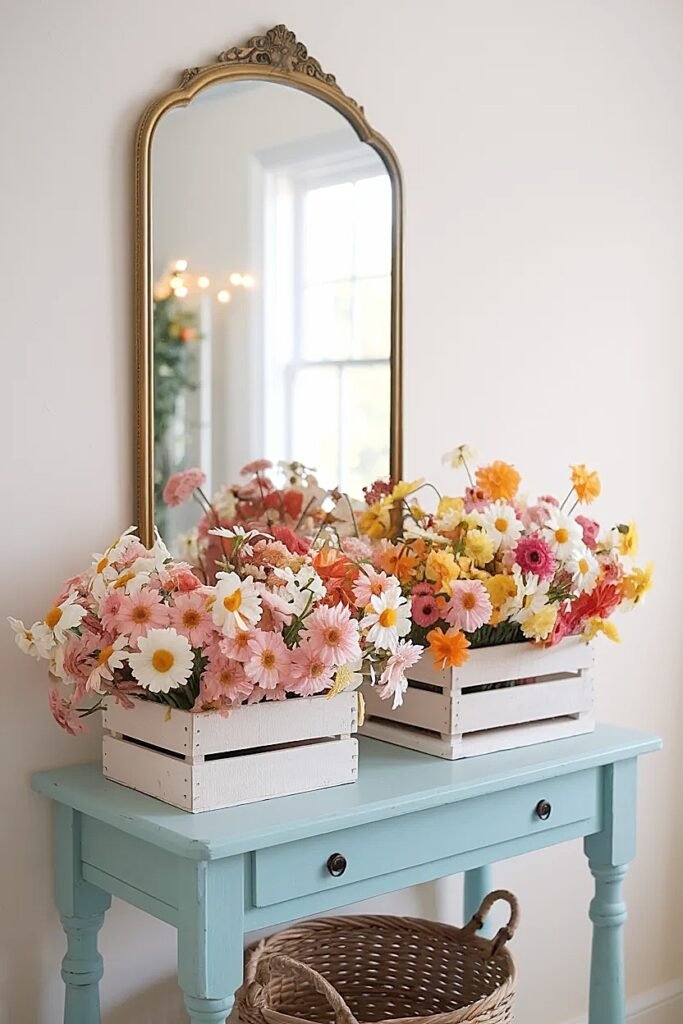
Not every summer flower works equally well in a crate entry display. You are selecting for compact bloom size, sturdy stems that hold position in a tight vessel, and color that reads clearly from across a room or entryway rather than just up close. A flower that looks beautiful in a garden or a tall vase can look muddy and indistinct inside a crate arrangement viewed at distance.
The five flowers below are the strongest performers for this specific application, based on bloom size, stem stability, color saturation at distance, and availability at any grocery store throughout the summer season.
1. Lisianthus Lisianthus is the top choice for entry crate arrangements because the tight, layered blooms hold their shape and color without drooping, even when cut short. The compact, rose-like structure fills small vessels at exactly the right visual density for a crate display. Available in white, blush, deep purple, and lavender, it reads clearly from across a room at any light level. One bunch fills three to four small arrangements at a fraction of the cost of roses.
2. Zinnias Zinnias bring a color punch to entry crate displays that no other grocery store flower matches. The flat, dense faces read at full saturation from across a room, which matters more in an entry space than anywhere else in the home. They hold their shape without wilting in warm entry areas, and the wide variety of colors, from pale cream to deep burgundy, makes them adaptable to any birthday color scheme. One bunch per crate level is enough for a full display.
3. Ranunculus Ranunculus gives entry crate arrangements a layered, abundant quality that larger flowers cannot achieve at the same stem count. Each stem branches into multiple blooms, meaning three stems in a small vessel look like eight. The tightly layered petals hold their structure for four to six days without water changes, making them ideal for entry setups that need to last through a party without attention. Peach and coral ranunculus are the strongest color choices for warm summer entry spaces.
4. Waxflower Waxflower is the filler flower that does genuine structural work in entry crate arrangements. The tiny clustered blooms add visual texture between larger focal flowers and fill gaps without adding bulk. Used alone, a dense bunch of waxflower in a small jar looks finished and intentional. Mixed with one larger bloom per vessel, it doubles the visual density of the arrangement without doubling the cost. White and pale pink waxflower pair with every other flower on this list.
5. Sunflowers (Dwarf or Standard Cut Short) A single sunflower cut to three to four inches and placed in a small, heavy ceramic jar is one of the most visually striking things you can put inside a crate. The oversized face at short stem height creates a bold focal point that smaller blooms cannot replicate. One sunflower per crate level is enough. More than that and the scale tips too heavy for a crate display. Cut standard grocery store sunflowers short rather than buying dwarf varieties.
More ahead on how foyer benches call for a different approach to crate and arrangement sizing.
How to Arrange Summer Flowers on Foyer Benches with Crates and Small Arrangements
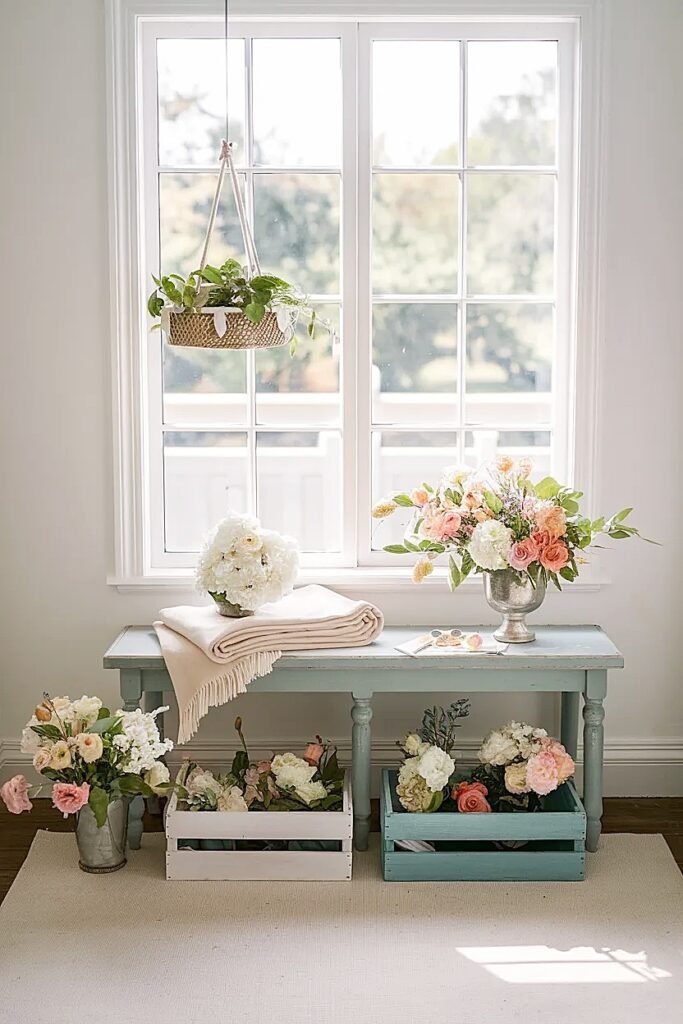
Foyer benches present a spatial challenge that entry tables do not. They are lower to the ground, narrower front-to-back, and used by guests who sit on them to remove shoes. Any arrangement has to accommodate that use pattern: nothing tippy, nothing tall enough to block a seated person’s face, nothing fragile at reaching-hand height.
Crates solve all of those problems at once. A single crate placed at one end of the foyer bench contains the arrangement completely and removes it from the active sitting zone. The crate physically marks the decor zone versus the sitting zone. Guests intuitively leave the crate area alone because it reads as a defined display rather than empty space.
For a foyer bench, the most effective crate arrangement is a single crate set on its side at one end of the bench, with the interior opening facing outward. Stack two or three small vessels inside the crate’s open compartment, varying heights slightly, and fill each with two to three stems of a compact summer flower. Set one small jar outside the crate on the bench surface, flanking the crate on the open side. That single flanking jar creates enough visual extension to fill the bench without competing with the crate display.
Keep all stem heights low enough that a seated guest is looking slightly down at the flowers rather than having them at face level. Three to five inches above the vessel rim is the ceiling for any foyer bench arrangement. Above it, the bench becomes less welcoming for the actual seating use it is supposed to serve.
More ahead on how stacked crates beside the entry doorway create the highest-impact display position in any birthday entry setup.
Ideas for Summer Flowers in Stacked Crates Beside a Birthday Entry Doorway
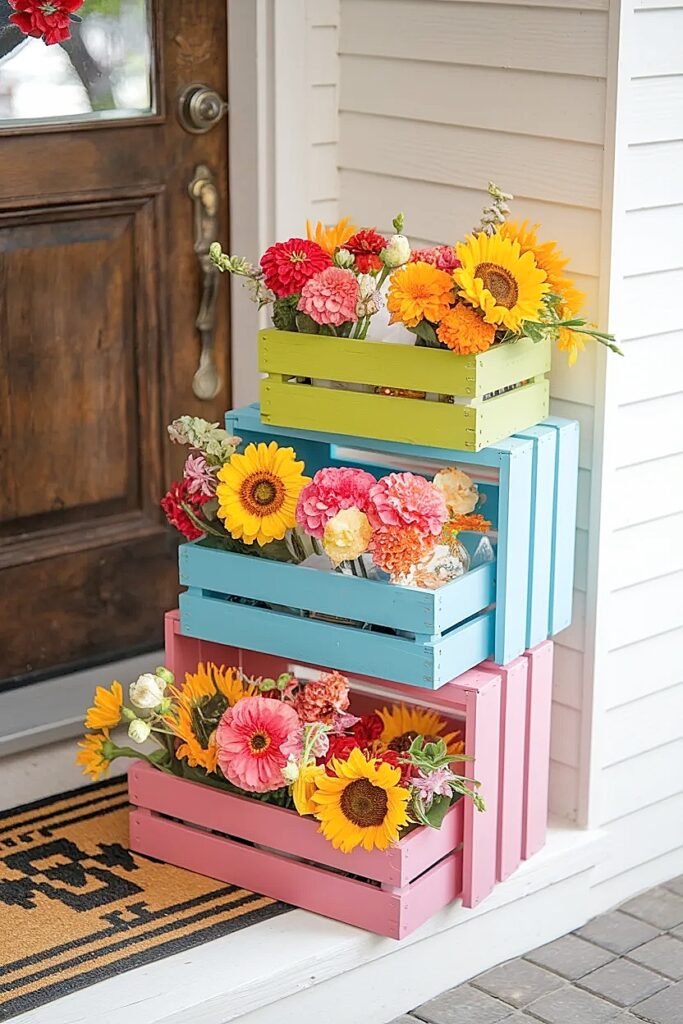
The entry doorway is the most valuable real estate in any birthday party setup. Every single guest passes through it. Nothing else in the entire party gets that kind of guaranteed audience. A stacked crate display beside the entry doorway is the one place where you can go slightly bigger, slightly more dramatic, and slightly more detailed than anywhere else in the entry area, because the investment in attention and materials will reach every person who attends.
Stacked crates give you a vertical display with distinct levels, each one a separate design decision. Two crates stacked gives you three visible surfaces: the top of the lower crate, the inside of the upper crate, and the top of the upper crate. Three crates stacked gives you five. The key is treating each level independently rather than trying to build one large arrangement that spans all of them.
1. Color-Gradient Stack Assign one color family per crate level, progressing from lightest at the bottom to deepest at the top. Pale yellow zinnias at the base, coral ranunculus in the middle, deep gold sunflowers at the top. The color gradient reads as designed and intentional from across the entry space and draws the eye upward through the full height of the stack. Use matched vessel types, all ceramic or all glass, on every level so the color progression reads cleanly without visual competition from the containers.
2. Single-Stem Feature Display Place one significant flower in a tall, narrow bud vase on the very top crate and fill the lower levels with smaller supporting arrangements. A single large sunflower face at the apex of a three-crate stack creates a focal point visible from the street before guests even reach the door. The lower levels, packed with zinnia clusters and waxflower bunches, give visual weight at base and middle without competing with the statement flower at the top of the display.
3. Mixed Texture Levels Assign each crate level a different texture rather than a different color. Top level: loose, airy waxflower stems in a clear jar. Middle level: dense, tight zinnia clusters in a ceramic mug. Bottom level: flat-faced sunflowers in a wide terracotta saucer. The contrast between airy, dense, and flat textures creates visual interest that a single texture or color approach cannot match. Use one unifying color across all three levels to keep the display from reading as chaotic.
4. Trailing Vine Connector Build one tight arrangement on each crate level and connect all three levels with a single long strand of seeded eucalyptus or variegated ivy draped loosely over the crate edges from top to bottom. The trailing vine unifies the separate levels into one continuous vertical display and adds an organic, garden quality that strictly potted or vased arrangements do not have. Tuck the vine ends under vessel bases at each level so nothing hangs loose.
5. Birthday Color Block Match all flowers across all crate levels to the birthday party’s primary color scheme. All pink, all yellow, or all white, with only the flower variety changing between levels. Lisianthus on top, zinnias in the middle, ranunculus at the base, all in the same color family. The monochromatic approach reads as highly intentional and sophisticated from a distance, and it makes the crate stack look like a curated floral installation rather than a decorative arrangement.
More ahead on how welcome tables, which often serve double duty as gift and sign-in stations, need a crate strategy that handles the extra traffic and use demands.
How to Layer Summer Flowers on Welcome Tables with Crates and Small Arrangements
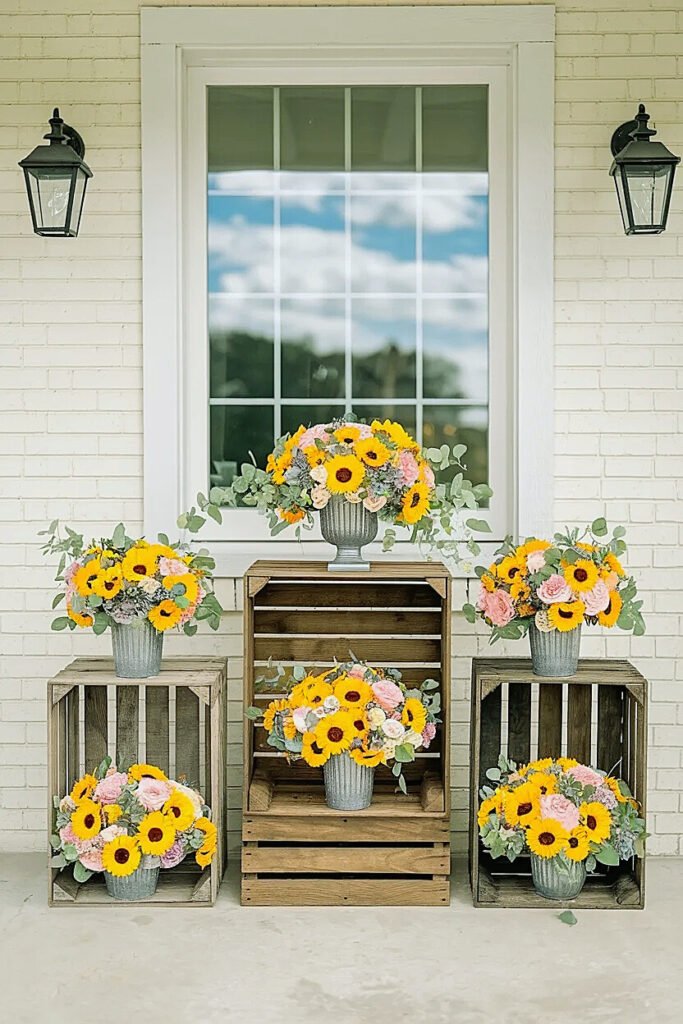
Welcome tables are the busiest surface in any birthday entry. Guests set down gifts, pick up name tags, sign the guest book, and grab a welcome drink all from the same surface. A welcome table arrangement has to look beautiful from six feet away, stay completely intact when someone reaches across it, and not take up space that guests need for practical use.
The layered crate approach solves all of that. One crate at the back edge of the welcome table creates an elevated display zone that is visually prominent but physically removed from the active working zone at the front of the table. Everything flowers and decorative goes in and on the crate. Everything practical goes in the clear zone in front of the crate.
Within the crate, layer three heights: a wide, low arrangement inside the crate at the base level, a medium bud vase or two on top of the crate, and one tall, dramatic element, a single sunflower or a branch of greenery, standing behind the crate against the wall or backdrop. The three-level layer creates a display that reads as full and abundant from across the room without occupying the working surface guests need.
Vessel choices matter more on a welcome table than anywhere else in the entry because guests stand close to it, looking carefully while they sign in or sort gifts. Use your best-looking vessels here: a handmade ceramic mug, a vintage glass jar, a small terracotta pot with good patina. Close-range viewing means vessel quality and texture do the work that distance and color do everywhere else. Keep reading for how stair landing tables offer a completely different set of display possibilities.
Ways to Use Summer Flowers on Stair Landing Tables with Small Birthday Arrangements
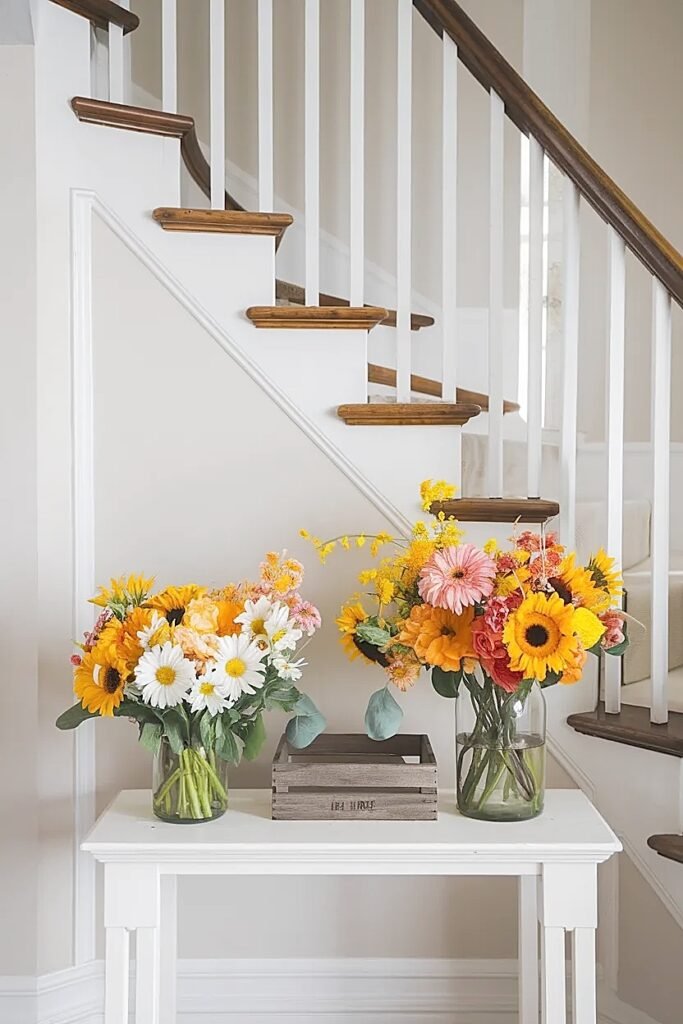
Stair landing tables are one of the most underutilized surfaces in birthday entry decorating. They sit at eye level when guests are on the stairs, close range, and get multiple views as guests move up and down throughout the party. A well-styled stair landing table is seen more times than almost any other single display in the house.
Because guests are already elevated when they reach a mid-flight landing, the table display does not need to be tall to read at eye level. A flat, face-up arrangement works as well here as a tall vertical one.
1. Face-Up Cluster Tray Fill a long narrow tray with three to five face-up arrangements of compact summer flowers: zinnias, daisies, and small sunflowers cut to one inch above a shallow vessel rim. Set the tray on the stair landing table so the blooms face directly upward toward descending guests. The face-up perspective creates a completely different visual experience than any ground-level arrangement. From the stairs, looking down into open flower faces is genuinely striking and memorable.
2. Single Crate with Trailing Vine Place a single crate on the stair landing table, fill the interior with three compact arrangements of zinnias and lisianthus, and trail a strand of seeded eucalyptus or ivy down over the crate edge toward the stair edge of the table. The trailing vine creates a connection between the table display and the staircase itself, making the two feel like one designed element rather than a table sitting next to a staircase.
3. Graduated Jar Lineup Line five bud vases of gradually increasing height along the back edge of the stair landing table, each holding one or two stems of a different summer flower: daisy, zinnia, ranunculus, waxflower, sunflower. No crate needed for this one. The graduated heights mirror the ascending steps of the staircase and create a visual rhythm that guests ascending or descending will notice and appreciate without necessarily being able to articulate why.
4. Mirror-Backed Crate Display Place a small mirror against the wall directly behind the stair landing table and set a crate display in front of it. The mirror doubles the visual depth of the arrangement and creates the impression of a much fuller display than the actual flower count warrants. One bunch of flowers reads as two. Three vessels read as six. This is the highest-impact setup for the lowest material investment on any stair landing table.
5. Fragrant Herb and Bloom Mix Fill a crate on the stair landing table with a mix of fresh grocery store herbs and compact summer blooms: rosemary, mint, basil alongside zinnias, ranunculus, and lisianthus. Guests ascending the stairs brush close to the table and the fragrance makes the whole landing feel like a designed moment rather than just a landing with a table on it. The herb-and-bloom combination looks intentional, smells exceptional, and costs almost nothing.
More in this article on how the welcome table coordinates with a stair landing display to create a complete entry experience.
Conclusion
Crates are the most underused tool in birthday entry decorating. They cost almost nothing, require no permanent installation, and transform a flat surface into a multi-level display in under ten minutes. Paired with small, tight summer flower arrangements in good-looking vessels, they create the kind of entry decor that guests remember and ask about.
Start with a single crate on your entry table and one bunch each of zinnias and lisianthus. Get that combination working, understand why the height layering matters, and every other technique in this article becomes an obvious extension of that first setup. The entry is the first thing guests see and the last thing they pass on their way out. It deserves more than a single vase on a flat surface.
This website contains affiliate links, and some products are gifted by the brand to test. As an Amazon Associate, I earn from qualified purchases. Some of the content on this website was researched and created with the assistance of AI technology.