This website contains affiliate links, and some products are gifted by the brand to test. As an Amazon Associate, I earn from qualified purchases. Some of the content on this website was researched and created with the assistance of AI technology.
Key Takeaways
- Map the table into zones first: center display, end edges, place settings, and clear working surface between them
- Gravel in every outdoor vessel before adding water: afternoon heat and outdoor exposure will tip unweighted vessels within the first hour
- Two to four inches above the vessel rim is the height ceiling for any display zone that needs to preserve sightlines
- Bold, saturated colors perform significantly better than soft pastels on an outdoor table in direct summer sun
- The clear working surface between zones is as important as the flower elements themselves: overcrowding kills functionality
- Whatever flowers you use at the table center should be echoed in a smaller or simpler version at the end positions for visual continuity
Using summer flowers across a backyard patio party table is something most people approach from the wrong direction. They decide on the flowers first and then figure out where to put them. I spent years doing exactly that, ending up with arrangements that were either too tall, too dense in the wrong spots, or too spread out to read as cohesive from any viewpoint. The approach that actually works is to map the table zones first, understand what each zone needs to do visually, and then choose flowers that fit those specific roles. The flowers are almost the last decision.
A backyard patio party table has four distinct zones: the center display zone, the edge zones at each end, the place setting positions, and the space between all of those. Treat each zone as its own design problem and the full table comes together naturally. Try to style the whole surface as a single canvas and it becomes a complicated negotiation between competing visual elements. Zone thinking simplifies everything, keeps flowers out of the working surface area, and produces a table that looks designed from every angle guests approach it.
Use this backyard patio party table chart to match each floral role with the best Summer Flowers for a useful, guest-friendly table. It helps readers choose low blooms, practical scale, color balance, and flower placement so the table feels festive, usable, and comfortable for real outdoor entertaining. Extension-style guidance supports annuals for quick seasonal color and floral-design principles like line, form, texture, and space.
| Table Role | Best Flower Type | Why It Works | Best Party Tip |
|---|---|---|---|
| Main floral accent Center rhythm across the table |
Zinnias, marigolds | Rounded blooms create strong cheerful color even in small repeated clusters. | Repeat several small clusters instead of one oversized centerpiece so guests still have space. |
| Texture flower Adds detail |
Gomphrena, celosia | Texture flowers make a patio table feel richer without needing extra height. | Use texture flowers in small doses so the table still feels relaxed and easy to use. |
| Airy softener Lightens the look |
Cosmos, chamomile-like blooms | Airier flowers help repeated table clusters feel softer instead of stiff or heavy. | Place airy stems at the outer edge of each cluster, not across serving lanes. |
| Heat-tolerant option Outdoor durability |
Gomphrena, zinnias | These are especially useful choices for hot summer patio setups. | Choose sturdier flowers when the table will sit outdoors before guests arrive. |
| Low-scale placement Guest comfort |
Compact horizontal clusters | Low arrangements support conversation, sightlines, and food sharing better than tall centerpieces. | Keep flowers below glass height whenever possible. |
| Budget-friendly mix Color without overspending |
Zinnias, marigolds, cosmos, gomphrena | Simple summer annuals still create strong cheerful color across a full party table. | Use one stronger bloom and let easier filler flowers handle the rest. |
| Kid-friendly styling Family table use |
Low sturdy blooms | Compact floral details are easier to live with at real family gatherings and outdoor meals. | Leave extra room for dessert plates, cups, and snack bowls around every cluster. |
| Color strategy Whole-table cohesion |
Repeat 2–3 main tones | Repeated tones help the full table feel coordinated without looking too busy. | Echo the same tones across napkins, plates, and floral accents for a cleaner patio-party look. |
Ways to Use Summer Flowers Across a Backyard Patio Party Table
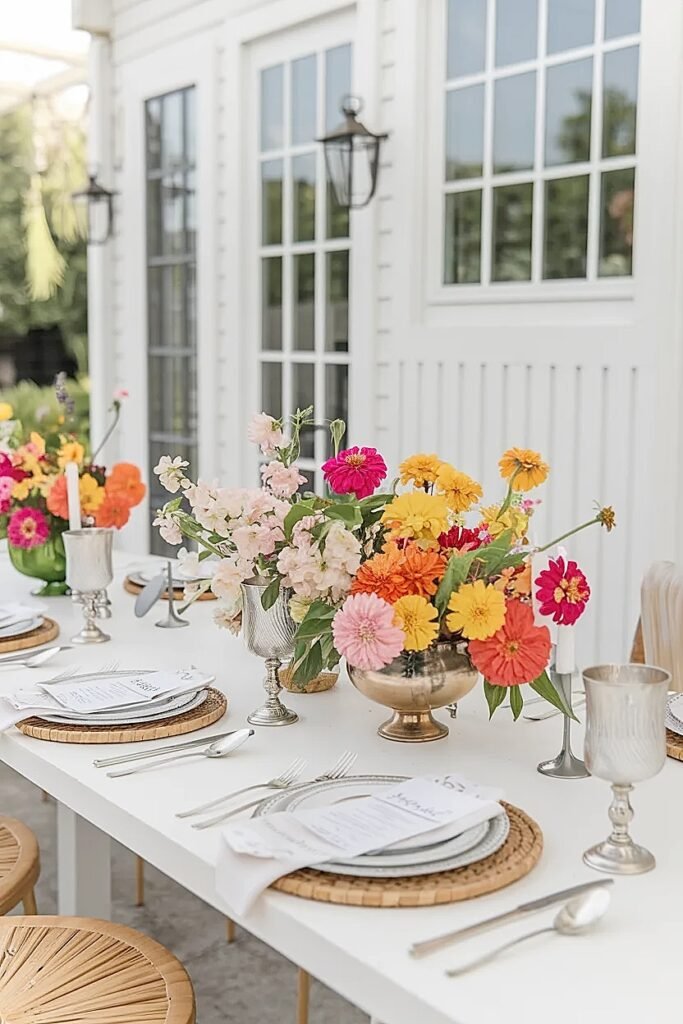
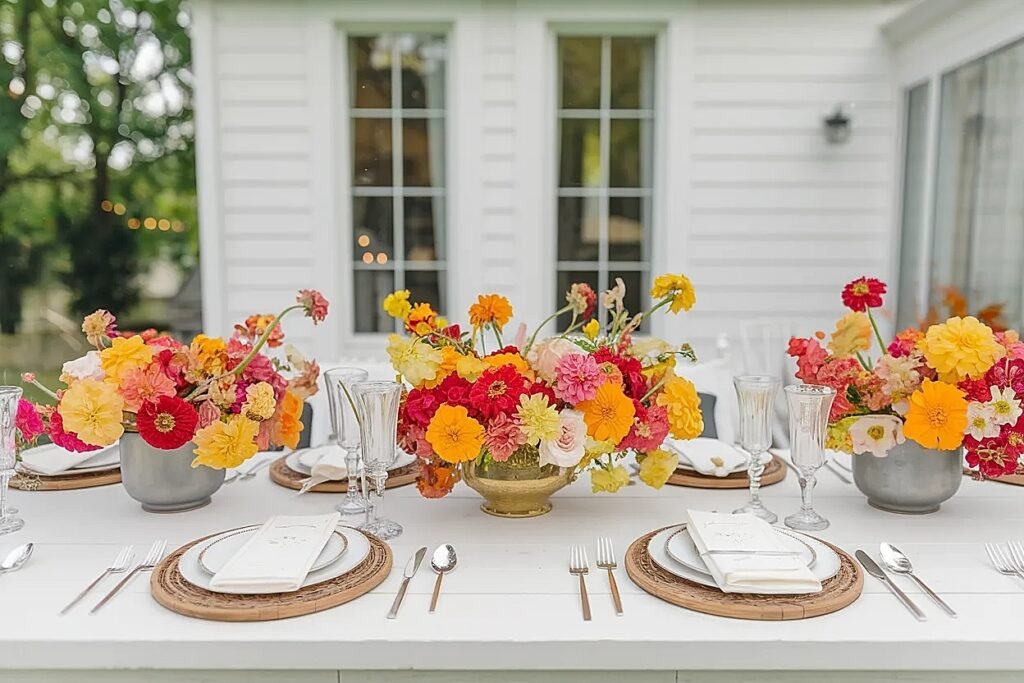
The center display zone is the spine of the table. It runs down the center of the table from end to end and holds either a continuous runner, a garland of vessels, or a series of spaced clusters. On a standard six-foot outdoor party table, five vessels at twelve-inch intervals connected by a trailing vine of seeded eucalyptus creates a runner that reads as designed without crowding the working surface.
The end zones, the last eight to ten inches of table at each far end, hold the single most stable and most impactful flower positions on the table. Corner placements at each end get close-range viewing from guests seated at the heads of the table and visible from distance by guests at the sides. A generously filled pot at each far corner with blooms four to five inches above the rim frames the entire table display.
Place setting positions, the spot above and to the left of each plate, are the personal zone of the table. These get one small bud vase or a single stem tucked into the napkin. Not a cluster. Not a mixed arrangement. One element, personal and small, that tells each guest they were thought of specifically.
The working surface between all of these zones stays completely clear. No trailing greenery that extends into the plate zone. No vessel placed at a position that crowds the reach of a seated guest. The open surface is not empty space waiting to be filled: it is a functional requirement that makes the flower zones visible by contrast.
For more on how to decorate a shared napkin basket to match the table style, check out how to decorate a backyard party shared napkin basket with summer flowers. Share this with anyone planning a backyard patio party. More ahead on every specific flower and table technique.
What Are the Best Summer Flowers for a Low Backyard Patio Party Table?
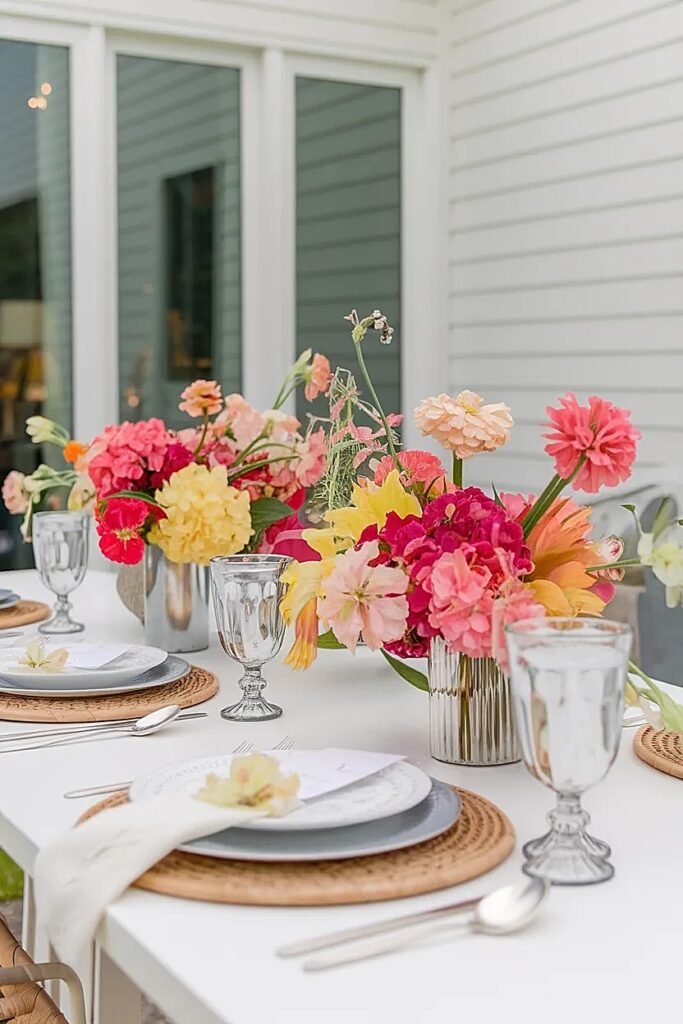
Low table arrangements require flowers that work at a specific viewing geometry: guests looking slightly down at the table surface from a seated position see the top of the arrangement, while standing guests approaching the table see it from the side. The bloom faces need to read from both perspectives simultaneously.
Every flower below is grocery store accessible throughout summer, holds its color in direct outdoor conditions, and creates strong visual presence at the two to four inch above-the-rim height that low table arrangements require.
1. Zinnias The flat, face-forward petal structure reads clearly from both above and the side simultaneously. Zero pollen, bold color range, and one grocery store bunch fills three to four gravel-weighted vessels at very low cost. They hold vivid saturation in direct afternoon sun longer than almost.
2. Marigolds Dense pom-pom blooms with no accessible stamen hold vivid orange and yellow in direct summer sun through a full party. The rounded form reads equally well from overhead or side angles. They resist wilting in outdoor heat far longer than most grocery store alternatives. One.
3. Strawflowers The papery petal structure creates strong visual texture at low table height that catches overhead outdoor light in a way smooth-petaled flowers do not. They hold their form and color in direct heat indefinitely, require no special water management, and have zero accessible pollen at.
4. Gomphrena The compact ball bloom is specifically proportioned for low table arrangements. At two to three inches above the vessel rim, one gomphrena ball reads as a distinct, designed element rather than a stray accent. The vivid pink or purple holds in outdoor heat without bleaching.
5. Waxflower Waxflower fills visual gaps at low table height that no focal flower can replicate at the same cost. The dense, fine-stemmed clusters double the apparent fullness of any low vessel arrangement without adding bulk or height. Zero pollen, mild fragrance, and the white or pale.
6. Chamomile Fresh chamomile at low table height creates the most delicate, garden-quality visual quality of any flower on this list. The small yellow-centered daisy faces catch overhead outdoor light with a warmth that larger blooms cannot replicate at close seated viewing distance. Pre-hydrate one hour; holds.
7. Lisianthus Lisianthus at low table height in a covered or shaded outdoor setup creates a visual sophistication that the more robust outdoor flowers cannot match. The layered blooms are virtually pollen-free and hold their form for five to seven days in fresh cold water. White, blush,.
More ahead on how to select specifically for heat tolerance when the table sits in direct afternoon sun for the full party duration.
How to Choose Heat-Tolerant Summer Flowers for a Backyard Patio Party Table
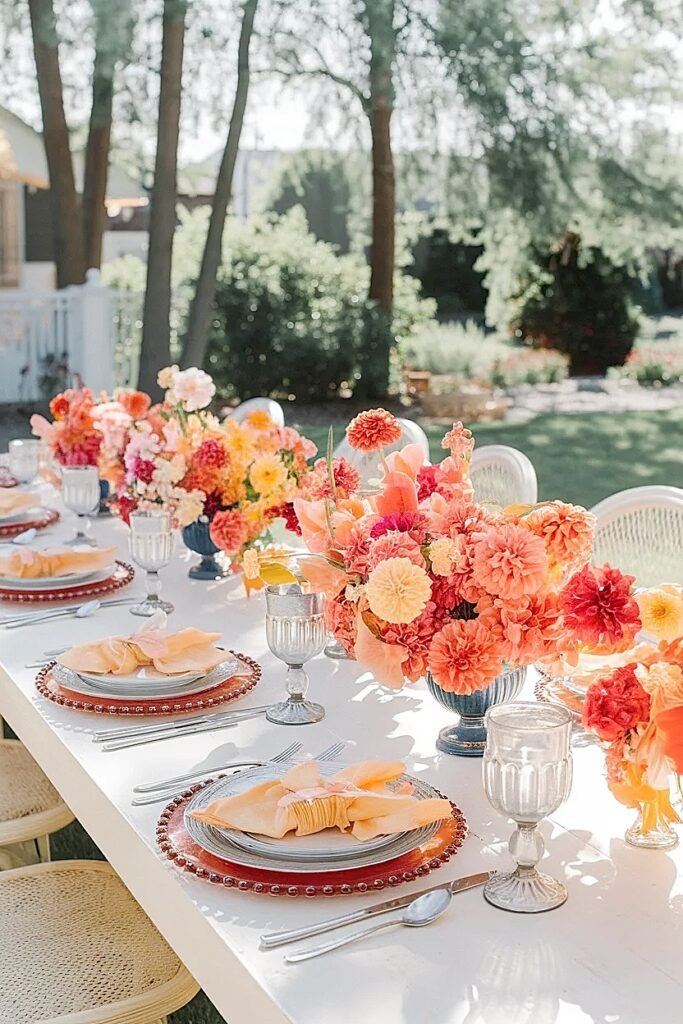
Heat tolerance is not one variable. It is three: structural integrity in high ambient temperature, color stability under direct UV, and petal retention as warm air accelerates drying. A flower can hold its shape while losing half its color in two hours of direct sun. A flower can maintain color while dropping petals into the food by mid-party. Knowing which dimension of heat tolerance matters most for the specific outdoor table scenario determines which flowers to prioritize.
For a table in full afternoon sun with no shade structure, color stability is the critical variable. Deep, saturated blooms hold visual presence longer than pale shades under direct UV. Zinnias, marigolds, strawflowers, and pompom dahlias are the four best color-stable party table flowers because their dense petal structures resist the bleaching that affects softer flowers within the first two hours of direct outdoor sun.
One practical heat management technique worth using at every outdoor party table: fill vessels with cold water immediately before guests arrive, not thirty minutes before. Cold water at setup gives stems an extra window of structural stability as the vessel temperature adjusts to the outdoor ambient. Combined with gravel in the vessel base for stability and the right flower variety for the sun exposure, that timing shift produces meaningfully better results over the arc of a long outdoor afternoon party.
For shaded setups, lisianthus, waxflower, and ranunculus become viable additions to the palette. The absence of direct UV bleaching extends their color life significantly and the reduced temperature keeps stems from collapsing as quickly as they do in full afternoon heat. If any portion of the table gets shade from a pergola, umbrella, or fence, position the more delicate flowers in that zone and reserve the robust varieties for the sun-exposed positions.
There is more ahead on which flowers work best when the table itself is genuinely small, which changes the visual scale of everything.
What Are the Best Summer Flowers for a Tiny Backyard Patio Party Table?
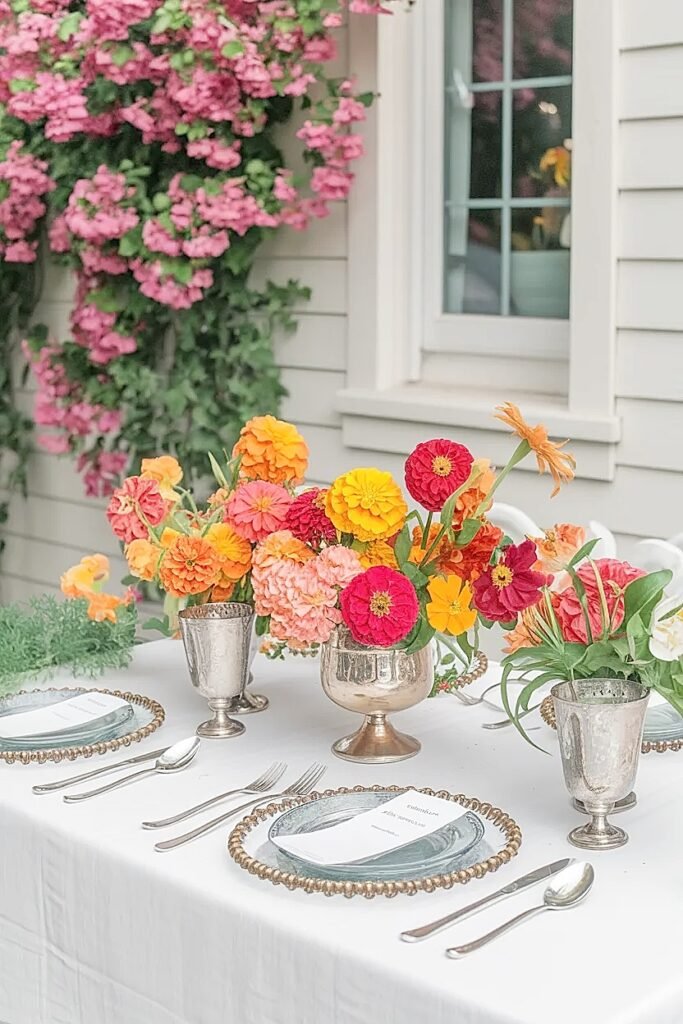
A tiny outdoor party table, four feet or shorter, demands a different scale logic from a standard six-footer. One standard-sized centerpiece arrangement consumes all the available center space and leaves no room for food, plates, or guests to reach across. The flowers here need to be physically small, arranged in the minimum number of positions that still read as designed, and chosen in colors vivid enough to hold visual presence at the smaller scale.
1. Single Zinnia per Vessel One zinnia per small vessel at a tiny table reads as intentional minimalism rather than sparse. Cut to two inches of stem in a short, heavy bud vase with gravel. One vessel at the table center and one at each far end. Three vessels total.
2. Gomphrena (Multi-Head Stem) One gomphrena stem carries three to five ball blooms on branching stems. At a tiny table, one stem in a compact vessel creates a multi-element display within the footprint of a single placement. The small ball scale suits the proportions of a compact table without.
3. Waxflower Cluster A tight bunch of waxflower in one small vessel at the table center fills visual space efficiently at small table scale. The dense fine stems create fullness within a very small vessel footprint. One bunch split between two small vessels at each end of a.
4. Chamomile Spray Fresh chamomile cut to three to four inches creates a flat, delicate spray at tiny table height that reads as a complete arrangement without any additional material. Three to five stems in one low vessel. The daisy scale suits the proportions of a compact outdoor.
5. Strawflower (Small Head) Small-headed strawflowers in cream, pale yellow, or soft pink suit the scale of a tiny party table better than the large-headed orange or red varieties. The proportionally smaller bloom reads correctly at compact table size. Zero water requirement makes placement within any tight arrangement uncomplicated.
6. Single Herb Pot One compact potted herb, a small rosemary bush or low basil plant, at the center of a tiny outdoor party table is the most practical and most visually appropriate single-element tiny-table treatment available. No cut stem management, zero pollen concern, and the living plant adds.
7. Statice Spray A small statice spray in one low, wide vessel creates the most visual coverage per dollar of any tiny table flower. The spray spreads horizontally, filling visual space efficiently within a minimal vessel footprint. Zero water requirement, full outdoor heat stability, and the papery texture.
More ahead on how to incorporate sunflowers specifically, which have proportional challenges at any table scale but particularly rewarding results when handled correctly.
How to Build a Backyard Patio Party Table with Summer Flowers and Sunflowers
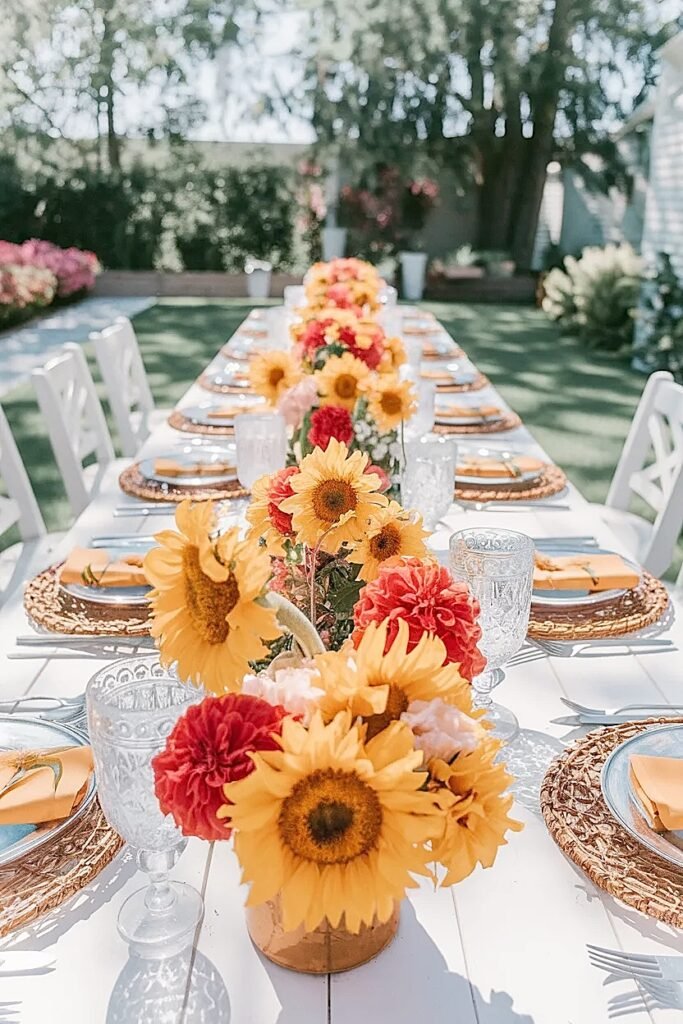
Sunflowers on an outdoor party table require a specific approach that most guides skip: the height problem. A full grocery store sunflower at natural stem length rises fifteen to twenty inches above the rim of any standard vessel, which blocks sightlines completely and catches afternoon wind aggressively. Uncut, a sunflower has no business on a party table. Cut short, it becomes one of the most visually powerful per-stem elements in any outdoor table display.
Cut each sunflower to four to six inches above the vessel rim. At that height the oversized flat face sits in the low display zone rather than above it, reads as bold and celebratory from every position around the table without blocking eye contact, and catches overhead outdoor light from directly above in the most effective orientation possible for a flat-petaled flower. One sunflower per vessel. Never two in the same container. The single overscaled face at low height is the entire design statement.
The supporting flowers around a short-cut sunflower need to be smaller in scale to avoid visual competition. Waxflower, statice, and seeded eucalyptus all work well because their fine structure makes the sunflower face look even larger by contrast. Zinnias and marigolds at full scale become competitors at the same vessel. Keep the surrounding material small and the sunflower reads as the clear focal point of the full table display.
Gravel is especially important in sunflower table vessels because the heavy bloom head creates top-weight that tips standard-weighted vessels more aggressively than any other common party flower. Two full inches of gravel before adding cold water. For any vessel holding a sunflower on an outdoor table where guests will be reaching across, that gravel depth is the non-negotiable minimum.
More ahead on the specific techniques that preserve sightlines across the full table while still creating a genuinely full and festive table display.
Ways to Build a Sightline-Safe Backyard Patio Party Table with Summer Flowers
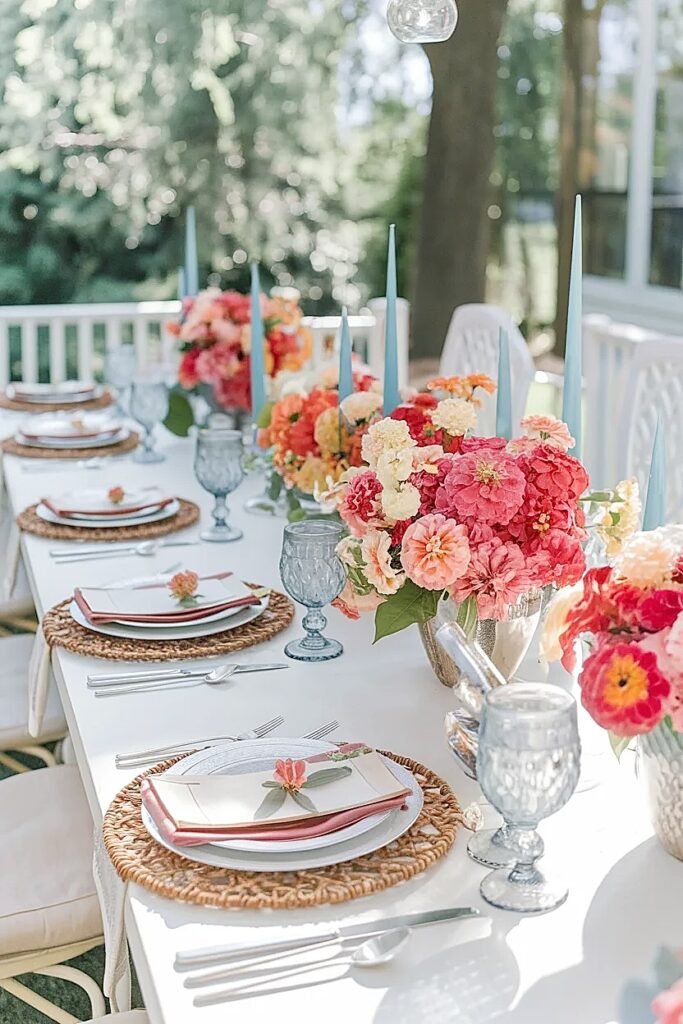
Sightline safety at an outdoor party table means every seated guest can make eye contact with every other seated guest across the table without leaning, shifting, or working around flower arrangements. This is the functional test that separates a well-designed outdoor party table from a beautiful-looking obstacle course. I have sat at too many outdoor tables where the centerpiece required leaning sideways to see the person directly across from me. Once experienced, it becomes the first thing I check when I style any party table.
1. Maximum Four-Inch Bloom Height Rule Cut every stem so the bloom face sits no more than four inches above the vessel rim. Measure from the rim, not the table. Four inches is the height at which a bloom registers clearly in peripheral vision from a seated position without crossing into the sightline zone. Below that threshold, the full table of.
2. Floating Bloom Bowl at Center Fill a wide, low bowl with one inch of water and float five to seven zinnia or marigold faces face-up across the surface. Set the bowl at the table center. Nothing rises above the bowl rim. Overhead outdoor light catches the open faces beautifully from above. Zero sightline impact from any seated position. The most.
3. Five Vessel Garland Below the Horizon Line Build a runner of five gravel-weighted short vessels at even twelve-inch intervals down the table center, each holding two stems cut to three inches above the rim, connected by seeded eucalyptus tucked under each base. The three-inch maximum keeps the display well below the seated eye horizon. The connecting vine creates the garland visual without.
4. Two Far-End Corner Pots Only Place one compact gravel-weighted pot at each far end of the table, each holding three to four stems at four inches, and leave the full center of the table completely clear. The two far-end corner pots read as a frame that defines the table as styled from every angle, while the clear center maintains perfect.
5. Face-Up Dish Display Five wide, shallow ceramic dishes down the table center, each with a half-inch of water and three to four zinnia or marigold heads placed face-up directly on the water surface. Nothing rises above the dish rim. Guests see open bloom faces from above at their seated position and from the side as they approach. The.
More ahead on how bright mini flower varieties specifically work across a party table when the goal is maximum color visibility from minimum material.
Ideas for Bright Mini Summer Flowers Across a Backyard Patio Party Table
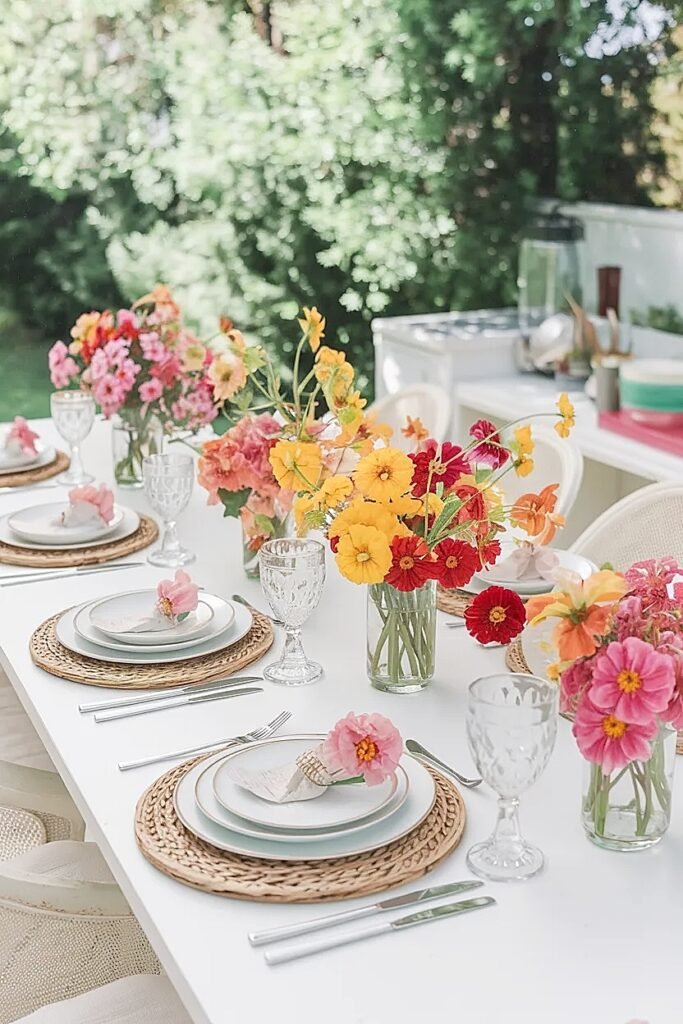
Mini and compact flower varieties are not a default to reach for when the budget is tight. They are the right choice for an outdoor party table when maximum color visibility across multiple table positions is the goal. One vivid mini arrangement per zone, the center garland, the end corners, and the place settings, creates a color rhythm across the full table that reads as designed from every approach angle.
1. Gomphrena Ball Row at Center Line five to seven small gravel-weighted vessels down the table center, each holding one gomphrena stem at two to three inches above the rim. The repeating ball pattern creates a graphic, intentional visual line that reads clearly from standing height. One color across all vessels,.
2. Single-Color Waxflower Cluster Trio Place three matching short vessels at even intervals down the table center, each holding a dense bunch of waxflower in one color, all white or all pale pink, at rim height. The three-vessel repetition of one variety in one color creates a clean, restrained display.
3. Alternating Chamomile and Zinnia Mini Vessels Alternate short vessels of chamomile and single zinnia stems down the center of the table: chamomile vessel, zinnia vessel, chamomile vessel, zinnia vessel. The alternating texture and scale creates a visual rhythm that reads as designed. The chamomile provides fine delicate texture, the zinnia provides.
Conclusion
Using summer flowers across a backyard patio party table comes down to zone thinking, height discipline, color saturation for outdoor light, and gravel in every vessel. Map the center display, the end corners, and the place setting positions first. Choose flowers that hold vivid color in direct outdoor sun. Keep everything below four inches above the vessel rim. Leave the working surface between zones completely clear.
Start with the center garland and the two end corners. Get those three positions right and every other decision on the table follows naturally from the visual framework they establish.
This website contains affiliate links, and some products are gifted by the brand to test. As an Amazon Associate, I earn from qualified purchases. Some of the content on this website was researched and created with the assistance of AI technology.