This website contains affiliate links, and some products are gifted by the brand to test. As an Amazon Associate, I earn from qualified purchases. Some of the content on this website was researched and created with the assistance of AI technology.
Key Takeaways
- Maximum centerpiece footprint: 30% of table surface preserving 70% for food and serving
- Low bowls under 6 inches tall maintain sightlines and prevent visual barriers across tables
- Off-center positioning leaves prime central space clear for serving platters and shared dishes
- Runner arrangements using multiple small vessels distribute beauty without claiming contiguous space
- Compact summer flowers like zinnias and marigolds create impact in minimal footprints
- Round table centerpieces need radial symmetry maintaining equal clearance from all seating positions
- Coffee table arrangements require ultra-low profiles preserving drink-setting and snack-access zones
Making summer flowers centerpieces that don’t block food on patio tables requires abandoning every indoor dining aesthetic you’ve absorbed from magazines or Pinterest boards. Those towering dramatic arrangements? Disasters outdoors where people need unobstructed access to serving platters, where platters themselves occupy substantial real estate, and where the casual nature of patio dining means food constantly moves around tables rather than staying in fixed positions. I learned this hosting my first outdoor dinner party five years ago, my “beautiful” centerpiece became an obstacle that guests kept relocating or leaning around awkwardly trying to reach the potato salad.
The brutal truth: outdoor dining centerpieces exist to enhance meals, not complicate them. Every flower arrangement must answer one critical question before earning table space: does it preserve adequate surface area for food service and dining? If the answer involves any hesitation, the centerpiece fails. The successful approach embraces restraint, smaller vessels, lower profiles, strategic positioning that treats food service as the primary table function and flowers as the supporting aesthetic element. This hierarchy feels backwards initially because we’re conditioned to make centerpieces the star, but outdoor dining demands humility from your flowers.
Patio tables get crowded fast—especially once the food hits. This cheat sheet shows how to keep Summer Flowers centerpieces low, wide, and out of the way using serve lanes, off-center placement, trays, and runner layouts. Tap the mobile cards and copy the checklist for quick, food-friendly setup.
Food-Friendly Summer Flowers Patio Centerpieces: Serve-Lane Cheat Sheet
Built for low, wide Summer Flowers centerpieces that keep platters, plates, and hands moving.
| Patio Setup | Best Container Mix | Summer Flowers Formula | Do This / Avoid This |
|---|---|---|---|
|
Main dining table serve lanelow + wideno blocking |
Shallow matte bowl placed off-center
Goal: centerpiece looks styled, platters still fit.
|
Pocket clusters: zinnias + daisies + marigold pops (short stems)
Pro: width from pockets, not height.
|
Do: keep a clear lane for food. Avoid: tall stems + puffy filler. |
| Snack-heavy table snack zonecompact |
Low non-slip tray + defined coaster/plate zone | Small pockets only; keep silhouette low | Do: reserve snack space. Avoid: tray sprawl. |
| Long patio table runner feelplate space |
Low trough OR 7–9 mini low bowls | Repeat pockets down centerline; ends stay open for platters | Do: keep ends clear. Avoid: center clutter. |
| Buffet/serve table labels visiblegrab space |
Low trough on one end; middle open | Compact pockets; no tall blooms | Do: keep label zone clear. Avoid: blocking utensils. |
| Round patio table even spacebalanced |
Shallow round bowl sized to table | Even circular pockets; keep center low | Do: leave plate ring space. Avoid: tall center stack. |
Main dining table (Serve lane stays open)
Snack-heavy table (Tray + defined snack zone)
Long patio table (Runner that keeps ends clear)
Buffet/serve table (Labels + utensils visible)
Round patio table (Plate ring space stays open)
How to Make Summer Flowers Centerpieces That Don’t Block Food on Patio Tables Using Low Bowls
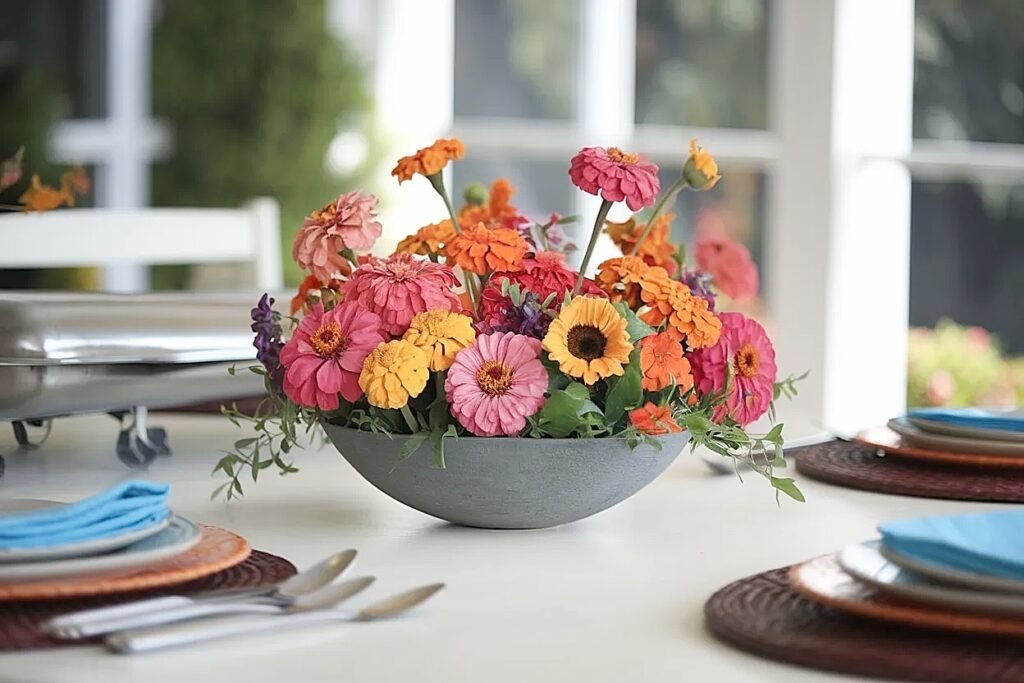
Low bowls solve the fundamental patio centerpiece dilemma by creating horizontal emphasis that preserves vertical sightlines and leaves maximum surface area available for the food that actually matters at outdoor meals. I approach these with militant discipline about proportions, the bowl’s diameter determines how much table real estate gets claimed, while its depth dictates whether the resulting arrangement will interfere with serving or stay appropriately low.
Maximum bowl diameter for standard 48-inch round patio tables: 14 inches. That claims roughly 154 square inches of an 1,809 square-inch table surface, about 8.5% of total area, leaving massive clearance for serving dishes, plates, and the inevitable moments when someone needs to set down a pitcher or platter mid-meal. On rectangular tables I calculate even more conservatively, limiting centerpieces to 12 inches diameter preserving generous linear surface for family-style serving.
The shallow depth requirement forces appropriate height restrictions automatically. I use bowls with 3-4 inch depths maximum, there’s simply not enough vertical space for tall stems even if you wanted them. This depth limitation creates inherently low-profile arrangements that won’t block sightlines across tables or create visual barriers between diners trying to have conversations while eating.
I fill these shallow wide bowls with summer flowers cut to 6-8 inches total stem length, creating arrangements topping out at maybe 10 inches including vessel height. The wide diameter creates horizontal spread maximizing visual impact while the restricted height keeps everything dining-friendly. Maybe 10-12 zinnias creating a vibrant dome, or 8 small sunflowers spreading outward, or 12-15 marigolds packed densely creating lush coverage within the confined footprint.
The positioning discipline matters as much as the vessel choice. I never place bowls dead-center on patio tables, that prime location belongs to shared serving dishes, not flowers. Instead I position bowls offset by 6-8 inches toward table edges, leaving the absolute center clear for that inevitable platter of grilled chicken or bowl of pasta salad that becomes the meal’s actual focal point, and for comprehensive guidance on creating food-friendly summer patio arrangements for various celebration contexts, there are detailed strategies worth exploring, share this with anyone hosting outdoor summer gatherings!
The low bowl foundation establishes spatial discipline, and the off-center placement techniques ahead show how to preserve prime serving zones.
Ways to Place Summer Flowers Centerpieces Off-Center So Patio Tables Stay Serve-Ready
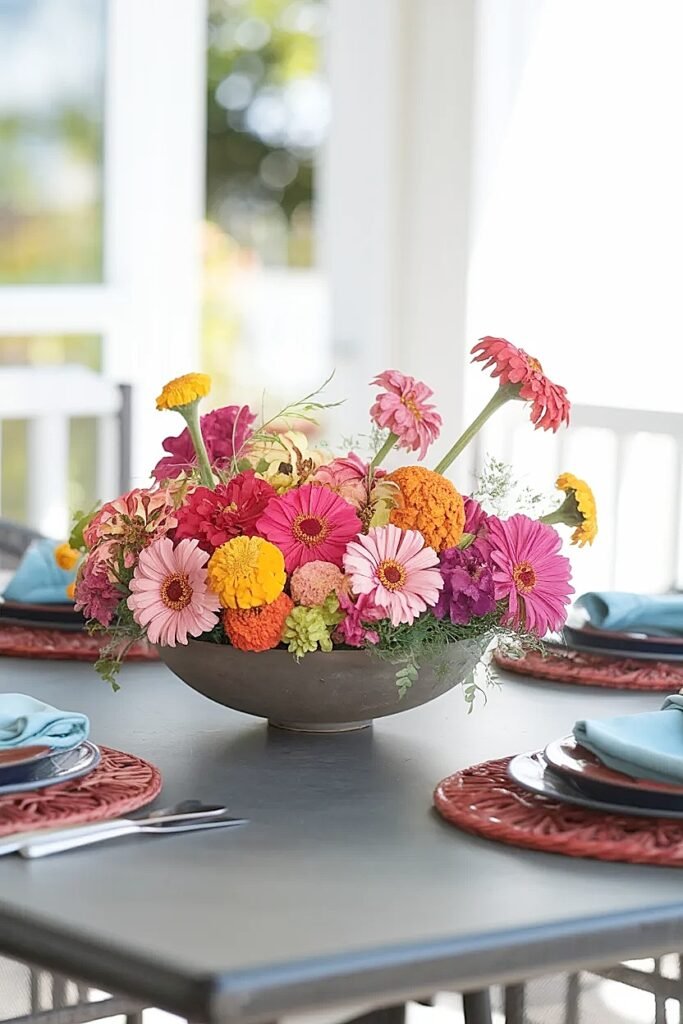
Off-center positioning feels instinctively wrong because we’re trained to center decorative elements creating symmetry and balance. But patio tables serving actual meals operate under different rules, the center position must stay available for shared dishes that everyone needs to access, making traditional centered centerpieces actively problematic rather than merely decorative.
I’ve adopted asymmetric positioning as my default outdoor approach, treating the table center as sacred serving territory that flowers can never occupy.
1. Edge-Offset Positioning Preserving Central Clearance
Position centerpiece 8-10 inches from table edge rather than centered, creating asymmetric placement that leaves massive central zone completely clear for serving dishes and plates. On 48-inch round tables, this offset positioning claims edge territory while preserving roughly 30+ inches of central diameter for food service. The asymmetry feels deliberate rather than accidental through consistent offset distance. Use 10-12 inch bowl with summer flowers creating substantial presence despite non-central location. The offset preserves sightlines across tables while central clearance accommodates serving logistics.
2. Corner Positioning on Rectangular Tables
Place centerpiece in one table corner rather than center, claiming underutilized corner real estate while entire central span stays free for linear food service down table length. This works brilliantly on rectangular patio tables where the corner position provides visual interest without interfering with the dominant linear serving pattern most outdoor meals follow. Use 8-10 inch vessel in corner with asymmetric arrangement extending toward table interior creating dynamic composition while functional space stays clear.
3. Dual End Placement Creating Bookend Effect
Position two smaller centerpieces at opposite table ends rather than one central piece, creating bookend framing while the entire middle span remains available for food. Use two 8-inch bowls at table extremes leaving 80%+ of linear surface clear for serving. The dual placement distributes floral presence creating visual interest at table boundaries while central zone handles the heavy lifting of actual dining logistics. Total floral footprint stays minimal despite two arrangements through strategic end positioning.
The off-center strategies liberate prime serving zones, and the runner concepts ahead show how to distribute floral beauty without claiming contiguous space.
How to Build Summer Flowers “Runner” Centerpieces That Don’t Block Food on Long Patio Tables
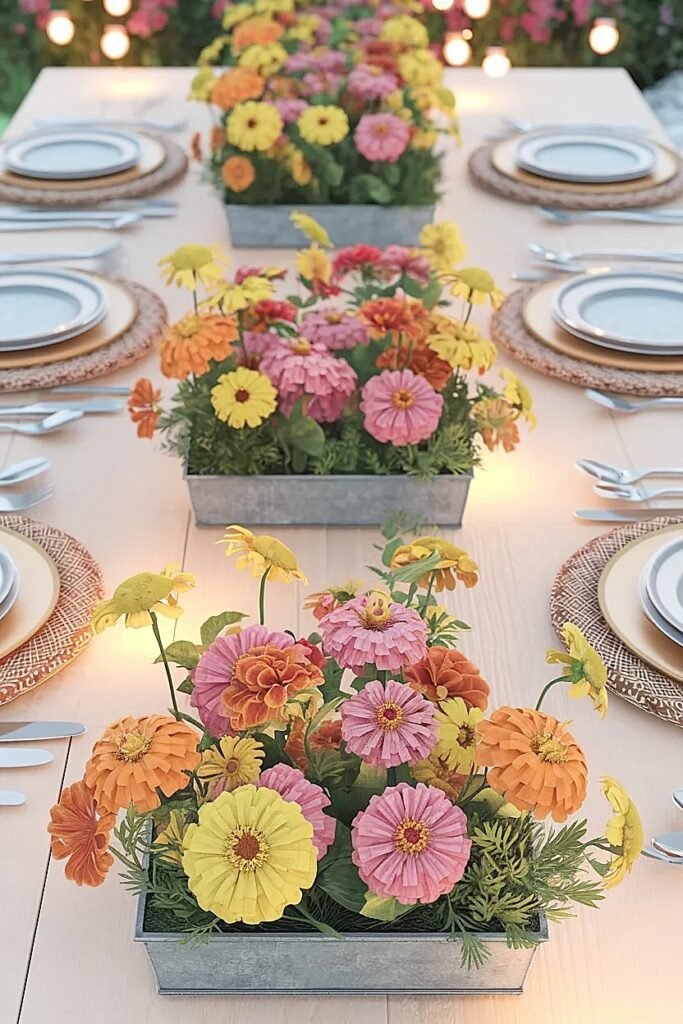
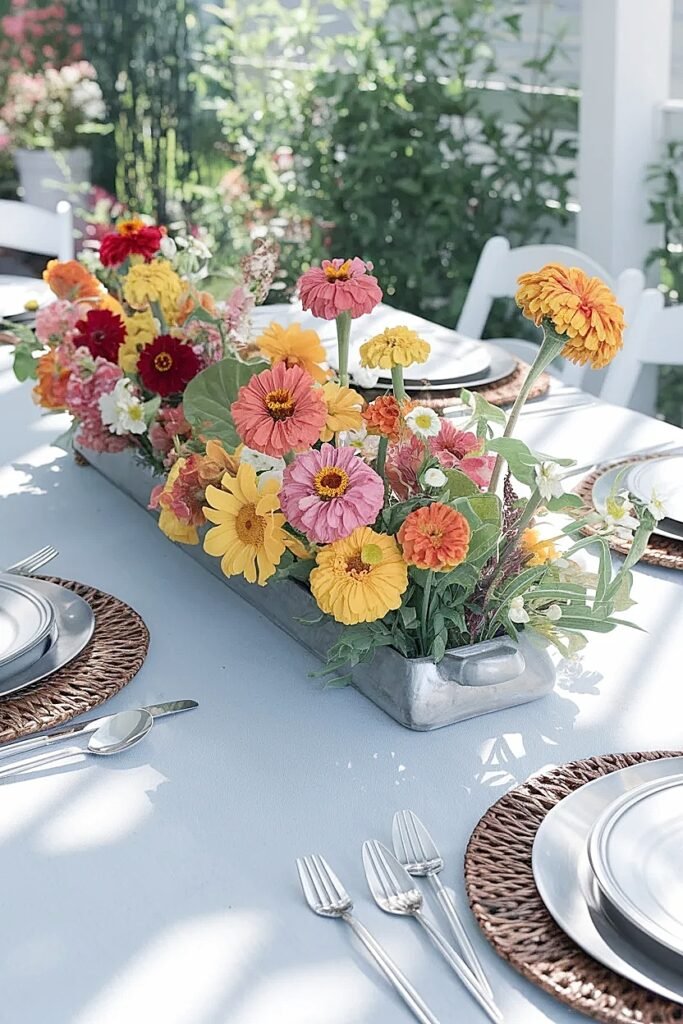
Table runners using multiple small vessels create continuous visual interest along table lengths while preserving the critical gaps between vessels where serving dishes, plates, and hands must navigate during meals. The distributed approach also adapts better to outdoor dining’s fluid nature, vessels can be temporarily relocated during serving then repositioned after everyone’s plated.
I use 5-7 small containers measuring just 4-6 inches diameter each, spacing them 12-18 inches apart creating rhythmic pattern down table length. The individual small footprints mean each vessel claims maybe 20-30 square inches while the gaps between provide generous clearance for all the serving logistics that patio dining demands.
The spacing discipline prevents the runner from becoming a continuous barrier. Those 12-18 inch gaps between vessels create designated serving zones where platters can sit, where hands can reach across without navigating around flowers, and where the table’s function as food surface gets preserved despite the floral decoration.
I build these runners using identical small vessels for visual cohesion, maybe mason jars, small terracotta pots, or simple ceramic bowls, each holding 3-5 summer flower stems. The uniformity creates intentional design while the small scale keeps everything manageable. Total flower investment might be 20-25 stems distributed across 5 vessels, creating substantial visual presence through strategic distribution rather than concentrated mass that would claim excessive space.
The color approach can unify or vary. I sometimes use single colors across all vessels creating monochromatic runner installations, other times I alternate colors creating rhythmic variation. Both work, but the key remains consistent: the runner creates beauty through multiplication and distribution, not through individual vessel impact.
The runner distribution maximizes beauty while minimizing spatial claims, and the flower selection guidance ahead identifies which specific blooms work best in constrained patio contexts.
What are the Best Summer Flowers for Patio Table Centerpieces That Don’t Block Food?
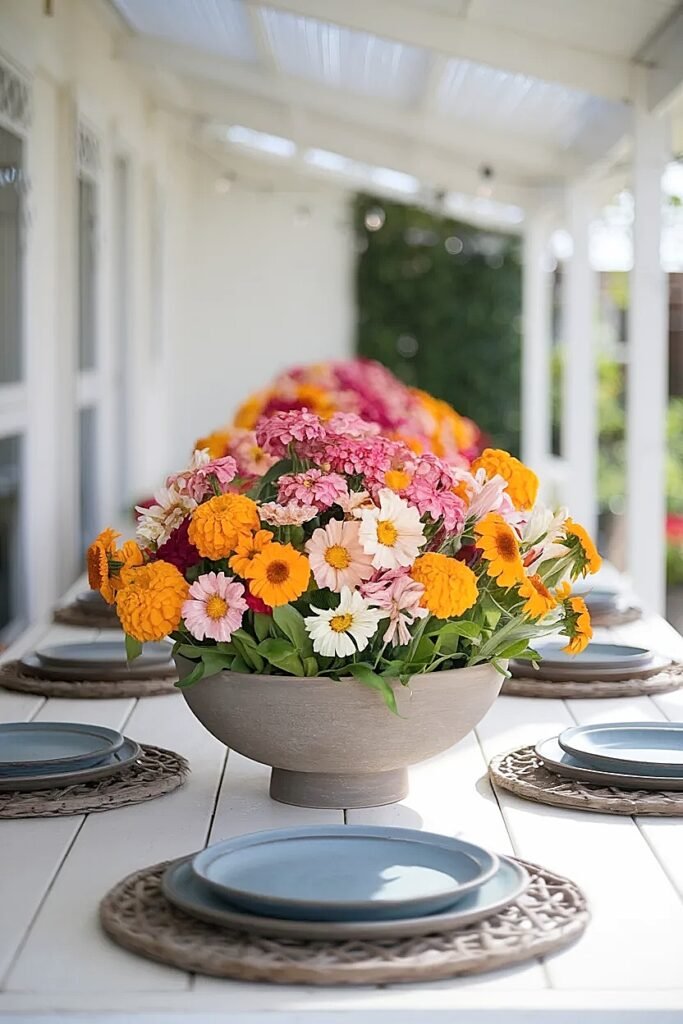
Not all summer flowers work equally well in food-friendly patio centerpieces, some naturally grow compact and cooperative while others demand space and height that outdoor dining tables simply cannot accommodate. The winners combine compact growth habits, substantial blooms relative to stem length, and the ability to look intentional rather than stunted when cut short.
These seven consistently deliver maximum impact in minimal footprints.
1. Zinnias for Compact Colorful Impact
Zinnias produce substantial 2-4 inch blooms on relatively compact stems perfect for low arrangements that won’t interfere with food service. The bold daisy-like flowers create impact even when cut to just 6-7 inches total height. The incredible color range from white through coral to deep burgundy provides options for any aesthetic. The sturdy stems hold positions well in arrangements. Grocery stores sell zinnia bunches for $8-12 providing excellent value creating impressive centerpieces under $15 total investment.
2. Marigolds for Budget-Friendly Abundance
Marigolds offer exceptional value, large bunches at $5-8 providing 15-20 stems creating generous coverage. The pompom blooms in orange, yellow, and burgundy create cheerful summer energy. The compact growth habit means they look natural cut to 5-6 inches maintaining proper proportions. The sturdy construction withstands outdoor conditions including heat and occasional wind. The abundance per bunch allows multiple small arrangements from single purchase creating runner installations economically.
3. Dahlias for Upscale Compact Beauty
Small dahlia varieties produce substantial layered blooms on stems that work beautifully cut to 7-8 inches total height. The complex petal structures create sophisticated visual interest. The range from soft pastels to deep saturated colors provides versatility. While more expensive at $12-15 per bunch, the premium appearance justifies investment for special outdoor meals. The substantial blooms create impact from fewer stems making them economical despite higher per-stem costs.
4. Cosmos for Airy Delicate Presence
Cosmos features delicate daisy-like blooms on thin stems creating airy presence that doesn’t feel heavy or obstructive on patio tables loaded with food. The flowers sit naturally at 6-8 inches creating appropriate low profiles. The variety of colors from white through pink to burgundy coordinates with various outdoor settings. The delicate nature prevents arrangements from feeling imposing or formal. Budget-friendly at $6-10 per bunch.
5. Celosia for Unusual Textural Interest
Celosia’s unique crested or plumed flower heads create unusual texture adding interest to standard summer flower selections. The compact growth suits low arrangements perfectly. The vivid colors, hot pink, orange, yellow, burgundy, create bold statements. The unusual form makes even simple arrangements feel special and considered. Available at $8-12 per bunch creating distinctive centerpieces that stand out from typical summer flowers.
6. Gerbera Daisies for Bold Cheerful Presence
Gerbera daisies produce large cheerful blooms (3-4 inches diameter) on short stems naturally suited to low centerpiece work. The bold simple form creates instant impact. The saturated colors create vibrant energy perfect for casual outdoor dining. While individual stems cost more ($2-3 each), their substantial presence means fewer stems create impressive arrangements. Five gerberas create impactful centerpieces for under $15.
7. Lisianthus for Romantic Elegance
Lisianthus produces rose-like blooms on delicate branching stems creating romantic sophisticated arrangements in compact formats. The soft colors, white, pale pink, lavender, create elegant presence without overwhelming. The multiple blooms per stem provide good value. The delicate nature suits intimate outdoor dinners where subtlety beats boldness. Available at $10-14 per bunch creating upscale-looking centerpieces from moderate investments.
These flower selections work naturally in constrained formats, and the bud vase techniques ahead show how to minimize spatial claims even further.
Ways to Use Mini Summer Flowers Bud Vases to Keep Patio Tables Clear for Food
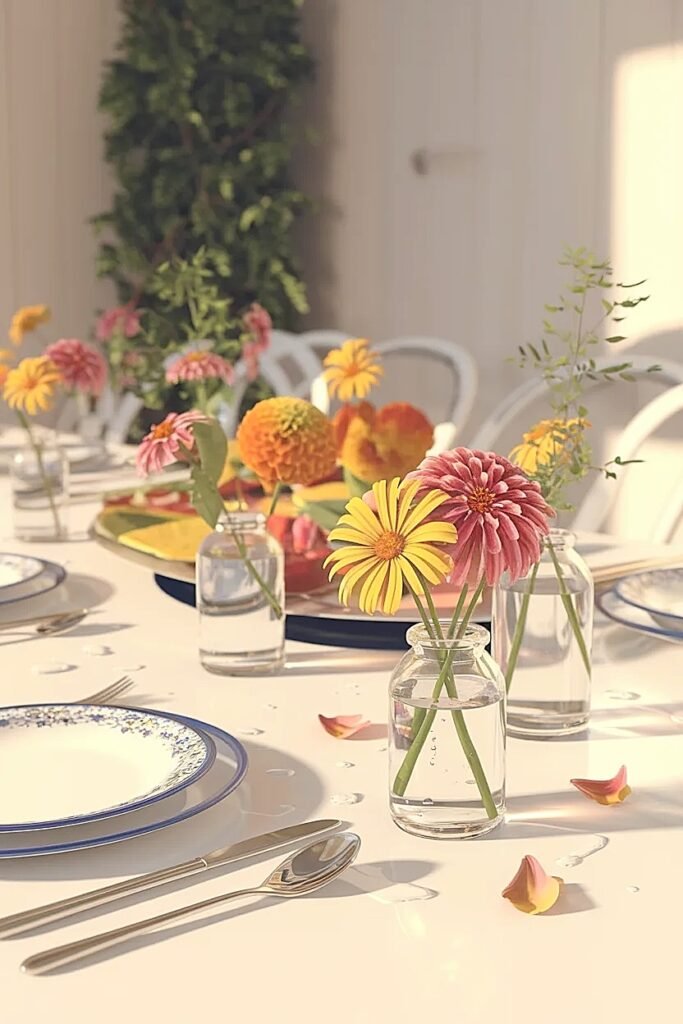
Bud vases represent the ultimate space-efficient approach, each individual vessel claims maybe 6-10 square inches of table surface while collectively creating substantial visual presence through multiplication. The tiny individual footprints mean they can nestle between serving dishes, plates, and glassware without creating spatial conflicts that larger centerpieces would generate.
I buy 6-10 small bud vases measuring 3-4 inches diameter and 4-6 inches tall, distributing them across the table in strategic patterns that create beauty without blocking function.
1. Scattered Random Distribution Creating Organic Feel
Position 8-10 bud vases randomly across table surface creating organic scattered effect rather than rigid geometric pattern. Each vase holds one perfect summer bloom, maybe individual zinnias, dahlias, or cosmos. The random distribution feels natural and uncontrived while the tiny individual footprints mean they nestle between plates and serving dishes without interference. The collective impact creates substantial floral presence despite minimal individual claims. Buy one flower bunch ($10-12) distributing stems across multiple vases creating impressive installation under $25 including inexpensive vessels.
2. Linear Row Creating Minimalist Runner Effect
Arrange 6-8 bud vases in straight line running table length creating minimalist runner installation with maximum spatial efficiency. Each vase holds 1-2 stems creating delicate vertical accents. Space vases 10-12 inches apart leaving generous gaps for serving access. The linear organization creates intentional design while tiny footprints preserve table functionality. This approach works brilliantly on rectangular patio tables where the linear form echoes table geometry. Total cost under $20 for flowers and basic glass bud vases.
3. Clustered Groupings at Table Thirds
Create three clustered groupings of 2-3 bud vases each positioned at table thirds rather than even distribution. Each cluster creates focal point while spacing creates serving gaps. Each vase holds one bloom creating delicate grouped installations. The clustered approach feels more intentional than random scattering while maintaining the space efficiency that bud vases provide. The thirds division creates rhythm and organization. Works on tables 60+ inches long where the spacing creates meaningful zones.
4. Perimeter Ring Leaving Central Zone Clear
Position 8-10 bud vases in ring around table perimeter leaving entire central zone completely open for serving dishes and plates. Each vase sits near table edge creating boundary definition while center stays functional. The perimeter positioning maximizes floral presence while preserving maximum serving space. This works particularly well on round tables where the ring creates even distribution visible from all seating positions. The center clearance accommodates shared dishes everyone needs to access.
5. Alternating Bud Vase and Serving Dish Pattern
Rather than fighting serving dishes for table space, embrace them by creating alternating pattern, bud vase, serving dish, bud vase, serving dish, integrating flowers into the serving layout itself. The bud vases nestle between functional items becoming part of the tablescape rather than competing with it. The integrated approach creates cohesive aesthetic where flowers and food relate harmoniously. The tiny bud vase footprints allow this integration without spatial conflicts larger centerpieces would create.
The bud vase approaches minimize spatial impact, and the height guidance ahead ensures arrangements work in dining contexts.
How to Keep Summer Flowers Centerpieces Low for Conversation and Serving on Patio Tables
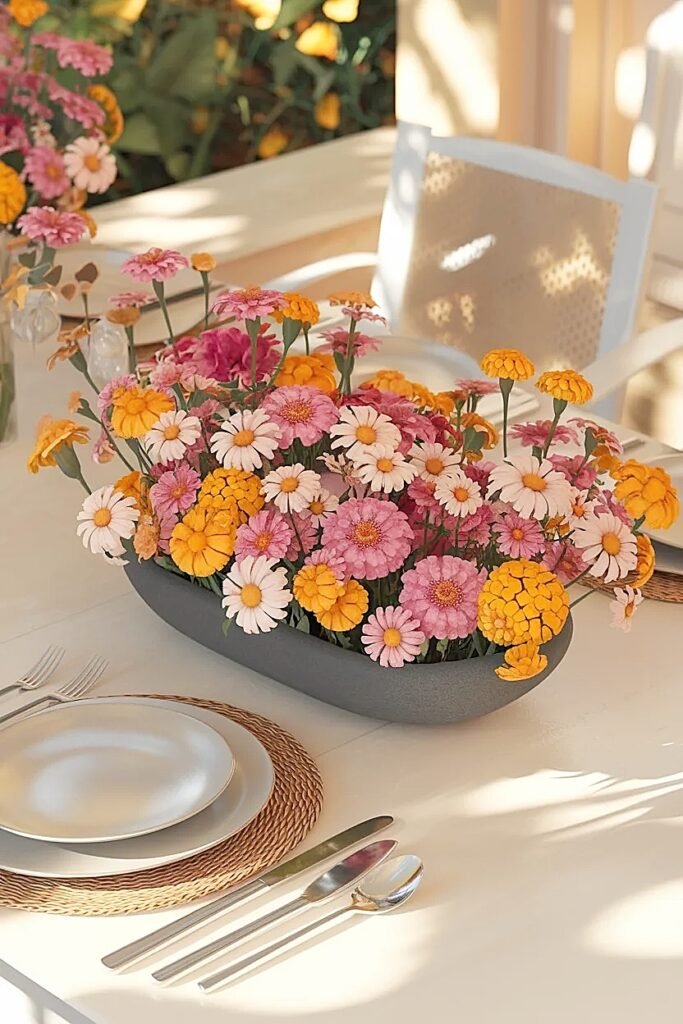
Low profiles serve two critical functions on patio dining tables: maintaining conversation sightlines between diners and ensuring serving dishes remain visible and accessible rather than getting hidden behind tall floral barriers. The maximum height for outdoor dining centerpieces is 12 inches total, anything taller blocks views and interferes with the casual interactive nature that patio meals embody.
I cut all summer flower stems to 6-8 inches before arranging, creating finished heights between 9-11 inches including vessel depth. This feels wasteful initially, those stems arrive maybe 16-20 inches long and trimming away half seems like discarding value. But the bloom-covered tops deliver visual impact, not the bare stem length.
The cutting discipline forces horizontal spread rather than vertical growth. When stems stay long, arrangements naturally build upward. Cut to 6-8 inches, they have nowhere to go but outward, creating the wide low coverage that patio dining demands. I angle stems outward from bowl centers creating dome shapes extending beyond vessel rims, maximizing perceived diameter while maintaining restricted height.
I also use floral foam or grid supports to hold stems at desired angles, preventing them from standing vertically which would add unwanted height. The mechanical support enables the outward positioning that creates width without height, achieving the dimensional priorities outdoor dining requires.
Testing from seated positions proves essential. I physically sit at my patio table before finalizing arrangements, checking sightlines from normal dining perspectives. If I can’t clearly see someone sitting opposite me, the arrangement is too tall and gets recut immediately. The 12-inch maximum works for most contexts, but some situations demand even lower profiles, maybe 8-10 inches for particularly low patio furniture.
The height discipline ensures functionality, and the round table guidance ahead addresses all-around access requirements.
How to Make Summer Flowers Centerpieces for Round Patio Tables Without Crowding Plates
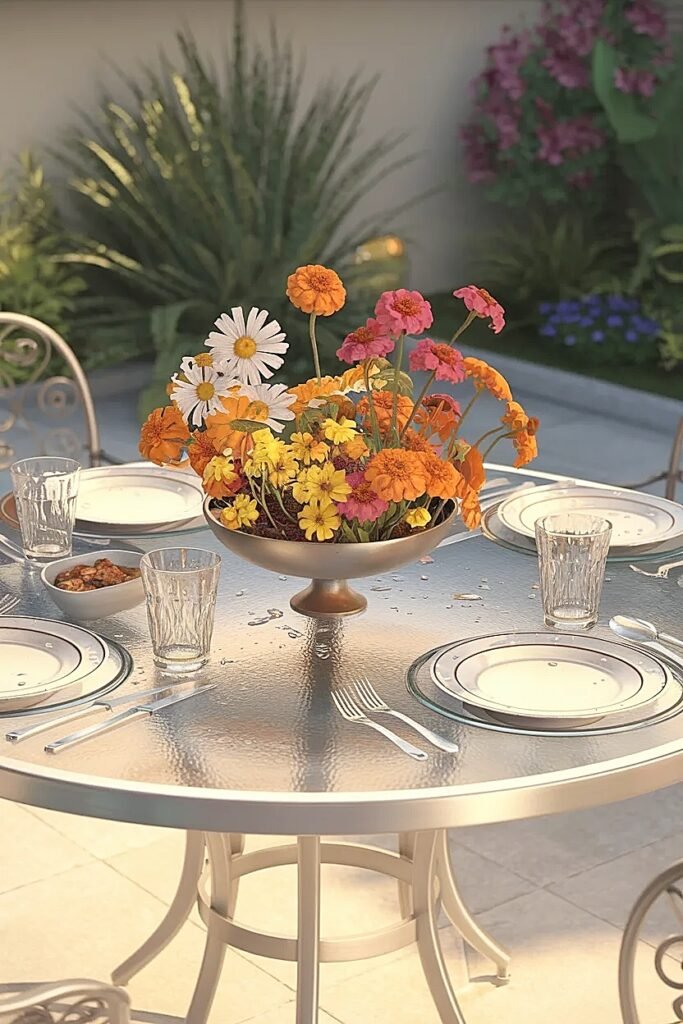
Round patio tables present unique challenges, every seat position needs equal access to central shared dishes, making centerpiece placement critically important. Unlike rectangular tables where one end might accommodate centerpieces while the other serves food, round tables demand radial symmetry where the centerpiece must maintain equal distance from all seating positions.
I use 10-12 inch diameter bowls maximum on standard 48-inch round patio tables, creating arrangements that occupy the central 10-12 inches while leaving roughly 18 inches of clear radius around the perimeter where plates, glasses, and serving dishes live during meals. This radial clearance ensures every diner has adequate personal space plus easy access to shared central dishes positioned around the centerpiece.
The centerpiece itself must work from all viewing angles, every seat sees it differently, making 360-degree attractiveness essential. I build with radial symmetry, inserting stems in circular patterns ensuring even coverage from all directions. Every stem positioned on one side gets matched by corresponding stem opposite creating balanced all-around appearance.
I test round table arrangements by walking completely around the table evaluating from every potential seat position. Any angle looking sparse or revealing gaps gets additional stem insertion until coverage feels consistent regardless of viewing direction. This systematic approach prevents the common failure where one side looks gorgeous while the opposite reveals awkward emptiness.
The plate crowding prevention requires discipline about centerpiece scale. That 10-12 inch diameter limit isn’t arbitrary, it’s calculated to leave adequate radial clearance for the standard 10-12 inch dinner plates people will use plus the serving utensils, glasses, and napkins that accompany outdoor dining. Exceed that centerpiece size and plates start getting crowded toward table edges creating uncomfortable dining where people feel squeezed.
The round table discipline demands spatial respect, and the coffee table techniques ahead address low surfaces with different functional priorities.
Ways to Make Summer Flowers Centerpieces for Patio Coffee Tables (Drinks + Snacks Friendly)
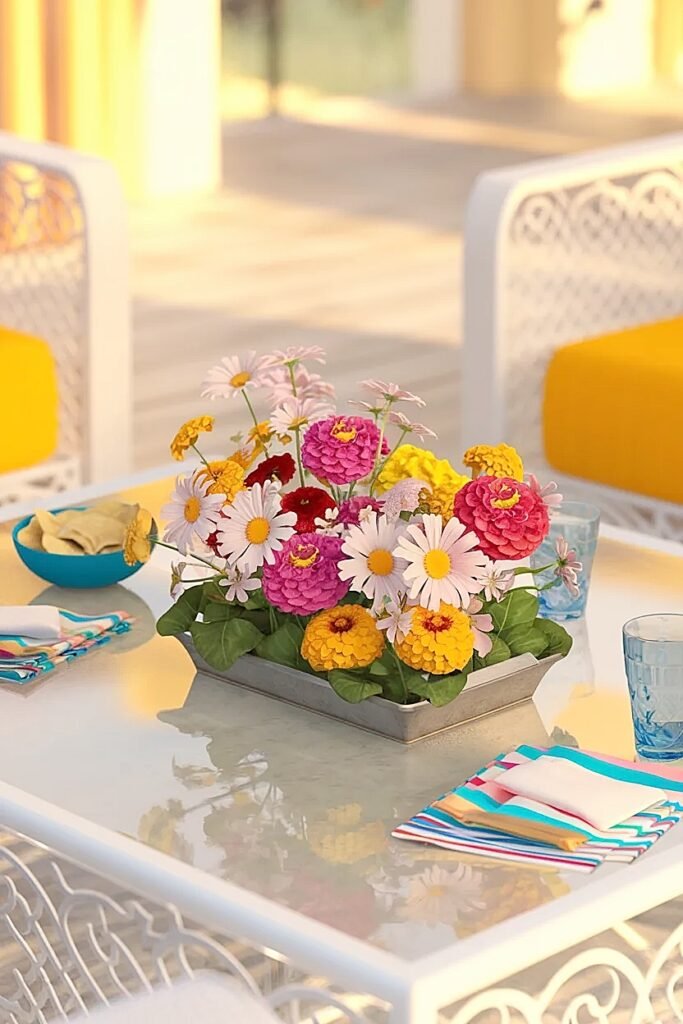
Patio coffee tables serve outdoor gatherings as drink stations and snack surfaces demanding arrangements that enhance without interfering with constant beverage setting and food grabbing. Maximum height for coffee table centerpieces: 6-8 inches total, anything taller blocks views from low seating while also creating obstacles for reaching across tables.
These five approaches maximize beauty while preserving functionality.
1. Ultra-Shallow Tray at Table Back Edge
Position wide shallow tray (14×8 inches, 2-inch depth) at coffee table’s back edge against seating creating floral presence while front surface stays completely clear for drinks and snacks. Fill tray with summer flowers cut to just 4-5 inches creating carpet-like arrangement viewed from above. The back positioning ensures visibility without claiming functional surface. Use 8-10 short-stemmed blooms creating colorful backdrop. The tray approach costs under $15 total creating impressive presence without spatial interference. The shallow depth forces appropriate ultra-low profiles.
2. Corner Cluster Preserving Diagonal Clearance
Position small 6-inch bowl in one coffee table corner filled with summer flowers creating concentrated beauty while diagonal clearance from corner to opposite corner stays open for drinks and snacks. Use 5-7 flowers cut to 5-6 inches total. The corner location uses underutilized space while the diagonal clearance accommodates the reaching and setting that coffee tables constantly accommodate during gatherings. The asymmetric single-corner approach feels contemporary rather than traditional symmetric centering.
3. Bud Vase Perimeter Ring with Central Clearance
Position 6-8 tiny bud vases in ring around coffee table perimeter leaving entire center zone completely open for functional use. Each vase holds one perfect bloom creating delicate accents. The perimeter positioning maximizes floral presence while center clearance handles all the drink-setting and snack-grabbing activities. The distributed approach through multiple tiny vessels claims minimal total footprint despite creating substantial collective presence. Total under $20 for flowers and basic vases.
4. Suspended Hanging Installation Above Table
Hang small floral installation from overhead structure, pergola beam, umbrella frame, tree branch, positioning flowers above rather than on coffee table surface. This completely liberates table space while creating vertical floral interest visible from seating. Use small hanging basket with 6-8 summer stems creating overhead accent. The suspended approach requires overhead structure but delivers maximum spatial efficiency when available. The unconventional vertical positioning creates memorable aesthetic.
5. Single Statement Stem in Minimal Vase
Embrace radical minimalism through one perfect summer flower, maybe a dramatic dahlia or bold sunflower, in tiny 3-inch vase positioned at table edge. The single-stem approach creates focal point without spatial demands that multi-stem arrangements require. The minimalism reads as intentional restraint rather than insufficient effort. The tiny vessel footprint means it nestles anywhere without interfering. Rotate stem color or variety weekly maintaining freshness. Cost under $5 creating elegant simplicity.
Conclusion
Making summer flowers centerpieces that don’t block food on patio tables requires ruthless spatial discipline prioritizing function over decorative ambition. Low bowls under 6 inches tall with 10-14 inch diameters create horizontal emphasis preserving sightlines and surface space. Off-center positioning, distributed runner arrangements, and bud vase multiplication all demonstrate strategies that add floral beauty without claiming the prime table real estate that outdoor dining demands for actual food service.
Compact summer flowers like zinnias, marigolds, and cosmos work naturally in these constrained formats, creating impact through bloom quality rather than arrangement scale. The 12-inch maximum height rule maintains conversation-friendly profiles while radial clearance on round tables and ultra-low coffee table approaches all demonstrate context-specific techniques that balance beauty with functionality. Master this functional-first mindset and your patio flower arrangements will finally enhance outdoor meals rather than complicating them.
This website contains affiliate links, and some products are gifted by the brand to test. As an Amazon Associate, I earn from qualified purchases. Some of the content on this website was researched and created with the assistance of AI technology.