
This website contains affiliate links, and some products are gifted by the brand to test. As an Amazon Associate, I earn from qualified purchases. Some of the content on this website was researched and created with the assistance of AI technology.
Key Takeaways
- Baby’s breath costs $5-7 per bunch creating instant gap-filling coverage in wide summer arrangements
- The airy branching structure fills negative space between focal flowers without adding bulk or weight
- Cloud edge technique positions baby’s breath at bowl perimeters extending visual boundaries beyond vessels
- Summer flowers like zinnias, dahlias, and hydrangeas pair perfectly with baby’s breath’s delicate texture
- Keeping baby’s breath stems at 5-6 inches maintains sightline-safe low profiles for dining tables
- Kitchen island arrangements need narrow vessels, baby’s breath creates width perception without claiming prep space
- Round table centerpieces benefit from radial baby’s breath positioning creating even coverage from all viewing angles
- Outdoor patio arrangements require weighted vessels, baby’s breath adds fullness without wind-catch problems
Using Baby’s Breath to hide gaps in wide summer flower centerpieces solved my biggest arranging frustration, those awkward empty spaces between flowers that make even generous stem counts look sparse and amateur. I’d spend $30 on summer dahlias or zinnias, arrange them carefully in wide bowls, then step back feeling disappointed by how much bare bowl interior showed through the arrangement. The flowers themselves looked beautiful, but the composition screamed “I don’t know what I’m doing” through all that visible negative space destroying any illusion of abundance or professional skill.
Then I watched a wedding florist work her magic and noticed she wasn’t using more focal flowers to create fullness, she was strategically positioning baby’s breath to eliminate every visible gap. Those wispy white clouds filled spaces between larger blooms, extended arrangements beyond bowl edges, and created the seamless coverage that separates professional work from amateur attempts. That revelation changed everything: I didn’t need more expensive flowers, I needed to understand gap-filling mechanics. One $6 bunch of baby’s breath transforms sparse-looking arrangements into genuinely impressive compositions by doing the unsexy but essential work of covering every inch of negative space that would otherwise expose your arrangement’s structural weaknesses.
Wide Summer Flowers centerpieces can look “patchy” fast. This cheat sheet shows where to place Baby’s Breath to hide gaps (between pockets + rim line), which low containers work best by surface, and what to do/avoid so you get a smooth, wide look that stays practical in real life.
Baby’s Breath Gap-Hiding Cheat Sheet for Wide Summer Flowers Centerpieces
Built for wide summer centerpieces using Baby’s Breath in the between + rim line zones to erase gaps.
| Home Surface | Best Container Mix | Baby’s Breath Gap-Hiding Formula | Do This / Avoid This |
|---|---|---|---|
|
Dining table wide footprintsmooth edgelow bowl |
Shallow matte bowl (main) + optional mini bud cup (side)
Goal: “smooth outline” without tall filler.
|
Cluster Summer Flowers → Baby’s Breath between pockets → rim-line edge
Pro: hides patchy gaps fast.
|
Do: keep Baby’s Breath low; fill gaps last. Avoid: puffy height above blooms. |
| Kitchen island prep lanelow + tidy |
Low oval bowl placed off-center (prep lane stays open) | Small pockets + Baby’s Breath tucked low to erase empty space | Do: off-center placement. Avoid: center sprawl. |
| Coffee table tray drink spacegap hiding |
Low tray (non-slip) + tiny dish (optional) | Pocket blooms + Baby’s Breath “edge line” to smooth the outline | Do: leave coaster zone open. Avoid: cluttered tray. |
| Sideboard wide lookserve lane |
Low trough (elongated) + 1 mini bud cup on end | Repeat pockets; connect gaps with low Baby’s Breath bands | Do: keep serve lane clear. Avoid: tall pieces hiding labels. |
| Outdoor patio heat awarestable |
Heavy low bowl + shaded placement (avoid direct heat) | Low pockets + Baby’s Breath tucked into gaps (no tall fluff) | Do: keep low + stable. Avoid: airy tall filler. |
Dining table (Between + rim line hides gaps)
Kitchen island (Prep lane stays open)
Coffee table tray (Hide gaps + keep drink space)
Sideboard (Serve lane stays clear)
Outdoor patio (Low + stable)
How to Use Baby’s Breath to Hide Gaps in Wide Summer Flowers Centerpieces in Low Bowls
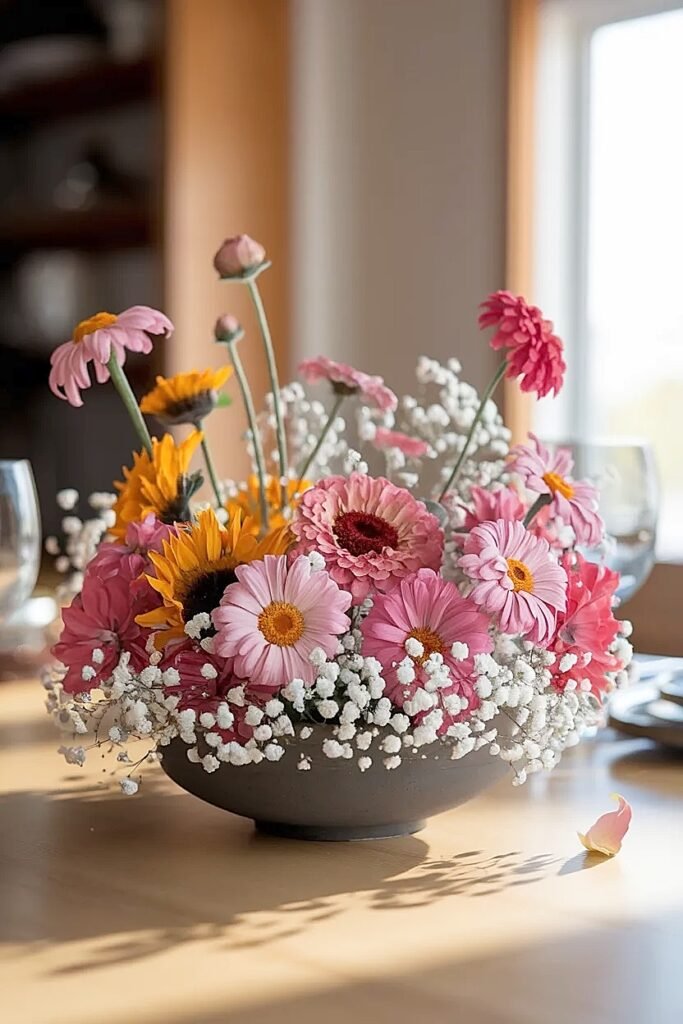
Low bowls create horizontal emphasis perfect for wide summer centerpieces, but their shallow depths and generous diameters create massive surface areas that focal flowers alone struggle to cover adequately. A 14-inch diameter bowl offers roughly 154 square inches of surface, way too much for 10-12 summer stems to fill convincingly without visible gaps screaming “this arrangement is sparse.”
Baby’s breath conquers this coverage challenge through branching architecture that spreads horizontally when stems get positioned at outward angles. Each baby’s breath stem features multiple branch points covered in tiny blooms, creating perhaps 6-8 inches of lateral spread from single insertion points. This branching multiplication means 8-10 baby’s breath stems can cover what would otherwise require 30+ vertically-oriented focal flowers.
I build low bowl arrangements by positioning focal summer flowers first, maybe 8 zinnias or 10 dahlias, establishing color and structure. These focal flowers create the arrangement’s bones but leave obvious gaps. Then I systematically insert baby’s breath stems into every visible gap, angling each stem outward at roughly 45 degrees from vertical. This outward positioning forces the branching to spread horizontally across bowl surfaces rather than rising vertically.
The insertion density matters enormously. I don’t skimp trying to stretch one baby’s breath bunch across multiple arrangements, I commit entire bunches to single wide bowls, using 15-20 stems creating genuine coverage. That generosity transforms the arrangement from “flowers in a bowl with baby’s breath added” to “seamless composition where baby’s breath and focal flowers create unified whole.”
The visual test: crouch to table level viewing the arrangement from normal seated dining positions. If you see bare bowl, floral foam, or awkward gaps, add more baby’s breath until those spaces disappear completely, and for additional techniques on using baby’s breath to elevate budget grocery store flowers, there’s comprehensive guidance worth exploring, share this with anyone battling sparse-looking summer arrangements!
The low bowl foundation establishes core gap-filling principles, and the cloud edge techniques ahead show how to extend coverage beyond vessel boundaries.
Ways to Make Baby’s Breath a Low “Cloud Edge” to Hide Gaps in Wide Summer Flowers Centerpieces
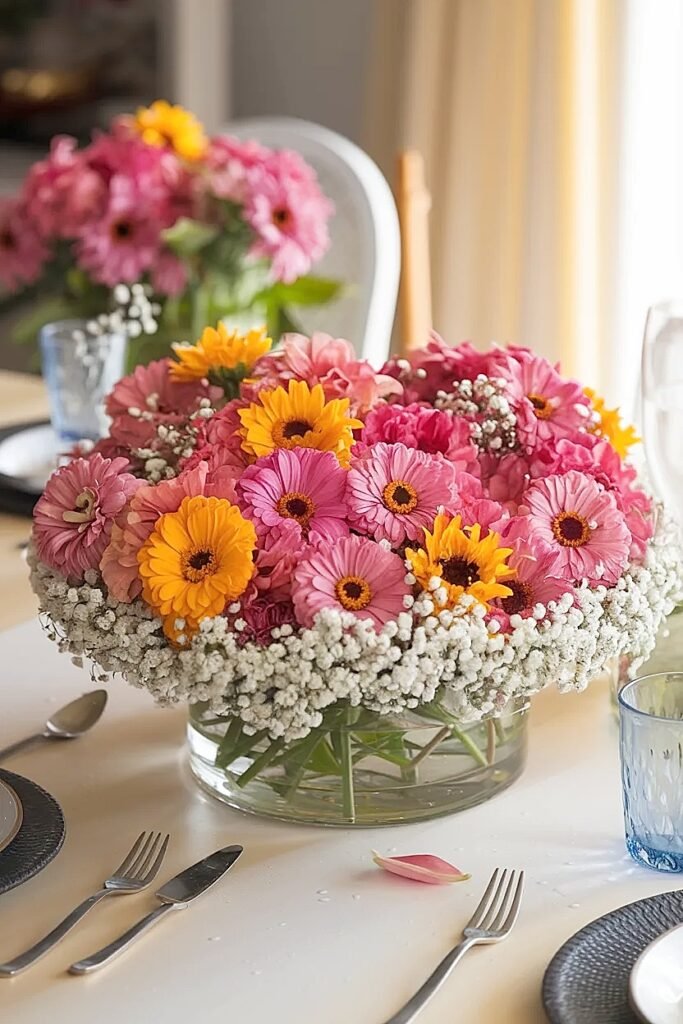
The cloud edge technique positions baby’s breath specifically at arrangement perimeters creating the illusion that the arrangement extends well beyond its actual vessel boundaries. This perimeter emphasis hides the bowl-to-flower transition zone where gaps most obviously appear while making modest stem counts feel abundant through extended visual diameter.
I discovered cloud edges watching high-end restaurant arrangements and noticing how baby’s breath always seemed to blur the boundary between vessel and arrangement, creating soft transitions rather than hard edges.
1. Continuous Perimeter Ring Method
Position 12-15 baby’s breath stems in unbroken ring around bowl’s complete outer edge, angling each stem 45-60 degrees outward so blooms extend 3-4 inches beyond bowl rim. This creates continuous cloud collar encircling the entire arrangement. Insert focal flowers centrally rising from this baby’s breath foundation. The perimeter ring hides the bowl edge completely while extending perceived arrangement diameter substantially. Works brilliantly in 12-16 inch wide bowls transforming them into arrangements appearing 18-20 inches across.
2. Asymmetric Cascade Edge
Concentrate baby’s breath heavily along one bowl edge (perhaps 10-12 stems) creating dramatic cascading cloud, while opposite edge gets minimal coverage (2-3 stems). This asymmetric approach creates contemporary dynamic edge rather than traditional uniform coverage. Position focal flowers throughout with the baby’s breath cascade providing dramatic counterweight. The heavy cascade draws attention making the overall arrangement feel more substantial despite the asymmetric distribution creating actual stem economy.
3. Graduated Density Edge Technique
Position baby’s breath most densely at bowl’s front edge (visible from primary viewing direction) using 8-10 stems, moderately at sides with 4-5 stems each, minimally at back edge with 2-3 stems. This graduated approach maximizes baby’s breath impact where arrangements get viewed most while conserving stems at less visible areas. The front-heavy distribution creates impressive first impressions while back conservation makes single baby’s breath bunch cover wide bowls effectively.
These cloud edge methods create boundary-blurring effects, and the sightline safety guidance ahead ensures summer arrangements work in dining contexts.
How to Keep Baby’s Breath Low in Wide Summer Flowers Centerpieces (Sightline-Safe Rule)
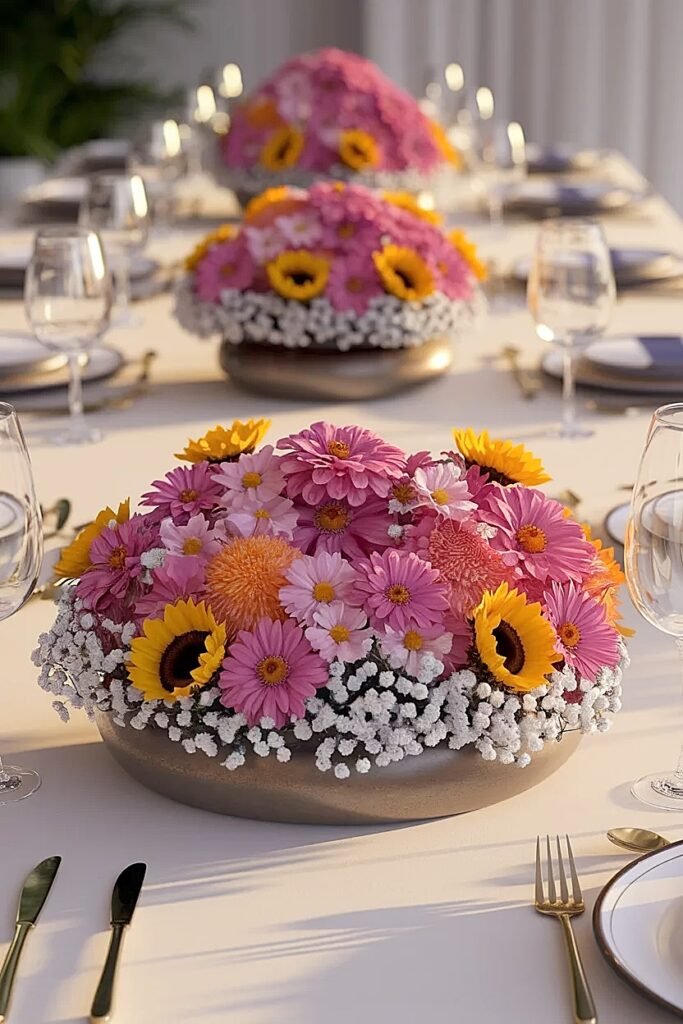
Summer dining table centerpieces face the same sightline constraint as spring arrangements, nothing can exceed 12 inches total height without blocking conversation views across tables. Baby’s breath naturally wants to spread on branching stems, making it perfect for low work when you control stem heights deliberately rather than letting baby’s breath dictate arrangement proportions.
I cut every baby’s breath stem to 5-6 inches before insertion, forcing all branching to occur at appropriately low heights. This feels wasteful, those stems arrive maybe 20 inches long and cutting away two-thirds seems like discarding value. But the bloom-covered branching at stem tops delivers the visual impact, not the bare stem length below.
The cutting discipline creates two simultaneous benefits: it maintains dining-appropriate low profiles while forcing baby’s breath to spread horizontally rather than vertically. When stems stay long, baby’s breath grows upward creating tall airy masses. Cut to 5-6 inches, it has nowhere to go but outward, creating the wide low coverage that summer centerpieces demand.
I also position baby’s breath around arrangement perimeters and between focal flowers rather than at arrangement centers. This distributes coverage horizontally while keeping the tallest focal flowers, maybe summer roses at 8-9 inches, as the arrangement’s highest points. The baby’s breath foundation at 5-6 inches creates base layer defining the overall profile as appropriately low.
Testing from seated positions matters critically. I physically sit at my dining table viewing arrangements from normal dinner perspectives before finalizing them. If baby’s breath creates any sightline interference, I recut stems even shorter. The 5-6 inch target works for most contexts, but some situations demand 4-5 inches creating ultra-low profiles.
The height discipline ensures functionality, and the summer flower pairing guidance ahead identifies which specific blooms work best with baby’s breath for gap-free coverage.
What are the Best Summer Flowers to Pair with Baby’s Breath to Hide Gaps in Wide Centerpieces?
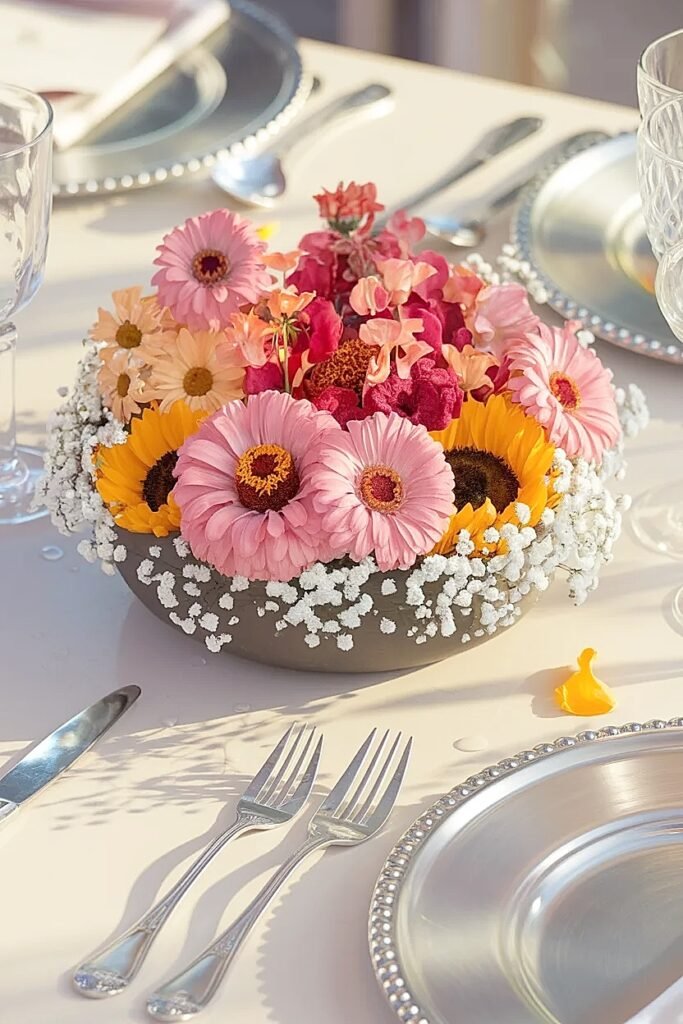
Summer flowers vary dramatically in bloom size, stem behavior, and growth habits, some naturally create full arrangements while others leave obvious gaps demanding baby’s breath intervention. The best pairings feature flowers whose scale and form create deliberate contrast with baby’s breath’s delicate texture while leaving sufficient gap space for baby’s breath to fill meaningfully.
I’ve tested every summer flower available at grocery stores and farmers markets, and these five consistently benefit most from baby’s breath gap-filling.
1. Zinnias for Bold-Delicate Contrast
Zinnias produce substantial 3-4 inch diameter blooms on relatively sparse stems leaving obvious gaps between flowers. Baby’s breath fills these spaces perfectly creating fullness around zinnia focal points. The zinnia’s bold daisy-like form contrasts baby’s breath’s tiny clustered blooms creating pleasing scale variation. Buy zinnia bunch ($8-12) and baby’s breath ($5-7) totaling under $20. Use 8-10 zinnias with one full baby’s breath bunch. The combination creates lush summer arrangements from modest stem counts.
2. Dahlias for Premium Look Economy
Dahlias’ substantial layered blooms command attention but their thick stems and large leaves create gaps at arrangement bases. Baby’s breath fills lower gaps while dahlias provide upper-level focal interest. The dahlia’s complex petal structure contrasts baby’s breath’s simplicity. Buy dahlia bunch ($12-15) and baby’s breath ($5-7) totaling under $25. Use 6-8 dahlias surrounded by generous baby’s breath. The combination appears expensive despite modest budgets.
3. Sunflowers for Dramatic Gap-Filling Needs
Sunflowers’ enormous blooms on thick stems create massive gaps requiring substantial baby’s breath intervention. The dramatic size difference between sunflower heads and baby’s breath’s tiny flowers creates maximum scale contrast. Buy sunflower bunch ($10-12) and baby’s breath ($5-7) totaling under $20. Use 5-7 sunflowers with one full baby’s breath bunch filling every gap. The pairing creates impressive arrangements perfect for casual summer entertaining.
4. Lisianthus for Romantic Sophistication
Lisianthus produces rose-like blooms on delicate branching stems creating natural gaps between flowers. Baby’s breath fills these spaces while complementing lisianthus’s romantic aesthetic through shared delicate quality. The similar soft textures create cohesive rather than contrasting pairing. Buy lisianthus bunch ($10-14) and baby’s breath ($5-7) totaling under $22. Use 8-10 lisianthus stems interwoven with baby’s breath creating seamless romantic compositions.
5. Hydrangeas for Textural Layering
Hydrangeas’ mophead blooms create substantial upper-level coverage but stems and foliage leave lower gaps. Baby’s breath fills these base-level spaces creating tiered layering. The hydrangea’s clustered tiny florets create textural kinship with baby’s breath despite dramatic size differences. Buy hydrangea stems ($3-5 each, use 4-5) and baby’s breath ($5-7) totaling under $30. The combination creates luxurious full arrangements suggesting premium investment.
These summer pairings maximize baby’s breath’s gap-filling power, and the kitchen island applications ahead address functional surfaces with spatial constraints.
Ideas for Wide Summer Flowers Centerpieces on Kitchen Islands Using Baby’s Breath to Hide Gaps
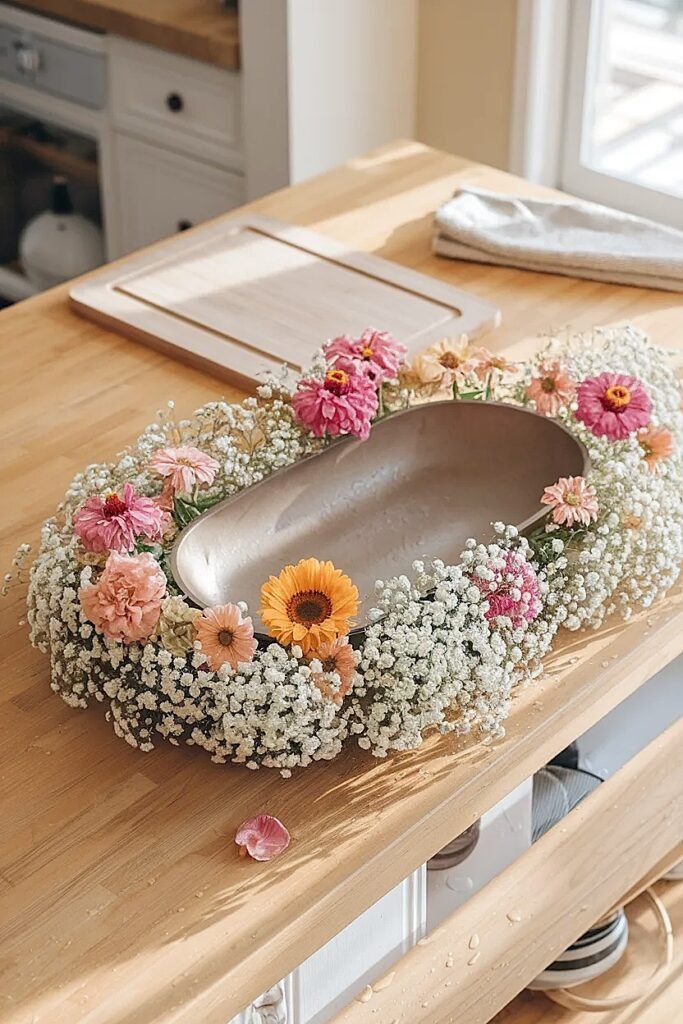
Kitchen islands demand wide visual presence without claiming prep space width, making baby’s breath essential for creating perceived fullness in narrow vessels that preserve workflow. The challenge: making 6-8 inch wide containers feel substantial through baby’s breath coverage extending visual boundaries beyond physical vessel limits.
Maximum island vessel width: 8 inches preserving adequate prep lanes. Baby’s breath achieves width perception within this constraint through aggressive outward angling.
1. Narrow Trough with Aggressive Baby’s Breath Spread
Position 18×6 inch trough along island back edge filled with baby’s breath angled dramatically outward creating 14-16 inch visual width from 6-inch physical width. Use one full baby’s breath bunch angling stems 60+ degrees outward. Add 6-8 summer focal flowers centrally. The extreme baby’s breath angles extend arrangement beyond trough boundaries creating substantial presence while narrow vessel preserves prep space. Cost under $20.
2. Dual Mini Bowls with Baby’s Breath Cloud Connection
Position two 6-inch bowls at island ends, each filled with baby’s breath and focal flowers, angling baby’s breath inward toward island center creating visual connection between separate elements. Use one baby’s breath bunch split between bowls. The baby’s breath angled toward center creates implied connection making separate bowls read as unified installation. Add 4-5 focal flowers per bowl. Total under $25.
3. Single Corner Bowl with Radial Baby’s Breath Extension
Place one 8-inch bowl in island back corner filled with baby’s breath positioned in radial pattern extending outward in all visible directions. Use half baby’s breath bunch creating generous coverage. Add 5-7 focal flowers centrally. The radial baby’s breath positioning maximizes coverage from the corner location while preserving central and front prep areas. Cost under $18.
The island strategies create presence economically, and the round table techniques ahead address all-around viewing requirements.
How to Use Baby’s Breath to Hide Gaps in Round Table Wide Summer Flowers Centerpieces
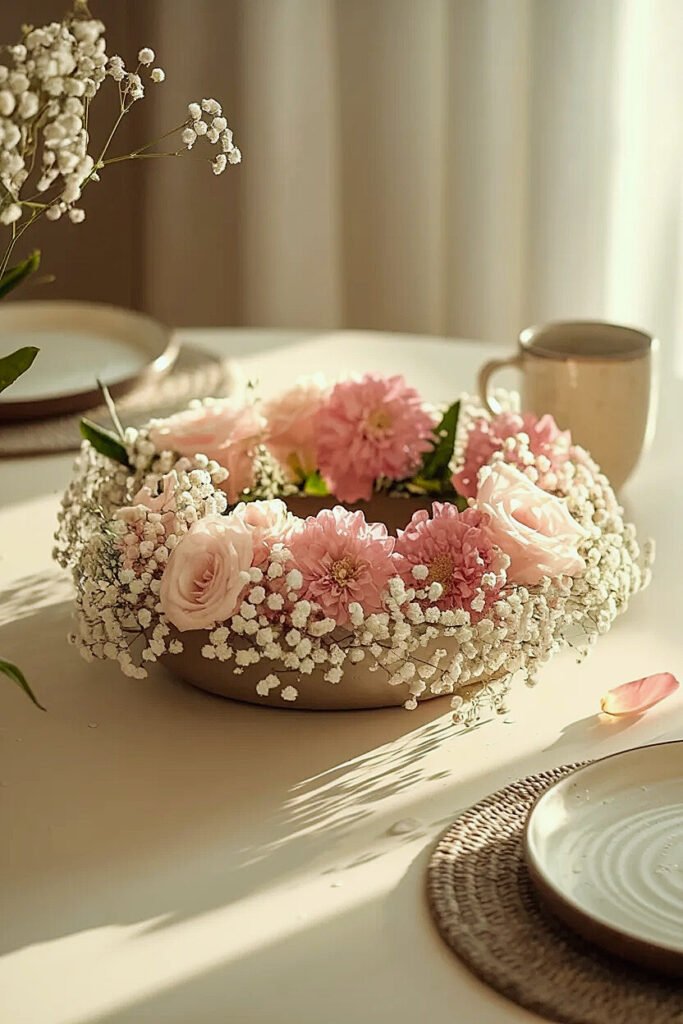
Round dining tables present unique gap-filling challenges, arrangements get viewed from every angle requiring 360-degree coverage rather than the front-focused approach that rectangular tables allow. Baby’s breath must fill gaps uniformly around entire arrangements preventing any viewing angle from exposing sparse areas.
I approach round table arrangements with radial symmetry, every baby’s breath insertion point gets matched by corresponding insertion on the opposite side maintaining balanced coverage from all directions. This prevents the common mistake where one side looks full while the opposite shows embarrassing gaps.
The radial building technique starts at arrangement center working outward in concentric rings. I position focal flowers first creating central cluster, then insert baby’s breath in first ring around these central blooms filling inner gaps. A second baby’s breath ring goes at arrangement perimeter angling outward creating edge coverage. This concentric approach ensures systematic gap elimination from every viewing angle.
The density distribution differs from rectangular table arrangements. Round table centerpieces need consistent density throughout rather than the front-heavy distribution that works when arrangements sit against walls or get viewed primarily from one direction. I use entire baby’s breath bunches on round table arrangements, maybe 20-25 stems, creating the uniform coverage that all-around viewing demands.
I test round table arrangements by walking completely around the table viewing from every angle guests will occupy. Any viewing position revealing gaps gets additional baby’s breath insertion until coverage feels seamless regardless of approach direction.
The round table requirements demand generous baby’s breath commitment, and the sideboard trough applications ahead show how to balance floral presence with serving functionality.
Ways to Use Baby’s Breath in Wide Summer Flowers Sideboard Troughs (Clear Serve Lane)
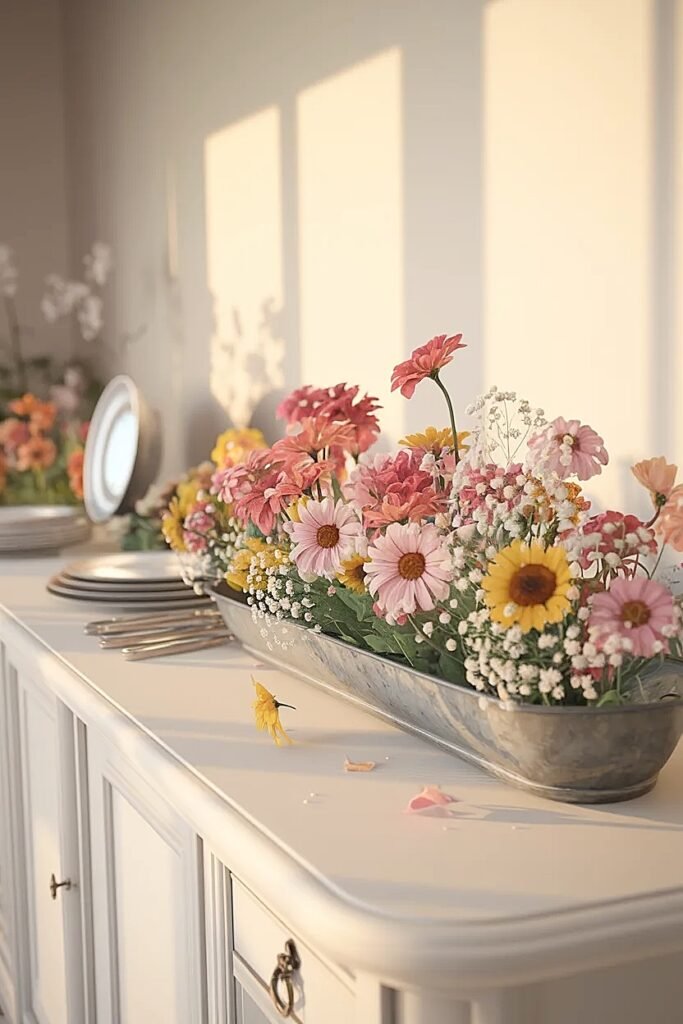
Sideboard troughs create linear summer installations perfect for buffets and serving contexts, but these arrangements must preserve clear serving lanes preventing flowers from interfering with food access. Baby’s breath fills trough gaps while strategic positioning maintains functional clearance.
The key: concentrating baby’s breath at trough backs and ends rather than centers, creating coverage without claiming prime serving frontage.
1. Back-Edge Baby’s Breath Foundation with Front Clearance
Position baby’s breath exclusively along trough’s back edge against any wall creating continuous foundation layer while entire front half stays clear for serving dish access. Use one full baby’s breath bunch creating generous back coverage with 8-10 summer focal flowers rising from this base. The baby’s breath fills rear gaps creating styled backdrop visible behind serving dishes without interfering with functional front zone. Insert focal flowers throughout with baby’s breath providing base support. Cost under $20 creating professional buffet styling.
2. End-Cap Baby’s Breath Concentration with Clear Center Run
Pack baby’s breath densely at both trough ends creating floral bookends while central span remains relatively clear except for focal flowers. Use one baby’s breath bunch split between both ends creating substantial end presence with 10-12 focal flowers distributed along trough length. The end concentration creates framing effect while center openness preserves serving access. The baby’s breath at ends fills gaps that would otherwise make trough edges look unfinished. Total under $25.
3. Alternating Baby’s Breath Sections with Serving Gaps
Create trough sections alternating baby’s breath-heavy zones with baby’s breath-minimal zones establishing rhythm while leaving clear gaps for serving utensil placement. Use one baby’s breath bunch creating three dense sections alternating with two clear sections. Add focal flowers throughout. The alternating pattern provides visual interest while clear sections offer functional serving access points where utensils and hands can navigate without floral interference. Cost under $22.
The sideboard strategies balance style and function, and the outdoor patio applications ahead address weather exposure and stability demands.
Ideas for Wide Summer Flowers Centerpieces for Outdoor Patio Tables Using Baby’s Breath (Low + Stable)
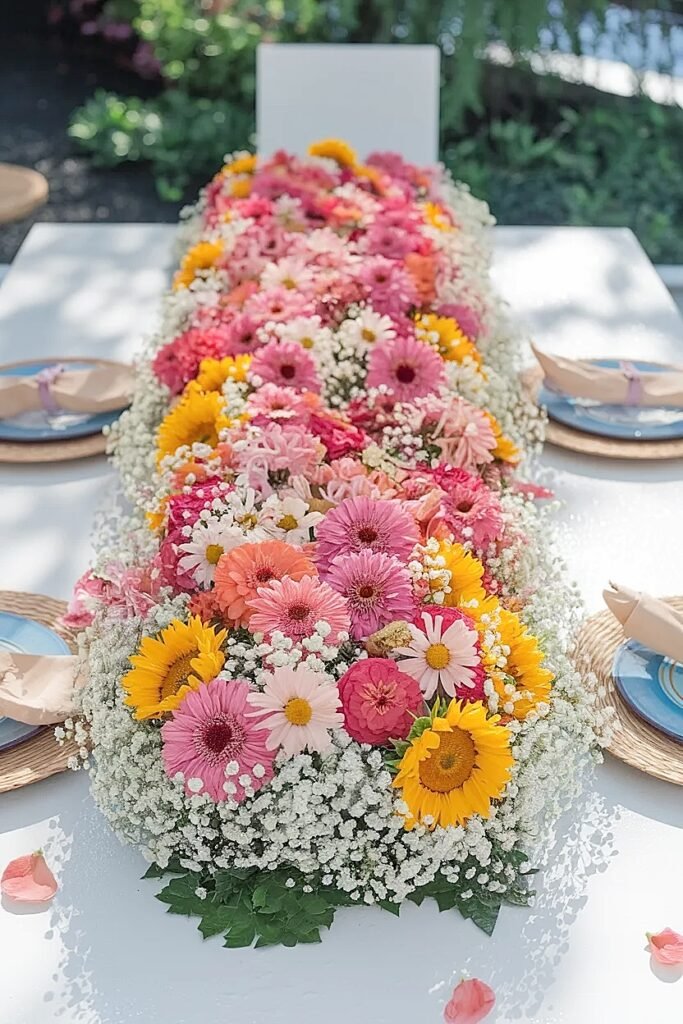
Outdoor patio arrangements face wind exposure requiring low profiles and weighted vessels, while baby’s breath’s delicate structure actually benefits from outdoor use through wind-resistant qualities when properly positioned. The airy branching bends with breezes rather than catching wind like solid-mass flowers.
These three approaches maximize baby’s breath’s outdoor advantages while maintaining stability.
1. Weighted Bowl with Dense Baby’s Breath Base Layer
Fill substantial weighted bowl (minimum 5 pounds) with baby’s breath creating dense low base layer at 4-5 inches height, topped with 8-10 summer focal flowers at 7-8 inches creating tiered outdoor arrangement. Use one full baby’s breath bunch creating generous base coverage with zinnias or dahlias providing color accents. The low baby’s breath layer resists wind while weighted vessel prevents tipping. The tiered structure creates interest while staying under 9 inches total maintaining outdoor-appropriate low profile. Cost under $20.
2. Low Terra Cotta Trough with Radial Baby’s Breath Pattern
Position baby’s breath in terra cotta trough (natural weight provides stability) using radial pattern extending outward from center, keeping all stems at 5-6 inches creating ultra-low wind-resistant profile. Use one baby’s breath bunch creating radial coverage with 6-8 focal flowers centrally positioned. The terra cotta weight prevents wind displacement while radial baby’s breath pattern creates even coverage from all viewing angles around outdoor tables. The low height prevents wind catch. Total under $18.
3. Concrete Bowl with Baby’s Breath Perimeter Ring
Fill concrete bowl (exceptional wind resistance through 8-10 pound weight) with baby’s breath positioned exclusively around perimeter creating protective ring, with summer focal flowers centrally clustered. Use three-quarters baby’s breath bunch creating generous perimeter coverage with 10-12 focal flowers packed centrally. The perimeter baby’s breath acts as wind buffer protecting central focal flowers while concrete vessel provides unmatched stability during outdoor exposure. The arrangement withstands significant wind without damage. Cost under $25.
Conclusion
Using baby’s breath to hide gaps in wide summer flower centerpieces transforms sparse-looking arrangements into professionally full compositions through strategic positioning that fills every visible negative space. The cloud edge technique extends visual boundaries beyond vessel limits, while 5-6 inch stem heights maintain dining-appropriate low profiles. Summer flowers like zinnias, dahlias, and sunflowers benefit enormously from baby’s breath’s gap-filling coverage, creating seamless arrangements from modest stem counts.
Kitchen island narrow vessels, round table all-around viewing, sideboard serving functionality, and outdoor patio stability all demand specific baby’s breath positioning strategies that balance fullness with practical constraints. The generous commitment, using entire baby’s breath bunches rather than stretching stems across multiple arrangements, creates the coverage density that separates amateur sparse attempts from professional-looking results. Master these gap-filling mechanics and your summer centerpieces will finally achieve the abundant seamless aesthetic you’ve been chasing.
This website contains affiliate links, and some products are gifted by the brand to test. As an Amazon Associate, I earn from qualified purchases. Some of the content on this website was researched and created with the assistance of AI technology.