This website contains affiliate links, and some products are gifted by the brand to test. As an Amazon Associate, I earn from qualified purchases. Some of the content on this website was researched and created with the assistance of AI technology.
Key Takeaways
- Direct summer sun bleaches pastels fast: bold, saturated colors hold visual punch through a full outdoor party while soft tones fade by the second hour
- Short stems and low profiles are non-negotiable for birthday centerpieces: anything taller than eight inches above the vessel rim blocks sightlines and conversation
- Gravel in every outdoor vessel before water: afternoon heat tips unweighted jars; gravel anchors everything
- Zinnias, marigolds, and sunflowers are the three most heat-resilient grocery store flowers for outdoor summer birthday centerpieces
- A budget-friendly centerpiece does not require expensive flowers: volume and color do more visual work than rare varieties
- Kid-friendly means zero exposed stamen: any flower with accessible pollen at a child’s eye level is a genuine irritant risk
Choosing the best summer flowers for a backyard birthday party centerpiece is a completely different exercise from choosing flowers for a wedding or any indoor event. The outdoor birthday context has specific demands that most flower guides ignore; direct afternoon heat, wind, the visual noise of birthday tablecloths and balloons, and the practical reality that guests will reach across and bump into your centerpiece repeatedly throughout the party. I spent three summers learning this the hard way.
The flowers that perform best in this context are not necessarily the most beautiful ones in the shop. They are the ones that hold color in direct sun, stay structurally intact through hours of outdoor exposure, register from across a busy backyard, and work in short-stem, low-profile arrangements. That combination narrows the field substantially, and the flowers left standing are some of the most joyful and affordable summer blooms available.
For more on how summer flowers work beyond the centerpiece itself, check out how to decorate a backyard birthday patio walk-up area with summer flowers — the arrival experience before guests reach the table is just as important as the table itself. If this has been useful, share it with anyone planning a summer backyard birthday.
Use this centerpiece chart to match each flower role with the best Summer Flowers for a backyard birthday table. It helps readers choose focal blooms, filler flowers, color balance, and practical arrangement height, so the centerpiece feels festive, low, guest-friendly, and much easier to style for a real outdoor celebration.
| Centerpiece Role | Best Flower Type | Why It Works | Best Party Tip |
|---|---|---|---|
| Main focal bloom Center of attention |
Sunflowers, dahlias, lisianthus | They give the arrangement a clear anchor and make the centerpiece look intentional. | Use only a few focal blooms so the arrangement stays balanced and low. |
| Bright filler bloom Color builder |
Zinnias, marigolds, cosmos | These add cheerful summer color and help the centerpiece feel fuller without bulk. | Repeat two or three shades instead of using every color at once. |
| Texture flower Movement and contrast |
Celosia, gomphrena | They add shape contrast and visual interest so the centerpiece feels more layered. | Use texture flowers in small clusters so they read as accents, not clutter. |
| Airy softener Breathable spacing |
Cosmos, chamomile-like blooms | They keep the arrangement from looking too dense and make it feel lighter. | Place airy flowers around the edges to soften the overall shape. |
| Low guest-friendly shape Conversation-safe design |
Wide rounded forms | A broad, low shape keeps sightlines open and supports real outdoor dining. | Build width before height so the table stays more comfortable for guests. |
| Heat-tolerant choice Warm-weather support |
Gomphrena, zinnias, celosia, marigolds | These feel sturdier outdoors and suit sunny backyard party tables well. | Use stronger summer flowers when the centerpiece will sit outside for hours. |
| Long table strategy Rectangular layouts |
Repeated low flower clusters | Segmented groupings feel fuller and still leave room for serving pieces and dishes. | Break one long centerpiece into smaller moments for easier styling. |
| Budget-friendly mix Big visual payoff |
Zinnias, cosmos, marigolds, gomphrena | These can create generous color and texture without relying on expensive focal blooms. | Use one stronger focal flower and let easier summer blooms do the rest. |
What Are the Best Summer Flowers for a Backyard Birthday Party Centerpiece?
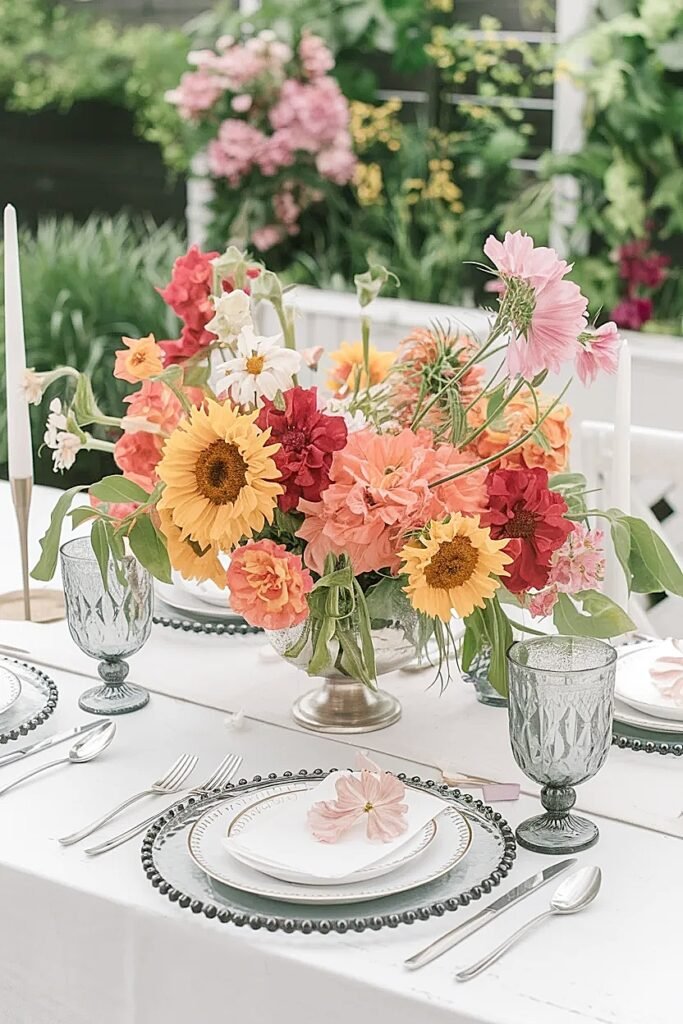
A backyard birthday centerpiece faces conditions that reveal the weaknesses of most cut flowers within the first hour: direct afternoon sun above ninety degrees, a breeze that catches tall stems, and the visual noise of a party setup competing for attention from every angle. The flowers that survive and thrive in that environment share three qualities: structural density, vivid color saturation, and heat tolerance.
Every flower below is grocery store accessible throughout summer, holds its form and color in direct outdoor conditions, and works beautifully at the compact, low-profile scale that an outdoor birthday centerpiece requires.
1. Zinnias Zinnias are the undisputed outdoor birthday centerpiece flower. The flat, dense petal structure holds full saturation, coral, burgundy, orange, yellow, and cream, in direct afternoon sun longer than any other grocery store cut flower. Zero accessible pollen, no meaningful fragrance, and one bunch fills three to four gravel-weighted outdoor vessels. They do not drop petals.
2. Marigolds Marigolds are built for exactly the conditions of a summer backyard birthday party. The dense pom-pom blooms maintain vivid orange and yellow in direct afternoon light longer than almost any other cut flower available at any price point. No accessible stamen, no petal drop when contacted, and the strong warm color reads as unambiguously celebratory.
3. Sunflowers (Cut Short) A single grocery store sunflower cut to five or six inches in a gravel-weighted vessel is the most visually impactful per-stem element in any outdoor birthday centerpiece. The bold flat face reads as festive and joyful from across the full backyard. One sunflower per vessel, not multiple: at short height, one face is the focal.
4. Dahlias (Pompom Variety) Small pompom dahlias are the most visually sophisticated centerpiece flower that also qualifies as genuinely sun-tolerant and outdoor-appropriate. The perfectly round tightly packed blooms have zero exposed pollen, create dramatic presence from every viewing angle, and the warm tones in deep coral, burgundy, and amber hold their saturation in outdoor light far better than cup-shaped.
5. Strawflowers Strawflowers are chronically underused at outdoor birthday parties. The papery, textured blooms are literally the most sun-stable cut flower available: they dry on the stem without wilting, maintain vivid orange, yellow, red, and burgundy in direct outdoor conditions, and hold their form when bumped or grazed by reaching hands. Zero accessible pollen, no shedding whatsoever,.
6. Lisianthus Lisianthus is the right choice for a covered or shaded outdoor birthday setup where softer light makes its refinement visible. The tightly layered blooms in white, blush, and deep purple are virtually pollen-free and do not drop petals. It holds its structure four to five days with fresh cold water. If the backyard birthday table.
7. Waxflower Waxflower does something no focal flower can: it fills visual gaps, doubles the apparent density of any arrangement, and adds fine texture that prevents the overall cluster from reading heavy or monotone. The dense, tiny star-shaped blooms along each stem look like several flowers at once at low vessel height. Zero accessible pollen, mild fragrance,.
More ahead on heat tolerance and which varieties are truly worth your confidence in high summer conditions.
How to Choose Heat-Tolerant Summer Flowers for a Backyard Birthday Party Centerpiece
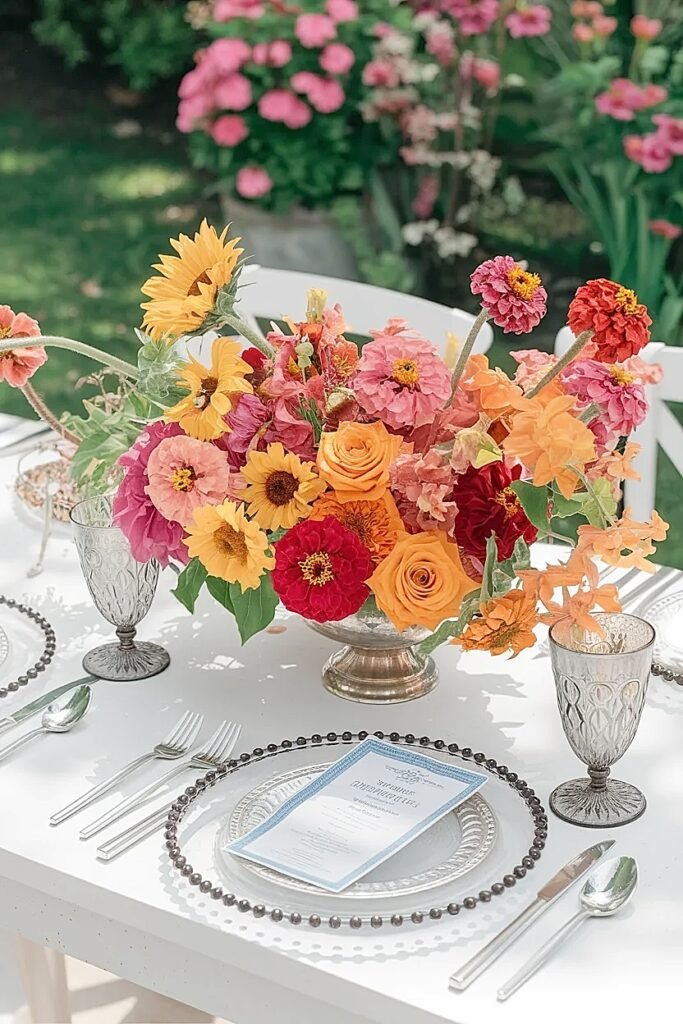
Heat tolerance in a cut flower has three distinct components: structural integrity in heat, color stability in direct sun, and petal retention when warm air accelerates drop. A flower can hold its physical structure in heat while losing half its color saturation by noon. Understanding which dimension of heat tolerance matters most for your specific birthday setup determines which flowers you should actually reach for.
For a birthday table in full afternoon sun with no shade structure, color stability is the critical variable. Deep, saturated blooms hold their visual presence far longer than pastels in direct summer light. Zinnias, marigolds, strawflowers, and pompom dahlias are the top four color-stable outdoor birthday centerpiece flowers because their dense petal structures slow the bleaching process that washes out softer flowers within the first two hours.
For a shaded or covered outdoor setup, lisianthus, waxflower, and ranunculus all perform significantly better than they would in direct sun. The absence of UV bleaching extends their color life considerably, and the temperature reduction under a shade structure keeps stems from collapsing as quickly as they do in direct heat.
One practical heat-management technique: cut fresh stems at a diagonal, add an inch of gravel to the vessel, then fill with cold water immediately before placing the arrangement. Cold water at setup gives outdoor centerpiece flowers an extra thirty to sixty minutes of structural stability.
More ahead on how to keep centerpiece height low enough to preserve sightlines and conversation quality.
Ideas for Low Summer Flowers That Keep a Backyard Birthday Party Centerpiece Guest-Friendly
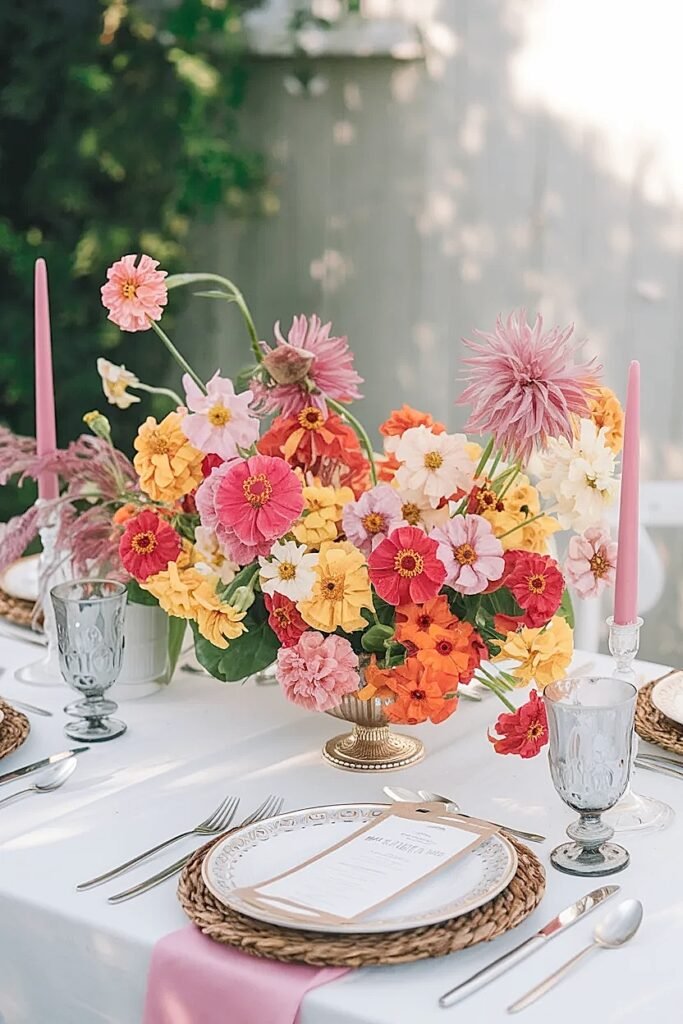
A centerpiece that blocks conversation is not a centerpiece. It is a partition. I have sat at too many outdoor birthday tables leaning sideways to make eye contact across from me because a tall arrangement was sitting exactly between us. The standard rule, nothing taller than twelve inches above the table surface, applies even more strictly outdoors, where wind catches tall stems and the informal energy of a birthday party makes a formal arrangement feel out of register.
The low-centerpiece approach is a design advantage, not a compromise. Short, tight arrangements in good-looking vessels catch overhead outdoor light from directly above, creating a richness of color and shadow that tall, loose arrangements at eye height cannot replicate. The flowers are seen from above, from the side, and from across the table simultaneously.
1. Single-Flower-Per-Vessel Garland Five short gravel-weighted ceramic vessels down the table center, each holding one focal bloom cut to three inches above the rim, connected by a strand of seeded eucalyptus tucked under each base. The single-bloom-per-vessel approach keeps every arrangement compact while the connecting vine reads as a continuous designed display. Total height stays at four to.
2. Floating Bloom Bowl Trio Three wide, low bowls spaced evenly along the table center, each filled with water and four or five zinnia or marigold heads floating face-up. Nothing extends above the bowl rim. The face-up perspective in overhead outdoor light creates a dramatic visual effect while maintaining zero height above the table surface. Guest-friendly in the most literal.
3. Wide Terracotta Saucer Cluster Three to five wide terracotta saucers along the table center, each packed with mixed summer blooms pressed into wet moss-topped soaked floral foam at rim height. The saucer profile keeps everything at rim level with nothing projecting above. Terracotta sits flat on any outdoor table surface, resists wind, and the warm material tone pairs beautifully.
4. Face-Up Ceramic Dish Arrangements Five shallow ceramic dishes down the table center, each filled with one inch of water and a tight cluster of bloom heads placed face-up. Daisy-like flowers, zinnias, chamomile, cosmos, all pressed open face against the shallow water surface. The arrangement looks like a garden viewed from above at every seat around the table. Zero projection.
5. Low Crate with Vessel Cluster One flat-bottom wooden crate along the table center holding three to five short, gravel-weighted vessels at varying heights, all short enough that the tallest element stays at four to five inches above the crate rim. The crate adds a warm material layer below the flowers and makes the whole cluster appear to be one contained.
6. Two-Corner Flower Pair One compact gravel-weighted pot at each far end of the table, each holding a dense cluster of three to four bright zinnia or marigold stems at four inches above the rim. Nothing in the center. The full center of the table stays completely clear for food, cake, and conversation. The two-corner approach is the lowest-maintenance.
7. Herb and Bloom Flat Tray A long, low wooden tray down the table center holding three to five compact mixed-bloom and herb clusters in short, matched ceramic vessels. Basil and zinnias, rosemary and marigolds, mint and ranunculus. The tray defines the display zone visually and makes the whole centerpiece moveable as one unit if the table needs to be reconfigured.
More ahead on how soft sunset color palettes create a completely different centerpiece atmosphere from the standard vivid birthday approach.
How to Style Soft Sunset Summer Flowers in a Backyard Birthday Party Centerpiece
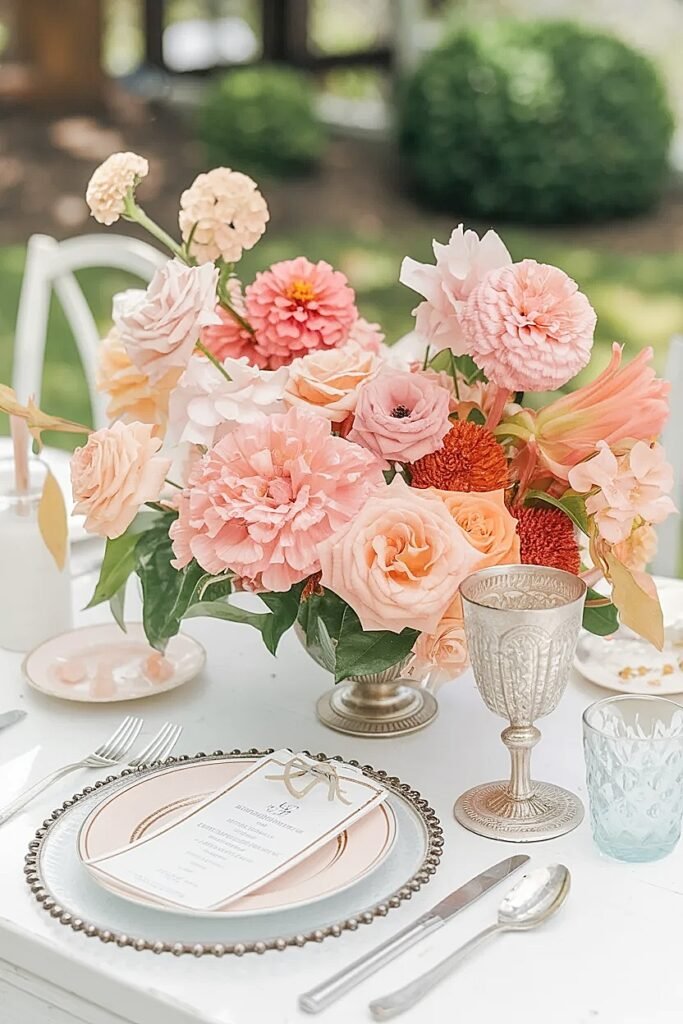
A sunset palette centerpiece, warm coral, deep peach, golden amber, and soft cream, works in a specific lighting context. In direct midday sun, sunset tones can look washed out alongside a vivid party setup. In late afternoon and early evening light, they are transformative: the warm tones interact with the changing light in a way that makes the centerpiece appear to glow.
If the birthday runs from mid-afternoon into the evening, a sunset palette is the right call. The centerpiece will look decent at three and genuinely spectacular at six. If the party ends before four, choose the vivid palette.
Ranunculus in peach and coral, cosmos in warm white, zinnias in the lightest apricot, and strawflowers in amber and golden yellow are the primary flowers for a sunset outdoor birthday centerpiece. Seeded eucalyptus is the connecting greenery: the silvery-gray frames the warm tones without introducing any cool hue.
The single most important rule for a sunset centerpiece: no cool tones. One purple statice, one blue-adjacent cosmos breaks the warmth and reduces the sunset centerpiece from an immersive color experience to a mixed arrangement with warm tendencies.
Keep reading for the budget-friendly flower choices that deliver the most visual return without requiring specialty varieties.
Ideas for Budget-Friendly Summer Flowers in a Backyard Birthday Party Centerpiece
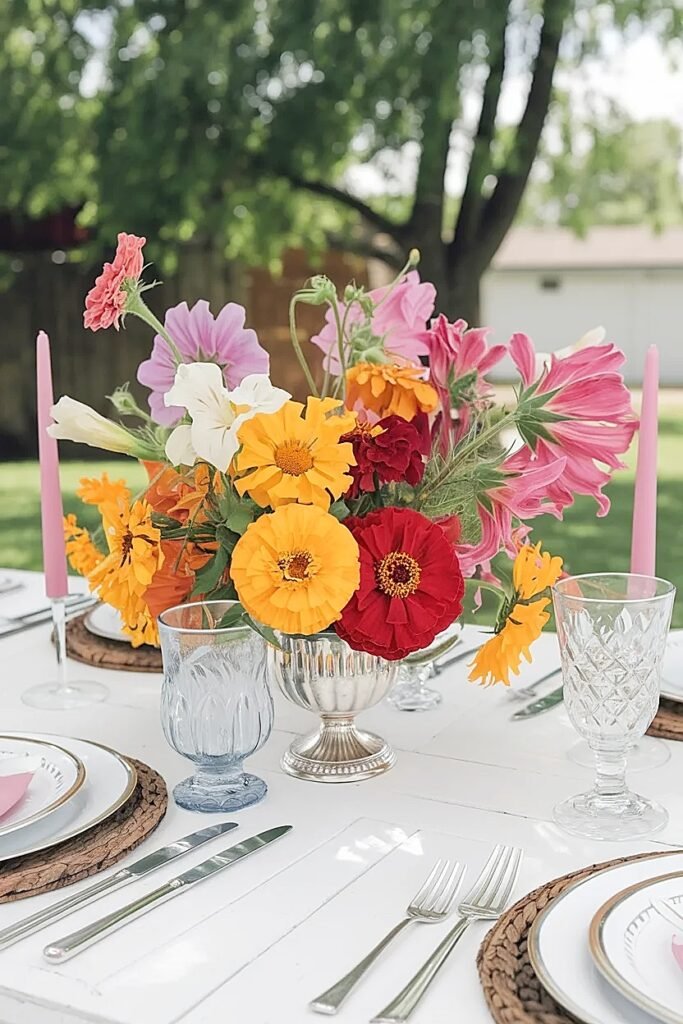
A fully designed outdoor birthday centerpiece does not require expensive flowers. The flowers that do the most visual work in an outdoor birthday centerpiece, zinnias, marigolds, strawflowers, and statice, are also among the least expensive flowers at any grocery store throughout the summer. The design decisions that make a centerpiece look expensive are vessel quality, color discipline, and arrangement density, not flower cost.
One bunch of mixed bright zinnias at four to six dollars, one bunch of orange marigolds at three to five dollars, and one bunch of white statice at three to four dollars give you enough material to build a full cluster garland centerpiece for a standard six-foot birthday table for twelve to fifteen dollars total. That is the actual budget, not a theoretical minimum.
1. Single Zinnia Variety, Maximum Volume Buy three bunches of the same vivid zinnia in one color and fill every centerpiece vessel with that one flower at maximum density. Volume in one color beats variety at low density in almost every outdoor birthday context. The visual result reads as designed and abundant rather than budget-conscious. Color discipline, one flower, one tone,.
2. Marigold and Eucalyptus Minimum Two bunches of mixed marigolds plus one bunch of seeded eucalyptus is a complete outdoor birthday centerpiece for eight dollars total. The marigolds provide the color, the eucalyptus provides the structural filler and trailing connector between vessels. No other materials required. The combination reads as vivid, festive, and intentionally designed from across the backyard.
3. Statice as Structural Filler One bunch of white or purple statice stretches any centerpiece arrangement significantly. Statice is dense, long-lasting, and visually complete enough to use as a primary element rather than just a filler. Mixed with two stems of zinnia or marigold per vessel, statice doubles the apparent density of each arrangement without doubling the cost. Most grocery.
4. Grocery Store Mixed Bunch Plus One Hero Stem Buy one grocery store mixed summer bunch for the filler and one stem of the most dramatic available flower, a large dahlia, one sunflower, or a pompom cluster, for each centerpiece vessel. Place the hero stem at center and pack the mixed bunch around it. The result looks like a florist-arranged centerpiece because the focal.
5. Potted Plants as Permanent Elements One compact marigold plant, one zinnia starter pot, or one rosemary bush per centerpiece position costs eight to twelve dollars and lasts through multiple parties. For a recurring backyard birthday host, potted plants as centerpiece anchors deliver far better long-term value than buying cut flowers repeatedly. After the party, the plants go into the garden.
More on the safest flower choices when kids are the primary birthday guests.
What Are the Best Summer Flowers for a Kid-Friendly Backyard Birthday Party Centerpiece?
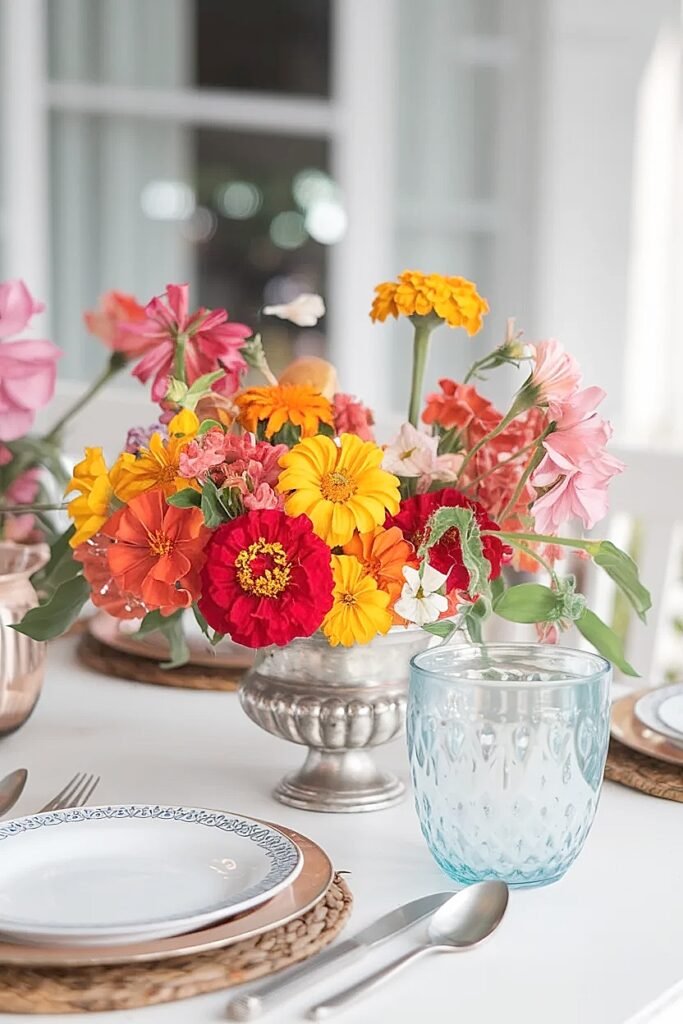
Kids at an outdoor birthday party interact with the centerpiece in ways that adults at a dinner party do not: they reach across it, lean over it, pick at the petals, and occasionally try to smell it at extremely close range. Any flower with accessible exposed stamen at a child’s eye level is a pollen delivery mechanism that will have itchy eyes and sneezing within the first twenty minutes. This is not hypothetical.
The flowers below have essentially zero accessible pollen at any developmental stage, hold up to contact and handling, and look genuinely beautiful in a kid-friendly outdoor birthday context.
1. Zinnias Zinnias have the densest petal structure of any common summer birthday flower, leaving no accessible stamen at any point in the bloom cycle. Zero pollen risk regardless of contact level. They do not drop petals when grabbed or handled. Vivid colors hold in outdoor sun. One bunch fills the entire centerpiece setup for a kids’.
2. Statice Statice is physically inert at a kids’ party. Zero accessible pollen, zero fragrance, and the papery blooms do not drop or shed regardless of how much contact they receive from curious hands. The blooms maintain their color and form for the full party without any attention or water changes. Purple and white statice mixed with.
3. Marigolds Marigolds have no accessible stamen from the surface at any bloom stage, making them pollen-safe even at direct contact range. The strong marigold fragrance is worth noting: it is pleasant at table distance but noticeable at close range. Kids who are sensitive to fragrances may react even without pollen exposure. Keep marigolds toward the outer.
4. Strawflowers Strawflowers are among the safest flowers for a kids’ birthday centerpiece. The papery petals contain no accessible pollen, shed nothing when touched, and maintain their form when grabbed, pulled at, or pressed flat by curious hands. They are genuinely indestructible in the way that no delicate cut flower is. Kids can interact with a strawflower.
5. Waxflower Waxflower has essentially zero accessible pollen and a barely perceptible fragrance that children rarely react to even at direct contact. The tiny clustered blooms do not shed when touched, hold structure through an outdoor birthday party, and white or pale pink waxflower mixes with every other flower on this list to double the visual density.
More ahead on building a centerpiece that reads as generously full without crossing into cluttered or visually overwhelming.
How to Build a Backyard Birthday Party Centerpiece with Summer Flowers That Feels Full but Not Crowded
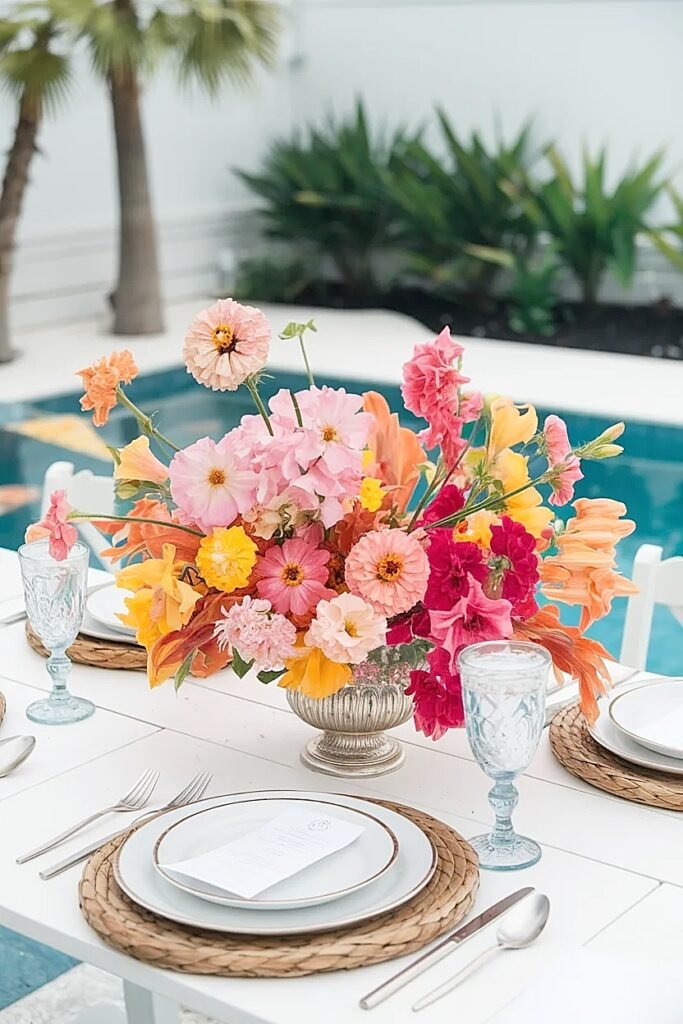
Full and crowded are different things. Full means every vessel looks abundant and the overall display reads as generous. Crowded means vessels are too close, stems are too dense, or the scale overwhelms the table surface.
The most effective technique for achieving full without crowded is the density gradient: pack the focal element tightly within each vessel, use a single trailing greenery strand to connect the vessels, and leave the surface between vessels completely clear. Three to four stems per vessel, one connecting strand, clear table surface everywhere else. Each individual vessel reads as abundant.
Spacing matters. On a six-foot table, five vessels at even twelve-inch intervals is a full garland centerpiece. Move those same five vessels to ten-inch intervals and the display starts to read as crowded with the same material.
The right outdoor birthday centerpiece vessel is compact enough to hold the arrangement tightly but substantial enough to support upright blooms. Short, wide ceramic vessels between four and six inches in diameter hit that balance consistently.
Ideas for Summer Flowers in a Backyard Birthday Party Dessert Table Centerpiece
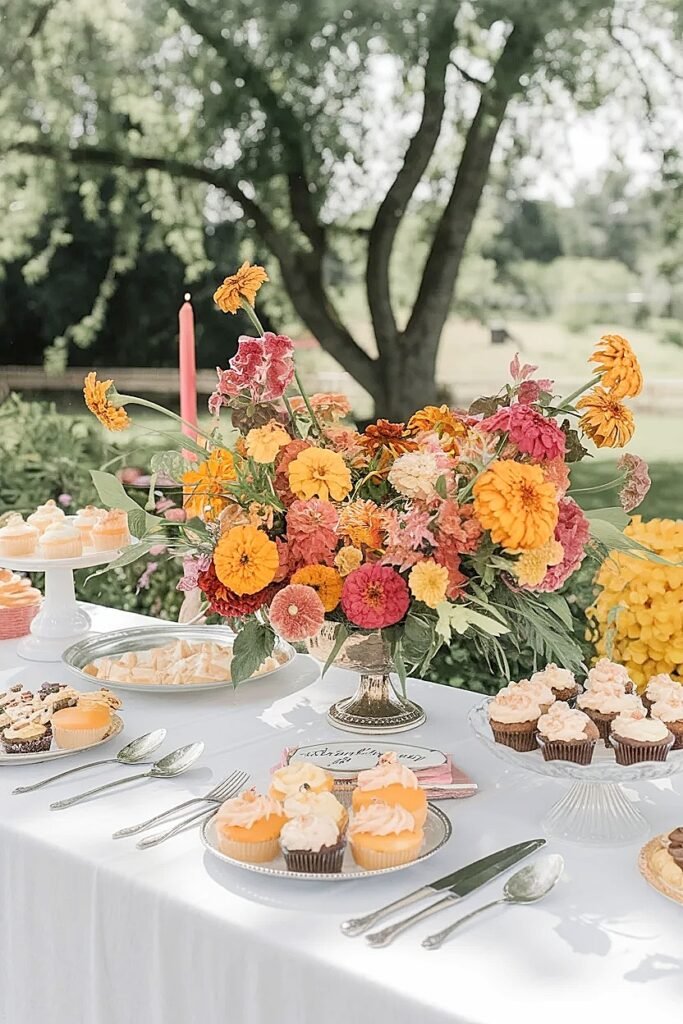
The dessert table at a backyard birthday party is the most visually competitive surface at the event. Birthday cake, cookies, fruit, cupcakes, and assorted party foods create a surface that already does substantial visual work on its own. Flowers at the dessert table function as framing elements, not focal points. The cake is the star. The flowers frame it.
One arrangement at each end of the dessert table, with the full center clear for the cake and dessert spread, is the right formula. The flower arrangements should complement the dessert colors rather than compete with them.
1. Single Bud Vase Pair at Dessert Table Ends One small bud vase at each far end of the dessert table, each holding two or three stems of ranunculus or pale zinnias. The two-vase treatment frames the dessert spread symmetrically. Keep both vessels at identical heights and identical flower varieties. The symmetry reads as intentionally designed from across the party space and creates a.
2. Floating Bloom Bowl at One End One wide, low ceramic bowl at one end of the dessert table, filled with water and floating ranunculus, cosmos, or chamomile blooms face-up across the surface. The floating arrangement occupies minimal surface area, creates a beautiful effect in overhead outdoor party light, and leaves the full dessert spread visually unobstructed. Nothing extends above the bowl.
3. Single Potted Herb at Back Center One compact potted rosemary or basil plant at the back center of the dessert table, behind the birthday cake position. The living potted plant adds genuine fragrance that works as a pleasant background element at dessert table scale without competing with the sweet dessert aromas. Zero loose elements, zero petal drop, and the plant goes.
4. Low Herb and Bloom Tray A narrow wooden tray along the very back edge of the dessert table holding three short vessels: one with a herb bundle, one with pale zinnias, one with waxflower. The tray creates a physical boundary between the decor zone and the dessert zone and makes the full arrangement moveable as one unit if the dessert.
5. Two Terracotta Saucers at Dessert Table Corners One wide, low terracotta saucer at each back corner of the dessert table, each packed with a compact cluster of pale summer blooms pressed to rim height. Corner saucers at the dessert table create a clean, symmetrical framing treatment that photographs beautifully with the birthday cake at center. Terracotta does not shatter if displaced by.
Conclusion
Choosing the best summer flowers for a backyard birthday party centerpiece comes down to five practical decisions: color saturation for outdoor sun resilience, low-profile arrangements for guest sightlines, gravel-weighted vessels for outdoor stability, zero-pollen varieties when kids are present, and visual continuity between the centerpiece and the rest of the birthday setup. Get those five decisions right and the flower variety almost chooses itself.
Start with zinnias and marigolds from the grocery store in the boldest colors available. Get one arrangement right on a test vessel before the party. Understand the height, the stem count, and the gravel weight that works for your specific table. Then replicate it across every centerpiece position. The flowers are the straightforward part. The system behind them is what makes everything hold up through the full afternoon of a real backyard birthday party.
This website contains affiliate links, and some products are gifted by the brand to test. As an Amazon Associate, I earn from qualified purchases. Some of the content on this website was researched and created with the assistance of AI technology.