This website contains affiliate links, and some products are gifted by the brand to test. As an Amazon Associate, I earn from qualified purchases. Some of the content on this website was researched and created with the assistance of AI technology.
Key Takeaways
- White cosmos blooms close in low light and overnight — always stage them in bright light before moving to the table, never straight from a dark storage spot
- Cosmos stems need support inside the vessel; a clear tape grid or gravel base is not optional — it is what keeps the arrangement looking composed rather than scattered
- Cosmos petals show heat stress as edge browning faster than most white flowers; use cold water, avoid direct afternoon sun positions, and cut stems before each water change
- Pairing cosmos with a structurally dense partner, white zinnias or statice, creates the visual stability the cosmos alone cannot provide without losing its airy quality
- Low bowl arrangements suit cosmos better than narrow-neck vessels because the wide mouth allows the natural arching habit to display freely
- Narrow balcony tables, typically twelve to sixteen inches deep, allow only a single very small arrangement or a bud vase at one end
Creating white cosmos summer bouquets for small patio tables is the flower project that keeps surprising me with how much visual return it gives per dollar spent. One grocery store bunch of white cosmos, properly handled and intelligently placed, creates an arrangement that looks like it came from a florist rather than a checkout aisle. The flower does the design work. The stem is naturally arching. The blooms orient themselves beautifully. The tissue-thin petals create light-catching translucency that no dense flower produces at the same cost.
The challenge is real, though. Cosmos is not forgiving in the way a zinnia is. The delicate stems need support, the blooms close in low light, and the tissue-thin petals show heat stress faster than almost any other white summer flower. Knowing those specific vulnerabilities before you start is the difference between an arrangement that looks like a garden snapshot and one that looks like something went wrong at the last minute.
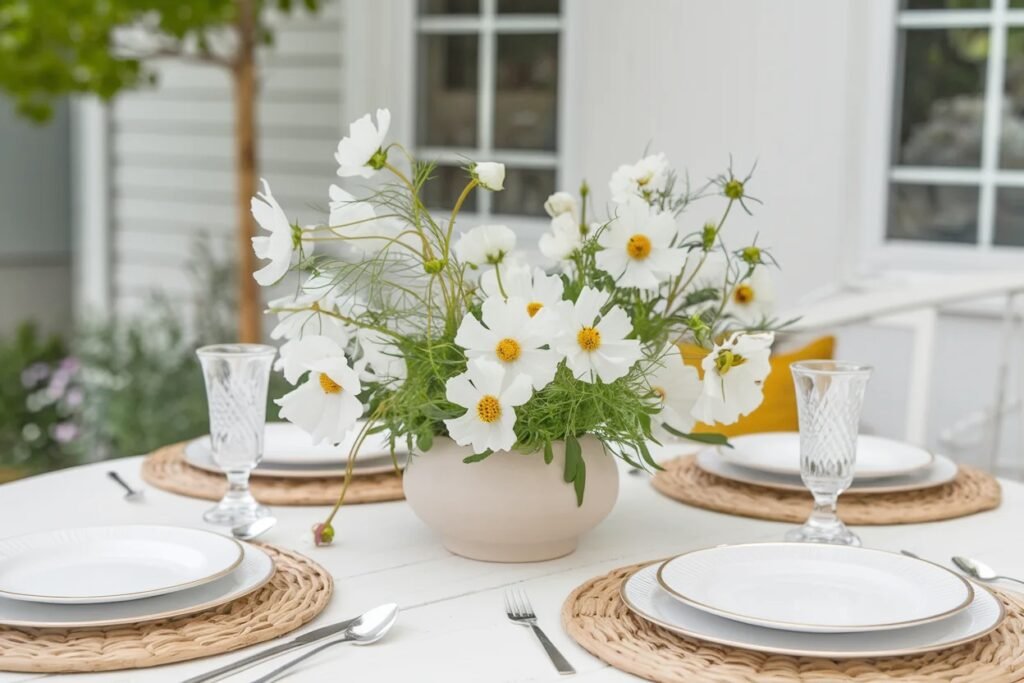
Use this guide before placing white cosmos on a small patio table. Cosmos are naturally airy, so the trick is not making them too tall or floppy. Match your vessel, filler, and table placement to the way you actually eat, serve, and move around the table.
Easy White Cosmos Summer Flowers for Small Patio Tables
Choose the right cosmos setup by table size, meal type, and how much room the food needs.
| Small Patio Table Need | Best Cosmos Bouquet Setup | Best Supporting Flowers | Smart Styling Tip |
|---|---|---|---|
| Two-person bistro tableVery limited room for plates and shared food. | One low bowlTrim cosmos short and keep the bouquet rounded. | Feverfew, gomphrena, mintSmall texture supports airy cosmos without bulk. | Keep a clear ringLeave visible space between the bowl and each plate. |
| Narrow balcony tableLong, slim, and easy to overcrowd. | Two tiny cupsPlace them near opposite corners instead of the middle. | Yarrow, thyme, small astersUse low texture and fine herbs. | Lean stems outwardKeep cosmos away from the eating space. |
| Shared small platesThe table needs clear serving access. | Off-center slim vesselA narrow bouquet leaves the middle useful. | Scabiosa, feverfew, herbsSoft support keeps cosmos from looking sparse. | Frame the foodDo not place flowers directly in the serving path. |
| Outdoor coffee tableLow seating makes tall flowers awkward fast. | Mini cup bouquetUse a few short cosmos buds and herbs. | Gomphrena, mint, feverfewSmall stems keep the look relaxed. | Stay extra shortThe lower the seating, the shorter the flowers should be. |
| Longer patio mealFlowers need to stay fresh and easy to fix. | Water-friendly low vesselUse a cup or bowl that is easy to refill. | Statice, gomphrena, yarrowThese add texture if cosmos fade first. | Clean lower stemsKeep leaves out of water for fresher bouquets. |
Resources:
- How to Care for Cut Flowers | Yard and Garden
- Add a Touch of Whimsy to Your Vase: A Guide to Growing Cosmos for Cut Flowers
- Growing Cosmos for Floral Design — the kokoro garden
- How To Cut Cosmos For The Longest Vase Life – The Floral Project
How to Style Easy White Cosmos Summer Flowers Bouquets Low Enough for Small Patio Tables
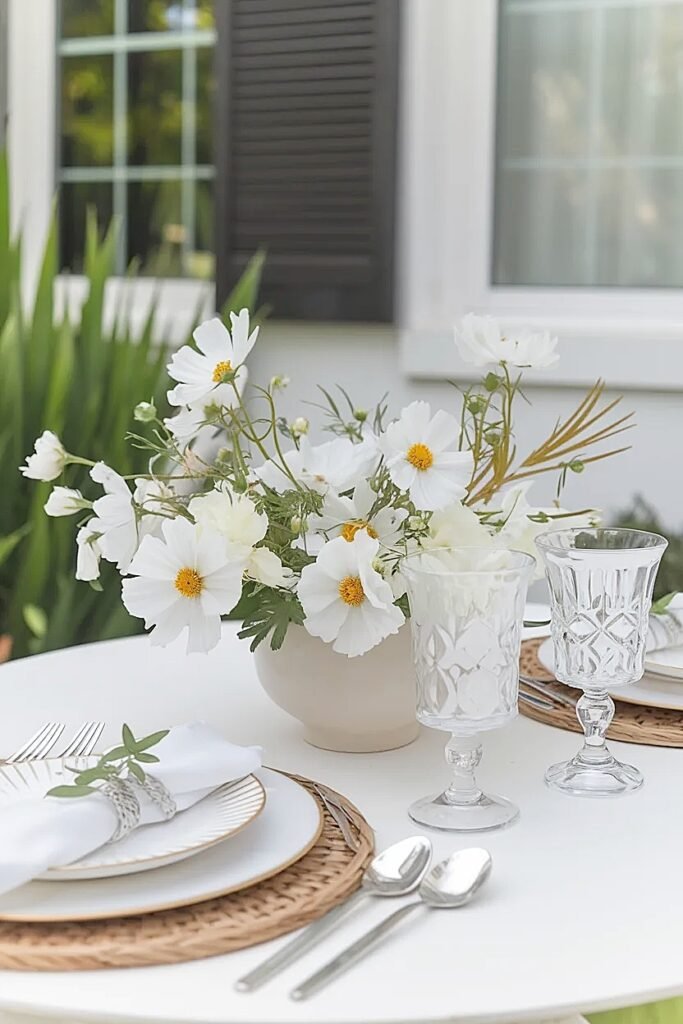
Cosmos wants to arch. Let it.
The natural arching habit of a cosmos stem is its most beautiful quality. It is also what makes cosmos difficult to style low without mechanical support, because an arching stem tends to lean outward and upward rather than holding a contained three-inch position above the vessel rim. The answer is not to cut it shorter. The answer is to support each stem individually so the arch is expressed within a controlled position rather than at random.
Clear tape grid. Two to three horizontal strips, two to three vertical strips across the vessel mouth. Grid openings about three-quarters of an inch. Insert one cosmos stem per opening at whatever angle sits the bloom face approximately three inches above the rim. The tape holds each stem at its intended angle while the bloom arches naturally within that anchor point. From above, the tape is invisible. From the side, every bloom sits at the height you intended it to.
This approach does two things at once. The stems hold at three to four inches above the rim, which keeps the arrangement below the sightline threshold that creates conversation problems at a small patio table. And each stem’s natural arch is expressed within its grid position, so the arrangement retains the cosmos’s living, organic movement quality that makes it worth using in the first place.
Use cold water. Fill the vessel immediately before the party, not an hour before. Cosmos stems are sensitive to water temperature in a way that woody-stemmed flowers are not, and warm water accelerates the bacterial buildup that causes the delicate stem tissue to fail faster than it otherwise would. A diagonal recut on each stem before it goes into the vessel maximizes uptake at the most critical moment.
For more on white summer flower bouquets for small outdoor tables, including low bowl formats and bistro table arrangements across multiple flower types, check out easy white summer flower bouquets for small outdoor tables. Share this with anyone building a small patio table arrangement this summer. More ahead on fillers, herb pairings, and everything else cosmos needs to perform well.
What Are the Best Fillers for White Cosmos Summer Flowers Bouquets on Small Patio Tables?
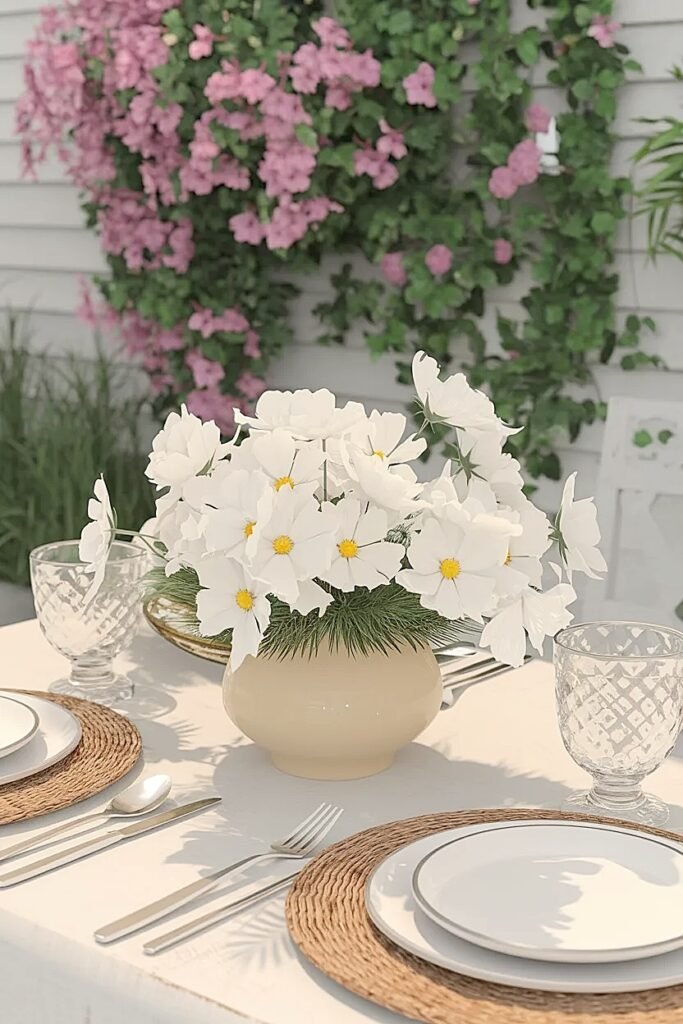
Cosmos alone in a small patio vessel looks unfinished. Not sparse, exactly, but incomplete. The stems and the bloom faces are beautiful, but the visual gaps between them read as something missing rather than as intentional negative space.
The filler solves this. And the filler for cosmos needs to be specifically chosen — something that adds visual mass and stem-support density without overwhelming the cosmos’s defining quality, which is lightness.
1. White Waxflower White waxflower creates the finest-textured supporting mass available for a white cosmos arrangement at any scale. The tiny star-shaped blooms along each branching stem fill the visual gaps between cosmos faces without any single branch drawing attention to itself. At small patio table close range, the waxflower texture becomes visible in detail. One or two waxflower stems fill a small vessel arrangement completely without ever.
2. Seeded Eucalyptus Seeded eucalyptus trails naturally between cosmos stems, adding silver-grey textural contrast at the vessel perimeter while its branching structure provides soft lateral support to the leaning cosmos stems nearby. The round seed clusters echo the circular cosmos bloom face at a much smaller scale, creating visual echo without repetition. One eucalyptus stem per arrangement is usually sufficient; more than that and the eucalyptus starts to.
3. White Chamomile Fresh chamomile cut to slightly shorter than the cosmos stems creates a warm daisy-face filler at the arrangement base. The yellow centers add the one warm accent note that prevents an all-cool white cosmos display from reading as flat. At small patio dining close range, the chamomile honey fragrance adds a layered sensory quality that purely ornamental fillers cannot provide. Both flowers share compatible cultural.
4. White Statice White statice at the vessel base provides structured, papery filler texture that adds visual mass without any stem reaching high enough to interfere with the cosmos at upper arrangement levels. The papery blooms hold ten or more days, which means the statice continues looking complete as cosmos stems are replaced throughout the arrangement’s lifespan. No water management concern: statice holds under any condition.
5. Gypsophila (Baby’s Breath) Baby’s breath used at low proportion, one stem per five cosmos stems, creates atmospheric supporting mist rather than the heavy filler application that gave it a dated reputation. Position the gypsophila toward the rear of the arrangement so the white mist reads as a soft backdrop against which cosmos stems pass. The mist creates spatial depth that same-level fillers do not produce.
6. Maidenhair Fern Fronds Maidenhair fern creates the most botanically compatible greenery for cosmos. Both have fine stems and communicate organic delicacy in the same visual language. The fan-shaped maidenhair leaflets on thin black stems add a distinctive dark-stemmed texture at the arrangement base that contrasts with the cosmos’s green stems above them. Keep maidenhair stems in cold water until the very last moment before assembly.
7. Fresh Dill Fronds Dill’s feathery yellow-green fronds create the most fragrant, most food-adjacent filler for a small patio dining cosmos arrangement. The anise fragrance at close table range is gentle and food-compatible. The dill fronds fill the visual gaps between cosmos stems with a fine-textured green that matches the cosmos’s own lightness without competing with it. Cut dill one to two inches longer than the cosmos stems so.
More ahead on the low bowl format specifically, which is the one format that lets cosmos display its natural arching habit at the most intimate scale.
How to Arrange White Cosmos Summer Flowers Bouquets in One Low Bowl for Tiny Patio Tables
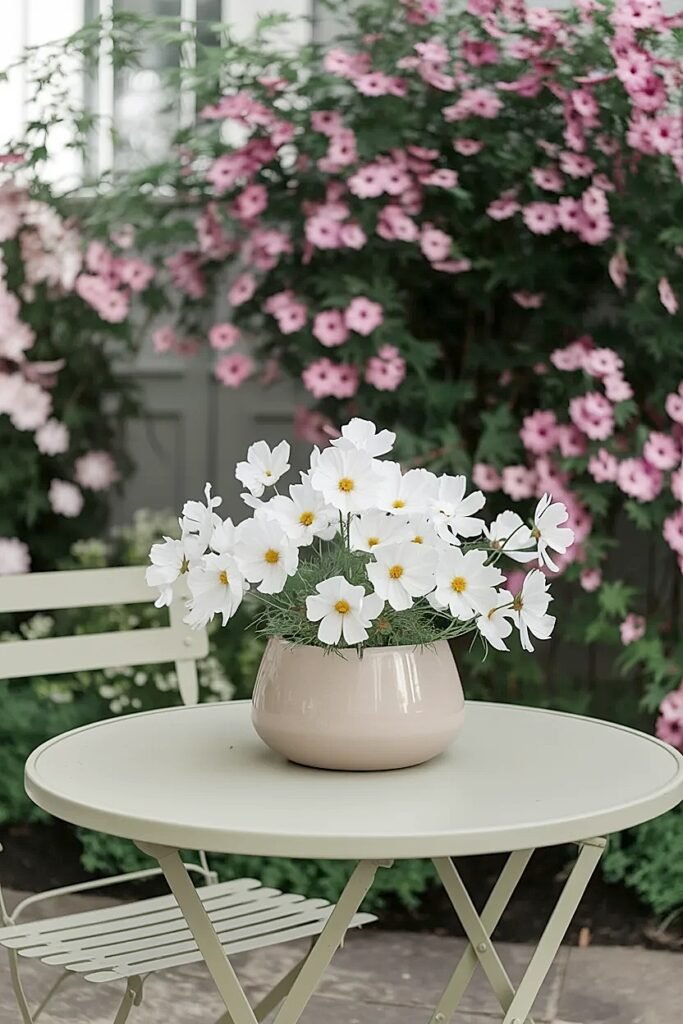
Tiny patio tables — the kind you find on a studio balcony or beside a single chair in a corner garden — barely support two glasses and a plate, let alone a conventional flower arrangement. The low bowl format is the only one that works here without occupying functional table surface that cannot be sacrificed.
Wide, shallow, heavy. Those three words describe the ideal cosmos low bowl vessel for a tiny patio table. Wide enough to display multiple bloom faces across its diameter. Shallow enough that bloom stems at rim height keep the arrangement below the functional sightline of a solo or paired diner. Heavy enough that afternoon patio breeze does not slide it across the table or tip it sideways.
Cut cosmos stems to two inches above the rim. Press them into a small amount of gravel at the bowl base rather than using a pin frog, which can become unstable in the wide shallow water volume a low bowl holds. The gravel distributes stem anchor points across the bowl diameter rather than concentrating them at one central structure. Each stem presses into its own gravel position and holds independently.
Two to three waxflower stems tucked between the cosmos at the same two-inch height complete the arrangement. The cosmos’s arching habit, even at this very short-cut height, creates slight variation in how each bloom face sits above the rim. Some face more directly up. Some angle slightly outward. That natural variation is the quality that makes the low bowl cosmos arrangement look gathered rather than arranged.
There is more ahead on herb pairings for cosmos at small patio table scale, where fragrance at close range becomes a genuine design contribution.
Ways to Pair White Cosmos Summer Flowers Bouquets with Herbs for Small Patio Dining
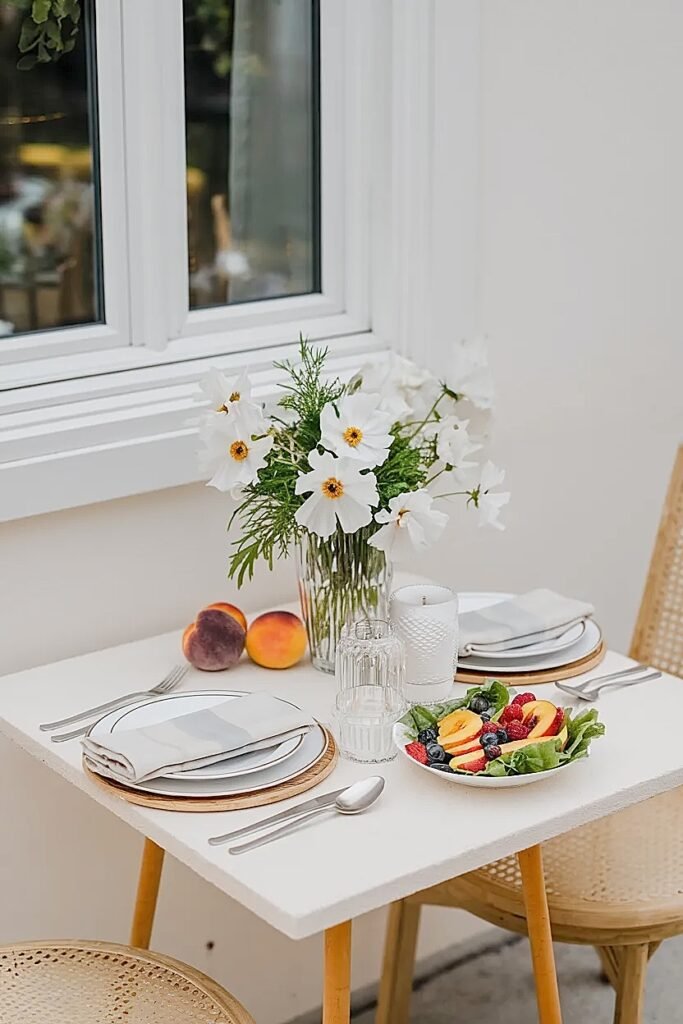
1. White Cosmos with Fresh Dill Dill fronds inserted among cosmos stems create the most visually compatible herb-and-flower combination available for small patio arrangements. The feathery yellow-green fronds match the cosmos’s own visual delicacy. The anise fragrance is gentle enough for close dining range. Cut dill to slightly longer than the.
2. White Cosmos with Lemon Verbena Lemon verbena’s citrus fragrance alongside cosmos at a small patio table creates a specific summer-afternoon sensory quality that no ornamental greenery provides. The narrow bright-green verbena leaves add light-green foliage contrast at close range. Position verbena stems slightly behind the cosmos blooms so the leaves.
3. White Cosmos with Fresh Basil Dark basil leaves create the most dramatic contrast against white cosmos petals of any herb option available. The basil fragrance at close outdoor range is vivid and food-adjacent, which suits a patio dining context specifically. Use immediately after cutting, as basil wilts faster than most.
4. White Cosmos with Mint Spearmint’s rounded leaves and fresh fragrance create a cooling sensory combination with white cosmos at an outdoor summer table. The mint fragrance intensifies in heat, making it more present at a sun-lit patio table than in a cool indoor arrangement. Two mint sprigs alongside three.
5. White Cosmos with Rosemary Rosemary’s needle-like silver-green foliage creates fine-textured structural support alongside cosmos’s more delicate stems. The rosemary fragrance is clean, specific, and food-compatible at close patio range. The rosemary stems provide lateral support for the arching cosmos, reducing the tendency of cosmos stems to lean outward at.
More ahead on how white zinnias specifically solve the structural instability that cosmos creates when used alone in small patio arrangements.
Creative Ways to Mix White Cosmos Summer Flowers Bouquets with White Zinnias for Structure
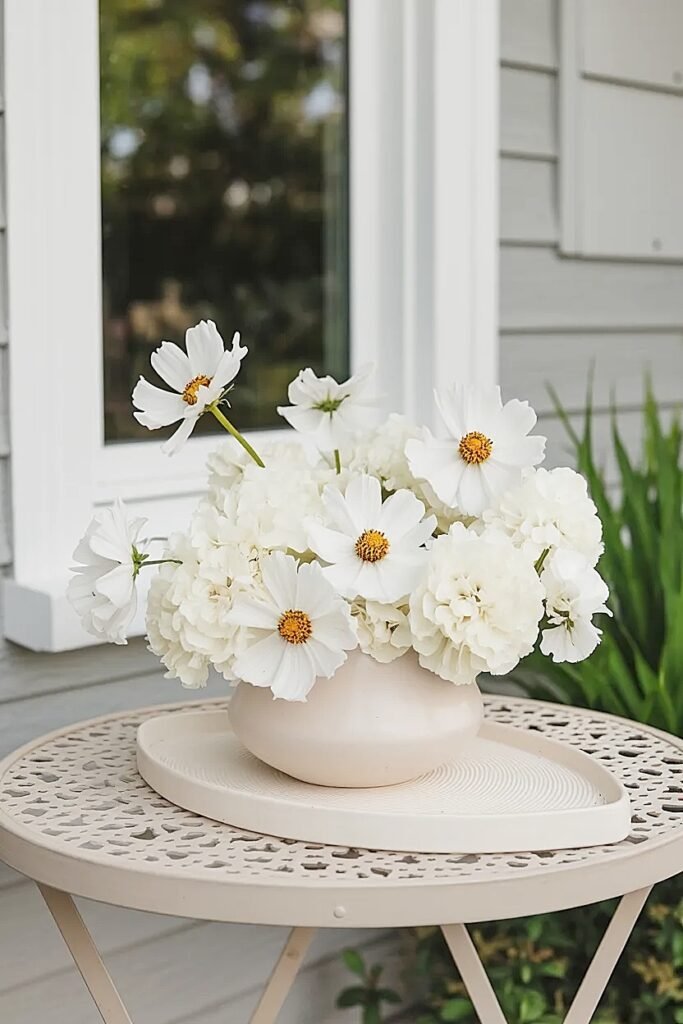
Cosmos without structure drifts. Zinnias without movement sit. Together, they create the arrangement that neither one produces alone.
The cosmos provides the airy, light-catching translucency that makes the arrangement feel alive. The zinnia provides the dense, flat-faced structural anchor that keeps the whole composition from reading as a collection of wandering stems. One flower gives the arrangement its soul. The other gives it its bones.
1. Zinnia Center with Cosmos Perimeter Three white zinnia stems at the vessel center with four to five cosmos stems inserted at the outer edges, angling outward slightly. The zinnia creates a dense white focal mass; the cosmos creates an airy halo around it. Dense center, light edge. The arrangement reads.
2. Equal Proportion Mixed Throughout Four zinnia stems plus four cosmos stems distributed throughout one vessel, no zone separation. Equal proportion creates a visual blend where the flat zinnia faces and tissue-thin cosmos faces are visible side by side at close range. The structural contrast between the two white flowers.
3. One Zinnia as the Anchor Among Many Cosmos Six to seven cosmos stems with one white zinnia stem inserted at the arrangement center creates a cosmos-dominated display with a single structural reference point. The zinnia prevents the all-cosmos arrangement from reading as unmoored without changing its fundamentally airy character. One dense bloom in.
4. Cosmos Arching Over a Low Zinnia Base Cut four zinnia stems to two inches and position them at the vessel base, creating a rim-level dense foundation. Insert five cosmos stems at four to five inches so they arch over the low zinnia layer. The zinnia base creates visual stability; the cosmos creates.
5. Alternating Vessels in a Table Row In a multi-vessel centerpiece arrangement, alternate cosmos-only vessels with zinnia-only vessels down the table center. The alternating texture creates a rhythm that reads as designed rather than random. Guests nearest the cosmos vessels experience airy lightness; guests nearest the zinnia vessels experience graphic density. The.
More ahead on the specific techniques that maintain cosmos’s defining airiness while making the arrangement look genuinely full at small patio table scale.
How to Make White Cosmos Summer Flowers Bouquets Look Full Without Losing Airiness
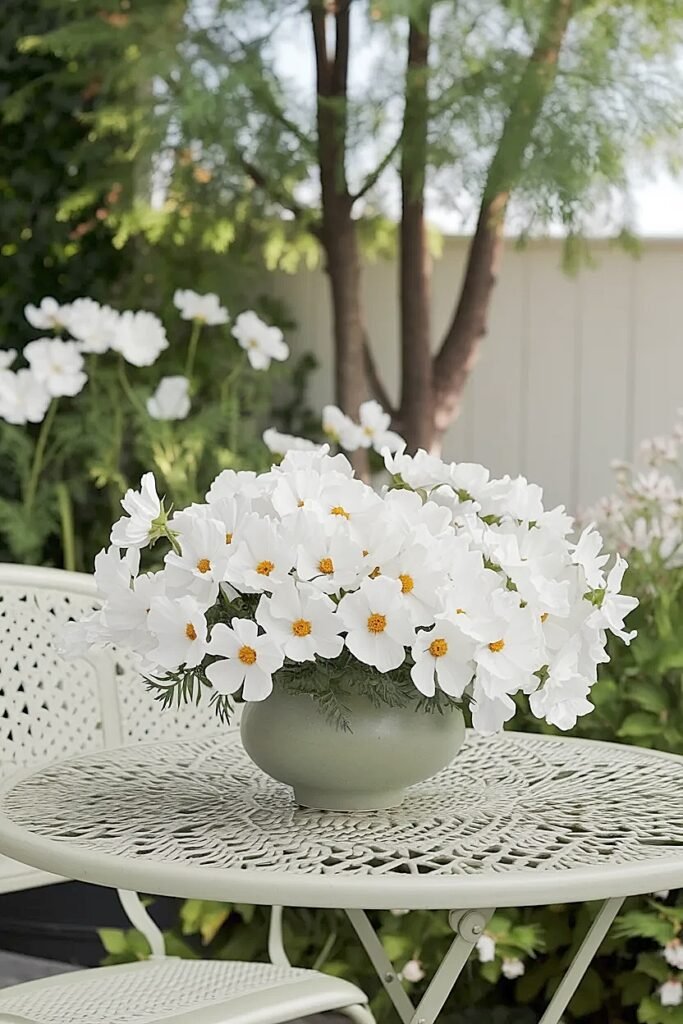
Full and airy seem like opposites. They are not. The conflict is imaginary.
An airy arrangement looks full when every visible surface and visual gap is occupied by something intentional, even if that intentional element is more delicate than the blooms themselves. The gaps between cosmos stems are not empty. They are spaces where dill fronds, waxflower branches, or fennel fronds exist at a finer texture scale. The viewer’s eye registers those fine elements as part of the fullness without identifying them individually.
The specific technique: build from the inside out rather than the outside in. Place the filler material first, distributed throughout the vessel at the gravel or tape grid level. Then insert the cosmos stems through the filler layer so the cosmos blooms rise above it. The filler now occupies the interior visual space that would otherwise read as stem-and-gap, and the cosmos occupies the upper arrangement level that defines the display’s character.
Short cuts add to perceived fullness at small table scale. A cosmos stem cut to three inches above the rim covers more visual diameter from the overhead seated viewing angle than the same stem cut to six inches, because the shorter position places the bloom face closer to the vessel opening, covering the vessel interior from above. Counterintuitive but consistently true: shorter, more blooms, wider-mouth vessel creates more fullness than taller, fewer blooms, narrow vessel.
Resist the urge to add more cosmos stems when the arrangement feels incomplete. Almost always, the feeling of incompleteness comes from filler absence rather than from insufficient focal flower stems. Add one waxflower stem or two dill fronds before reaching for another cosmos stem. The filler fills. The cosmos does not need to.
Easy Ideas for White Cosmos Summer Flowers Bouquets on Narrow Balcony Tables
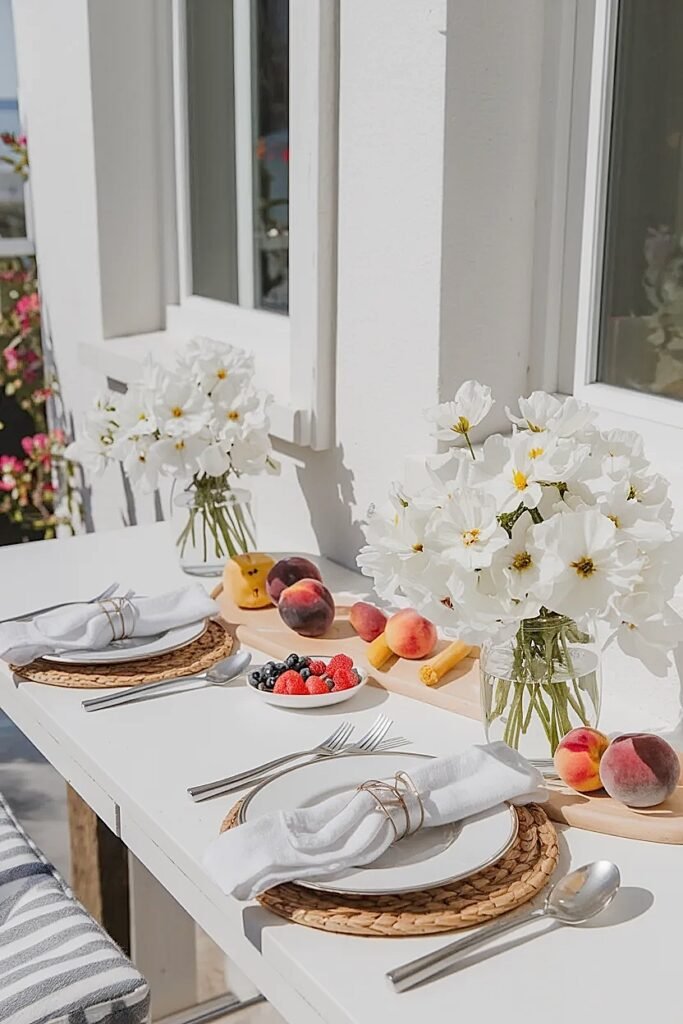
Narrow balcony tables are twelve to sixteen inches deep. That is the depth of one dinner plate and one wine glass.
The arrangement cannot go in the center. The center is a plate position. The arrangement goes at one end of the table, or at the corner, or it sits on the balcony ledge rather than the table itself.
1. Single Bud Vase at the Narrow Table End One slim bud vase with two cosmos stems and one dill frond at the far end of a narrow balcony table. The end position keeps the arrangement clear of all plate and glass positions throughout the meal. The cosmos arches naturally over the table edge.
2. One Bud Vase Per Guest on the Balcony Ledge Place one small bud vase with two cosmos stems on the balcony ledge or railing top beside each seated position rather than on the table itself. The table surface stays completely free. Each guest has a personal arrangement at arm’s reach. The cosmos at railing.
3. Three Cosmos Stems in a Narrow Bottle at the Table Corner Three white cosmos stems in a narrow bottle, a small olive oil bottle or a narrow glass sauce bottle, at one corner of the narrow balcony table. The narrow vessel footprint takes almost no surface space. The cosmos stems arch outward over the table edge.
Conclusion
White cosmos at a small patio table creates something most flowers at that scale cannot: the impression that the table exists in a garden rather than beside one.
The delicate stems, the tissue-thin petals, the gentle movement in afternoon breeze. These are not incidental qualities. They are the specific reason cosmos suits outdoor small table dining better than most cut flowers available at the same price.
Support the stems. Use cold water. Add one filler. Keep the height low. Those four decisions are all white cosmos needs to perform exactly the role a small patio table asks of it.
This website contains affiliate links, and some products are gifted by the brand to test. As an Amazon Associate, I earn from qualified purchases. Some of the content on this website was researched and created with the assistance of AI technology.