This website contains affiliate links, and some products are gifted by the brand to test. As an Amazon Associate, I earn from qualified purchases. Some of the content on this website was researched and created with the assistance of AI technology.
Key Takeaways
- The complementary relationship between orange and green creates natural visual tension: that tension is an asset when controlled through proportion and managed through herb selection
- The green-to-orange proportion ceiling for fall herb arrangements: one herb stem per three to four flower stems prevents the herb from dominating the complementary relationship
- Rosemary’s silver-green needle foliage suits vivid pumpkin orange; deep green basil suits rust and amber orange; sage’s grey-green suits soft apricot and peach-orange tones
- Fragrance management is more critical for mint-and-orange combinations than for any other herb-orange pairing: spearmint at dining close range works, peppermint at the same distance often becomes overwhelming
- The green-to-orange ratio changes with orange tone: vivid saturated oranges need more green contrast; soft muted peach-oranges need proportionally less, because the peach tone already reads as soft
- Thyme and dried wheat together create a three-material autumn combination with minimal fragrance commitment that suits Thanksgiving-adjacent fall events where food aromas dominate
Styling orange fall flowers with fresh green herb accents is the arrangement project that keeps revealing something new every time I come back to it. Orange and green sit directly opposite each other on the color wheel. That complementary relationship makes them one of the most visually energetic color pairings available in any season. But in autumn, the specific tones of orange available, the burnt sienna of late dahlias, the vivid pumpkin of marigolds, the soft apricot of certain chrysanthemums — and the specific greens of culinary herbs — create combinations that go well beyond complementary contrast into something that reads as specifically seasonal and deliberate.
What makes this different from simply putting green leaves beside orange flowers is the herb dimension. Rosemary, basil, thyme, and sage each have specific visual textures, fragrance profiles, and structural habits that interact with different orange tones in different ways. Vivid pumpkin orange behaves differently with fine-needle rosemary than it does with broad dark basil. Soft apricot-peach requires different herb choices than deep burnt sienna rust. Understanding those distinctions is the difference between an arrangement that looks designed and one that looks like whatever was available.
Orange flowers can look bright, muted, rustic, or refined depending on the herb beside them. Start with the orange shade, then choose an herb that offers the right leaf size, green depth, and texture. This quick guide makes it easier to build balanced bouquets without guessing or overfilling them.
| Orange Shade | Best Herb Accent | Why It Works | How to Avoid Overdoing It |
|---|---|---|---|
| Peach and apricot Soft and light. | Thyme or a little mint. | Small leaves keep delicate orange tones gentle. | Use two to four short sprigs around the edge. |
| Bright tangerine Clear and energetic. | Silvery green sage. | Muted sage cools vivid orange without dulling it. | Tuck sage low and behind the flower faces. |
| Rust orange Warm and earthy. | Deep green basil. | Broad dark leaves strengthen rich autumn color. | Keep basil behind blooms and trim extra leaves. |
| Golden orange Sunny and harvest-inspired. | Short rosemary sprigs. | Rosemary adds crisp structure and deeper contrast. | Angle sprigs sideways rather than straight upward. |
| Mixed orange shades Varied and lively. | Parsley or thyme. | Consistent green texture ties multiple orange tones together. | Choose one herb and repeat it lightly throughout. |
Resources:
- Add a dash of herbs to spice up floral bouquets | Illinois Extension | Illinois
- Warm Season Cut Flowers – Gardening Solutions
- Marigolds | UMN Extension
How to Balance Bright Orange Fall Flowers with Soft Fresh Green Herb Accents
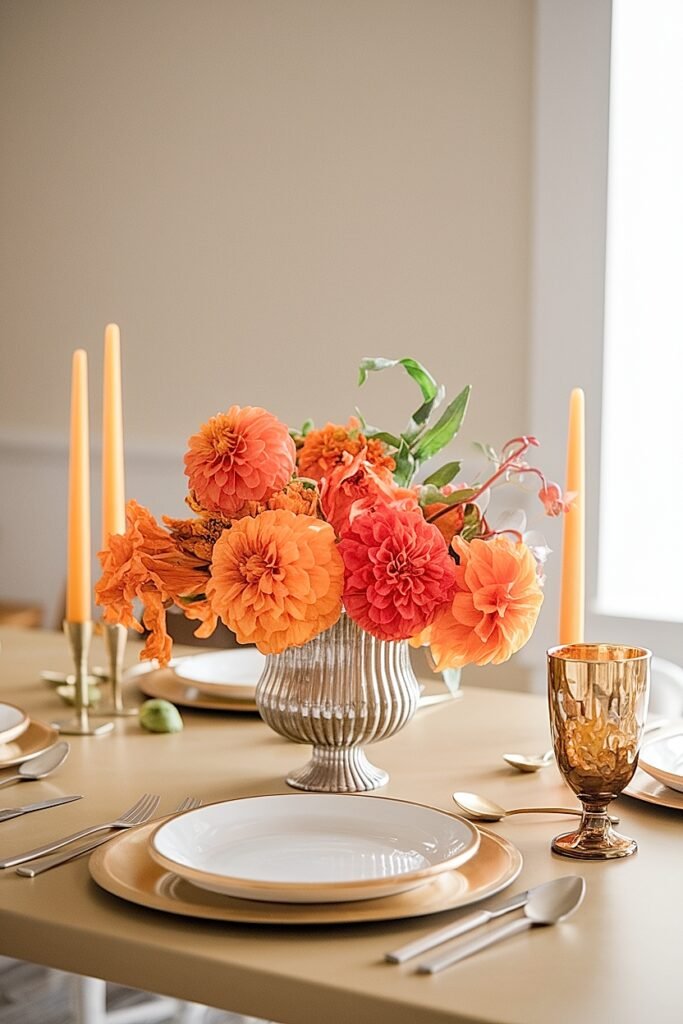
Bright orange is the most visually assertive tone in the autumn palette. It demands attention. It reads from across the room. And in the context of a fall arrangement, it can overwhelm every other element in the vessel if the composition does not provide visual counterweight.
Fresh green herbs create that counterweight. Not by competing with the orange for attention, but by providing a resting point for the eye — a visual breath between the vivid orange blooms that allows each bloom to read as distinct rather than as part of a single undifferentiated orange mass.
The technical principle is simultaneous contrast: each color makes the adjacent color appear more vivid than it would appear in isolation. Orange next to green appears more orange. Green next to orange appears more green. The complementary pair amplifies both elements simultaneously. This is why even one rosemary sprig in a vivid orange marigold arrangement creates an arrangement that reads as more visually complete than the same marigolds without any green.
Proportion control is the mechanism that prevents the amplification from becoming a visual argument. At one herb stem per four orange flower stems, the herb creates the contrast accent that the orange needs without claiming visual leadership. At one herb stem per two flower stems, the arrangement begins to read as herb-dominant. The eye reads it as a herb display with orange accents rather than an orange flower arrangement with herb support. That reversal is usually the outcome when the herb is added after the flowers without measuring the proportion consciously.
For more on autumn flower and herb pairings for dinner tables including the specific fragrance management strategies for close-range indoor dining arrangements, check out best autumn flower and herb pairings for small dinner parties. Share this with anyone building fall arrangements this season. More ahead on specific herb choices for every orange tone.
Creative Ways to Use Rosemary with Orange Fall Flowers Without Stiff Lines
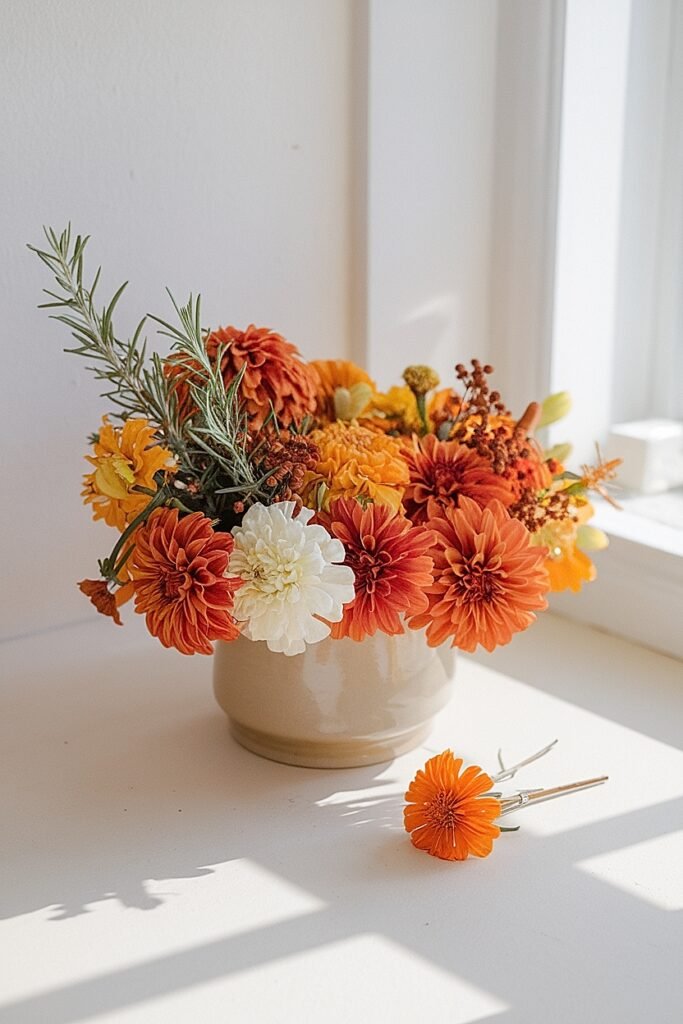
Rosemary has a posture problem in most arrangements.
The stiff woody stems and dense needle coverage create a naturally upright, slightly military quality that conflicts with the loose, seasonal character most fall arrangements aim for. Used at full branch length and placed upright in a vessel, rosemary reads as a structural element that looks planted rather than arranged. The solution is not less rosemary. The solution is different rosemary placement.
1. Rosemary on the Diagonal Through Orange Marigolds Insert one long rosemary branch diagonally across the full width of a vessel filled with orange marigolds, angling from one side of the vessel mouth to the other at roughly thirty degrees off horizontal. The diagonal branch crosses multiple orange blooms, creating visual movement through the arrangement rather than the stiff vertical that upright rosemary produces. The needle foliage appears above, between, and below the.
2. Short Rosemary Sections as Scattered Gap Fillers Cut rosemary into two-to-three-inch sections stripped of needles from the bottom inch and press the individual sections into the arrangement’s gravel base at the gaps between orange flower stems. Each short section contributes needle texture at a small local scale rather than a single dominant branch that reads as a structural element. The distributed sections create a uniform needle texture field throughout the arrangement interior.
3. Trailing Rosemary Over the Vessel Rim Insert one long rosemary branch so the cut end rests in the vessel water and the upper two-thirds of the branch trails outward over the vessel rim and downward below the vessel edge. The trailing branch softens the vessel perimeter. The needle texture moves from inside the orange arrangement to outside the vessel boundary, creating an organic connection between the arrangement and the table surface.
4. Rosemary Bundle as the Arrangement’s Structural Base Build the rosemary layer first: four to five rosemary sprigs pressed into the gravel at approximately the same height, creating a uniform needle texture base layer. Then insert the orange flowers through the rosemary layer so the stems emerge from the herb mass and the blooms sit above the rosemary canopy. The orange blooms appear to float above the green herb base, which reads as.
5. Single Rosemary Sprig Per Small Vessel at Place Settings In a small dinner table place-setting arrangement, one rosemary sprig in a bud vase with two orange flower stems creates the most intimate and controlled rosemary-orange close-range viewing. At this scale, the three-needle texture of rosemary is visible in its individual detail — the slight grey coating on the younger leaves, the varied needle length along one branch — that broader orange petal surfaces mask.
More ahead on how peach-orange tones require a completely different herb selection and proportion approach from vivid orange.
How to Style Peach-Orange Fall Flowers with Fresh Mint Without Excess Scent
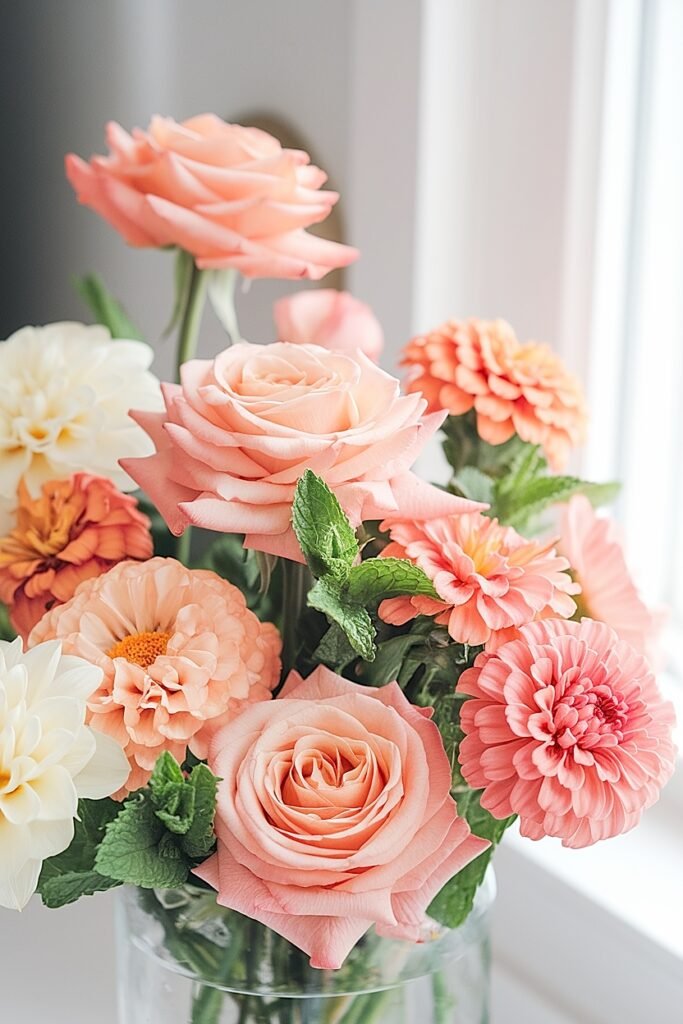
Peach-orange and mint is the fall flower pairing that surprises people with how well it works and how easily it goes wrong.
The surprise comes from the visual relationship: mint’s bright clean green creates a specific contrast with soft peach-orange that reads as fresh and modern rather than rustic and harvest-heavy. The same mint beside vivid pumpkin orange reads as competitive; beside soft apricot peach it reads as complementary and specifically light.
The failure mode is fragrance excess. Spearmint at one to two sprigs per arrangement at a fall dining table: pleasant and specific. Peppermint at the same quantity at the same table: dominant and potentially unpleasant at food-adjacent proximity. The distinction between spearmint and peppermint is not subtle. Spearmint’s menthol content is roughly half of peppermint’s. At close dining range, that difference changes the fragrance from a background note to a foreground element that competes with the meal.
Use spearmint. Always spearmint for fall dining arrangements. One to two sprigs per arrangement. Stripped lower leaves, cold water conditioning one hour before use. Replace at the midpoint of any event longer than four hours because mint wilts faster than the flowers in any indoor or outdoor fall condition.
There is more ahead on which green herbs suit deep orange fall flowers specifically, where the tone difference from peach-orange requires a completely different selection.
What Are the Best Fresh Green Herbs for Deep Orange Fall Flowers?
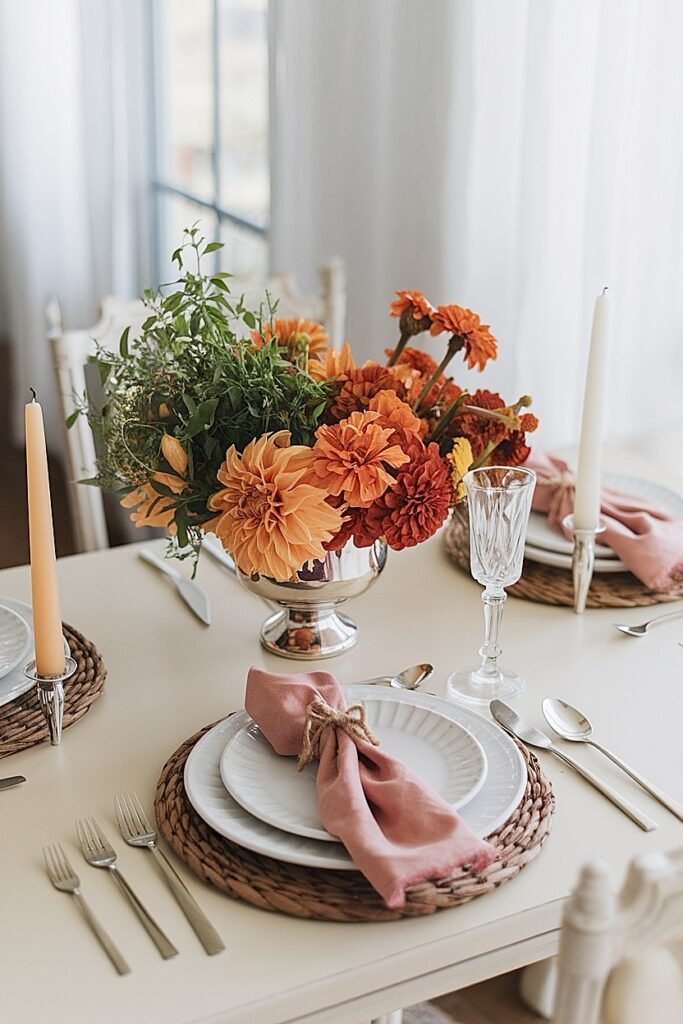
1. Deep Purple Basil Deep purple basil’s near-burgundy leaf color sits in the same warm spectrum as deep orange without competing for attention on the cool-green side. Against burnt sienna or deep amber orange, the purple basil leaves create shadow depth that reads as a tonal continuation of the.
2. Dark Italian Parsley Italian parsley’s flat, slightly glossy deep green leaves create the most saturated green contrast against deep orange of any common culinary herb. The leaf surface reflects light back toward the orange bloom faces above it, creating a luminous quality in the orange bloom zone that.
3. Common Garden Sage Sage’s grey-green felted leaf surface creates a softer contrast with deep orange than bright-green herbs produce. The slightly dusty quality of the sage leaf sits between the vivid orange bloom color and the green complement zone, creating a visual transition rather than a direct contrast.
4. Rosemary (Fine-Needle) Rosemary’s silver-green needle texture creates a finer-grained contrast against deep orange than broad-leaf herbs. At deep orange tones, the needle texture reads as detailed and specific at close range while the silver note in the needle color creates cool relief from the warm orange saturation.
5. Bronze Fennel Bronze fennel fronds, if available from the garden or a specialty market, create the most specifically autumn-harvest green texture available for deep orange arrangements. The copper-tinged feathery fronds add a warm bronze-green accent that sits in the fall color spectrum rather than creating cool-green contrast.
More ahead on the specific rust-and-basil pairing, which creates the warmest, darkest, most specifically October visual combination available from these material categories.
Ways to Pair Rust Orange Fall Flowers with Deep Green Basil Leaves
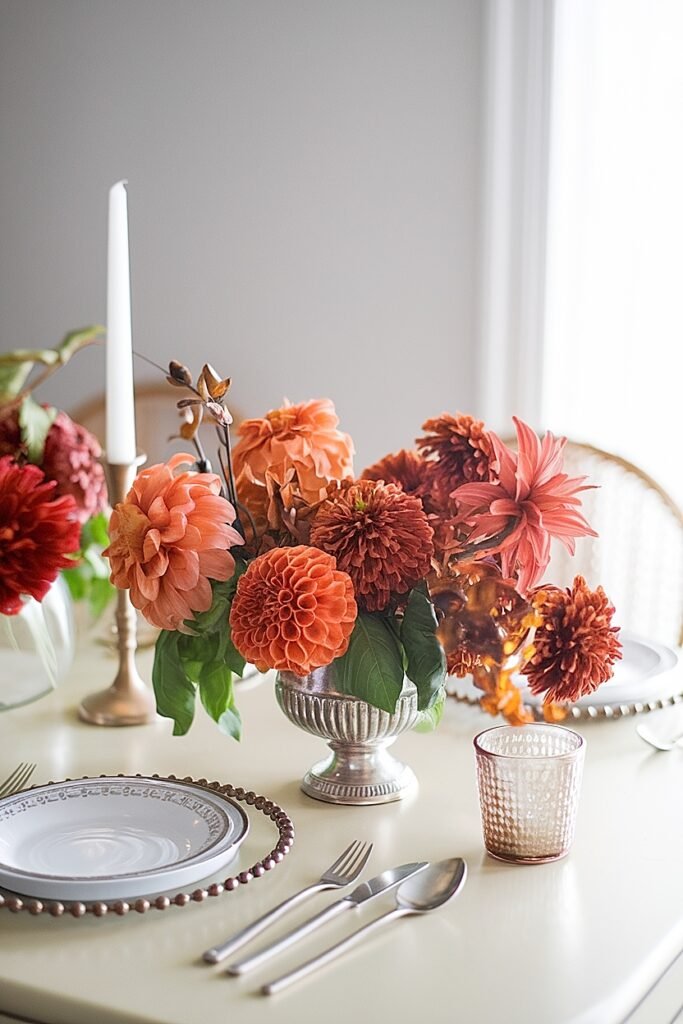
1. Rust Dahlia with Purple Basil Three rust or burnt orange dahlia stems plus two purple basil sprigs in a dark-toned vessel. The rust dahlia and the purple basil exist in the same warm-dark tonal register, creating a low-contrast warm pairing that reads as sophisticated and subdued rather than vivid and.
2. Rust Marigold with Green Basil Base Four to five rust-tone marigold stems in a vessel with two to three large green basil leaves pressed flat against the interior vessel walls, visible through the glass from the outside. The basil interior-wall technique creates visible green leaf color as a vessel-layer backdrop for.
3. Flat Rust Flower and Basil Table Bundle Three rust zinnia or dahlia stems bound with four dark basil sprigs into a flat bundle tied with jute, placed diagonally across the table surface beside the main serving vessel. The flat bundle creates a flower-and-herb detail at table surface level that reads as specifically.
4. Single Rust Bloom with Basil Leaf Accent One rust dahlia or marigold stem in a narrow bud vase with one large basil leaf pressed against the vessel interior wall and one small basil sprig visible above the vessel rim. The single-bloom-and-basil combination reads as the most restrained, most specifically considered of the.
5. Rust Zinnia and Basil Herb Pot A small terracotta herb pot with an established basil plant, with two to three rust zinnia bloom branches inserted into the basil foliage mass and into the soil alongside the plant. The basil provides structural support for the zinnia stems. The zinnia’s rust color reads.
More ahead on the specific green-to-orange ratio question, which changes based on the orange tone’s saturation level.
What Is the Best Green-to-Orange Ratio for Fall Flower Bouquets?
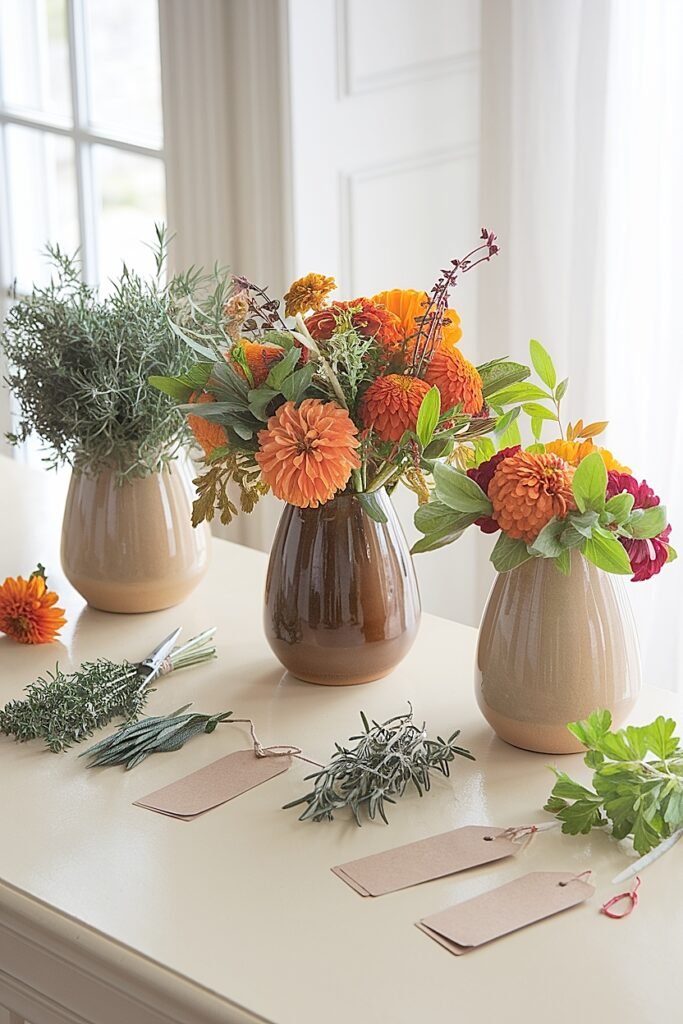
Ratio is a variable, not a fixed rule.
The correct green-to-orange ratio depends on two factors: the saturation of the orange tone and the viewing distance of the arrangement. These two factors point in opposite directions in most fall arrangement contexts, which is why the ratio question does not have a single universal answer.
High saturation orange, vivid pumpkin, electric marigold orange, or clear bright coral, reads as assertive from any distance. A one-to-four herb-to-flower proportion provides adequate visual relief. At low viewing distances, that same proportion may feel like enough green. At party table distances of ten to fifteen feet, the herb may disappear entirely against the vivid orange mass, making the arrangement look monochromatic at distance even though it reads as composed at close range.
Low saturation orange, soft apricot, muted terracotta, dusty peach, reads as quiet and requires less green to be balanced. A one-to-three herb-to-flower proportion at low saturation orange can make the arrangement feel herb-heavy. One sprig per five flower stems may be more appropriate, allowing the soft orange to lead without the more saturated green undercutting it.
The practical calibration technique: build the arrangement at the minimum herb proportion you think is correct. Step back to the viewing distance at which the arrangement will be experienced. If the orange reads as monochromatic, add one more herb stem. Repeat until the green is visible as a distinct element from the viewing distance without appearing dominant when viewed from close range. That is the correct ratio for the specific orange tone and the specific viewing distance in that context.
Easy Ideas for Layering Fresh Herbs Behind Orange Fall Flowers
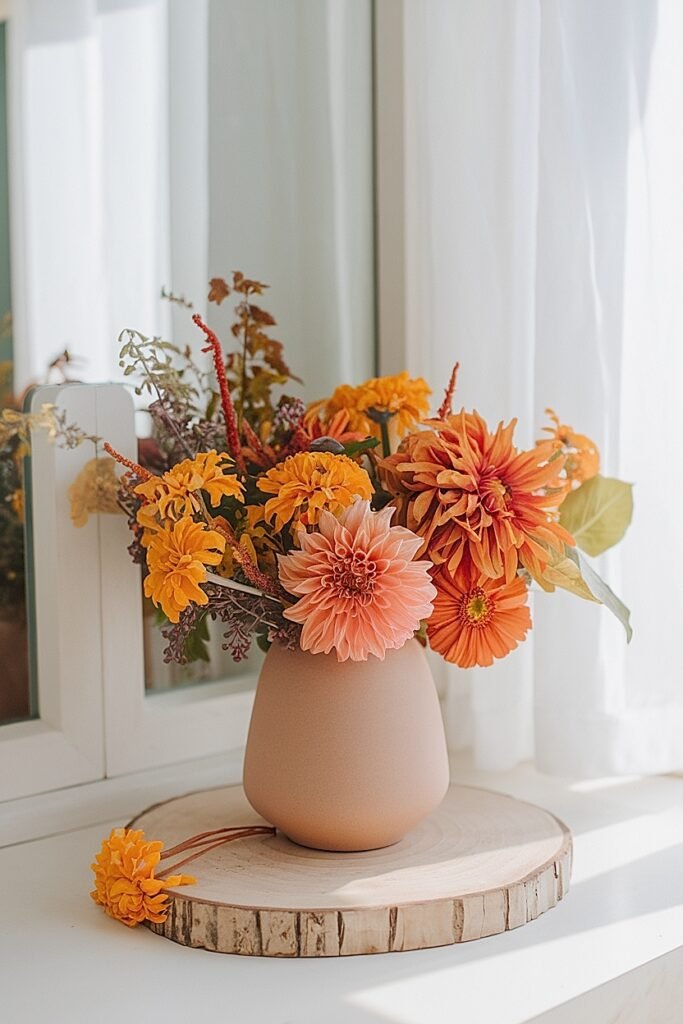
1. Rosemary Layer at Arrangement Rear Press three to four rosemary sprigs toward the back of the vessel interior before placing any orange flower stems. The rosemary mass creates a vertical green backdrop that the orange flowers sit in front of when viewed from the arrangement’s primary viewing angle. The needle.
2. Sage Spray Base Around the Vessel Rim Position four to five sage sprigs at the vessel base perimeter, angled outward at the rim so the sage leaves are visible from the side-viewing angle rather than the top. The sage creates a green perimeter at vessel-rim level from which the orange flower stems.
3. Mixed Herb Backdrop Using Two Varieties Press two rosemary sprigs at the arrangement’s left rear and two sage sprigs at the right rear, creating two different green textures visible behind different sections of the orange arrangement. The varied herb backdrop creates textural depth visible behind the orange blooms from the primary.
More ahead on combining orange fall flowers with thyme and wheat specifically, which creates a three-material combination that reads as deliberately harvest-quality.
Creative Ways to Combine Orange Fall Flowers with Thyme and Wheat
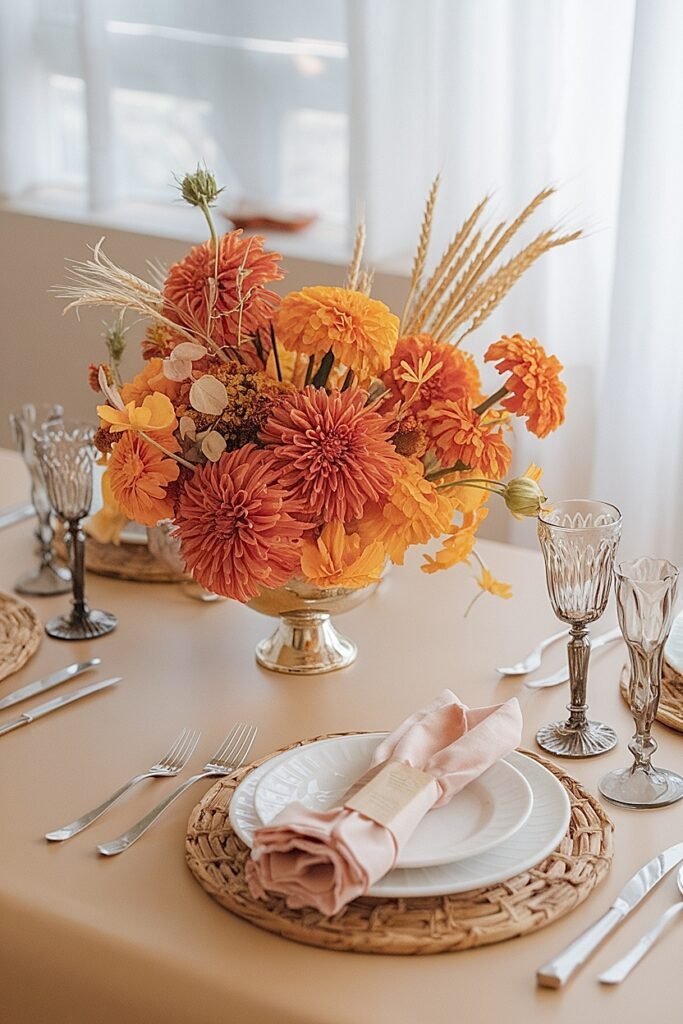
1. Orange Marigold, Thyme, and Dried Wheat Spray Five orange marigold stems plus two thyme sprigs plus two dried wheat stalks in a terracotta short pitcher. The dried wheat rises above the orange marigold bloom level, the marigolds occupy the mid-zone, and the thyme fills the base. Three distinct height zones in one.
2. Orange Dahlia, Thyme, and Wheat Flat Table Bundle Two orange dahlia stems bound with three thyme sprigs and two dried wheat stalks with jute twine, laid flat across the dinner table beside serving platters. The bound bundle requires no vessel. The wheat’s amber grain heads sit alongside the orange dahlia at the bundle’s.
3. Thyme and Wheat Wreath Ring with Orange Blooms A small six-inch circular wreath ring built from thyme sprigs and dried wheat sections intertwined, with four to five orange marigold or small dahlia heads pressed into the wreath at intervals. Lay the wreath flat at the dinner table center. Place a taper candle at.
4. Orange Zinnia and Thyme in Clear Glass with Wheat Stems Four orange zinnia stems plus two thyme sprigs in a clear glass vessel, with two dried wheat stalks placed outside the vessel against the glass exterior, held in position by the vessel’s own weight against the table surface. The wheat stalks visible through the clear.
5. Tall Wheat, Mid-Orange Bloom, Low Thyme Arrangement Three dried wheat stalks cut tall and pressed into the arrangement center. Three orange marigold or aster stems at medium height around the wheat base. Two thyme sprigs at the vessel base perimeter. Three distinct visual zones, tall-to-low, in one arrangement. The wheat creates architectural.
Conclusion
Orange and green create one of autumn’s most energetic visual relationships. The complementary tension amplifies both colors simultaneously, and the right herb choice, in the right proportion, turns that tension from an argument into a conversation.
One-to-four ratio. Match the herb tone to the orange tone: silver-green rosemary for vivid orange, grey-green sage for soft apricot, deep purple basil for dark rust. Layer the herbs behind and below, not mixed throughout at high volume.
The orange leads. The herb answers. The arrangement reads as fall at its most specific and most deliberately observed.
This website contains affiliate links, and some products are gifted by the brand to test. As an Amazon Associate, I earn from qualified purchases. Some of the content on this website was researched and created with the assistance of AI technology.