This website contains affiliate links, and some products are gifted by the brand to test. As an Amazon Associate, I earn from qualified purchases. Some of the content on this website was researched and created with the assistance of AI technology.
Key Takeaways
- Small dinner party herb fragrance should be detectable rather than dominant: woody herbs like rosemary and thyme are the safest choices because their fragrance is clean and food-compatible at close dining range
- Dahlia and sage is the most sophisticated autumn dinner party pairing available at grocery store and garden budget: the dahlia’s layered petals suit close-range examination, and sage adds seasonal fragrance without competing with food
- Rust and amber fall flowers create the warmest dinner party atmosphere, and basil’s dark leaf color deepens the visual warmth without introducing any additional contrasting color
- Per-place-setting herb-and-flower arrangements create a more genuinely personal dinner party experience than shared centerpieces, because each guest has their own close-range display
- Mint and white mum together at close dinner table range creates a specifically fresh pairing that counters the richness of autumn food without any fragrance conflict
- Marigold and rosemary is the most cost-effective autumn dinner party pairing: both are widely available, long-lasting, and fragrance-compatible at close dining table range
Choosing the best autumn flower and herb pairings for small dinner parties is genuinely different from choosing them for large outdoor gatherings, and most flower guides treat both situations identically. Small dinner parties have specific requirements: guests are within arm’s reach of the arrangements for two to three hours, close enough to read individual bloom detail and detect subtle fragrance layers. The scale is intimate. The display is scrutinized. And the fragrance competition with the food is at its most direct, because everyone is seated in the same enclosed or semi-enclosed outdoor or indoor space for the full dinner duration.
The pairings that succeed in this context share two qualities. The herbs provide fragrance at levels that enhance rather than compete with dinner aromas. The flowers provide visual presence at viewing distances of eighteen to thirty inches that reward close-range petal detail rather than relying on volume and scale for their impact. Small dinner party flowers are not seen from across the room. They are examined from across the table.
Choosing the right herb pairing starts with the dinner mood. A roasted meal needs cozy structure. A brunch table needs freshness. A neutral table needs softness. This quick guide helps readers match Fall Flowers with herbs that support the food, fit the table, and stay comfortable for guests.
| Dinner Mood | Best Pairing | Why It Works | Use Lightly By |
|---|---|---|---|
| Roasted autumn dinner Warm, cozy, savory. | Rust dahlias with rosemary. | Rosemary adds structure and a cozy scent. | Use short angled sprigs near the edge. |
| Neutral Thanksgiving table Soft, calm, classic. | Cream mums with sage. | Sage adds muted green-gray texture. | Tuck sage low behind the blooms. |
| Casual pasta dinner Relaxed, bright, easy. | Rust zinnias with oregano. | Oregano feels garden-fresh and casual. | Keep oregano around the sides only. |
| Small brunch gathering Fresh, light, soft. | Peach mums with mint. | Mint adds freshness to soft peach tones. | Use just two or three short sprigs. |
| Moody fall dinner Deep, elegant, intimate. | Burgundy dahlias with lavender. | Lavender adds scent and fine texture. | Place muted stems deep in the bouquet. |
Resources:
- Cut Flower Care – Gardening Solutions
- Growing | Herbs | Illinois Extension | Illinois
- 9 Herbs You Should Be Growing for Flower Arranging
- 7 Best Herbs for Flower Arrangements – The Home Depot
How to Pair Rosemary with Fall Flowers for Cozy Small Dinner Party Bouquets
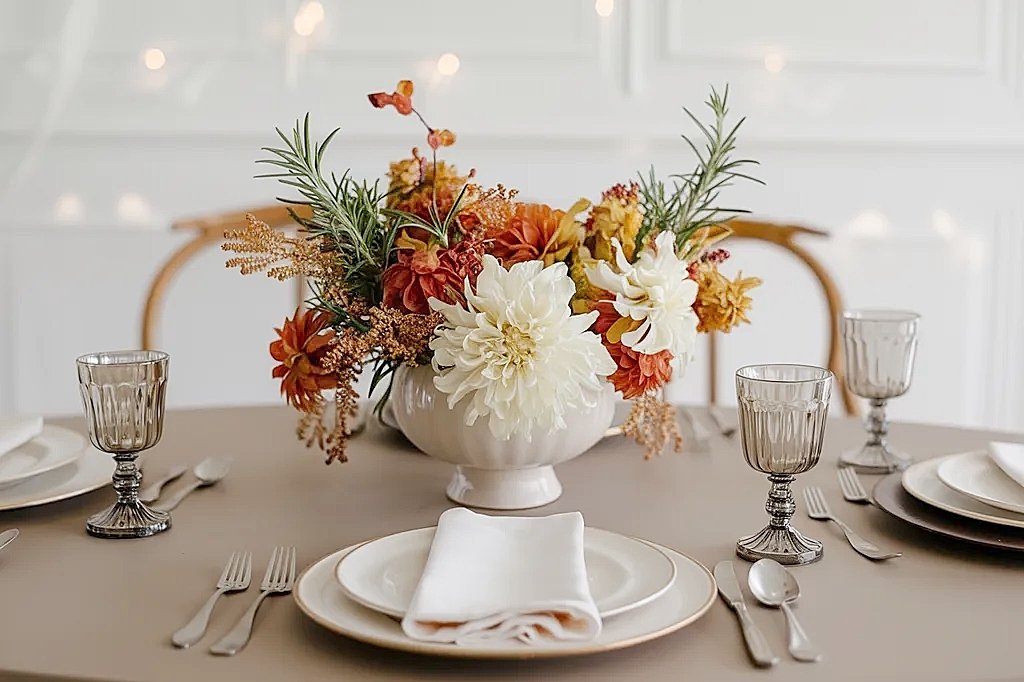
Rosemary at dinner table close range is a specific sensory commitment. At eighteen inches from a seated dinner guest, one rosemary sprig in a bud vase registers as a distinct herbal note in the room’s scent environment. Two or three sprigs in a centerpiece arrangement create a cumulative fragrance that fills the table zone. The guests either find it pleasant or distracting, and the decision point is usually the rosemary’s proportion relative to the other arrangement elements.
For small dinner parties, use one rosemary sprig per three to four flower stems and no more. At that proportion, the rosemary reads as a garden-quality fragrance accent rather than a kitchen herb display.
The visual pairing logic for rosemary with fall flowers: rosemary’s needle-like silver-green foliage creates fine-textured contrast against any broad-petaled fall flower. White chrysanthemums with rosemary. Deep burgundy dahlias with rosemary. Amber marigolds with rosemary. The needle foliage creates visual separation between dense fall blooms and the surrounding arrangement space that allows each bloom face to read distinctly at close viewing distance. Rosemary essentially creates spacing without the gaps reading as empty.
Woody-stemmed rosemary holds better in cold water than most herbs at three to five days with fresh-cut ends and stripped lower leaves. That durability makes rosemary the right choice for dinner party arrangements built the morning of the event or the day before, where soft-stemmed herbs like basil or dill would show stress before the first guest arrives.
For a complete guide to herb proportions in fall bouquets including specific ratios and the distinction between woody and soft-stemmed herbs for multi-day arrangements, check out how to use fresh herbs in fall flower bouquets without overdoing it. Share this with anyone planning a fall dinner party. More ahead on dahlia pairings, rust flower warmth, and every specific autumn dinner herb technique.
Easy Ideas for Sage and Dahlia Fall Flowers on Intimate Dinner Tables
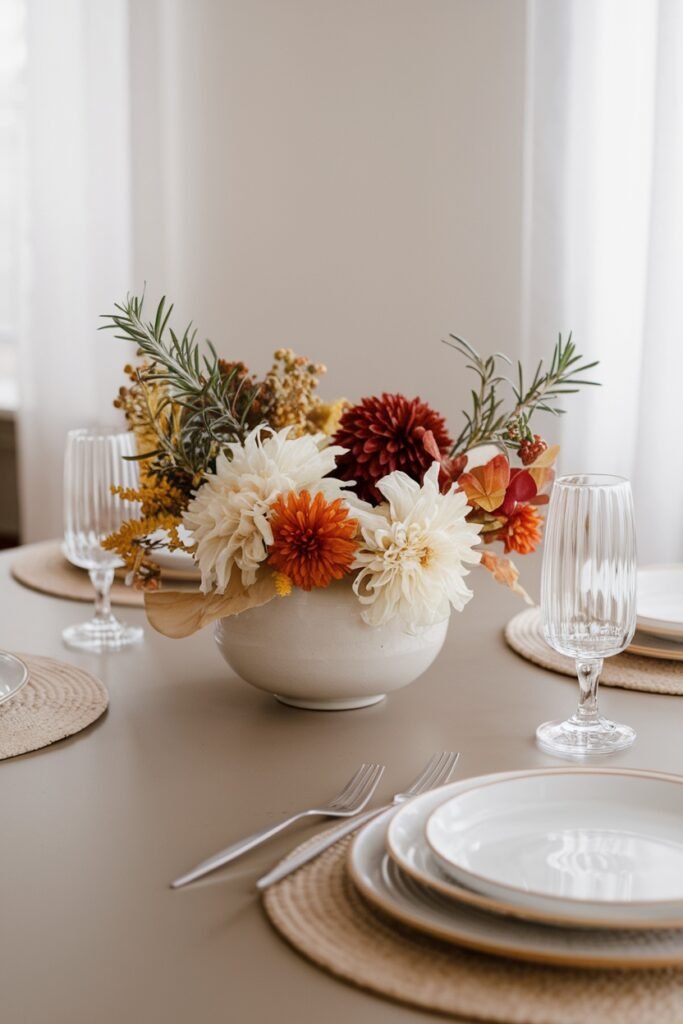
Sage and dahlia is the autumn dinner party pairing that takes the most visible effort to produce and requires the least.
The dahlia’s layered petals create extraordinary close-range visual depth visible specifically to guests seated within two feet of the arrangement. The sage’s grey-green felted texture sits in the dahlia’s visual environment as a seasonal anchor. Together, they communicate something deliberate about the evening: this table was prepared with specific attention to the season.
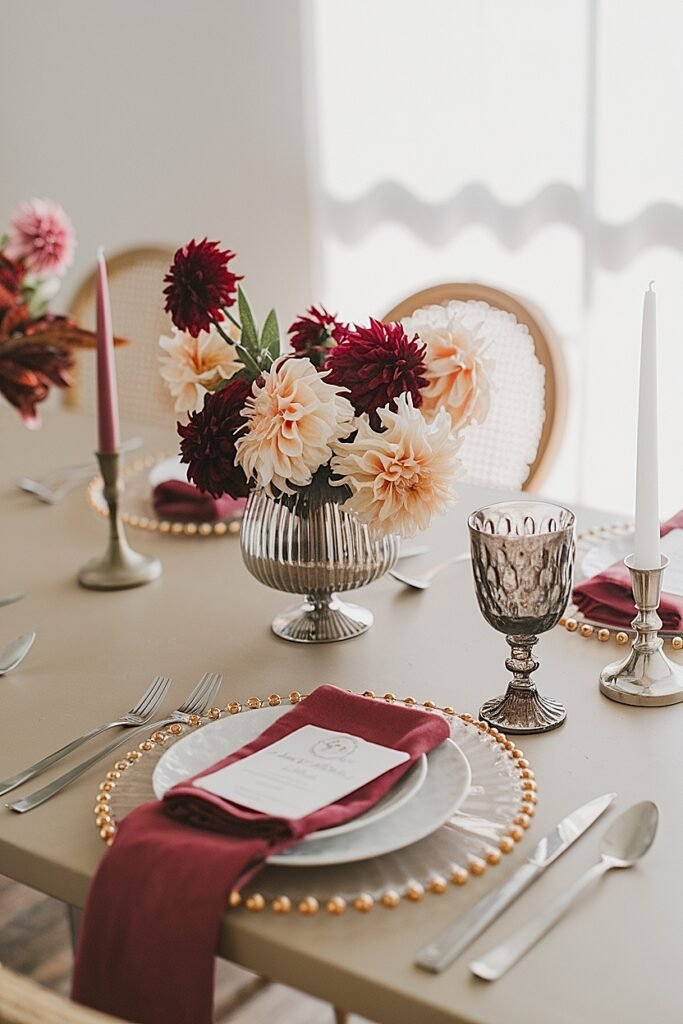
1. Single Deep Burgundy Dahlia with Purple Sage One deep burgundy ball or pompom dahlia stem with two purple sage sprigs in a narrow weighted bud vase. The warm red-purple dahlia and the lavender-grey sage exist in the same warm-cool spectrum, creating a tonal harmony at close range. The purple sage fragrance is mild and food-compatible. One stem per place setting reads as individually considered at small dinner party scale.
2. Three Dinner Plate Dahlias and Sage in a Wide Low Bowl Three white or blush dinner plate dahlias with four sage sprigs in a wide low ceramic bowl at the table center. At close intimate dining range, the large dahlia faces create maximum close-range petal detail while staying at the three-to-four-inch above-rim height that preserves guest sightlines. The sage base layer adds fragrance and grey-green tonal depth below the dahlia bloom level.
3. Mixed Fall Dahlia Heights with Sage Collar Five dahlia stems at two different heights, three taller stems at the center back and two shorter stems at the front, with a loose sage collar of four to five sage sprigs inserted at the vessel base perimeter. The height variation creates dimensional depth that flat arrangement profiles lack at close-range dinner viewing. The sage collar creates a visual ground transition between the vessel edge.
4. Two Apricot Dahlias with Garden Sage in a Terracotta Vessel Two apricot or soft coral pompom dahlia stems plus three garden sage sprigs in a short terracotta vessel. The terracotta’s warm buff-orange sits in the same warm spectrum as the apricot dahlia without being identical in tone. The sage adds the one cool element that prevents the arrangement from reading as entirely warm-on-warm. Small dinner party scale, specific and personalized.
5. Black-Centered White Dahlia with Sage and One Herb One white dahlia variety with a dark or near-black center, such as cactus or waterlily dahlia varieties that show dark interior coloring, with two sage sprigs and one rosemary sprig. The dark dahlia center creates visual drama at close-range dinner viewing that standard all-white dahlias do not produce. The sage and rosemary together create a layered herbal fragrance at genuinely restrained total volume.
6. Dahlia Bud Vase Row with Alternating Sage and Rosemary A row of three to four slim bud vases down the center of the dinner table, each holding one dahlia stem of a slightly different color stage and alternating between sage-sprig and rosemary-sprig companions. The alternating herb creates variety in the fragrance experience along the table length without any individual position becoming herb-dominant. Each dahlia color stage creates progression across the row.
7. Low Sage and Dahlia Bowl Beside Each Place Setting A compact low bowl with one dahlia bloom branch and two sage sprigs positioned beside each place setting rather than at the center. The per-place-setting format creates the most intimate small dinner party flower experience: each guest has their own arrangement. The sage fragrance disperses from multiple points around the table simultaneously rather than from a single center position.
More ahead on how basil’s dark leaf color creates warm visual depth in rust and amber fall color palettes.
How to Match Basil with Rust Fall Flowers for Warm Dinner Party Color
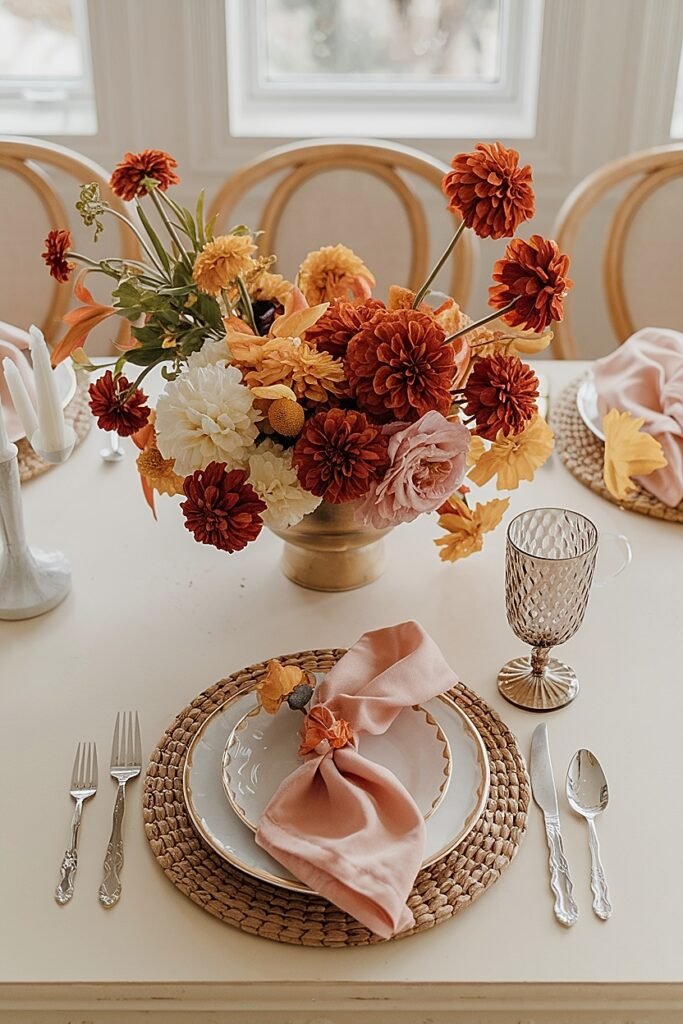
Rust is an autumn color that does not need more warmth. It already has all the warmth any arrangement requires.
What rust fall flowers need at small dinner party close range is depth: the visual layering that prevents a warm color scheme from reading as flat and one-dimensional. Deep purple basil provides that depth. The dark near-burgundy leaf color sits one tonal step darker than rust orange, creating shadow depth behind and below the rusty bloom faces that makes the warm colors appear richer and more three-dimensional than they would against green foliage alone.
This visual depth effect is specific to dark basil varieties. Standard green sweet basil against rust flowers reads as an unresolved green-and-orange contrast that neither warms nor deepens the palette. Purple basil against the same rust flowers creates a continuous warm-to-dark tonal progression that reads as designed. The practical test: hold one purple basil leaf and one green basil leaf beside the rust flowers in turn. The visual difference is immediate.
The management caveat for basil at small dinner parties is the same for any context: use it day-of. Basil’s soft stems wilt faster in any conditions than woody-stemmed fall herbs, and at the close intimate distance of a small dinner table, wilted basil is immediately visible to every guest. Cut basil the afternoon of the dinner. Condition in cold water for one hour before use. Replace if the dinner extends past four to five hours.
More ahead on thyme as a place-setting herb, which creates the most intimate and personal close-range detail of any herb used at a small dinner party scale.
Creative Ways to Use Thyme with Fall Flowers for Petite Place Setting Bouquets
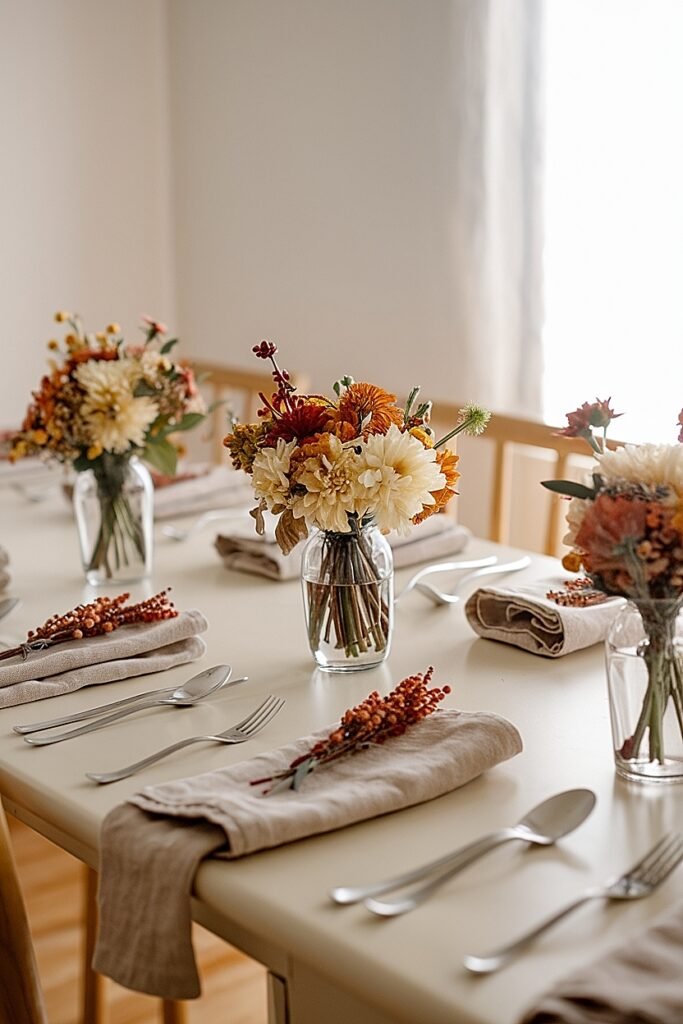
1. One Thyme Sprig Wrapped Around a Bud Vase Wrap one long thyme stem around the exterior of a narrow bud vase and secure with a small piece of jute twine at the top. The thyme wraps the vessel exterior rather than going into the water inside. The visual effect is a green-wrapped vessel.
2. Thyme in the Napkin Fold One thyme sprig tucked into the fold of each napkin at each place setting, positioned so the thyme tip points outward from the folded napkin edge. The thyme is visible before the guest unfolds the napkin. The fragrance at close-placement range creates the first sensory.
3. Thyme Tied with One Fall Bloom One fall flower stem, a small dahlia branch, one chrysanthemum stem, or a compact ranunculus, bound with one thyme sprig using a single piece of jute twine at the mid-stem point and placed in a small weighted bottle at each place setting. The bound pairing.
4. Short Thyme Section as Gap Filler One to two inch thyme sections cut from a longer stem, pressed into the gravel base of a small fall flower vessel at each place setting to fill any visible gaps between the flower stem and the vessel wall. The sections are invisible from above.
5. Thyme Sprig in a Clear Glass Tube Beside the Place Card One thyme sprig in a small clear glass bud tube with water, positioned beside the place card at each setting. The water tube keeps the thyme fresh throughout the full dinner. The thyme reads as the herb accent to whatever larger flowers are on the.
6. Thyme-Wrapped Taper Candle Base Three to four thyme sprigs laid horizontally against the base of each taper candle holder and secured with a narrow piece of jute or florist wire. The thyme wraps the candle base rather than a vessel. The candlelight warms the thyme’s grey-green tone into something.
7. Floating Thyme Sprig in a Water Glass One fresh thyme sprig floating on the water surface inside each guest’s water glass at the start of the dinner. The thyme infuses the water very mildly with its herbal note. The visual effect, a green floating herb in the glass, is a deliberate and.
More ahead on the mint and white mum combination, which creates the freshest, most contrasting autumn dinner table pairing in this article.
What Are the Best Mint and Mum Fall Flowers Pairings for Fresh Dinner Tables?
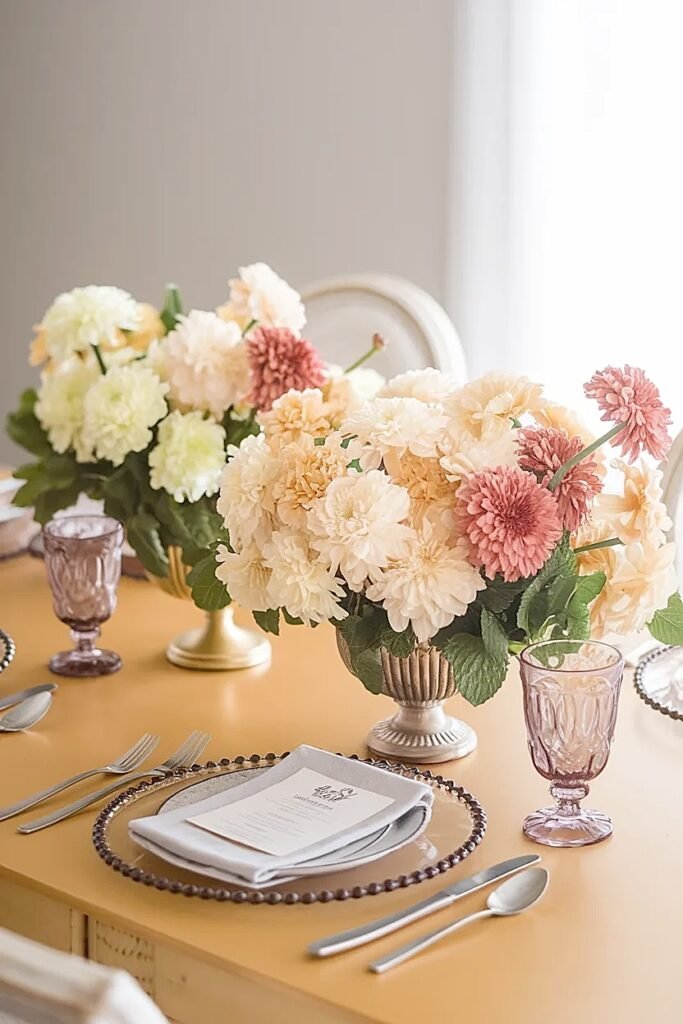
1. Spearmint and White Pompom Mum in Dark Vessel Three white pompom mum stems and two spearmint sprigs in a short dark navy or charcoal vessel. The dark vessel amplifies both the white mum brightness and the green mint contrast. The spearmint fragrance at dinner table proximity is clean and cooling, which counters the.
2. Mint and Mum Per-Place-Setting Bud Vase One white mum bloom branch and one spearmint sprig in a slim bud vase at each dinner place setting. The mint fragrance at this intimate personal scale creates a close-range fresh note for each individual guest. Refreshing rather than aromatic. The white mum at this.
3. Floating White Mum with Mint Leaf Surface Two white mum heads floating face-up in a wide low bowl with individual mint leaves scattered on the water surface between the blooms. The mint leaves at water level create a surface fragrance pattern. The floating mum faces at close intimate dining range are visible.
4. White Mum and Mint Bundle Beside Each Dish A small bundle of one white mum stem and two mint sprigs tied with jute, laid flat beside each shared serving dish rather than in a vessel. The flat bundle beside each dish creates a coordinated display system across the table. The mint fragrance from.
5. White Mum, Mint, and One Autumn Accent Three white mum stems plus two spearmint sprigs plus one amber or rust fall flower, a small marigold stem or one compact aster, in a medium vessel. The single warm-toned accent prevents the white-and-green combination from reading as purely fresh and wintry. The mint bridges.
More ahead on sage and wheat as the most specifically harvest-quality material combination for cozy dinner parties.
Ideas for Sage, Wheat, and Fall Flowers for Cozy Harvest Dinner Parties
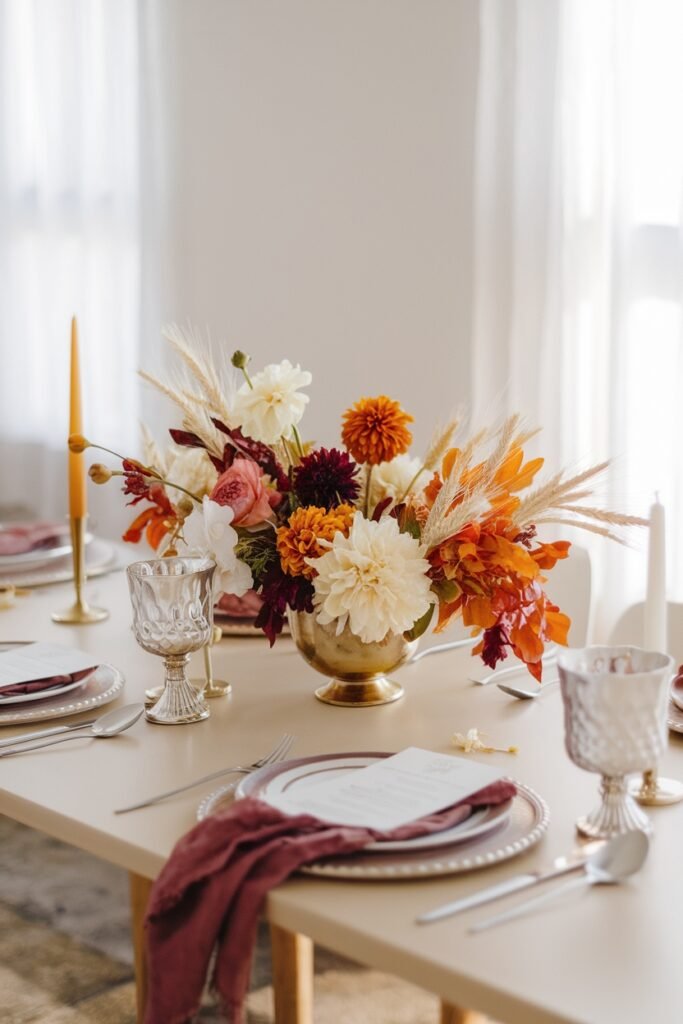
1. White Mum, Sage, and Dried Wheat Spray Three white pompom mum stems plus three garden sage sprigs plus two dried wheat stalks in a heavy terracotta or stoneware vessel. The dried wheat’s upright amber stalks add a vertical harvest accent above the white mum bloom level. The sage adds grey-green fragrant depth.
2. Amber Dahlia, Sage, and Wheat Flat Bundle Three amber or apricot dahlia stems bound with four sage sprigs and two dried wheat stalks into a flat jute-tied bundle, laid diagonally across the dinner table beside the main serving vessel. The flat bundle takes no table surface height. The bound combination reads as.
3. Sage and Wheat Only with Three Mum Accent Blooms A vessel filled predominantly with sage sprigs and dried wheat stalks, with three white or cream mum bloom branches inserted as accents within the herb-and-grain mass. The reversed proportion uses sage and wheat as the primary material and mum as the accent, creating an arrangement.
More ahead on marigold and rosemary, the pairing that creates the most golden, specifically autumnal warmth available at grocery store budget.
Easy Ideas for Marigold and Rosemary Fall Flowers with Golden Autumn Warmth
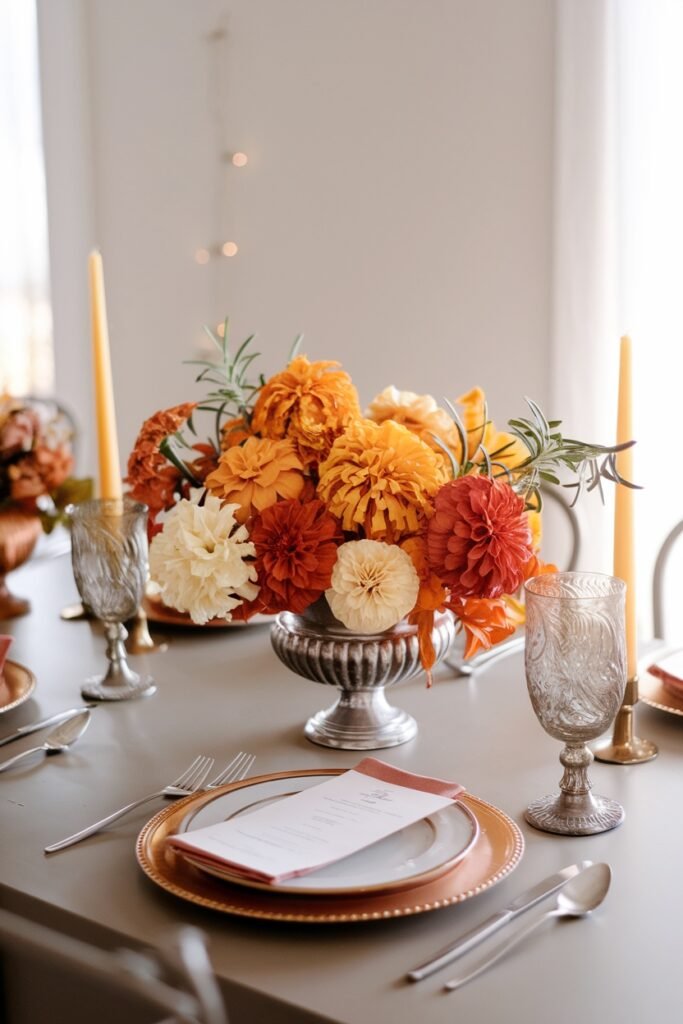
1. Orange Marigold and Rosemary in a Terracotta Short Pitcher Five to six orange marigold stems plus three rosemary sprigs in a short terracotta pitcher. The terracotta’s warm buff-orange amplifies the marigold’s golden tone by sitting in the same warm spectrum. The rosemary creates fine-needle textural contrast against the pom-pom marigold blooms. The combined rosemary.
2. Yellow Marigold and Rosemary Low Bowl Four to five yellow marigold bloom branches at rim height in a wide low ceramic bowl with two rosemary sprigs tucked around the bowl perimeter edge. The yellow marigold and the needle-leaf rosemary create a gold-and-silver textural pairing at close dinner range. The rosemary trails.
3. Marigold and Rosemary Per-Setting Herb Pot A small herb pot with one established rosemary plant, with two to three marigold bloom branches inserted into the soil alongside the rosemary shrub, at each dinner place setting. The rosemary plant provides ongoing fragrance throughout the dinner. The marigold blooms provide golden color at.
4. Mixed Marigold Heights with Rosemary Spray Six marigold stems at two heights, three tall stems and three short stems, with two long rosemary sprigs inserted diagonally across the arrangement mass. The diagonal rosemary creates a visual movement line through the arrangement that straight horizontal or vertical herb placement does not. The.
5. Dried Marigold Head and Rosemary Wreath Ring A small four to five inch circular wreath ring of dried rosemary sprigs with dried marigold heads pressed into the wreath at intervals, placed flat on the dinner table as a decorative surface ring rather than an upright vessel arrangement. A taper candle or small.
Conclusion
The best autumn dinner party flower and herb pairing is the one that creates a specific fragrant-and-visual atmosphere for the particular evening being celebrated.
Sage and dahlia for the sophisticated, candlelit October dinner. Marigold and rosemary for the warmest, most golden harvest table. Mint and white mum for the dinner that wants to feel clean and fresh against the autumn richness. Each pairing creates a different emotional register for the same season.
One herb variety. Measured proportion. Day-of soft herbs. That is the discipline that lets the pairing work without overwhelming the dinner it is there to enhance.
This website contains affiliate links, and some products are gifted by the brand to test. As an Amazon Associate, I earn from qualified purchases. Some of the content on this website was researched and created with the assistance of AI technology.