This website contains affiliate links, and some products are gifted by the brand to test. As an Amazon Associate, I earn from qualified purchases. Some of the content on this website was researched and created with the assistance of AI technology.
Key Takeaways
- Low arrangements, two to three inches above the vessel rim, never block sightlines and rarely conflict with serving dish reach zones
- Off-center positioning is the simplest fix: push the arrangement to one third of the table length from one end, and the remaining two thirds is open for serving
- Individual mini clusters at each end of the table rather than one large center arrangement frees the entire middle table zone for food service
- Table runners with planned empty breaks every twelve to sixteen inches allow serving dishes to sit in those gaps rather than displacing the flowers
- Wide, flat bowl arrangements with no stem height above the rim consume almost no functional table surface and can stay in place through the whole meal
- Water picks and bud vases along one table edge are the smallest-footprint flower format and work at tables where every inch counts
The arrangement looks great right up until dinner starts, and then someone has to move it.
Creating fall centerpieces that leave room for serving dishes is the one decorating problem that nobody warns you about until you are standing at a fully set table with a bowl of mashed potatoes in your hands and nowhere to put it. The flowers that looked perfect two hours ago are now in the way of everything. The candles need moving. The bread basket has no home. The whole table becomes an obstacle course during the meal.
This is a solvable problem. It requires thinking about the table the way you think about it during dinner, not before dinner. The arrangement competes with serving dishes, wine bottles, water pitchers, bread boards, and the plate of someone’s second helping. Once you account for all of that, the right centerpiece format becomes obvious pretty fast.
Use this serving-space guide before arranging Fall Flowers on your dining table. Each row helps you choose the right centerpiece layout, flower height, serving dish placement, and best table type. The goal is a cozy fall table that looks beautiful while still leaving room for real food, plates, and guests.
| Centerpiece Layout | Best Serving Dish Plan | Flower Height Tip | Best Table Type |
|---|---|---|---|
| One low off-center bowl | Keep the middle open for one large serving bowl. | Trim stems short and build flowers outward. | Small rectangular or kitchen dining table |
| Two side floral clusters | Place food in the open center lane. | Keep wheat and foliage close to each vessel. | Family-style rectangular table |
| Three movable mini vases | Shift one vase when platters arrive. | Use one or two short blooms per vessel. | Apartment table or narrow dining table |
| Broken flower runner | Leave gaps for bread, salad, and shared sides. | Use small clusters instead of one long strip. | Long rectangular table |
| Place setting bundles | Skip the main centerpiece for maximum food space. | Use one tiny bloom and one short wheat stem. | Crowded table or buffet-style dinner |
Resources:
- How to Care for Cut Flowers | Yard and Garden
- Dry flowers & grains to extend season – Growing For Market
- Ornamental grasses for fall—and throughout the year | Chicago Botanic Garden
- The Principles & Elements of Design w/ Sharon McGukin
- How to make your own dried grass, pod, or floral arrangement
How to Create Low Fall Flowers Centerpieces That Leave Room for Serving Dishes
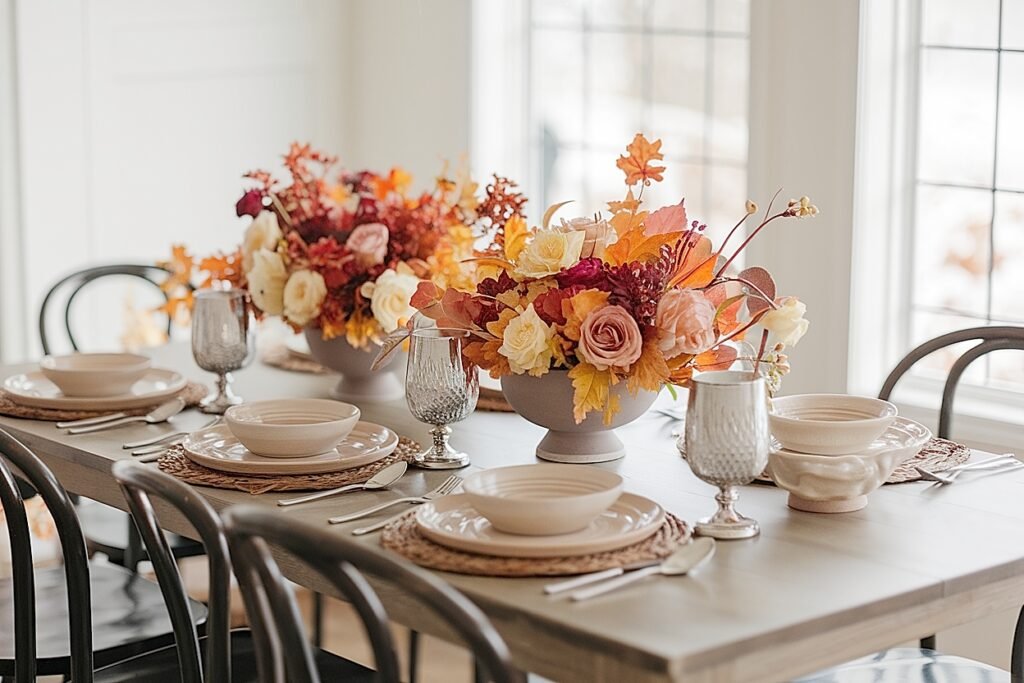
Here is the thing about fall centerpieces and serving dishes: they are both trying to occupy the same surface.
The only way to solve that is to size the arrangement for the table’s serving reality rather than its empty state. An empty dining table looks generous. Set it for four people with glasses, plates, salad bowls, bread baskets, and two serving dishes, and the available open center surface shrinks to about a third of what you started with. The arrangement needs to fit in that remaining third. Not the other way around.
Low is the first solution. A centerpiece that stays below eight inches of total height, vessel included, does not block anyone’s view across the table and rarely gets in the way of serving reach. The sweet spot for a fall arrangement that survives dinner service is stems cut to two to three inches above the vessel rim and a vessel that is itself under five inches tall. Total profile stays under eight inches. Everyone can see each other, nobody has to reach over a floral wall to get to the gravy, and the arrangement still looks complete and intentional.
The vessel width matters as much as the height. A tall narrow vessel takes up very little table surface but creates height issues. A short wide vessel takes up more surface but stays low. The best format for serving space is a wide, flat bowl, six to eight inches in diameter but only two to three inches tall, filled with gravel, water, and stems cut to rim level. The whole arrangement is essentially flat. You could set a serving dish twelve inches from it with no visual or physical conflict.
The gravel base does double work here. It anchors the stems at low heights without the stems flopping over toward each other, and it adds weight to the bottom of the bowl so a wide flat vessel does not get nudged or tipped when someone sets a serving dish nearby. A wide flat bowl with no gravel is physically unstable at a working dinner table. With two inches of gravel, it stays where you put it.
For more on budget fall centerpiece combinations including the specific cream mum, rust carnation, and wheat setups that look great at low bowl heights, check out budget fall centerpieces with cream mums, rust carnations, and wheat. Share this with someone who has experienced the serving-dish problem. More ahead on the best flowers for serving-space situations and every specific layout format.
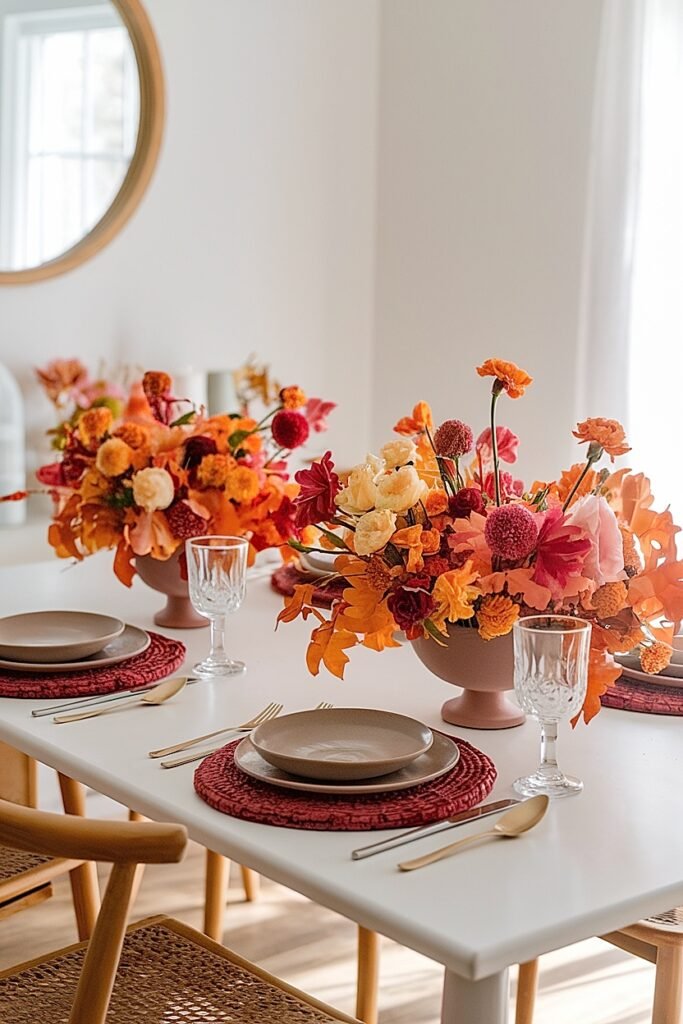
What Are the Best Fall Flowers for Centerpieces That Leave Serving Space?
Not every flower suits a low, service-compatible arrangement. The flowers that work best here hold their visual impact at rim height rather than needing stem length to look their best.
1. Cream or Rust Pompom Chrysanthemums Pompom mums hold their visual quality at rim level better than almost any other fall flower. The rounded bloom face reads as complete from the overhead angle at close dining range without needing to be elevated above the vessel edge. One grocery store bunch of cream or rust pompom mums cut to two inches above the rim in a wide dark bowl creates a full, visually complete arrangement. Holds ten.
2. Rust or Amber Carnations Carnation blooms at rim height are visible from every seated position at a dinner table because the fringed bloom face opens in a full circle rather than facing a single direction. Cut rust carnations to rim level in a wide bowl and the bloom faces are visible from above and from the side simultaneously. The fringed petal surface visible at close dining distance adds textural interest that smooth-petaled flowers do.
3. White or Mauve Asters Asters are the best fall flower for serving-space arrangements because the small flat daisy face is fully visible and recognizable at even minimal stem height. A small aster head at one inch above the rim reads as a designed arrangement element. A dinner plate dahlia at the same height looks like something shoved in a bowl. Asters suit the format specifically because their value is in abundance and fine-scaled texture,.
4. Gomphrema (Globe Amaranth) Gomphrema ball blooms at rim height create the most graphic, most visible fall arrangement at minimal height of any flower on this list. The compact ball form holds its shape from every viewing angle including directly above, which is exactly how seated dinner guests experience a low centerpiece. Available in rust, cream, burgundy, and wine red. Zero pollen, no fragrance concern near food. Holds two weeks or more at room.
5. Dried Wheat or Golden Grain Stalks Dried grain is the one element in a serving-space arrangement that sits fully outside the water vessel and can be positioned as a flat table element rather than an upright stem. Three wheat stalks laid flat on the table surface around the bowl create visual interest at table surface level without adding any height to the arrangement. The wheat grain heads extend outward from the bowl without obstructing any functional.
More ahead on the specific conversation and serving height thresholds that determine whether a fall arrangement actually works at a working dinner table.
How to Keep Fall Flowers Low Enough for Conversation and Serving
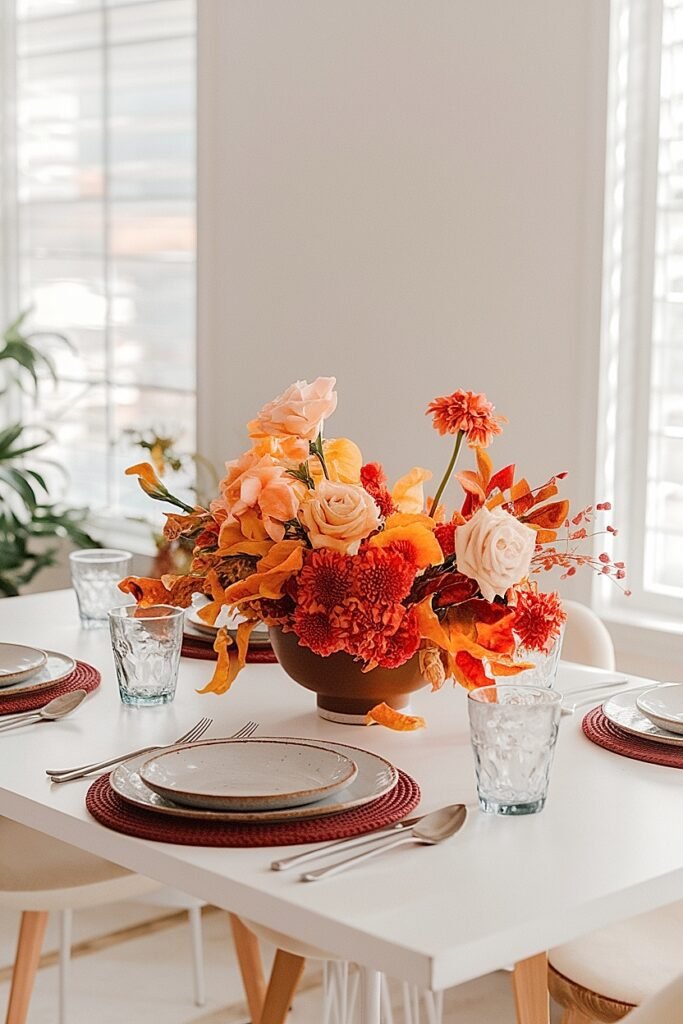
Eight inches. That is the number.
Total arrangement height, vessel included, should stay under eight inches at any table where people are expected to hold a conversation across from each other and pass serving dishes between courses. Below eight inches and the arrangement is an ambient detail. Above eight inches and it starts becoming a physical participant in the dinner rather than a background element.
The way to hit that target every time is to measure the vessel first, then cut the stems to fill the remaining height budget. If the vessel is five inches tall, the stems get cut to two to three inches above the rim. Five plus three equals eight. If the vessel is three inches tall, the stems can be four to five inches above the rim. Same total profile. The vessel and the stem height together determine the total, and the total is what matters.
The outward-angle rule helps here too. Stems angled outward at thirty degrees from vertical stay shorter than stems that project straight up, because the bloom face sits at a lower absolute height even if the stem is the same length. An outward-angled four-inch stem reaches about three and a half inches above the rim in absolute height. A vertical four-inch stem reaches four inches. That half-inch difference across a bowl full of stems adds up to a meaningful height reduction with no change in stem count.
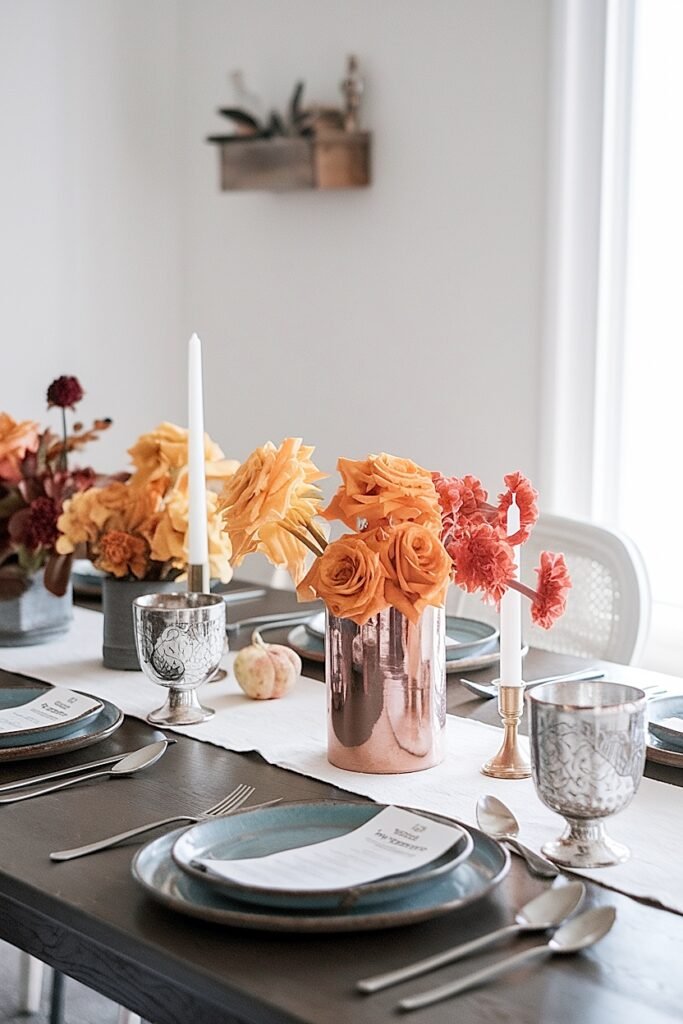
Candles complicate this. A taper candle beside the fall arrangement adds height that is not part of the floral arrangement itself but occupies the same visual and physical zone above the table. Either keep the taper candle as a separate element at the table end rather than beside the centerpiece, or use a tea light or votive at table level instead. Tea lights at table surface level next to a low fall bowl arrangement do not add any height and create the same warm candlelight effect.
More ahead on off-center positioning, which solves the serving dish conflict without changing the arrangement at all.
Ways to Style Fall Flowers Off-Center So Serving Dishes Still Fit
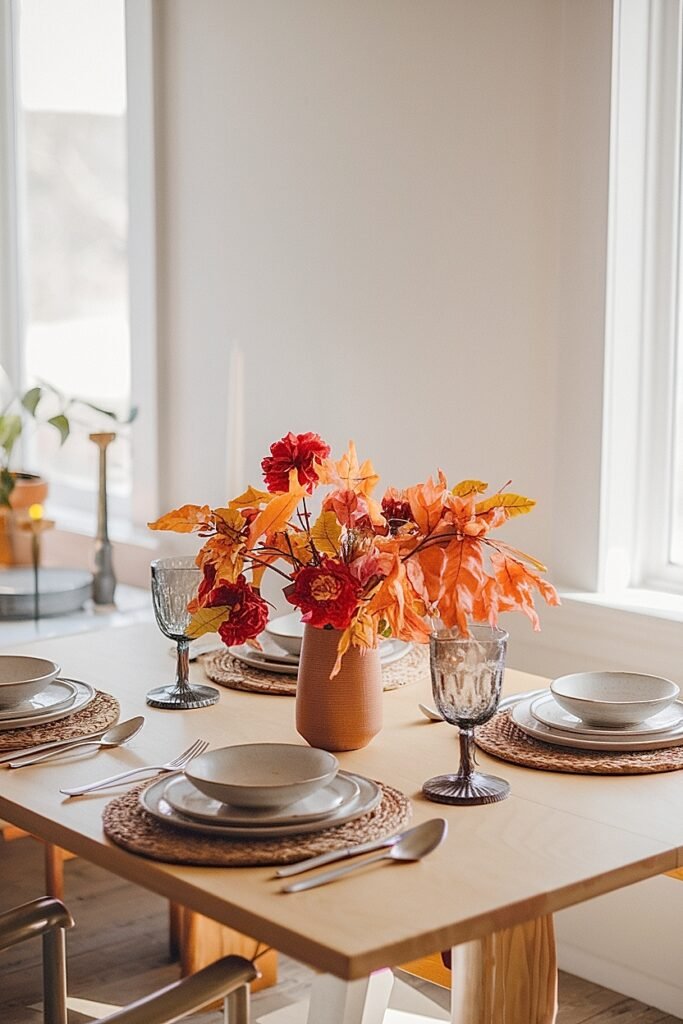
1. One-Third Position From One Table End Push the fall arrangement to one third of the table length from one end rather than the center. The remaining two thirds of the table length stays completely open for serving dishes throughout the meal. From any seated position, the arrangement is still visible and still reads as a deliberate.
2. Corner Placement for Round Tables On a round dining table, push the arrangement to one side of the table rather than the center. The center of a round table is equidistant from every seat, which makes it the natural reach zone for every guest simultaneously. An off-center placement on a round table leaves the center.
3. One Arrangement at Each Table End Two small matching arrangements, one at each narrow end of a rectangular table rather than one large arrangement at the center. Both ends stay decorated. The entire center zone of the table length stays open for serving platters, water pitchers, wine bottles, and every other item that gets set down.
4. Wall Side of the Table On a table positioned against a wall or near a buffet, push the arrangement to the wall side of the table center. Guests seated at that side have less reach requirement across the table than guests on the open side. The arrangement sits in the lower-traffic reach zone. The higher-traffic.
5. Clip-On Vessel at the Table Edge A small clip-on bud vase attached to the table edge holds one to three fall flower stems with no table surface consumed at all. The vessel clips to the table side and hangs down rather than sitting on the flat surface. The entire table top stays free for service. The.
More ahead on mini cluster formats, which distribute the arrangement presence across the table without concentrating it in a single location that creates a conflict.
DIY Ideas for Fall Flowers Mini Clusters That Leave Room for Dinner Plates
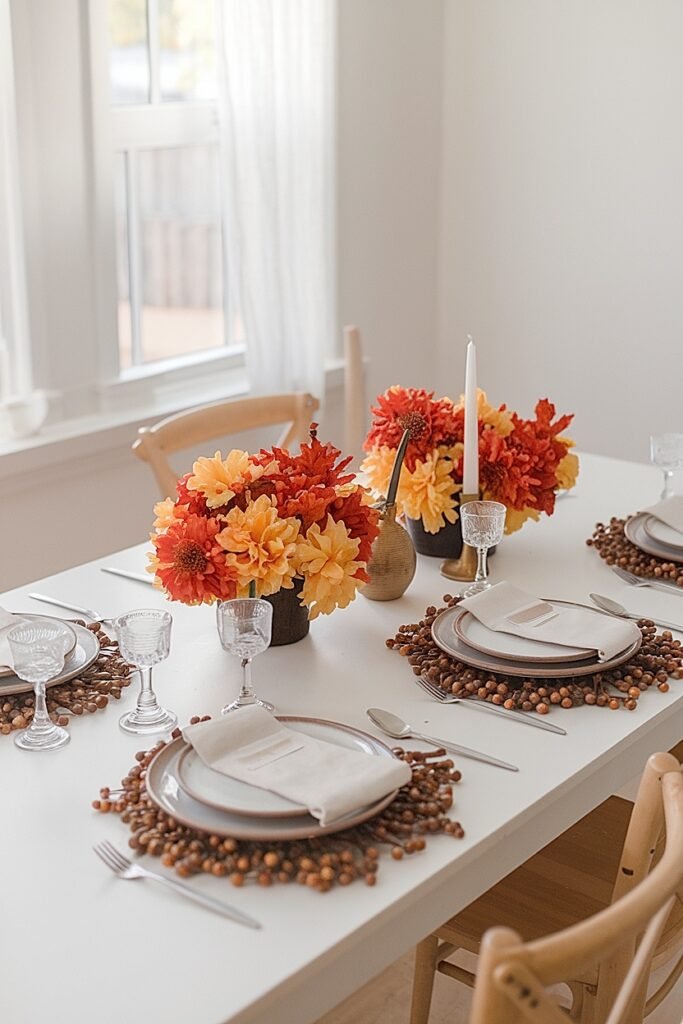
1. Three Small Matched Vessels at the Table Ends and Center With Wide Gaps Three short dark ceramic vessels, one at each narrow table end and one at the center, each holding three to four fall flower stems. The gaps between the three vessels, roughly twelve to fourteen inches on each side of the center vessel, are available for serving dishes throughout dinner. The.
2. Per-Place-Setting Bud Vases That Belong to Each Guest One small bud vase with two fall flower stems at each place setting, positioned at the upper right corner of each place outside the plate and glass zone. Each guest has their own flower detail and it is at their place rather than in the serving zone. When serving dishes.
3. Individual Floating Bloom Saucers at Each Setting One wide shallow saucer with one fall bloom head floating face-up in cold water at each place setting, positioned above the plate rather than beside it. The saucer sits in the area between the plate top edge and the table center. When guests are served, the saucer moves to the.
More ahead on how to keep one central fall arrangement and still serve a family-style meal without constantly moving flowers.
How to Use One Fall Flowers Centerpiece and Still Serve Family-Style Meals
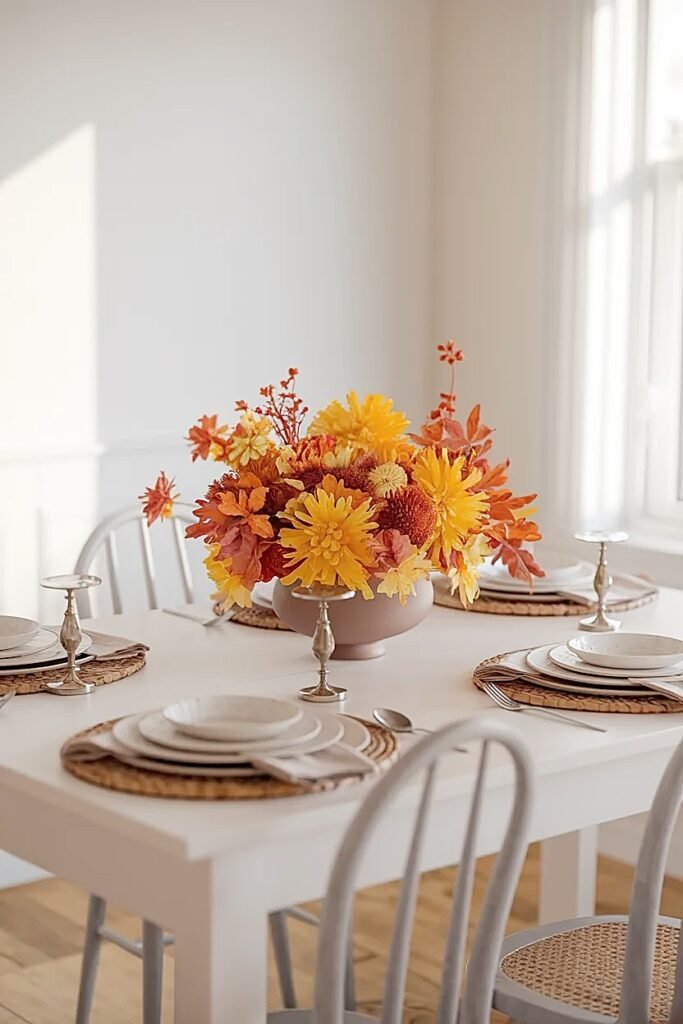
One arrangement is fine. It just needs to be positioned correctly and sized correctly before dinner starts.
The center of a family-style table is where dishes go. That is non-negotiable. A serving platter needs to reach every guest at the table, which means it lands in the middle. The arrangement needs to be somewhere else. Not off the table. Just not in that exact center zone.
Push a single fall arrangement to one third of the table length from one end and leave the other two thirds completely empty before dinner. When the serving dishes arrive, they fill the empty two thirds. The flowers occupy the end third for the whole meal without being moved once. Guests at the far end of the table have the arrangement right beside them. Guests at the serving end have the dishes right beside them. Nobody has to relocate anything mid-dinner.
The arrangement size that makes this work: no wider than one third of the table width and positioned to take up no more than one third of the table length. A six-inch wide bowl at a thirty-six-inch wide table takes up one sixth of the table width. Plenty of room for a serving platter on the same surface at the same time with no conflict.
Ideas for Fall Flowers Table Runners With Breaks for Serving Dishes
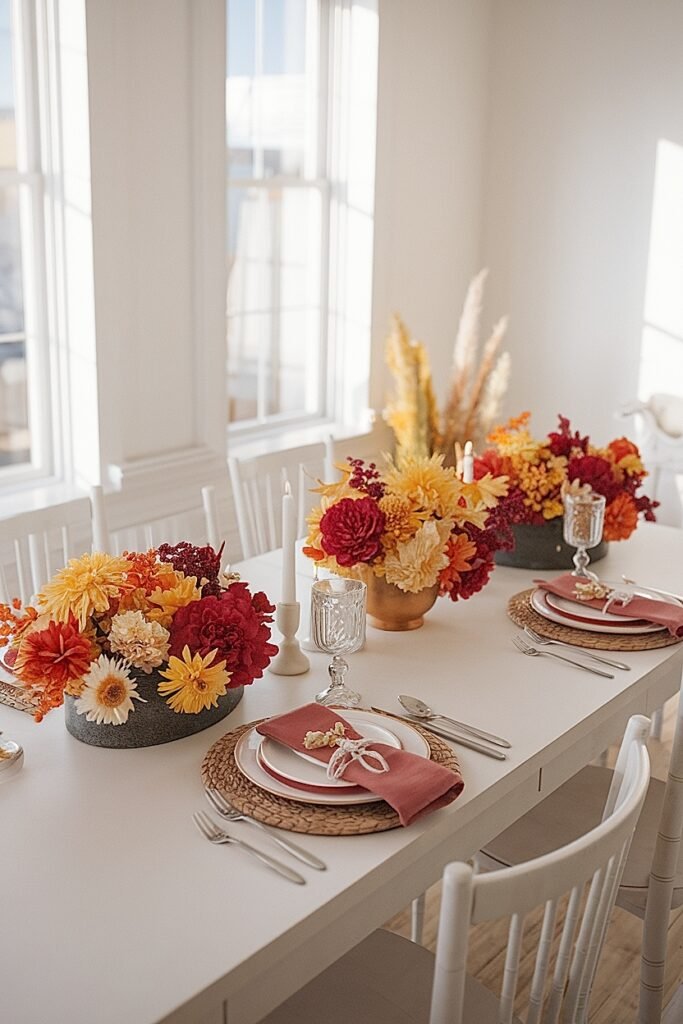
1. Three Vessel Row With Twelve-Inch Empty Gaps Three short dark vessels placed in a row down the table center, each holding three to four fall flower stems, with twelve to fourteen inches of empty table surface between each vessel. The empty gaps are where serving dishes go. The vessels define the runner visually. The gaps function as.
2. Water Pick Row With Planned Empty Sections Eight to ten individual water picks with one fall flower stem each, arranged in two groups of four or five at each end of the table center, with the middle third of the table length completely empty. The two flower groupings frame the empty center serving zone. During dinner, the.
3. Alternating Flower and Wheat Flat Runner With Empty Sections Flower stems in water picks alternating with flat wheat stalks on the table surface, with twelve-inch empty breaks every two flower positions. The wheat stalks on the table surface cost nothing to lay down and nothing to pick up. The water picks hold blooms upright in their positions. The empty.
4. Single-Side Runner Along One Table Edge All runner elements, flowers in water picks, flat wheat stalks, and small bud vases, positioned along one long edge of the table rather than down the center. The entire center table surface and the opposite edge stay free for serving dishes, water pitchers, and serving utensils. The single-side runner is.
5. Candle and Flower Runner With Dish-Sized Clear Zones Three tea lights at table surface level alternating with two small bud vases of fall flowers, positioned down the table center with dish-sized gaps between each element. The gaps are exactly wide enough for a standard serving bowl or platter to sit in during dinner. The candles and flowers define.
Conclusion
The serving dish problem is not a decorating problem. It is a planning problem.
Plan the table for the meal it is going to host, not the empty table that looks great before anyone sits down. Low arrangements. Off-center positioning. Mini clusters at the table ends. Runner gaps sized for serving platters. Any of those approaches lets the flowers stay on the table through the whole meal without interrupting dinner once.
The arrangement that works at a dinner table is the one nobody has to move.
This website contains affiliate links, and some products are gifted by the brand to test. As an Amazon Associate, I earn from qualified purchases. Some of the content on this website was researched and created with the assistance of AI technology.