This website contains affiliate links, and some products are gifted by the brand to test. As an Amazon Associate, I earn from qualified purchases. Some of the content on this website was researched and created with the assistance of AI technology.
Key Takeaways
- Asters suit fall table decor specifically because their dusty, muted tones in mauve, pale blue-violet, and soft purple sit in the autumn palette without competing with the harvest colors around them
- Golden wheat adds autumn grain texture and warm amber tones at a cost of three to five dollars per bundle, which covers multiple arrangements
- The small daisy face of an aster reads fully at rim height in a low bowl, which makes asters one of the best flowers for arrangements that need to stay below the dinner conversation threshold
- Neutral linens, warm white, oatmeal, and natural linen, amplify the soft aster and wheat color combination more than patterned or deeply colored table linens
- One bunch of asters typically holds ten to fifteen stems. Split across two to three small vessels, one bunch covers an entire fall table setup
- Purple and mauve asters with golden wheat in a dark forest-green or matte charcoal vessel create the most specifically soft and sophisticated fall table combination
Asters do not get enough credit. That’s the short version.
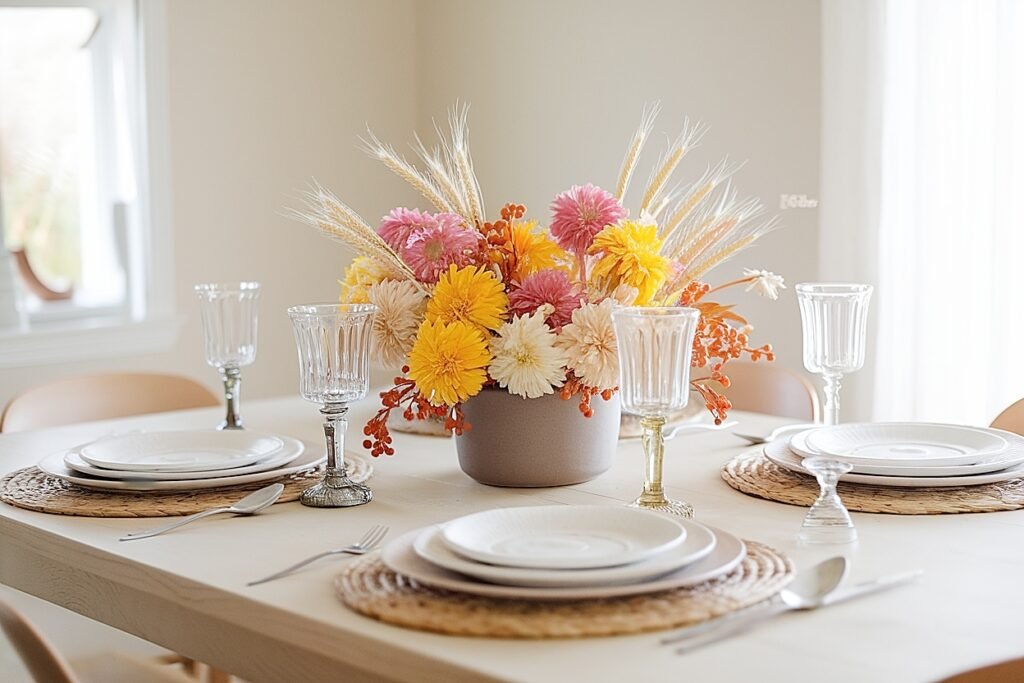
Making an aster and wheat centerpiece to create soft fall table decor is one of the quietest and most genuinely effective fall decorating moves I know. Asters are small, abundant, available in the best muted tones of the entire fall color range, and they hold five to seven days in cold water without drama. Paired with golden wheat, which brings warm amber grain texture and autumn harvest character from a single material that costs almost nothing, the combination creates a fall table that reads as soft and considered rather than loud and seasonally obvious.
Most fall decor announces itself. Orange pumpkins, burgundy dahlias, rust-and-amber everything. Aster-and-wheat does the opposite. It whispers fall. And at a dinner table, that whisper is often the more elegant choice.
Use this soft-style guide to choose the right aster and wheat pairing before arranging your fall table. Each row helps match aster color, wheat placement, table mood, and best support detail. The goal is a gentle Fall Flowers centerpiece that feels airy, seasonal, practical, and easy to recreate.
| Aster Choice | Best Wheat Placement | Soft Table Mood | Best Support Detail |
|---|---|---|---|
| Mauve asters | Short stems around the bowl rim | Romantic, gentle, and relaxed | Pale sedum and oatmeal linens |
| White asters | Light rim framing with fewer stems | Airy, clean, and softly autumnal | Sage foliage and cream plates |
| Lavender asters | Low angled stems near the edge | Cool, calm, and slightly romantic | Taupe linens and matte clay bowls |
| Purple asters | Sparse wheat tucked close to flowers | Colorful but still gentle | White asters and neutral linens |
| Mixed soft asters | One repeated short wheat accent per cluster | Meadow-style, airy, and natural | Mini vases and sage sprigs |
Resources:
- Grasses, Grains, and Pods – Floret Flowers
- Following Nature’s Cues for Floral Design | Longwood Gardens
- How Often To Change Flower Water To Keep Them Looking Fresh
How to Style Aster and Wheat Fall Flowers for Soft Fall Table Decor
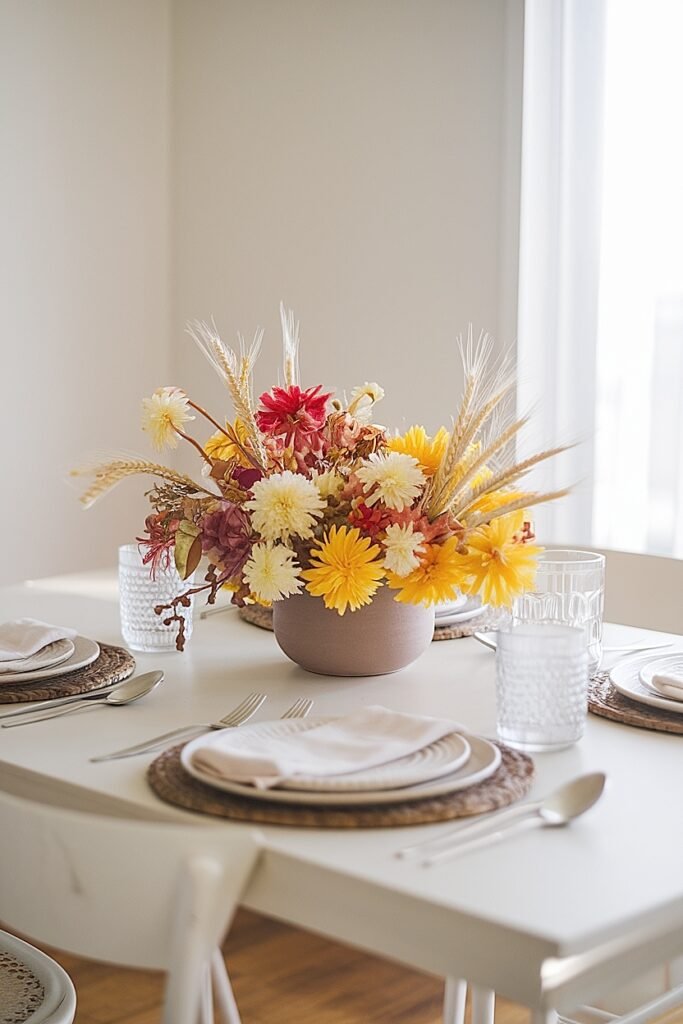
Soft fall decor is not less than dramatic fall decor. It is a different aesthetic choice that suits a different kind of table.
The dramatic fall table, deep burgundy dahlias, heavy ceramic, candlelight that reads as intentionally moody, suits a dinner party where the atmosphere is the point. The soft fall table, pale mauve asters, golden wheat, warm neutral linens, suits a fall table where the food and the conversation are the point and the flowers are the quiet, pleasant background detail. Neither is wrong. They just serve different purposes.
Asters and wheat serve the soft purpose specifically because both materials operate in a muted register. Asters are not vivid. Their mauve and pale purple tones have a dusty, softened quality that reads as autumnal without competing with whatever is on the table beside them. Golden wheat is warm but not saturated. The combination of muted cool-toned flower and warm neutral grain creates a fall arrangement that feels specific and seasonal without making itself the main event at the table.
The styling principle for a soft aster-and-wheat arrangement is restraint in everything except bloom count. More asters than you think you need. Three or four stems per small vessel reads as spare. Seven or eight stems per vessel, all at rim height in a wide bowl, reads as full and deliberately abundant. The small bloom scale means you need higher stem counts than with large focal flowers to achieve a visually complete arrangement. The good news is that asters are cheap enough that going to ten or twelve stems per bowl costs about the same as going to five.
For more on building fall centerpieces that work around serving dishes and table function, including the exact height and placement rules that keep arrangements out of the way during dinner, check out how to create fall centerpieces that leave room for serving dishes. Share this with someone who decorates for fall. More ahead on the best bowl formats, linen pairings, and every specific aster-and-wheat combination.
Ideas for Mauve Aster and Wheat Fall Flowers in Low Ceramic Bowls
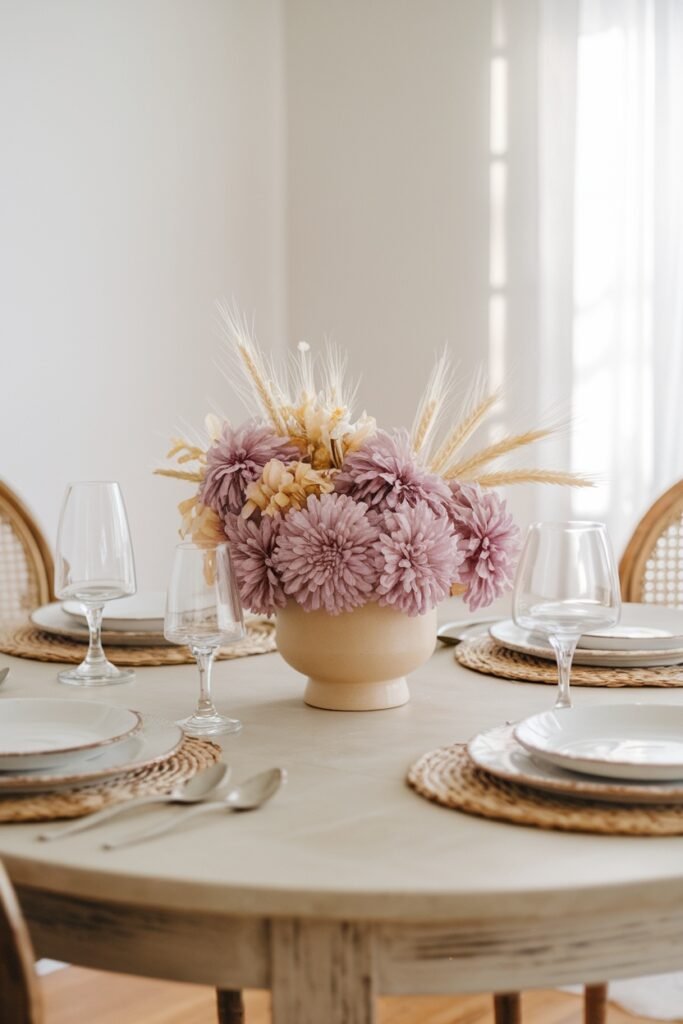
Mauve asters are the right choice for anyone who wants a fall table that does not look like everyone else’s fall table.
The dusty rose-purple of a mauve aster sits at a different point in the autumn palette from the typical rust-and-orange. It reads as warm but not saturated, feminine but not precious, and specifically October in a way that lavender or true purple does not quite achieve. Alongside golden wheat, mauve creates a warm-cool pairing where the grain amber warms the whole arrangement and the dusty mauve provides the soft color note that holds everything together.
1. Seven Mauve Aster Stems and Two Wheat Stalks in a Wide Dark Charcoal Bowl Seven mauve aster stems cut to two inches above the rim plus two outward-angled wheat stalks in the gravel base, in a wide dark charcoal ceramic bowl with cold water. The charcoal amplifies the mauve tone by contrast without competing with it the way navy or black might. From the seated overhead angle at a dinner table, the mauve daisy faces and amber grain heads create a soft, full fall.
2. Mauve Aster, Wheat, and One Sage Sprig in a Low Green Glazed Bowl Eight mauve aster stems plus two wheat stalks plus one fresh sage sprig in a low forest-green glazed ceramic bowl. The green glaze creates a cool-tone vessel that aligns with the dusty mauve aster rather than contrasting against it. The sage adds herbal autumn fragrance at close dining range. The warm amber wheat provides the one element of harvest warmth in an otherwise soft, cool-toned arrangement.
3. Mauve Aster and Wheat in a Terracotta Bowl With Eucalyptus Trail Six mauve aster stems plus two wheat stalks plus one seeded eucalyptus strand in a wide low terracotta bowl. The eucalyptus trails slightly over the bowl rim on one side. The silver-grey eucalyptus connects the dusty mauve aster and the amber wheat tones without competing with either. The terracotta’s warm buff note adds autumn depth at the vessel level. Holds seven to ten days with cold water and stripped lower.
4. Mixed Mauve and White Asters With Wheat in a Low Navy Bowl Five mauve aster stems plus four white aster stems plus two wheat stalks in a wide low navy ceramic bowl. The white asters between the mauve ones create a tonal variation that reads as deliberate at close dining range. The navy bowl amplifies both the white and the mauve tones simultaneously. The golden wheat grain heads at the outer bowl edge anchor the warm tone in an otherwise cool arrangement.
5. Mauve Aster, Wheat, and Dried Pampas Grass Section in a Wide Stoneware Bowl Six mauve aster stems plus two wheat stalks plus one small section of dried pampas cut to three to four inches in a wide dark stoneware bowl. The pampas section adds a feathery cream-white backdrop texture behind the mauve bloom zone without overwhelming the arrangement the way a full pampas plume would. One small section, not a full plume. The stoneware’s earthy character suits the soft fall palette directly.
More ahead on height management, which is the specific concern that determines whether an aster-and-wheat arrangement actually works at a dinner table.
How to Keep Aster and Wheat Fall Flowers Low for Dinner Conversation
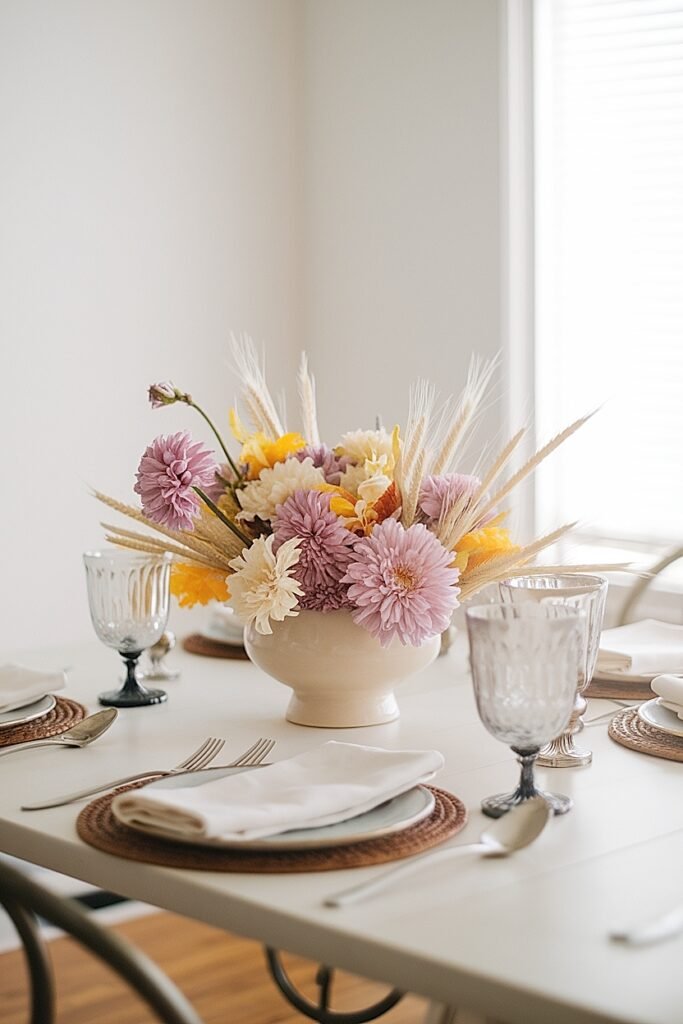
Asters are easy to keep low because their visual quality does not depend on stem length.
A dinner-plate dahlia needs height. The large bloom face needs to be elevated above the vessel rim to read as a focal element rather than a flower crammed into a bowl. An aster at rim level looks complete and intentional. The small flat daisy face is fully readable from the overhead dining angle at rim height. It does not need to be elevated to read as a deliberate arrangement element.
The practical target for aster-and-wheat arrangements at a dinner table: stems cut to one and a half to two and a half inches above the rim, wheat stalks angled outward to grain heads at the vessel outer edge or just below the rim boundary. Total arrangement height, vessel included, stays under seven inches. Nobody leans sideways. No serving dish has to move around it.
The wide bowl format works specifically for keeping asters low because it allows high stem counts at rim height without crowding. Eight asters at rim height in a six-inch wide bowl creates a full, abundant arrangement that reads as complete without rising above two inches of stem. The same eight asters in a four-inch wide bowl would create an overcrowded upright display that rises to six inches of stem simply to find space. Bowl width is the key variable.
The wheat goes in at thirty degrees outward rather than vertical. Outward-angled wheat stays lower than vertical wheat at the same stem length because the angle keeps the grain head at a diagonal rather than projecting straight up. One outward-angled wheat stalk at a low bowl reaches about two inches of absolute height at the grain tip. One vertical wheat stalk at the same stem length reaches four or five inches. The angle does the work without changing anything else.
More ahead on purple asters with neutral linens, which is the pairing that shows the full potential of the aster-and-wheat combination.
DIY Ideas for Purple Aster and Wheat Fall Flowers With Neutral Linens
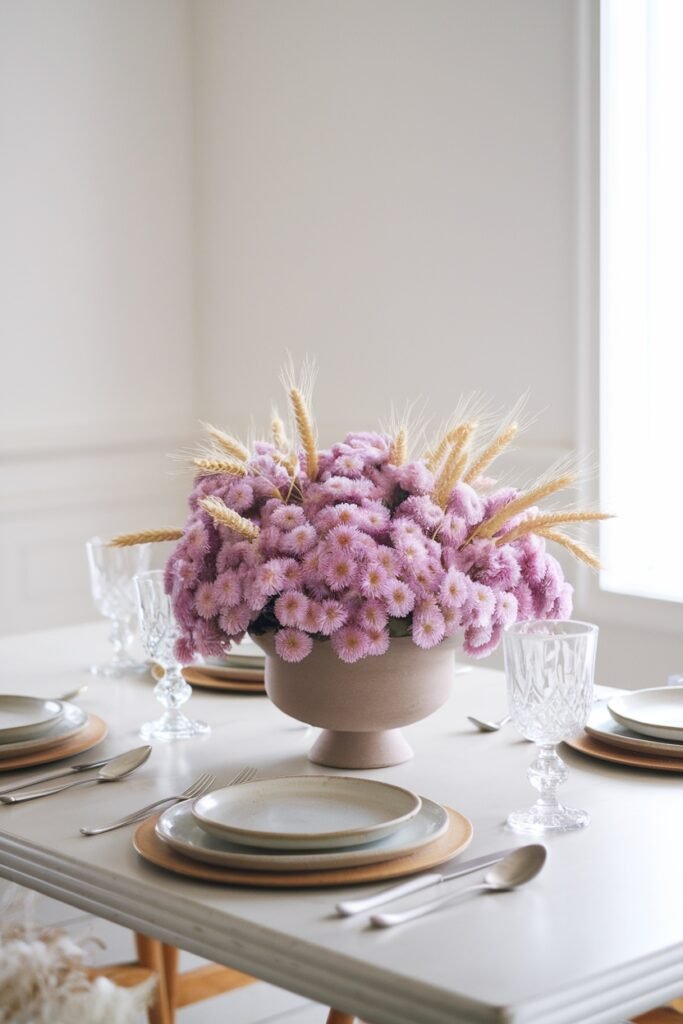
1. Deep Purple Asters and Wheat in a Dark Matte Bowl on a Natural Linen Runner Eight deep purple aster stems plus two wheat stalks in a wide dark matte ceramic bowl, placed on a natural undyed linen table runner. The natural linen’s warm off-white tone creates the most effective backdrop for the cool deep purple asters and the warm amber wheat. The three tones, cool.
2. Purple Aster and Wheat Low Bowl Centered Between Two Taper Candles on Neutral Cloth Seven purple aster stems plus two wheat stalks in a low dark bowl, centered between two taper candles in brass holders on an oatmeal-colored linen cloth. The candle warmth shifts the purple aster tone toward violet in low light. The oatmeal linen backdrop keeps the whole arrangement in a soft.
3. Per-Place-Setting Purple Aster and Wheat Bud Vase on Warm White Napkin One purple aster stem and one short wheat stalk in a small dark bud vase at each place setting, placed on a folded warm white cotton napkin. The warm white napkin provides a consistent neutral backdrop at each seat. The purple aster and wheat combination at close personal dining range.
4. Mixed Purple and Mauve Aster Flat Runner on Natural Burlap Table Cloth Purple and mauve aster stems in water picks alternating with flat wheat stalks on the table surface, centered on a natural burlap or raw cotton tablecloth. The rough natural fiber texture of the burlap provides tactile autumn character at table level that smooth linen does not. The mixed purple-and-mauve asters.
5. Purple Aster, Wheat, and Sage Bundle Beside Each Plate on Oatmeal Linen Two purple aster stems plus two wheat stalks plus one sage sprig gathered and placed flat beside each dinner plate on an oatmeal-colored linen placemat. No vessel, no water. The sage holds its fragrance for two to three hours without water. The sage grey-green, wheat amber, and purple aster create.
More ahead on aster-and-wheat setups specifically for small dining tables, where the scale requirements change the whole approach.
Easy Ideas for Aster and Wheat Fall Flowers on Small Dining Tables
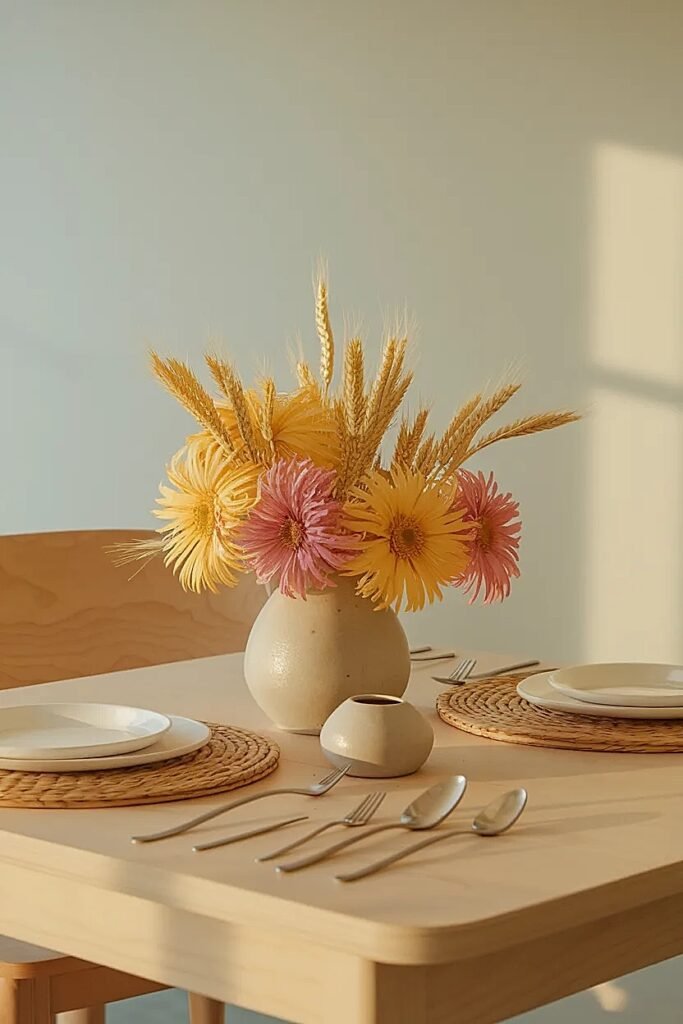
1. One Wide Low Bowl at One End of the Table Eight aster stems plus two wheat stalks in a wide low dark bowl positioned at one narrow end of a small dining table rather than the center. The end position keeps the full table surface free for plates, glasses, and serving dishes. The arrangement is visible from every seat without.
2. Two Matched Bud Vases at Opposite Table Corners One small dark bud vase with three aster stems and one wheat stalk at each far corner of the small table. Both corners stay decorated throughout the meal. The entire center table surface and both long edges stay free for every plate, glass, and serving item the meal requires. Under.
3. Single Floating Aster and Wheat Grain Head Saucer at Table Center One aster bloom head and one wheat grain head snipped from the stalk, both floating face-up in a small wide saucer with one inch of cold water at the table center. The whole setup occupies about four inches of table surface at zero height. At close small-table dining range, the.
More ahead on balancing the dried wheat texture with the fresh aster blooms, which is the one thing that can go wrong if the wheat proportion is off.
How to Balance Aster and Wheat Fall Flowers Without Too Much Dry Texture
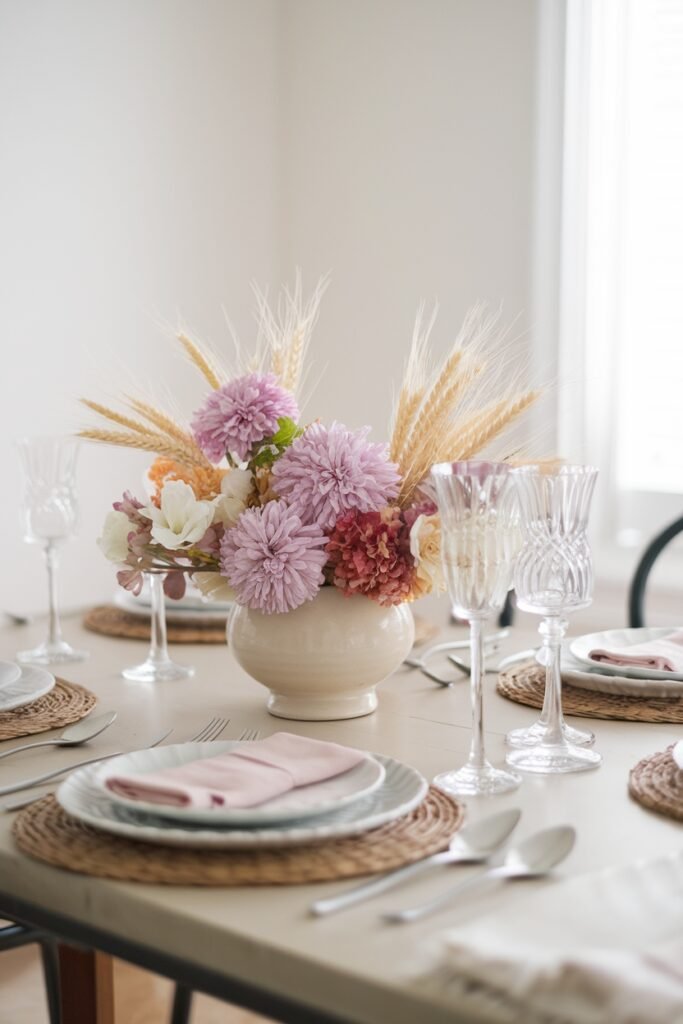
Too much wheat in an aster arrangement does not just look dry. It looks unfinished.
The wheat is the texture element. The asters are the color element. When the wheat outnumbers or visually dominates the asters, the arrangement loses its identity as a flower display and starts reading as a dried grain arrangement with some flowers mixed in. That is a completely different aesthetic with a different purpose.
The right balance: asters lead in stem count and in visual zone. Three or four wheat stalks per ten aster stems. Not the reverse. The asters fill the vessel center and the mid-height zone. The wheat stalks frame the outer edge of the arrangement at an outward angle. The wheat is visible and intentional. It just does not compete with the bloom zone for primary visual attention.
The one thing that tips the balance wrong fast is placing the wheat stalks upright in the vessel center rather than at the outer edge at an outward angle. Vertical wheat at the arrangement center creates a grain focal point that pulls attention away from the aster bloom zone. Outward-angled wheat at the vessel perimeter creates a grain frame that directs attention back toward the blooms at the center. Position determines the balance more than stem count does.
If the wheat reads as too dominant after the arrangement is built, pull one or two wheat stalks and replace with two or three aster stems. Do not try to counterbalance with a different material. More asters is the fix. The bloom zone needs numerical and positional dominance for the arrangement to read as a flower display rather than a harvest display.
What Are the Best Containers for Aster and Wheat Fall Flowers?
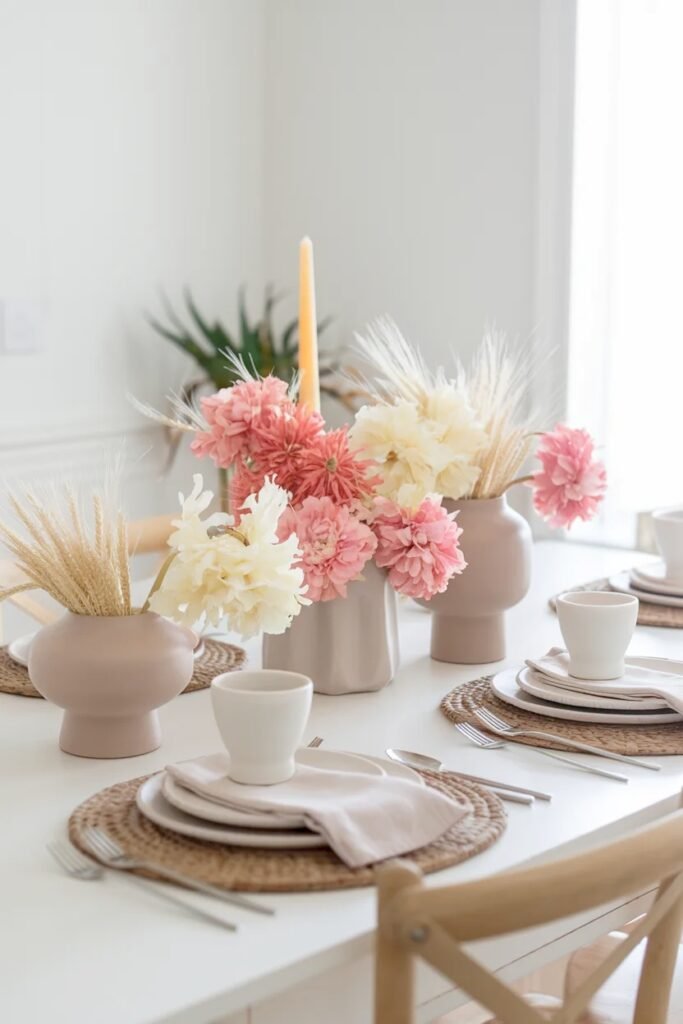
1. Wide Dark Ceramic Bowl Six to eight inches in diameter, two to three inches tall, with a dark glaze in navy, charcoal, or matte black. The wide diameter accommodates the high aster stem counts that make small-bloomed arrangements look full. The dark tone amplifies both the dusty purple-mauve aster tone and the amber wheat.
2. Low Forest-Green Glazed Ceramic Compote A forest-green glazed compote with a raised foot creates more visual presence than a flat bowl at the same height, because the raised foot elevates the arrangement slightly above the table surface. The cool green glaze aligns with the dusty cool tone of mauve and purple asters without competing with.
3. Short Terracotta Wide Pot A standard terracotta bulb pot, three to four inches tall and five to six inches wide, provides warm harvest character at the vessel level without adding any color that competes with the asters. The buff-orange terracotta adds warmth that aligns with the golden wheat amber. For aster-and-wheat specifically, gravel in.
4. Dark Enamel Short Pitcher A cream or navy enamel short pitcher creates a vessel character that suits the casual-but-considered soft fall aesthetic of aster-and-wheat arrangements specifically. The pitcher handle creates asymmetry and visual direction. A cream enamel pitcher with mauve asters and wheat reads as domestic and warm. A navy enamel pitcher with the.
5. Heavy Stone or Concrete Low Bowl A cast concrete or heavy stone bowl provides the maximum tip-resistance of any vessel option. At a working dinner table where guests reach past the arrangement repeatedly, a concrete or stone bowl stays exactly where it is placed. The matte grey-buff tone of concrete or raw stone creates a natural,.
Conclusion
Asters and wheat do not demand attention. That is their whole value.
A dinner table does not need to announce that it is fall. A mauve aster beside a wheat stalk in a dark bowl on neutral linen says it quietly and specifically, without competing with the food, the candles, or the people sitting around it.
Seven asters, two wheat stalks, one wide dark bowl. That is the complete soft fall table. Nothing else required.
This website contains affiliate links, and some products are gifted by the brand to test. As an Amazon Associate, I earn from qualified purchases. Some of the content on this website was researched and created with the assistance of AI technology.