This website contains affiliate links, and some products are gifted by the brand to test. As an Amazon Associate, I earn from qualified purchases. Some of the content on this website was researched and created with the assistance of AI technology.
Key Takeaways
- Fresh garden sage holds its fragrance for three to four days in an arrangement before the leaves start to dry and the scent fades. At close dining range, that fragrance is an ambient autumn quality guests register before they consciously identify the source
- Common garden sage, Salvia officinalis, has the broadest, most felted leaf and the strongest fragrance of any culinary sage variety. Purple sage adds a lavender-grey leaf tone. Both suit aster pairings
- Strip the lower leaves off sage stems and make a fresh diagonal cut before placing in cold water. Crushed stem ends, common with woody-stemmed herbs, improve water uptake significantly
- One sage stem per three to four aster stems is the proportion that adds fragrance and grey-green foliage without the green taking over the arrangement
- White asters alongside sage create the airiest, least harvest-heavy combination of any aster color with sage. Mauve and purple asters alongside sage read as softer and more autumn-specific
- Pears placed beside, not inside, a sage-and-aster bowl create a gentle harvest still-life that costs nothing extra if the fruit is already in the kitchen
The fragrance is what gets people first. Before they even look at the arrangement.
Using sage foliage and aster fall flowers for autumn centerpieces is one of the most sensory-rich and least expected fall decorating choices available. Asters bring the soft muted color. Sage brings the fragrance. Together they create a fall table that guests experience before they sit down, that reads as quiet and specifically autumnal rather than loudly harvest-themed, and that costs less than almost any comparable fall arrangement. I’ve been using this combination for a few years now and the comments about the sage fragrance at close dining range happen every single time.
The autumn herb garden quality of sage foliage alongside asters is not an accident. Garden sage and asters both peak in late summer and early fall in temperate climates. They grow in the same seasonal window. They share a dusty, slightly dry quality that reads as specifically September and October in a way that florist-grown exotic varieties never quite achieve. This combination looks like someone went out to the garden and gathered what was ready.
Use this soft autumn guide to match sage foliage with the right aster color before building your centerpiece. Each row helps compare flower mood, best support detail, linen pairing, and table effect. The goal is a calm Fall Flowers arrangement that feels muted, seasonal, practical, and easy to recreate.
| Aster Choice | Best Sage Use | Best Linen Pairing | Autumn Centerpiece Mood |
|---|---|---|---|
| Mauve asters | Small sprigs between grouped blooms | Oatmeal napkins and taupe runner | Romantic, muted, and soft |
| White asters | Light green pockets near the bowl edge | Cream linens and warm plates | Airy, clean, and natural |
| Lavender asters | Sage tucked below the bloom line | Taupe linens and clay ceramics | Cool, calm, and gentle |
| Purple asters | Sparse sprigs to soften strong color | Oatmeal, cream, and soft brown | Colorful but controlled |
| Mixed soft asters | Repeated sprigs in mini vessels | Sage napkins and cream plates | Meadow-style, relaxed, and cohesive |
Resources:
- Bring in Flowers for Drying – Indiana Yard and Garden – Purdue Consumer HorticulturePurdue University Indiana Yard and Garden – Purdue Consumer Horticulture
- Grasses, Grains, and Pods – Floret Flowers
- 4H 5552 Preparing Floral Arrangements for Exhibit May 2024
How to Style Sage Foliage and Aster Fall Flowers for Soft Autumn Centerpieces
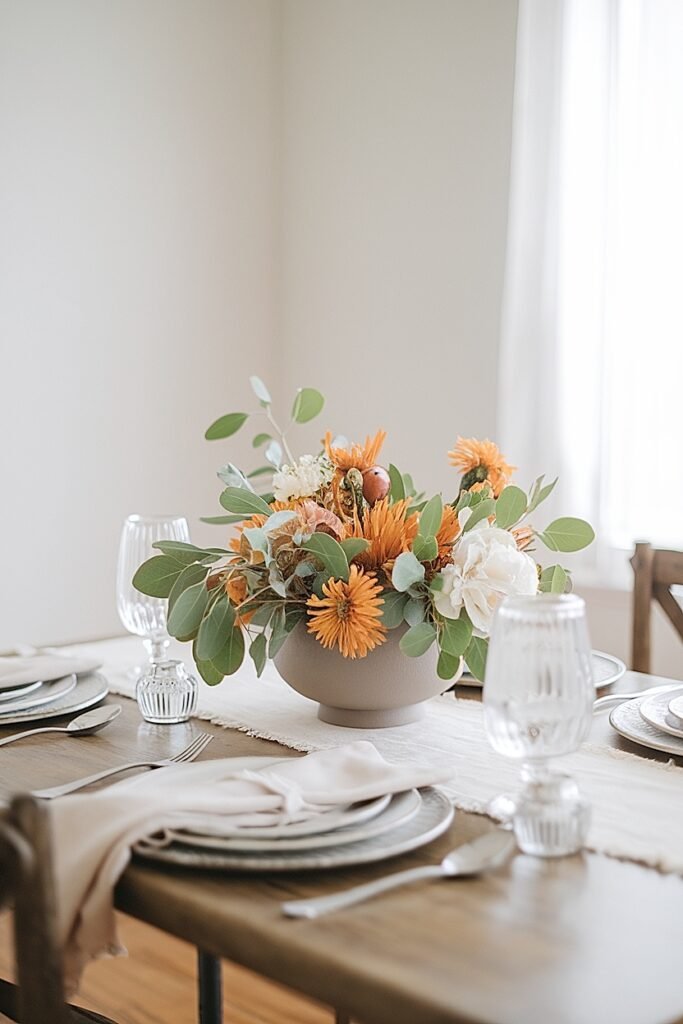
Sage does three things in a fall flower arrangement that no ornamental foliage does as well.
It adds fragrance. It adds a felted grey-green leaf texture that is completely different from waxy or glossy ornamental greens. And it signals the herb garden, which is a specific autumn quality that ornamental foliage just does not communicate.
The style principle for sage-and-aster arrangements is simple: asters lead, sage follows. More aster stems than sage sprigs, always. The asters provide the color and the bloom density that make the arrangement read as a flower display. The sage provides the fragrance, the foliage texture, and the autumn herb quality that makes the same flower display read as specifically gathered and seasonal rather than assembled from a flower bucket.
Position the sage toward the outer vessel edge or at the arrangement base rather than throughout the bloom zone. This keeps the sage visible and fragrant without the grey-green foliage competing with the aster bloom faces for visual attention. Sage pressed into the arrangement center between asters disappears visually and its leaf texture reads as background noise. Sage at the vessel perimeter reads as a deliberate green-and-grey framing element that the aster blooms sit inside of.
The build sequence: gravel base, cold water, sage stems at the outer vessel edge first, then asters filling the center zone. Sage stems into the gravel at the four outer positions of a six-inch bowl. Eight to ten aster stems filling the center. The asters fill the bowl. The sage frames the edge. The whole arrangement smells like October.
For more on aster and wheat combinations for soft fall table decor, including the bowl formats and linen pairings that work best alongside muted autumn flowers, check out aster and wheat centerpiece ideas for soft fall table decor. Share this with a friend who decorates for fall. More ahead on white asters, container choices, cream mum pairings, and everything else that makes sage-and-aster work.
Ways to Use White Aster Fall Flowers With Sage Foliage for Airy Centerpieces
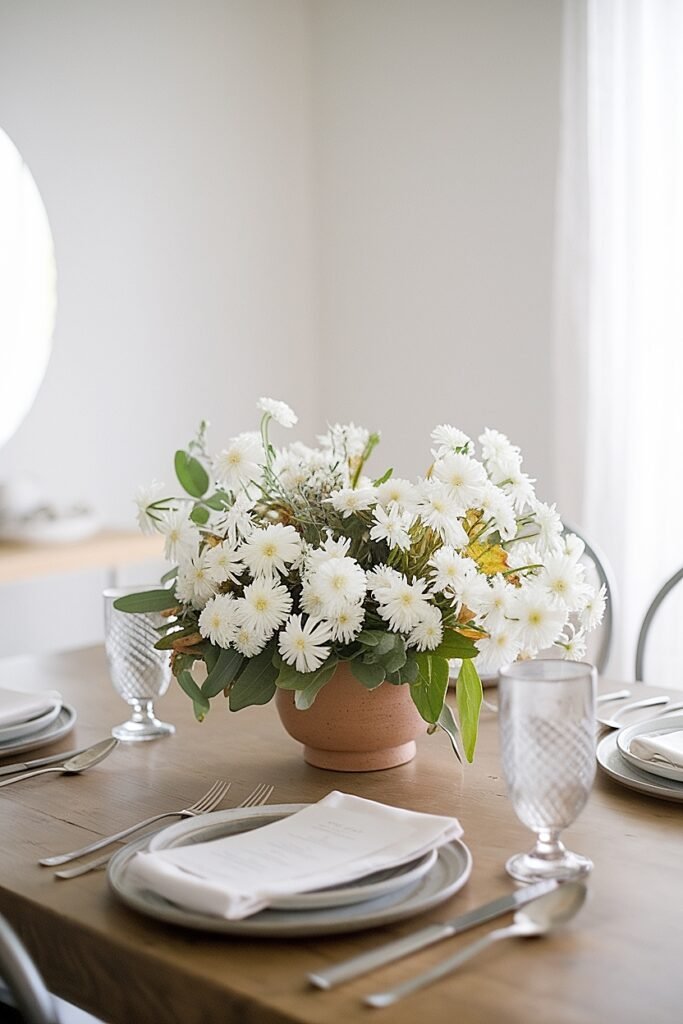
White asters alongside sage is the combination that reads as most airy, most light, and least harvest-heavy of any sage-and-aster pairing.
White has no autumn color saturation. It does not add orange warmth or purple-cool or any of the tonal weight that makes most fall arrangements feel seasonal. What it adds is luminosity. At close autumn dining range, white aster faces catch ambient light and candlelight and create small bright reference points throughout the grey-green sage foliage that makes the whole arrangement feel like it is glowing slightly. That quality is most visible at candlelit dinner tables, which is exactly where a close-range autumn centerpiece is most experienced.
1. Ten White Asters and Four Sage Sprigs in a Wide Dark Navy Bowl Ten white aster stems plus four sage sprigs at the outer vessel edge in a wide dark navy ceramic bowl with gravel and cold water, all cut to two inches above the rim. The navy creates the highest contrast available against white blooms. The sage grey-green reads at the arrangement perimeter between the white aster zone and the dark vessel edge. From the overhead dining angle, the arrangement reads as.
2. White Aster and Sage Floating Bowl With Sage Leaf Surface Eight white aster heads with stems removed plus three individual sage leaves placed flat on the water surface, all in a wide shallow bowl with one inch of cold water. The white aster heads float at the same level as the floating sage leaves. From above at close dining range, the white bloom faces and the grey-green felted sage leaves create a white-and-green surface. Zero stem height. Zero vessel height.
3. White Aster, Sage, and Golden Wheat in a Low Terracotta Bowl Eight white aster stems plus three sage sprigs plus two outward-angled wheat stalks in a wide low terracotta bowl. The wheat adds the one warm amber tone that prevents the white-and-grey combination from reading as too cool and winter-adjacent. The terracotta vessel adds warm buff-orange at the vessel level. The three tones together, white, grey-green, and amber, create a soft, specifically autumn palette.
4. White Aster and Sage Per-Place-Setting Bud Vase Three white aster stems plus one sage sprig in a small dark bud vase at each dinner place setting. The sage fragrance at this intimate close-setting distance is the primary sensory detail. The white aster faces at personal scale create a bright, welcoming detail per guest. Under a dollar fifty per setting from one bunch of asters and a few garden sage sprigs. The sage sprig holds its fragrance through.
5. White Aster, Sage, and Single Pear Still Life Seven white aster stems plus three sage sprigs in a wide low bowl, with one small whole Bosc pear placed on the table surface directly beside the bowl. The golden-green pear skin beside the white asters and grey-green sage creates a still-life quality that reads as a designed table composition rather than a flower arrangement with a piece of fruit next to it. The pear adds autumn harvest character at.
More ahead on how to make sure the sage foliage stays in the supporting role without taking the arrangement green and losing the flower character.
How to Balance Sage Foliage and Aster Fall Flowers Without Too Much Green
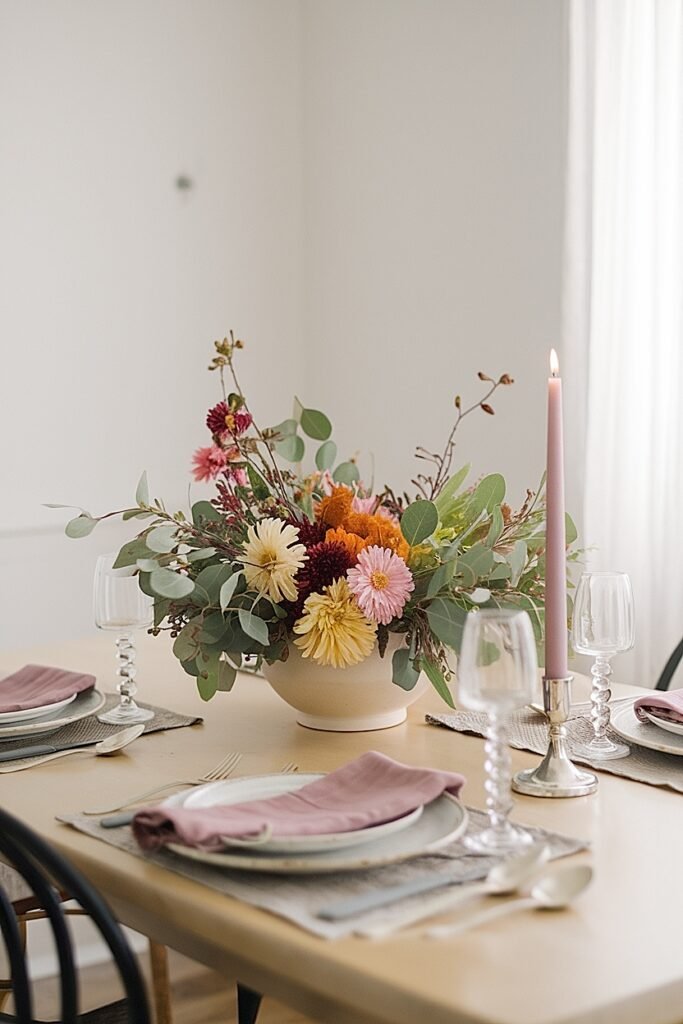
Here is the thing that goes wrong with sage in a flower arrangement: you use too much of it.
Sage is aromatic. When you are handling it, the fragrance is vivid and pleasant, and that vivid sensory quality makes it feel like an important element that deserves significant presence in the arrangement. So you add more sage. Then more. And by the time the arrangement is done, the green foliage has visually overwhelmed the flowers and the arrangement reads as a herb display with some asters mixed in. That is not what you were going for.
One sage stem per three to four aster stems. That’s the ratio. Not one-to-one. Not fifty-fifty. One sage sprig per cluster of three or four asters. At that proportion, the sage is clearly visible, its fragrance is fully expressed at close dining range, and the grey-green leaf texture reads as a deliberate foliage accent. The asters still lead. The arrangement still reads as a flower display.
The position rule helps too. Sage at the arrangement edge or base reads as a framing element. Sage pressed into the center of the arrangement competes with the flower zone. The same two sage sprigs that disappear when mixed through ten asters read clearly as deliberate foliage accents when positioned at the outer vessel edge between the aster blooms and the vessel rim.
If the arrangement tips green despite careful proportioning, the fastest fix is not to remove the sage. Add more asters. Two or three additional aster stems at the arrangement center push the bloom zone back to visual dominance without changing anything else. Asters are cheap enough that adding three stems mid-arrangement is not a significant cost. The bloom zone needs numerical majority and the sage provides the sensory and textural counterpoint.
More ahead on vessel choices, which matter differently for sage-and-aster than for most other fall flower combinations because the sage fragrance interacts with the vessel material in close-range situations.
What Are the Best Containers for Sage Foliage and Aster Fall Flowers?
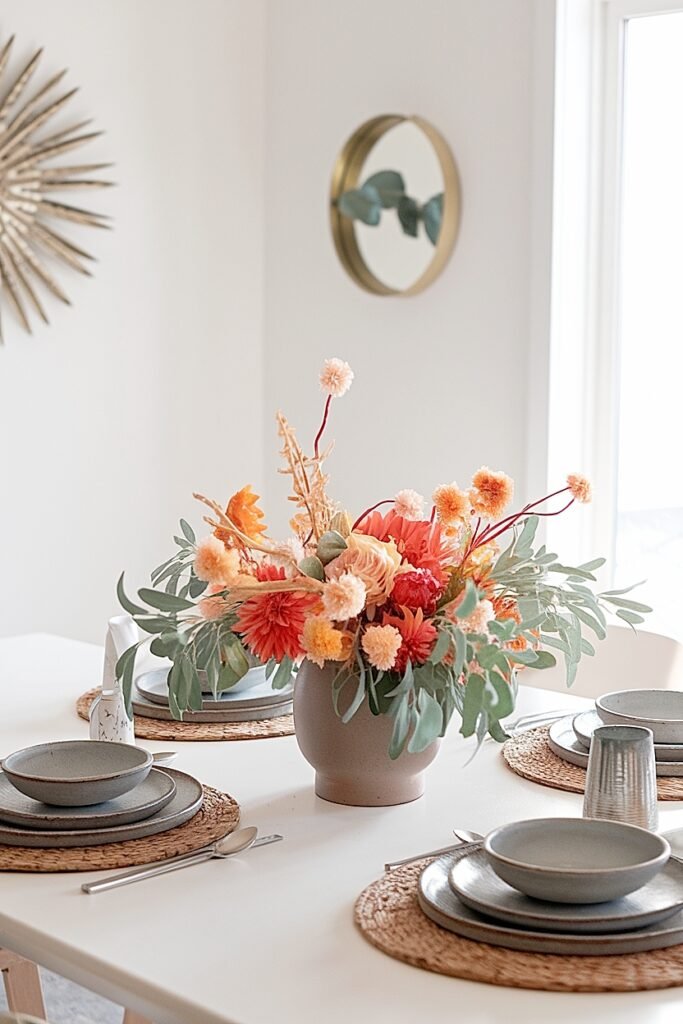
1. Wide Dark Matte Ceramic Bowl Six to eight inches in diameter, two to three inches tall, with a matte dark glaze in charcoal, navy, or black. The wide mouth accommodates both the high aster stem count and the sage sprigs at the outer edge without crowding. The dark matte tone amplifies the dusty cool tones.
2. Low Terracotta Wide Pot A bulb pot in terracotta, three to four inches tall and five to six inches wide, provides warm autumn character at the vessel level that suits the herb-and-flower autumn quality of sage and asters. The buff-orange terracotta adds warmth alongside the cool-toned flowers and grey-green foliage. Gravel ballast required because.
3. Dark Green Glazed Compote A low forest-green glazed compote aligns with the sage leaf tone at the vessel level, creating a cool-green backdrop for mauve or purple asters. The compote’s raised foot adds visual presence without adding stem height. The green vessel and grey-green sage foliage read in the same cool-toned register, which lets.
4. Copper or Brass Short Pitcher A small copper or brass pitcher alongside sage foliage creates a warm metallic vessel tone that contrasts with both the cool sage grey-green and the dusty aster tones in a warm-meets-cool arrangement dynamic. The pitcher handle creates visual direction. A copper pitcher with white asters and sage reads as harvest-warm.
5. Heavy Stone or Concrete Flat Bowl A cast concrete or rough stone bowl provides maximum base stability for a close-range sage and aster arrangement at a working dinner table. The matte grey or grey-buff tone of raw concrete or stone reads in the same cool-neutral register as the sage foliage, creating a vessel-and-herb visual harmony before.
More ahead on combining sage and asters with cream mums, which adds bloom density and a soft neutral tone that changes the fullness of the arrangement significantly.
Ideas for Sage Foliage and Aster Fall Flowers With Cream Mums for Fullness
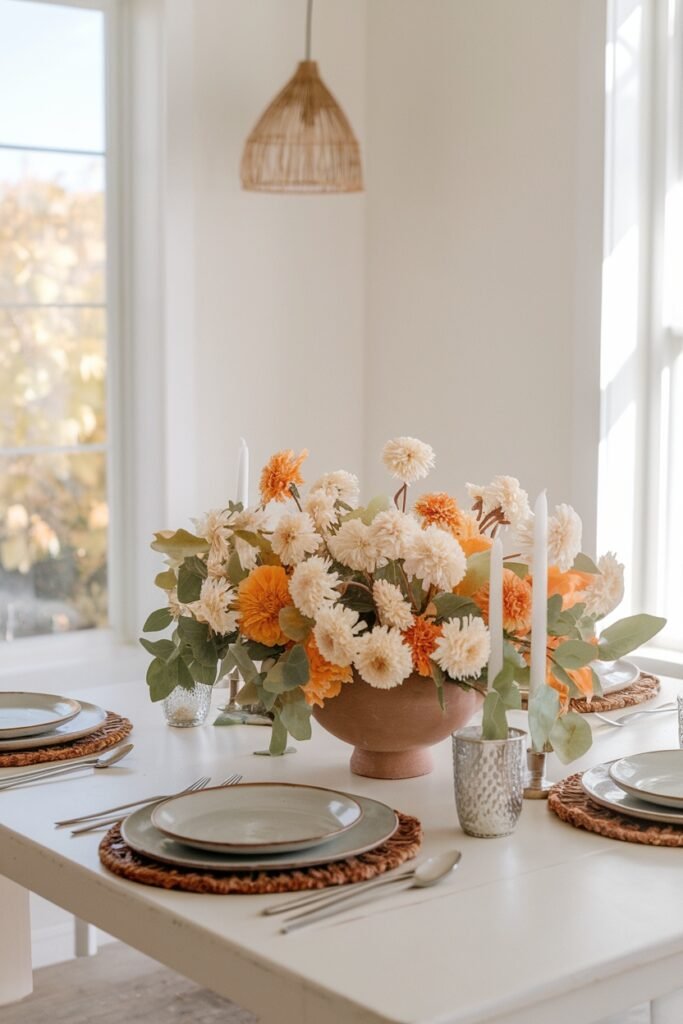
1. Cream Mum Forward With Asters and Sage at the Arrangement Base Five cream pompom mum stems at mid-height, six mauve aster stems at the inner base zone, and three sage sprigs at the outer vessel edge in a wide dark ceramic bowl. The cream mums create the upper visual focal zone. The asters fill the base bloom level. The sage frames.
2. Equal Cream Mum and Mauve Aster With Sage Between Four cream mum stems plus four mauve aster stems plus two sage sprigs in a wide low bowl, with the sage positioned between the cream and mauve bloom zones rather than at the outer edge. The sage grey-green creates a visual divider between the cream and mauve blooms that makes.
3. Cream Mum, White Aster, and Sage in a Compote for a Formal Setting Three cream pompom mum stems plus five white aster stems plus two sage sprigs in a low dark compote. The all-cool-and-neutral palette, cream, white, and grey-green, in a dark vessel with a candle beside it reads as restrained and formal in a way that works specifically at an intimate dinner.
4. Per-Setting Small Bowl With Cream Mum, One Aster, and Sage One cream mum branch plus two mauve aster stems plus one sage sprig in a small dark vessel at each dinner setting. The cream mum as the focal bloom, asters as supporting color, sage as fragrance. Each guest gets a complete micro-arrangement at their seat. Under two dollars per setting.
5. Cream Mum and Aster Row With Sage Between Vessels Three matched vessels in a row down the table center, each holding two cream mum stems and three aster stems. Fresh sage sprigs placed flat on the table surface between each pair of adjacent vessels as a connecting green element. The sage on the table surface does not need water.
More ahead on the pear addition, which is the one non-flower element that adds autumn harvest character to a sage-and-aster arrangement without any arrangement complexity.
Ideas for Sage Foliage and Aster Fall Flowers With Pears for Gentle Autumn Decor
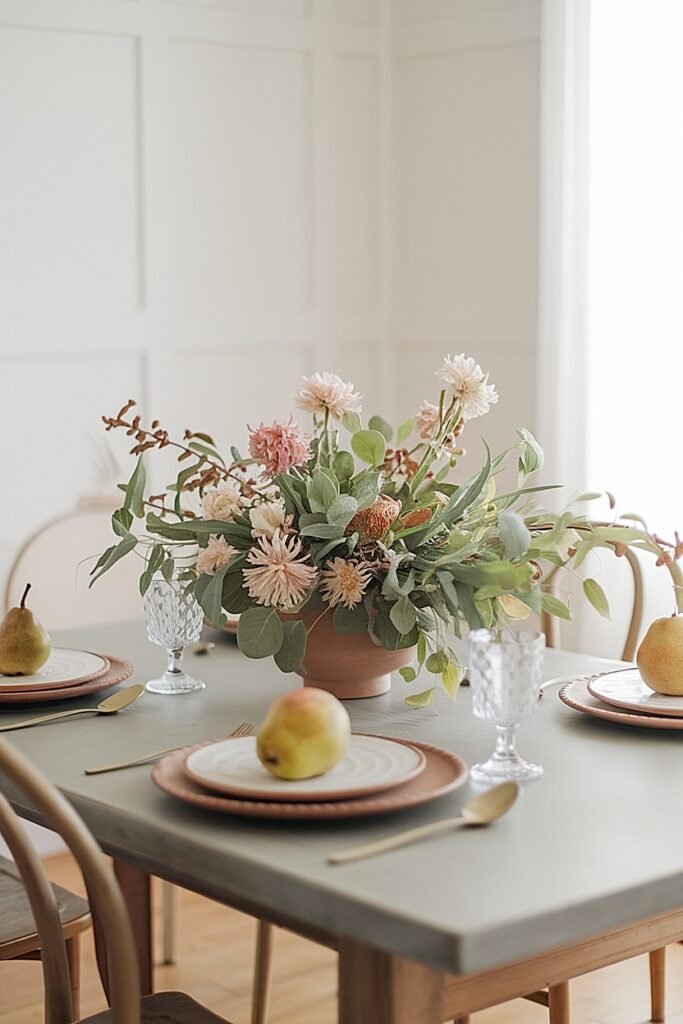
1. Small Bosc Pear Beside the Bowl on the Table Surface One whole small Bosc pear placed directly beside the sage-and-aster arrangement bowl on the table surface. No cutting, no preparation. The golden-green pear skin sits in the same cool-warm autumn tonal range as the sage grey-green and the amber grain if wheat is included. At close dining range, the pear.
2. Three Small Pears Around the Base of the Arrangement Three small Seckel or Bartlett pears placed around the base of the sage-and-aster bowl on the table surface, one on each side and one at the front. The pears create a ring of autumn harvest character at table surface level that frames the floral display above it. The arrangement reads.
3. Pear, Sage Bundle, and Single Aster Stem as a Table Corner Detail One small pear plus three sage sprigs gathered with jute twine plus one aster stem in a water pick, placed as a grouped still life at one table corner rather than a centered arrangement. No bowl required for the pear and sage. The water pick keeps the aster fresh. The.
4. Sliced Pear on a Wooden Board With a Small Sage and Aster Vessel A small wooden cutting board with two or three pear slices fanned beside a small sage-and-aster bud vase as a combined food-and-flower table element. The pear slices, the sage aroma, and the aster color together create a multi-sensory table detail at the food-and-flower intersection. The pear slices are meant to.
5. Miniature Pear Tucked Into the Arrangement Bowl Alongside the Flowers One very small whole pear, the kind sold in decorative autumn varieties, pressed into the gravel base of the wide sage-and-aster bowl alongside the flower stems. The pear stem extends upward. The fruit body sits at the same level as the flower bases. From above, the miniature pear visible among.
Conclusion
Sage and asters make people stop. Not because the arrangement is large or dramatic. Because it smells like an October garden and looks like someone knew what they were doing.
Grey-green sage at the outer vessel edge, asters filling the center, a dark bowl, and one candle beside it. That is all this requires.
The pear on the table beside the bowl is free. The sage might be in the garden right now. The asters cost five dollars. Fall decorating does not get more specific than this for less effort.
This website contains affiliate links, and some products are gifted by the brand to test. As an Amazon Associate, I earn from qualified purchases. Some of the content on this website was researched and created with the assistance of AI technology.