This website contains affiliate links, and some products are gifted by the brand to test. As an Amazon Associate, I earn from qualified purchases. Some of the content on this website was researched and created with the assistance of AI technology.
Key Takeaways
- Buy blooms in bud or barely open so they peak around the holiday instead of before it.
- Tuck small displays into a back corner. Your dresser still has to work as a dresser.
- Keep flowers away from the fruit bowl. Ripening fruit gives off ethylene, and carnations, roses, anemones, alstroemeria, and scabiosa are all sensitive to it.
- Chrysanthemums are toxic to cats, dogs, and horses, per the ASPCA. Alstroemeria gets a non-toxic rating.
- Skip real flames. The U.S. Fire Administration advises against lit candles in bedrooms, so go with battery tapers.
- Protect the wood finish with a sealed coaster or fitted liner under every vessel.
Creating Christmas white flower arrangements for a bedroom dresser is one of my favorite small holiday projects, mostly because nobody else ever thinks about that surface. The tree gets the attention. The mantel gets garland. Meanwhile the dresser, the first thing you see when you wake up on a dark December morning, sits there holding a phone charger and a pile of receipts.
I keep coming back to white for this spot. It works with walnut, painted oak, and glossy lacquer alike, it glows softly under low lamplight, and it calms a room down at the exact time of year when everything else gets loud. Below, I walk through eight flowers I trust for the job, plus the containers, placement, and care habits that keep each one fresh past Christmas morning.
Choosing white Christmas flowers for a bedroom dresser should feel peaceful and practical. Compare five distinct arrangements by flower type, container, available space, and maintenance. Discover which designs suit narrow dressers, guest rooms, or everyday storage while keeping furniture protected, personal belongings accessible, and the holiday atmosphere beautifully understated throughout.
Which White Christmas Flower Arrangement Suits Your Bedroom Dresser?
Choosing white Christmas flowers for a bedroom dresser should feel peaceful and practical. Compare five distinct arrangements by flower type, container, available space, and maintenance. Discover which designs suit narrow dressers, guest rooms, or everyday storage while keeping furniture protected, personal belongings accessible, and the holiday atmosphere beautifully understated throughout.
| Arrangement style | Best dresser | Flowers and container | Practical care tips |
|---|---|---|---|
Quiet romanceSpray rose accent | Narrow dresser corner | White spray roses; slim ceramic vase | Leave jewelry and daily essentials accessibleKeep containers stable and protect furniture. |
Long lastingWhite mum cluster | Traditional large dresser | Button mums; low stoneware bowl | Choose a wide base; check pet accessKeep containers stable and protect furniture. |
Graphic modernAnemone contrast | Modern dresser | White anemones; charcoal vessel | Use a few blooms for visual impactKeep containers stable and protect furniture. |
Easy careDried statice display | Moisture-sensitive surface | Dried white statice; small ceramic crock | Water-free; keep dry and away from heatKeep containers stable and protect furniture. |
Elegant welcomeLisianthus and silver | Guest bedroom dresser | White lisianthus; pale gray vase | Limit ornaments and consider fragranceKeep containers stable and protect furniture. |
Resources:
- 15 Christmas Bedroom Decorating Ideas | HGTV
- 20 Christmas Flower Arrangements – Winter Holiday Flower Arranging Ideas
- 26 Christmas Decor Ideas to Make Your Whole Home Feel Festive | Homes and Gardens
- White Botanicals | Pottery Barn
How to Arrange White Spray Roses on a Narrow Christmas Bedroom Dresser
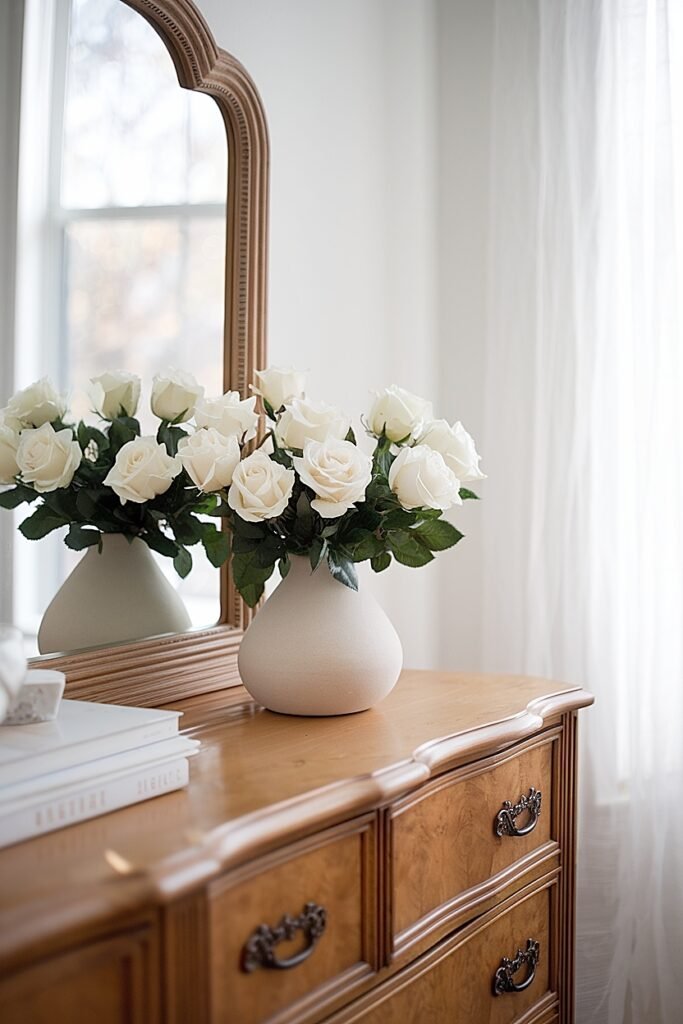
A narrow dresser gives you maybe ten inches of depth to play with, and half of that is already spoken for. That’s why I reach for spray roses here. Each stem branches into several small blooms, so one or two stems deliver the fullness of a bouquet without the bulk.
Standard long-stem roses tend to look top-heavy on a skinny surface. Spray roses stay in proportion.
The real decision is the vase. I like a slim ivory stoneware bud vase or tall cylinder, roughly six to eight inches high. Stoneware carries some weight at the base, so it won’t tip when someone grabs their keys in the dark, and ivory has a warmth that bright white glaze often lacks next to wood.
Water is the enemy of a dresser finish. Even a glazed vase sweats when the water inside is colder than the room, and that faint ring shows up a week later. I found this out on a walnut piece I still feel bad about. A cork-backed or rubber coaster ends the problem for good.
My method is simple. Strip any leaves that would sit below the waterline. Recut each stem with sharp clippers, because dull blades crush stems and slow water uptake, according to Oklahoma State University Extension. Drop three to five stems into fresh water mixed with flower food, let the tallest bloom stand about one and a half times the vase height, and set the whole thing toward the rear so the mirror and front edge stay clear.
- Select white spray roses with healthy buds rather than buying one oversized bouquet.
- Position the arrangement near a back corner to preserve space for daily belongings.
- Use a slim ivory stoneware vase with a waterproof coaster beneath it.
The same white palette works beyond the bedroom, and my guide to Christmas flower decorating for a holiday brunch shows how I carry it to the table. Know someone who always asks how your place looks so put together in December? Send them this post.
The anemone section comes next, and it holds a pairing mistake I see all the time, so keep scrolling.
Ideas for a Winter White Anemone Arrangement on a Modern Bedroom Dresser
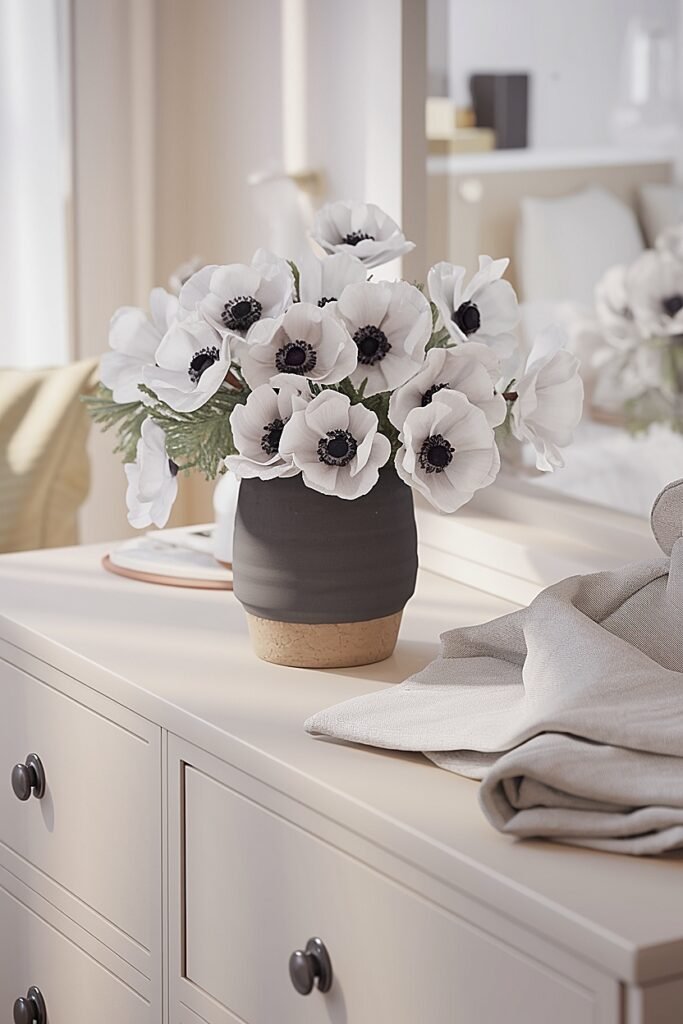
White anemones are the flower I’d grab if someone handed me one vase and told me to make a modern dresser look intentional. The petals are clean white. The center is an inky button ringed with black stamens, so you get contrast inside one flower.
Modern furniture usually means flat fronts, slim pulls, and a low profile. Fussy arrangements fight that. Anemones don’t, because their shape is simple and graphic.
They do ask for some care up front. North Carolina State University’s floriculture team recommends buying anemones in bud, with only a little color showing, and conditioning them in warm water with floral preservative. They’re also highly sensitive to ethylene, and NC State specifically names chrysanthemums as something to keep them away from. Planning mums elsewhere on that same dresser? Pick one or the other.
Heat makes them droop, per the same guidance, so keep them clear of sunny windows and radiators. A cool bedroom is a gift here.
Seven ideas I’d actually use:
1. Black matte vase, anemones only. Six or seven stems in a narrow black cylinder echo those dark centers and turn the piece into a two-tone study. Stagger heights by an inch so the faces don’t line up like buttons on a coat.
2. Short stems in a concrete bowl. Cut stems to three or four inches and gather them in a small cement bowl. It sits low under the mirror and adds a raw gray texture that suits a minimalist bedroom.
3. Anemones with silver dollar eucalyptus. A few sprigs soften the edges with dusty blue-green leaves. The combination feels wintry for all of December, not just Christmas week.
4. Twin bud vases on a long dresser. Split the flowers between two matching bud vases at opposite back corners. The center stays free for a jewelry tray or framed photo, and the symmetry fits clean modern lines.
5. Anemones beside a flameless taper. Set a battery-operated white taper in a brass holder next to three blooms. You get candlelight without the risk, and fire safety officials prefer flameless candles in bedrooms anyway.
6. A jute-tied bundle in clear glass. Wrap five stems with natural twine just above the waterline and stand them in a short tumbler. The twine adds texture, so an all-white display doesn’t feel sterile against glossy lacquer.
7. Bare birch or frosted branches. One tall birch twig or white-painted branch gives height while two or three blooms sit low near the rim. It looks like a winter walk brought indoors.
Smaller dressers call for an even smaller vessel, and the sugar bowl trick below might be the easiest idea in this whole post.
DIY Ideas for a White Carnation Christmas Dresser Arrangement in a Sugar Bowl
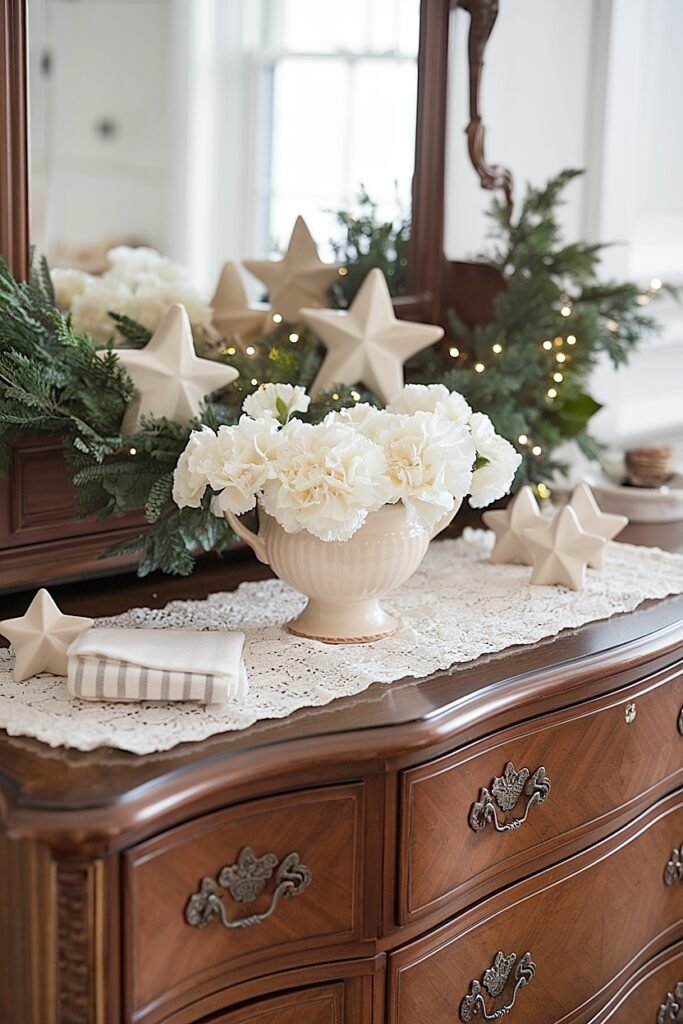
I picked up my favorite sugar bowl at an estate sale for four dollars. Bone china, thin gold rim, lid long gone. It has held carnations on my dresser every December since.
A sugar bowl forces restraint. The opening is small, the walls are short, and it takes up about as much room as a coffee mug. Perfect for a crowded top.
Carnations suit it because they last. With decent care they often hold two to three weeks, so a bowl you fill in mid-December can still look fresh on New Year’s Day. Oklahoma State lists them as ethylene-sensitive too, so that fruit bowl rule counts double here.
Yes, carnations have a reputation. People picture dyed ones jammed into gas station bouquets. Fresh white blooms packed tight in china look nothing like that. They look like a snowball with ruffled edges.
You won’t need floral foam. Make a small grid across the bowl’s opening with clear tape, or ball up a palm-sized piece of chicken wire inside, and the stems stay exactly where you put them. Then try one of these:
1. Holly and white carnations. Cut five or six carnations down to about four inches and tuck two short holly sprigs around the edge. Glossy leaves and red berries say Christmas without a second flower. Let the holly lean out past the rim a bit so the shape feels relaxed.
2. A tight dome with silver ribbon. Fill the bowl with seven or eight blooms trimmed to one height so the heads form a single mound. Tie thin silver ribbon around the base for a gift-wrapped finish.
3. Carnations and snowberry. Add two stems of white snowberry and let the round berries poke above the petals. They break up all that density and give the eye something different to land on.
Ranunculus brings a completely different shape, and the next section explains why the bowl matters as much as the bloom.
How to Create a White Ranunculus Dresser Bouquet with a Scalloped Bowl
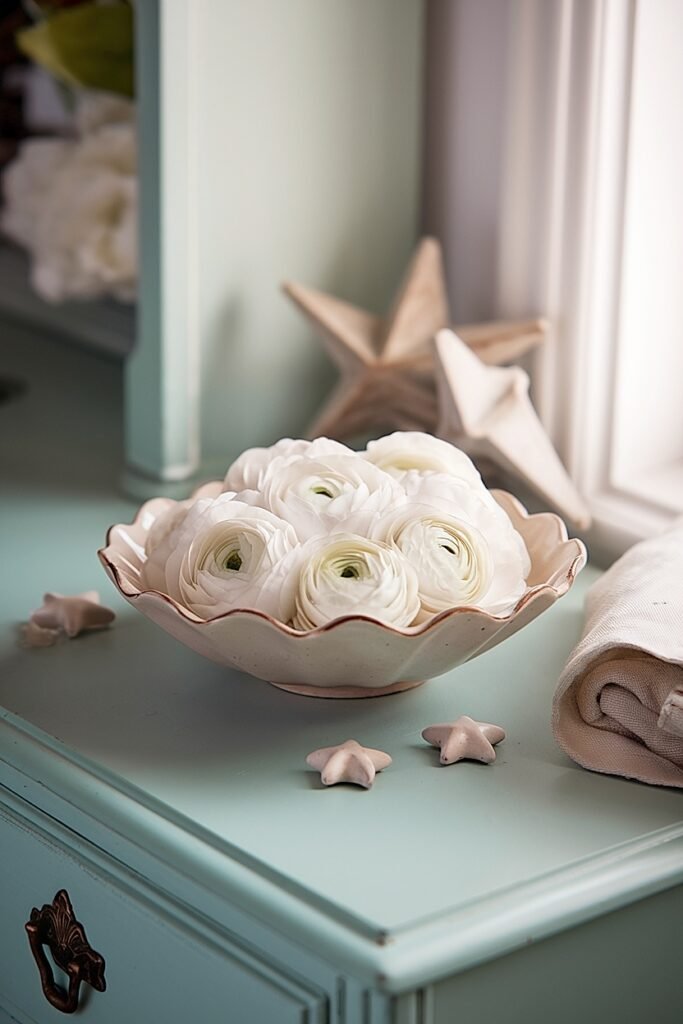
If carnations are snowballs, ranunculus are rosettes. Every bloom carries layer after layer of tissue-thin petals, tightly cupped at first and slowly loosening through the week.
In an all-white piece, that layering supplies the depth. Shadows fall between petals. You get texture with zero color.
A scalloped bowl is the natural partner. Its wavy rim repeats the curve of those petals, so container and flower look like they came as a set. A straight-sided cylinder can work, though it’s harder to make ranunculus look relaxed in one.
People miss this one. Lots of decorative ceramic bowls are glazed only on the outside, or the glaze has hairline crazing, and water creeps through over a few days. A fitted plastic or glass liner tucked inside stops that cold. Nobody sees it once the blooms go in.
Buy ranunculus when the buds are just beginning to open, the stage Oklahoma State recommends, and expect roughly seven to ten days of vase life. Cut stems short, somewhere between three and five inches. Start with the biggest bloom slightly off center, then fill around it, keeping the outline round and never letting the top climb higher than the bowl is wide.
- Feature several white ranunculus blooms with their naturally layered petals.
- Use a shallow ceramic bowl with a fitted watertight insert.
- Keep the flower arrangement low and rounded to prevent crowding.
The lisianthus ideas coming up get more playful, because ornaments join in.
Creative Ways to Pair White Lisianthus with Matte Silver Christmas Ornaments
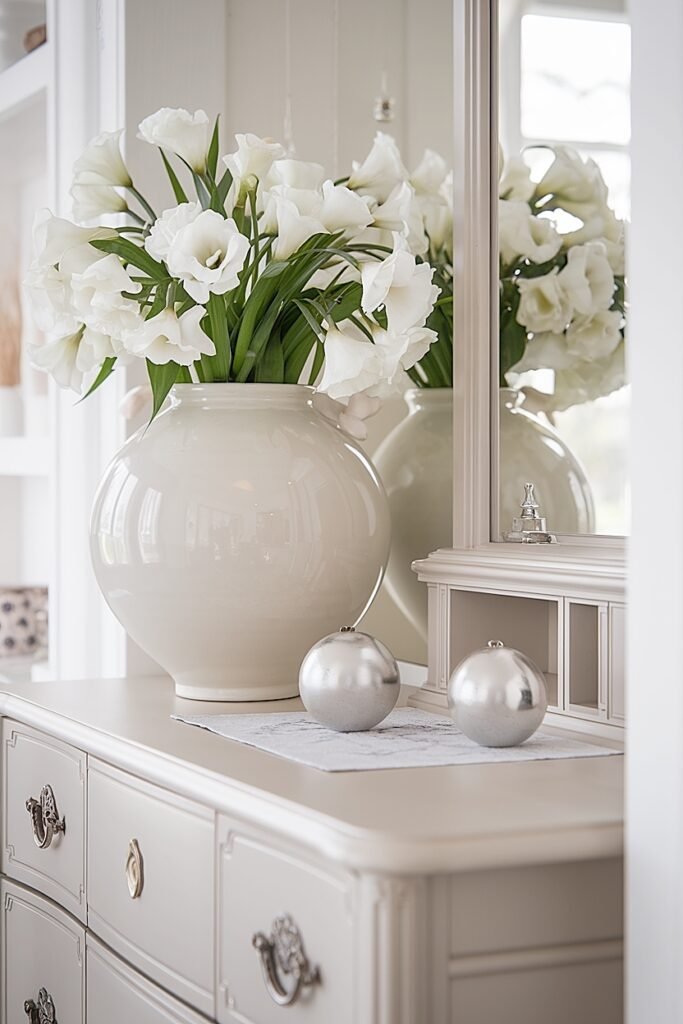
Lisianthus looks fragile. It isn’t. The ruffled, cup-shaped blooms land somewhere between a rose and a poppy, and each stem usually carries several buds at different stages.
So the display keeps changing as new flowers open, which makes it good company for ornaments. The baubles stay put while the blooms evolve.
Finish matters more than you’d guess. Shiny ornaments act like tiny mirrors, bouncing hot spots of lamplight, and those flashes steal focus from soft petals. Matte or satin silver just glows.
Size is the other half of it. A typical tree ornament runs two to three inches across, close to an open lisianthus flower, so keep them similar. Once ornaments get much bigger than the blooms, you’ve built an ornament display with a few flowers stuck in it. To give a bauble a stem, thread floral wire through its hanger loop, twist it tight, and tape the tail to a wooden pick.
Five pairings I like:
1. Baubles nestled at the base. Rest three small matte ornaments around the rim of a wide vase, right where stems meet the water. They anchor the design and hide the mechanics at once.
2. A single ornament as the focal point. Wire one larger bauble onto a pick and set it in the middle of the bouquet. It plays the role a focal flower normally would, and it works best after most buds have opened.
3. Ornaments dangling off the rim. Tie three to five tiny baubles onto silver wire of different lengths, then hook them over the lip of a ceramic vase. They catch the lamp and sway a little when the heat kicks on.
4. A silver tray grouping. Set the vase on a small mirrored or silver tray and scatter a handful of mini ornaments around it. The tray corrals everything into one footprint, so the dresser looks styled instead of cluttered.
5. Stems and baubles in low foam. Soak a block of floral foam, set it in a shallow bowl, and insert lisianthus and wired ornaments at angles. Press a finger into the foam daily to make sure it hasn’t dried out.
Lamps change everything about placement, so if your dresser has one, the alstroemeria advice ahead deserves a look.
Easy Ideas for a White Alstroemeria Christmas Arrangement Near a Dresser Lamp
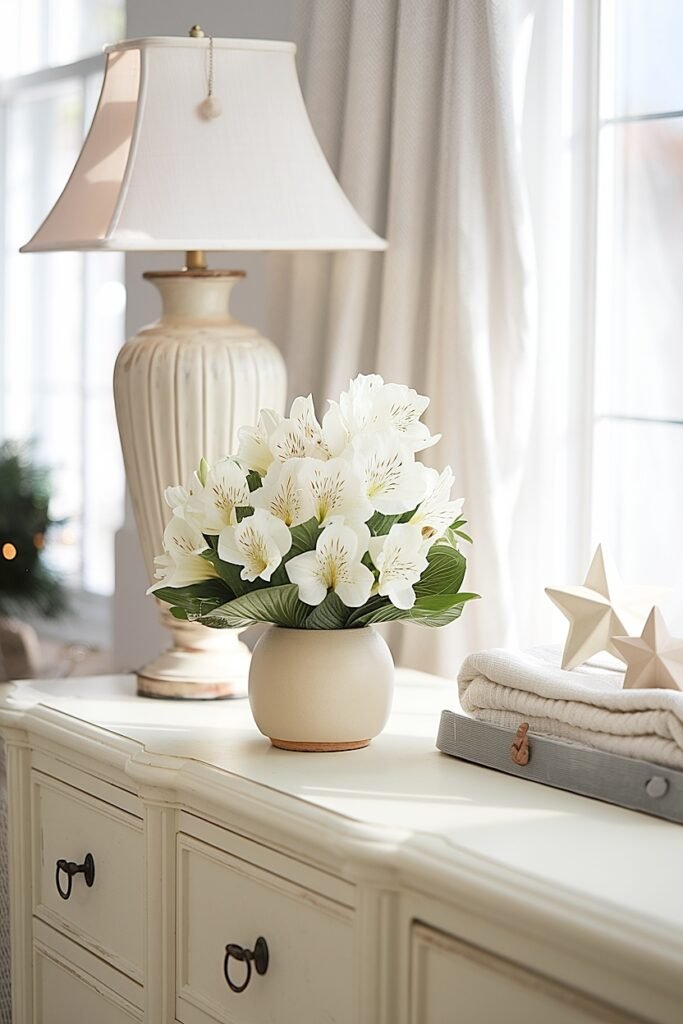
Most bedroom dressers have a lamp. It’s often the only light on at night, which makes the area right beside it the most visible spot on the surface.
Alstroemeria handles that spot well. Each stem branches into a cluster of small lily-like blooms, and white varieties usually show fine flecks or streaks inside the petals that come alive under warm light.
Heat is what you need to think about. Energy Star notes that incandescent bulbs release 90 percent of their energy as heat, which turns an old-style bulb a few inches from your flowers into a tiny space heater. LEDs waste far less energy that way. Still using an incandescent bulb? Switch to LED or give the vase more breathing room.
Two more things work in alstroemeria’s favor. It often lasts up to two weeks in a vase, and the ASPCA lists it as non-toxic to dogs, cats, and horses. In a house where the cat claims the pillow every night, that second point is huge.
Three easy setups:
1. A brass bud vase at the lamp base. Three or four short stems inside a little brass vessel catch the lamp’s warm glow on the metal. Pull off every leaf below the waterline, since submerged foliage breaks down and feeds bacteria.
2. Alstroemeria with preserved greenery. Mix four stems with a couple of sprigs of preserved eucalyptus or dried lunaria in a short glass. Preserved stems won’t wilt near a warm shade, and keeping it low lets the light spill across the dresser top.
3. A loose handful in a cream pitcher. Drop five or six stems into a small pitcher set just outside the shade’s edge. Florets keep opening over several days, so the pitcher looks fuller by the weekend.
Pet owners especially should read the chrysanthemum section next, since that flower comes with a real warning.
How to Make a White Chrysanthemum Christmas Dresser Display with Linen
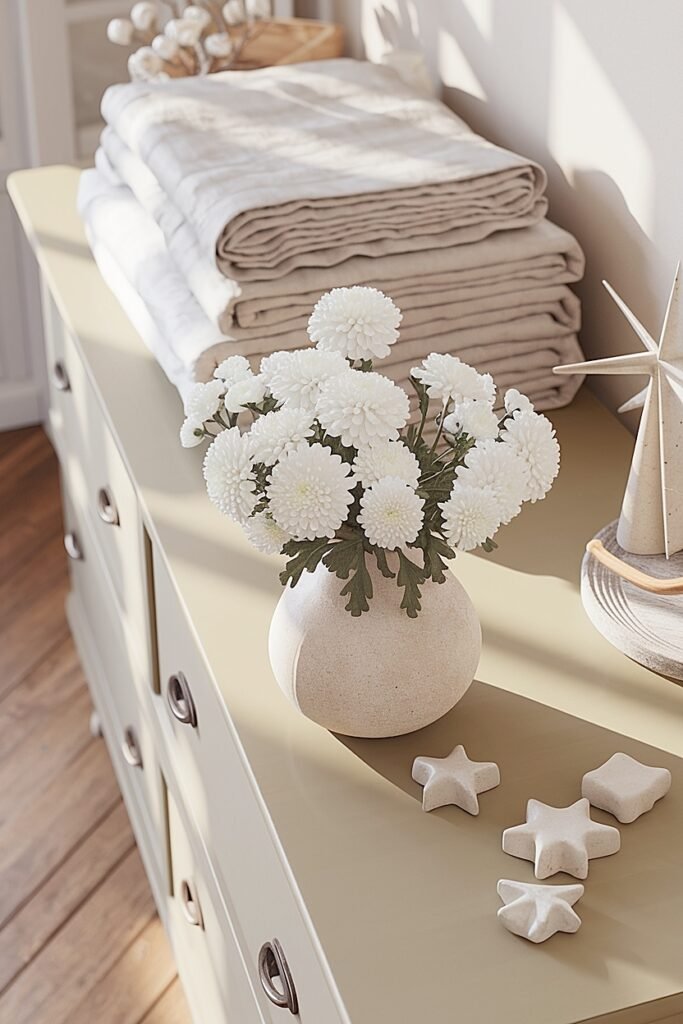
White button mums are the workhorse flower nobody brags about. Small, round, tidy, tough.
Many mums last around two weeks in a vase, some closer to three. Button types stay compact, too, with no sprawling petals or flopping heads, which is exactly what a dresser top wants.
Linen is what turns a jar of mums into a styled display. A square of natural oatmeal linen folded under the vase, or a short runner along that end of the dresser, adds softness and a homespun texture that white flowers on bare wood can’t manage alone.
Moisture is the trade-off. Oklahoma State points out that moving flowers from a cool place into a warm one causes condensation, and a vase of cold tap water does the same thing in a heated bedroom. Linen soaks it up and stains. Slide a waterproof coaster or small glass plate between vase and fabric, and always top up the water at the sink.
Now the part I won’t skip. The ASPCA lists chrysanthemums as toxic to dogs, cats, and horses. They contain pyrethrins and sesquiterpene lactones, and signs include vomiting, diarrhea, drooling, poor coordination, and skin irritation. Bedrooms are where pets nap. If your dog or cat explores furniture, I’d trade mums for alstroemeria. And remember the earlier anemone warning: these two shouldn’t share a surface.
- Use white button chrysanthemums for a compact winter arrangement.
- Pair the flowers with neatly folded natural linen, keeping fabric away from moisture.
- Discuss chrysanthemum toxicity when recommending flowers for pet-owning households.
One final flower remains, and it’s my pick for the tiniest dressers, so stick around for scabiosa.
Simple Ways to Arrange White Scabiosa Flowers on a Small Dresser
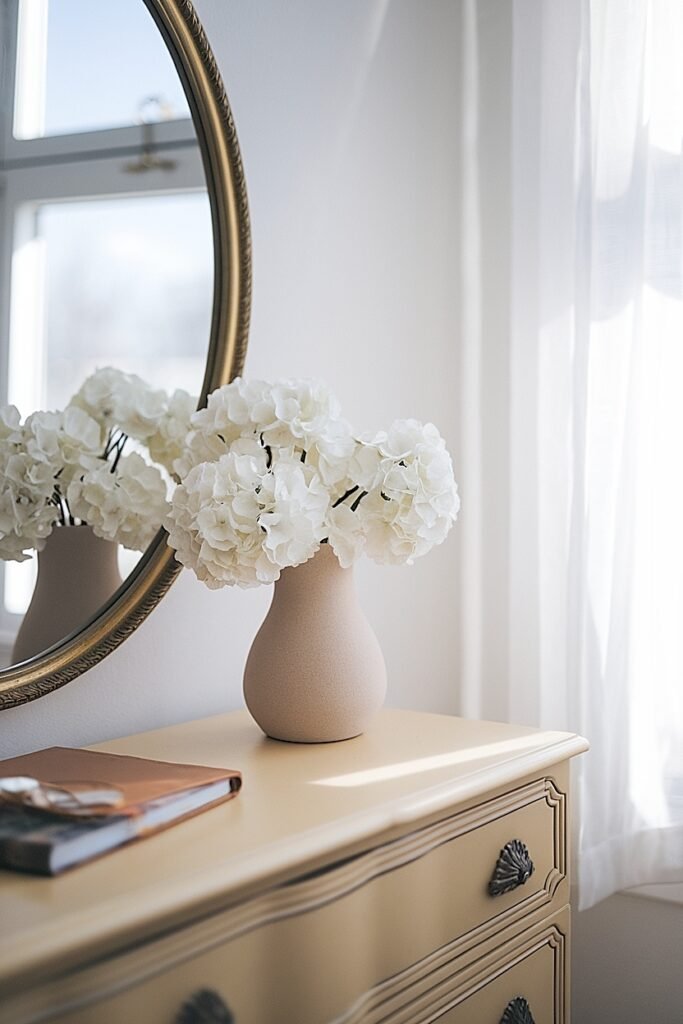
Scabiosa, sometimes called pincushion flower, gets overlooked at Christmas. You won’t always find it sitting in a grocery store bucket, so calling your florist ahead saves a wasted trip.
It’s worth the call. Each bloom has a domed, pin-studded center ringed with frilly white petals, held up on thin, wiry stems. Even a small handful feels airy.
That airiness is the whole point on a compact dresser. Fuller flowers like ranunculus or carnations take up visual space. Scabiosa lets you see through it to the wall or mirror behind, so a crowded top doesn’t feel heavier.
Care is easy, with one note. Oklahoma State lists scabiosa as ethylene-sensitive and suggests cutting it at the half-open stage. Buy stems partly open, keep them far from fruit, and change the water every couple of days.
1. A ribbon-tied ceramic jar. Put five stems at four or five inches into a little matte jar, then knot a narrow white or silver ribbon at the neck. It finishes the look like a small wrapped gift.
2. Scabiosa with waxflower. Tuck a few sprigs of white waxflower between the scabiosa in a bud vase. Those tiny star-shaped blooms fill gaps without competing, and the mix looks layered instead of sparse.
3. One stem in an apothecary bottle. On a really small dresser, a single open scabiosa in a vintage glass medicine bottle is plenty. Its curving stem gives the bottle a bit of personality.
Before you head to the florist, the conclusion pulls everything together into a quick game plan.
Conclusion
The dresser is a small stage, and that’s what makes it fun. You don’t need armloads of flowers. You need the right bloom, a container that suits the furniture, and a spot that leaves room for your morning routine.
Spray roses handle narrow tops. Anemones love modern pieces. Carnations outlast the holiday. Ranunculus and lisianthus bring ruffles and softness, while alstroemeria sits happily by the lamp and stays safe around pets, which is more than I can say for mums. Scabiosa rescues the smallest surfaces. Whatever you choose, keep the water fresh, the fruit bowl far away, and the candles battery-powered. Then enjoy waking up to something white and quiet on those dark December mornings.
This website contains affiliate links, and some products are gifted by the brand to test. As an Amazon Associate, I earn from qualified purchases. Some of the content on this website was researched and created with the assistance of AI technology.