This website contains affiliate links, and some products are gifted by the brand to test. As an Amazon Associate, I earn from qualified purchases. Some of the content on this website was researched and created with the assistance of AI technology.
Key Takeaways
- Burgundy fall flowers in candlelight reveal tonal depth — near-black inner zones opening to deep wine-red outer petals — that is visible only at intimate dining close range
- The burgundy-and-brass or burgundy-and-copper combination is one of the strongest fall dining table pairings: warm metal tones and deep wine-red exist in the same warm spectrum without competing
- At an intimate two-person dining table, one burgundy stem in a small copper or brass vessel is a complete arrangement — the close viewing distance does all the work that volume and scale do at larger tables
- Burgundy without a tonal partner reads as heavy and somber; pairing it with a single plum, mauve, or rust element creates tonal movement that prevents the arrangement from feeling static
- Matte black vessels create the highest contrast with burgundy blooms of any vessel option: the arrangement reads as graphic and bold even with minimal stem counts
- Dried grasses alongside burgundy flowers eliminate the arrangement’s visual weight by creating transparent texture that softens the dense burgundy bloom without changing its color contribution
Styling burgundy fall flowers for intimate autumn dining is the arrangement project that consistently produces the most atmosphere per dollar of any fall flower combination I know. Burgundy is not just a fall color. It is a dining color. Something about the deep wine-red tone at candlelit dinner table proximity creates warmth and enclosure that lighter, brighter fall colors do not — the same way a room painted in a deep warm hue reads as more intimate than the same room in a pale neutral. The burgundy flower at a candlelit autumn dinner does exactly what that deep wall paint does to a room.
The intimate dining context specifically rewards burgundy in ways that outdoor party or large gathering contexts do not. At close dining range, eighteen to thirty inches from a seated guest, burgundy fall flowers reveal their full tonal complexity in low light. Ball dahlias in deep burgundy have a near-black center at the tight inner petal zone that gradually opens to rich wine-red at the outer petals. Chrysanthemums in deep claret show a warmth shift between the inner and outer bloom zones. These details are invisible from a distance. At intimate dining close range, they are the entire point.
Use this quick color-and-placement guide when styling burgundy Fall Flowers for intimate autumn dining. It helps readers choose flower colors, table accents, container styles, and practical placement details without overthinking the design. The goal is simple: a table that feels warm, pretty, comfortable, and easy to enjoy during dinner.
| Design Choice | Best Option | Why It Works | Easy Styling Tip |
|---|---|---|---|
| Main Burgundy Fall Flowers | Dahlias, mums, carnations, zinnias | They bring rich wine color, strong shape, and cozy autumn depth. | Use one dramatic bloom, then repeat smaller burgundy flowers nearby. |
| Soft Accent Colors | Cream, mauve, rust, taupe | These shades keep burgundy from feeling too dark or heavy. | Add cream flowers near the darkest blooms for instant balance. |
| Container Style | Low ceramic bowl or short matte vase | A low vessel keeps the table practical and conversation-friendly. | Choose a container wider than it is tall for easier arranging. |
| Table Pairing | Linen napkins, warm plates, brass flatware | Soft texture and warm finishes make burgundy feel elegant. | Repeat burgundy once in a napkin tie or place card detail. |
| Dining Comfort | Low clusters with open gaps | Guests can see each other, pass food, and enjoy the flowers. | Leave empty space near serving bowls before adding more blooms. |
Resources:
- 50 Best Fall Flowers for Your Autumn Garden
- Is This the Longest Lasting Cut Flower? Perhaps. But, Beware.
- Flower Arranging 101 – Centerpiece Design Basics – Floranext – Florist Websites, Floral POS, Floral Software
- Vase Life Study Results of Roses, Alstroemeria, and Chrysanthemum using FloraLife® Flower Food – FloraLife
How to Style Burgundy Fall Flowers in a Low Dining Table Centerpiece
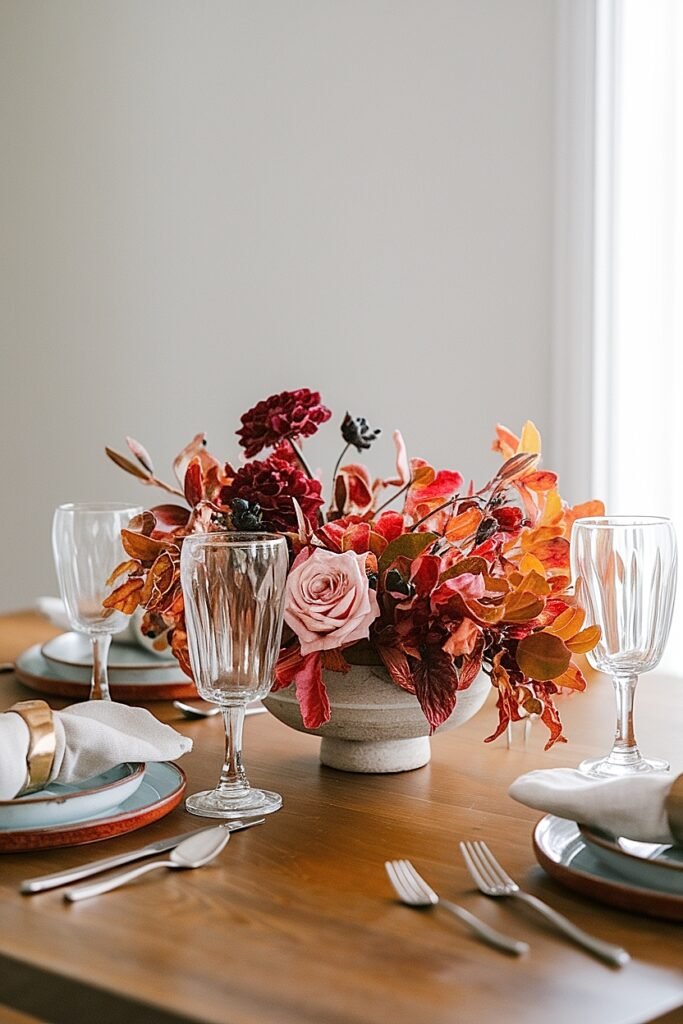
Low is especially important for burgundy fall flowers at a dining table.
In good ambient light, burgundy is a vivid, visually present color that holds its own at any height. In candlelight or low-wattage dining room lighting — which is the specific context where burgundy fall flowers perform best — a tall stem arrangement creates a dark visual mass that reads as furniture rather than decoration. At rim-height or just-above-rim-height, the same flowers in candlelight create intimate pools of deep color at the table level where the light reaches them most effectively.
The low centerpiece technique for burgundy specifically: cut stems to two to four inches above the vessel rim. Press into gravel. Orient bloom faces outward at slight angles rather than straight up, because at the low angle of candlelight, faces angled outward catch and reflect more light than upward-facing faces in the same position. A single taper candle beside the low burgundy arrangement completes the candlelit intimate dining atmosphere in a way that no arrangement adjustment can replicate without the candle.
The vessel contrast choice is the second most important burgundy low centerpiece decision. Matte black, dark navy, deep forest green, or warm brass and copper: all of these create tonal depth around the burgundy blooms that light, neutral, or clear vessels do not provide. A burgundy dahlia in a clear glass jar at a candlelit table disappears. The same dahlia in a small black ceramic crock reads as the most vivid point of color on the entire table surface.
Round low vessels suit burgundy better than rectangular or linear ones. The round perimeter distributes bloom faces outward in all directions, which creates a 360-degree visual presence that linear arrangements lose by having a clear front face. At a round dining table or a square intimate dining table, the round burgundy arrangement reads as complete from every seated position.
For more on fall flower arrangements for small dining tables including compact bloom selection, vessel size constraints, and the edge-placement strategy for two-person tables, check out easy fall flower arrangements for small apartment dining tables. Share this with anyone planning an intimate autumn dinner. More ahead on the best burgundy flower varieties, metallic accents, and every other intimate dining technique.
What Are the Best Burgundy Fall Flowers for Cozy Two-Person Dining?
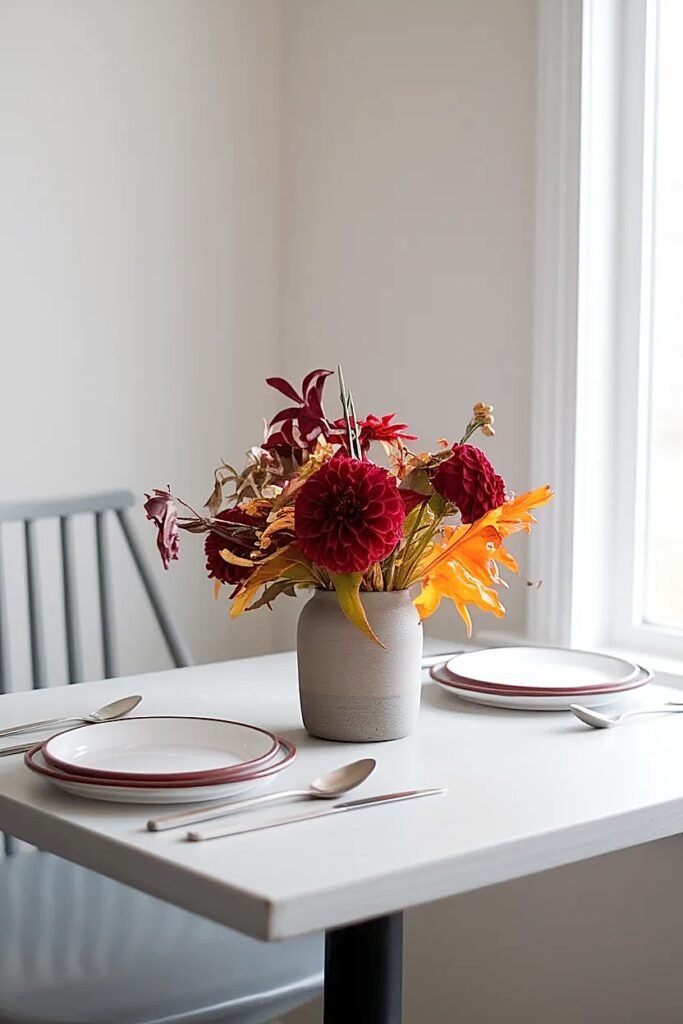
Two-person intimate dining has the most demanding bloom quality standard of any dining context. The stems are within arm’s reach. The blooms are examined at conversation distance. The fine detail of petal layering, center color graduation, and surface texture that distance viewing conceals is fully visible at the eighteen-inch span across a two-person dining table.
1. Deep Burgundy Ball Dahlias Ball dahlias in deep burgundy create the most sophisticated close-range intimate dining display available in any fall flower category. The tightly packed spherical petals create a gradual color transition from near-black at the inner bloom zone to deep wine-red at the outer petals, visible at conversation distance in the detail that makes this variety specifically suited to intimate scale. Available at farm markets from late.
2. Deep Claret Chrysanthemums Deep claret or wine-red pompom chrysanthemums at two-person dining close range reveal a color warmth that overhead grocery store fluorescent lighting completely conceals. In candlelight or warm incandescent dining room light, the claret tone shifts toward warm burgundy-red in a way that reads as specifically chosen for the occasion. The pompom’s dense rounded form creates a substantial focal presence from a single stem. Holds ten.
3. Burgundy Gomphrema Deep burgundy gomphrema ball stems create the most tactile, most three-dimensional close-range intimate dining display of any small-scale burgundy bloom option. The tightly packed ball structure has a texture quality visible and almost tangible at two-person dining distance that larger flat-faced flowers do not produce. One stem carries three to five ball heads, creating a multi-element arrangement from a single stem in a small vessel.
4. Deep Wine Anemones Deep wine or near-black anemones with their distinctive dark center ring create the most dramatically graphic burgundy bloom available for intimate dining. The flower’s visual character, a deep wine-colored outer petal ring surrounding a near-black center, creates a bold circular composition visible at close intimate range as a designed color relationship rather than a single monochromatic bloom face. One stem in a small brass or.
5. Burgundy Lisianthus Burgundy lisianthus provides the most layered petal complexity of any burgundy fall bloom choice. The multiple buds per stem open progressively, which means an arrangement built for Friday’s intimate dinner looks different and equally beautiful at Saturday evening’s. The ruffled bud stages, partially open mid-stage, and fully open bloom all exist on one stem simultaneously. At intimate dining close range, the petal ruffling and the.
More ahead on how metallic vessel choices change the visual and atmospheric character of any burgundy fall arrangement.
How to Use Burgundy Fall Flowers with Copper, Brass, and Matte Black Accents
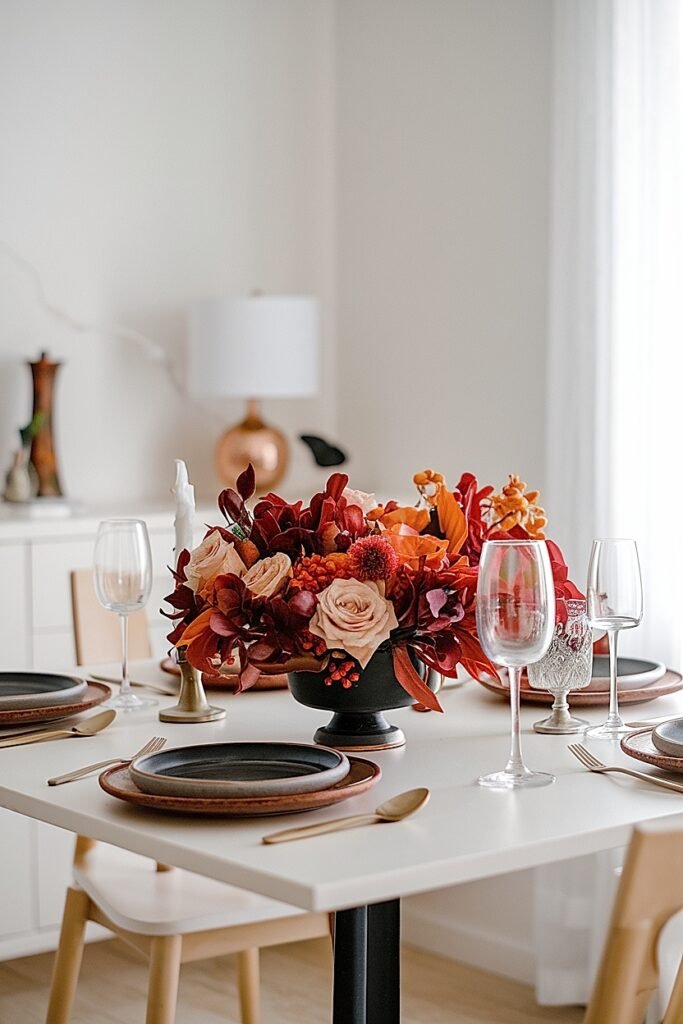
Copper and burgundy is one of the most specifically autumn pairing available in all of fall decoration.
Both sit in the warm-dark quadrant of the visual spectrum: copper’s warm metallic orange-brown and burgundy’s deep wine-red share tonal warmth without sharing tone. In candlelight, copper vessels glow with a warmth that amplifies the burgundy bloom’s own warm undertones in a way that cool metals like silver or chrome cannot. The combined warm glow of a copper vessel and three burgundy dahlia stems in candlelight creates more atmospheric presence than either element achieves in neutral lighting or in isolation.
Brass reads warmer and more yellow-adjacent than copper, which creates a slightly different relationship with burgundy. Where copper echoes the red undertone in burgundy, brass’s golden warmth creates contrast within the warm spectrum, distinguishing the metal from the flower while both remaining clearly in the autumn palette. A brass bud vase with two deep burgundy gomphrema stems reads as designed precisely because the tonal distinction between the brass and the burgundy is visible even as both are warm.
Matte black is the cold metal equivalent for burgundy: not warm, but maximally contrasting. A matte black ceramic crock or matte black vessel with burgundy fall blooms creates the most graphically bold version of the burgundy dining arrangement, where the near-black vessel and the near-black inner petal zone of a ball dahlia create a dark-on-dark tone match at the bloom center and a burgundy-on-black contrast at the outer petals. This pairing reads as dramatic and considered in a way warm metal pairings do not.
More ahead on the specific positioning and stem count strategies that prevent burgundy arrangements from blocking the conversation at intimate dining tables.
Ways to Use Burgundy Fall Flowers Without Blocking Dinner Conversation
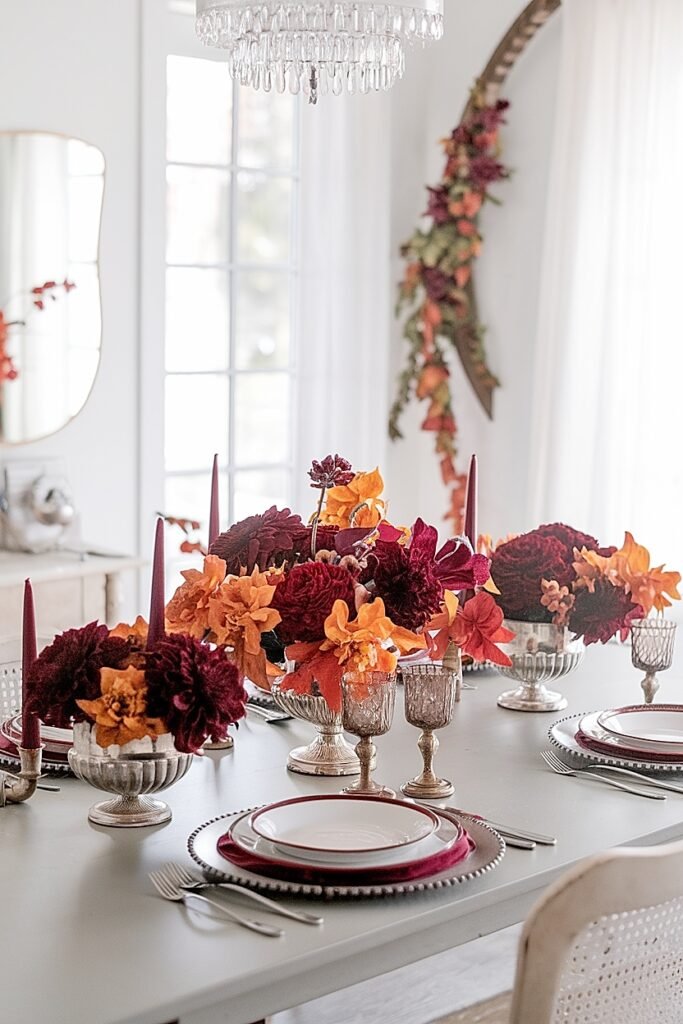
1. One Stem in a Matte Black Bud Vase at the Table Corner One deep burgundy bloom in a matte black bud vase at the table’s far corner from the two primary seated positions. The corner placement keeps the arrangement outside the visual field between the diners’ faces. The high contrast between matte black and burgundy creates visual.
2. Low Bowl with Three Burgundy Blooms at Rim Height Three burgundy bloom branches in a wide, low ceramic bowl with all stems cut to rim level, placed between the two place settings. The rim-height arrangement stays below the chin level of either diner, preserving eye contact while creating a burgundy color field visible from.
3. Two Matched Bud Vases at Opposite Table Corners One matte black bud vase with one burgundy stem at each far corner of the dining table. Both corners stay outside the conversational visual field between the diners. The two matched vessels create a symmetrical display framing the table. The burgundy at both corners creates.
4. Floating Burgundy Bloom in a Wide Shallow Dish One deep burgundy ball dahlia or anemone head floating face-up in a wide shallow dish with one inch of cold water at the table center. The flat-profile arrangement creates zero height. The floating bloom face visible between the plate positions reads as intimate and specifically.
5. Burgundy Bloom in a Clip-On Vessel at the Table Side A small clip-on vase with one burgundy stem attached to the table’s side edge rather than the flat top surface. The stem occupies zero table surface. The bloom is visible to both diners from their seated positions at the table’s outer edge. The arrangement requires.
More ahead on mixing burgundy with adjacent tones, which prevents the dark color from reading as somber or heavy.
Easy Ideas for Mixing Burgundy Fall Flowers with Plum, Mauve, and Rust
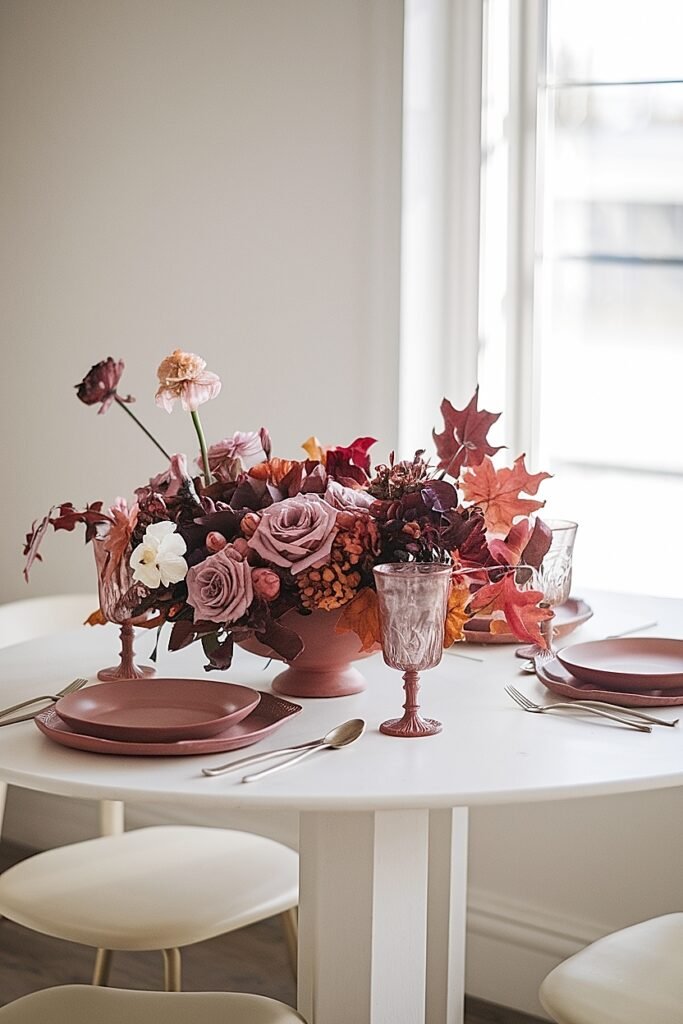
1. Burgundy Dahlia with One Plum Gomphrema Stem One deep burgundy dahlia stem plus one plum or deep purple gomphrema stem in a narrow brass or copper bud vase. The burgundy-to-plum tonal shift from the dahlia to the gomphrema creates a graduated warm-dark palette visible at close intimate dining range. Both tones exist.
2. Mauve Chrysanthemum with Dark Burgundy Lisianthus Two mauve or dusty-pink chrysanthemum stems plus one deep burgundy lisianthus stem in a short dark vessel. The mauve chrysanthemum reads as a lighter value version of the burgundy lisianthus, creating a tonal depth gradient from dark to light within the warm-red color family. The.
3. Rust Zinnia with Burgundy Gomphrema Two rust or burnt-orange zinnia stems plus two deep burgundy gomphrema stems in a low terracotta or copper vessel. The rust-to-burgundy color shift within the warm spectrum creates the most specifically autumn combination in this list. Both tones exist in the same warm-dark family but.
4. Plum and Burgundy Two-Stem Bud Vases at Each Setting One slim bud vase at each place setting, one holding a single burgundy bloom and one holding a single plum bloom. The matched-but-varied pair at each place creates a personal display of the warm-dark autumn palette at the most intimate possible scale. The two tones.
5. Burgundy, Mauve, and Copper Dried Arrangement Two burgundy preserved or dried flower stems plus two mauve dried strawflower stems plus one copper-toned dried grass stem in a small dark vessel. The three warm-dark tones create a color story entirely within the autumn warm spectrum. The dried materials hold indefinitely. No water.
More ahead on the neutral linen backdrop that allows burgundy to read at its maximum visual intensity.
How to Balance Dark Burgundy Fall Flowers with Soft Neutral Table Linens
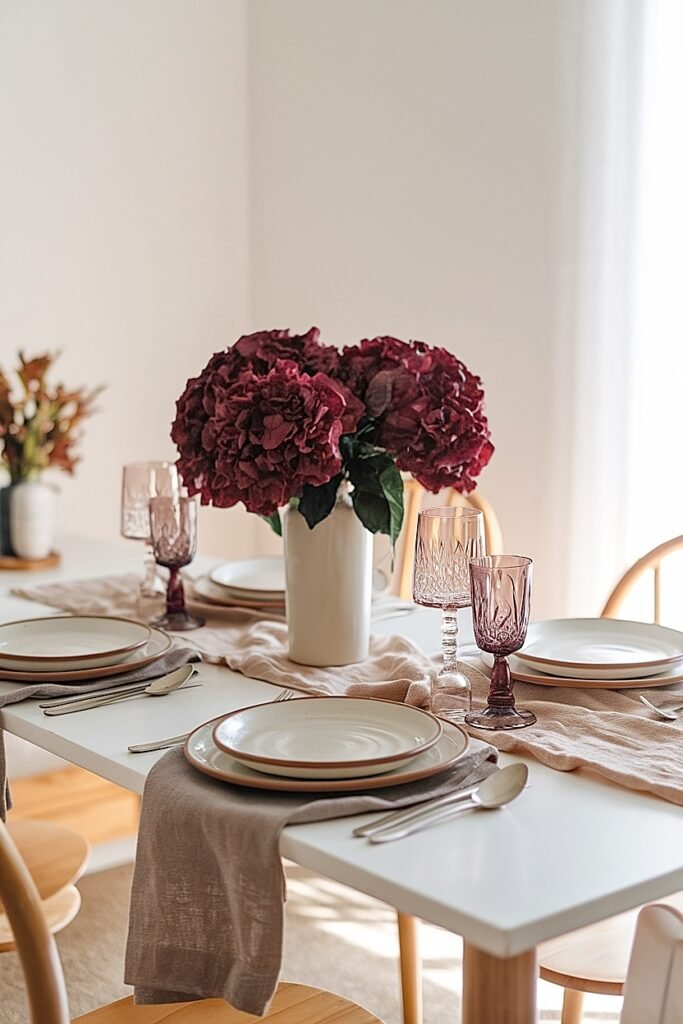
Burgundy is a demanding dinner table color in one specific way: the dark tone needs a neutral backdrop to read at full intensity.
Against a rich autumn linen, deep orange, warm ochre, or printed harvest pattern, burgundy fall flowers read as part of the overall warm palette rather than as a distinct focal element. The flower’s darkness gets absorbed into the visual richness of the setting. Against a soft neutral, ivory, warm white, soft stone, or pale linen natural tone, the same burgundy flower reads as the single most vivid color element on the table. The neutral creates the contrast that allows the burgundy to lead.
This is the principle behind high-end autumn table styling that uses rich flower colors alongside clean neutral table settings. The choice of an ivory or soft grey linen tablecloth when using deep burgundy flowers is not a safe, timid choice. It is the correct choice for maximizing the flower’s visual impact. The drama comes from the contrast between the minimal neutral ground and the single deep color, not from adding more rich tones to an already rich setting.
Candle color and holder material interact with burgundy and neutral linens in the same way. An ivory taper in a brass holder beside a deep burgundy arrangement on a pale linen tablecloth creates a warm-dark-on-neutral composition where each element is visible and legible. Add an autumn-colored plaid linen, a harvest-print runner, and a wicker charger to the same setting and the burgundy arrangement disappears into the visual complexity. Restraint in the textile choices amplifies everything at the flower level.
Ways to Layer Burgundy Fall Flowers with Dried Grasses for Soft Texture
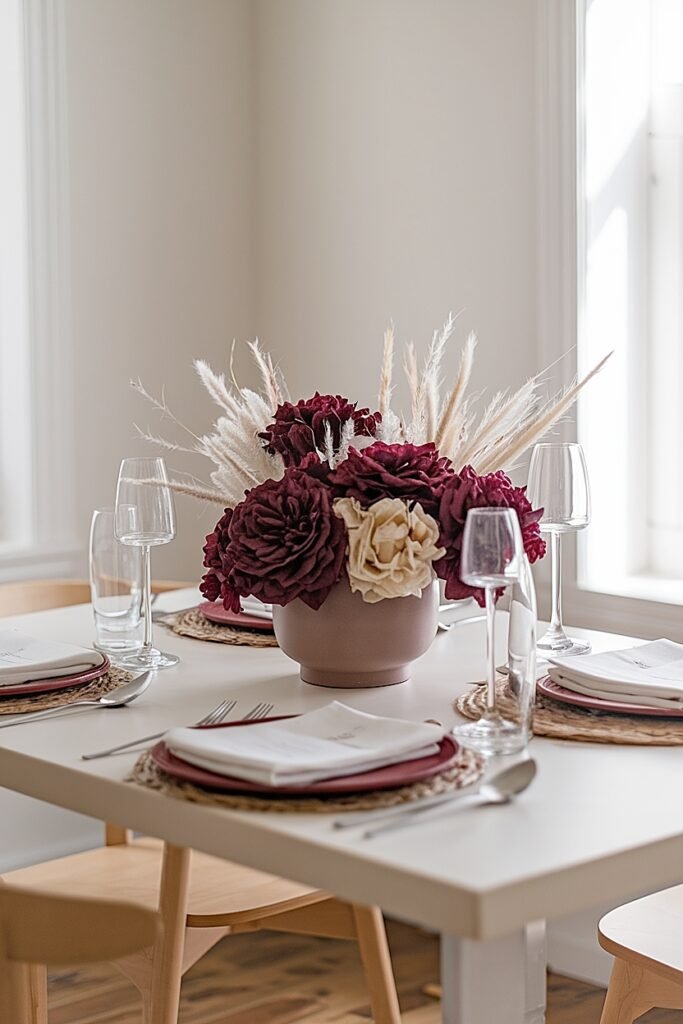
1. Burgundy Ball Dahlia with Dried Pampas Grass One burgundy ball dahlia stem plus one small pampas grass plume in a narrow copper or brass vessel. The pampas plume’s feathery pale texture creates a transparency contrast with the dense dark burgundy bloom. The plume’s movement in any air current adds life alongside the.
2. Burgundy Lisianthus with Dried Millet Spray Two burgundy lisianthus stems plus two dried millet spray stems in a dark ceramic short vessel. The millet’s upright grain structure creates vertical movement above the lisianthus bloom level. The dried amber-brown millet tone sits in the warm-dark autumn spectrum alongside the burgundy lisianthus. The.
3. Burgundy Gomphrema and Dried Panicum Grass Three burgundy gomphrema ball stems plus two stems of dried panicum or feather reed grass in a small weighted narrow vessel. The dried grass’s fine seed head texture creates a cloud-like surround around the graphic ball blooms. The contrast between the structured ball and the.
4. Burgundy Anemones with Dried Wheat and Grass Mix Two deep burgundy anemone stems plus one dried wheat stalk plus one dried ornamental grass stem in a small matte black or dark navy vessel. Three distinct materials, three distinct textures: smooth anemone petal, bristled wheat grain, and fine grass frond. The three-texture combination reads.
5. Dried Grass Base with Burgundy Bloom Accents Fill the vessel three-quarters full with dried pampas, millet, and panicum in a mixed dried grass composition, then insert two to three burgundy bloom stems through the dried grass mass so the blooms emerge at the top of the grass layer. The dried grass provides.
Conclusion
Burgundy fall flowers at an intimate autumn dinner table create something that most fall flower colors cannot: genuine atmospheric warmth that deepens with proximity rather than flattening at close range.
The close-range tonal complexity of a deep burgundy ball dahlia in candlelight is not visible in a grocery store display. It requires the right light, the right distance, and the specific intimacy of a two-person dinner to become the visual experience it was designed to be.
One stem. One copper or matte black vessel. One candle. That is the complete brief for an intimate autumn dining table that looks and feels as specific as October itself.
This website contains affiliate links, and some products are gifted by the brand to test. As an Amazon Associate, I earn from qualified purchases. Some of the content on this website was researched and created with the assistance of AI technology.