This website contains affiliate links, and some products are gifted by the brand to test. As an Amazon Associate, I earn from qualified purchases. Some of the content on this website was researched and created with the assistance of AI technology.
Key Takeaways
- Burgundy and cream create a warm tonal pairing within the same red-to-white spectrum: they contrast without competing because both tones share the same warm undertone quality
- The cream element amplifies the depth of the burgundy in any small dinner party arrangement: the lighter tone makes the darker one appear richer by comparison
- Cream mums and burgundy dahlias are the most cost-accessible burgundy-and-cream small dinner party combination at grocery store pricing, with both materials available from September through November
- Cream lisianthus’s progressive bud opening means one stem provides a full week of visual variety alongside stable burgundy blooms, making it the most durable cream companion for long small dinner party seasons
- Dried autumn foliage behind a burgundy-and-cream arrangement deepens the fall character of the display beyond what either flower alone creates
- Cream carnations are the most budget-accessible cream companion for burgundy fall flowers: dismissed unfairly as wedding-generic, they create genuine elegance in small dinner party close-range contexts
Styling burgundy and cream flower pairings for small fall dinner parties is one of the most forgiving and most reliably beautiful arrangements I have built across any season. The two colors share the same inherent visual logic: dark and light within the same warm-tonal family. Burgundy is the deep wine-red at the dark end. Cream is the warm off-white at the light end. Between them, they create every tonal relationship that a sophisticated arrangement requires without introducing any color outside the warm spectrum that might conflict with the dinner table setting or the autumn context.
What makes this specific to fall dinner parties is the contrast between the two elements at candlelit intimate dining distance. Cream flowers glow in candlelight in a way that cool white flowers do not. Burgundy at the same candlelit distance creates depth that absorbs and reflects the warm light differently at different petal zones. At eight inches from a lit taper candle, a cream dahlia and a deep burgundy gomphrema ball in the same small vessel create a visual display that outperforms arrangements ten times their material cost at a well-lit dinner party, precisely because the candlelight does more work than any arrangement can do in bright overhead light.
Use this quick pairing guide to choose the best burgundy and cream Fall Flowers for a small dinner party table. It helps readers match focal blooms, soft cream accents, filler flowers, and practical table size so the centerpiece feels rich, balanced, and dinner-friendly without taking over the whole table.
| Pairing Goal | Best Burgundy Flower | Best Cream Partner | Small Table Styling Tip |
|---|---|---|---|
| Full and cozy | Burgundy mums | Cream mums | Use a low bowl and cluster cream mums near the edges. |
| Soft and elegant | Wine zinnias | Cream dahlias | Place cream dahlias slightly off-center as the light focal point. |
| Romantic but seasonal | Dark dahlias | Cream roses | Add rust foliage so the roses feel autumnal, not bridal. |
| Budget-friendly volume | Burgundy carnations | Cream carnations | Group carnations in clusters for a fuller, more styled look. |
| Airy lightness | Burgundy dahlias | Cream asters | Tuck cream asters into gaps to brighten dark blooms softly. |
Resources:
- Selecting & Caring for Cut Flowers – Gardening | NC State Extension
- How to Care for Cut Flowers | Yard and Garden
- 50 Best Fall Flowers for Your Autumn Garden
- Flower Arranging 101 – Centerpiece Design Basics – Floranext – Florist Websites, Floral POS, Floral Software
How to Pair Burgundy Fall Flowers with Cream Mums for Small Dinner Parties
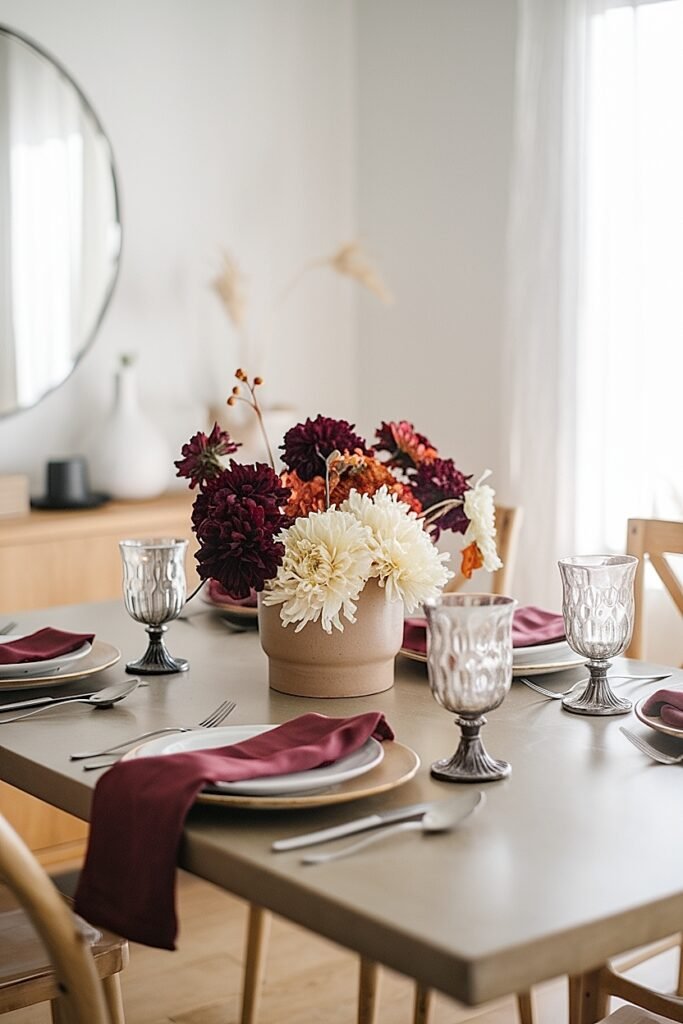
Cream chrysanthemums are the most widely available and most practically durable cream flower companion for burgundy fall arrangements. The grocery store mum supply through fall is reliable and dense. The vase life of ten to fourteen days in cold water means building a small dinner party arrangement on Monday works for Friday’s gathering without visible quality compromise. And the warm cream tone of late-season mum varieties — not cool white, but genuinely warm off-white with a slight golden undertone — sits in exactly the right tonal relationship with deep burgundy.
The build sequence for a cream mum and burgundy combination: cream first. Fill the vessel with cream mum stems at the target height, using the branching stem technique to maximize bloom coverage per stem. Then insert the burgundy element, one to two stems depending on the small dinner party vessel size, through the cream mum mass so the burgundy blooms emerge from within the cream layer rather than sitting beside it. The burgundy blooms that rise from within the cream mass read as discovered detail at close dinner party range, a visual reward for guests seated near the arrangement.
The proportion rule for cream-and-burgundy at small dinner party scale: two to three cream stems for every one burgundy stem. At equal proportion, the arrangement reads as evenly split between the two tones. At two-to-one cream, the cream creates the visual ground and the burgundy creates the focal accent. The arrangement has hierarchy.
The vessel choice for cream mums and burgundy together: matte black or deep navy amplifies both tones by creating a dark boundary that separates the arrangement from the table surface and increases the apparent brightness of the cream and the apparent depth of the burgundy simultaneously. Copper and brass warm both tones and create a more harmonious, less dramatic effect. Dark vessel for drama. Warm metal vessel for intimacy.
For more on styling burgundy fall flowers at intimate autumn dinner settings including the candlelight positioning technique and the neutral linen backdrop strategy, check out how to style burgundy fall flowers for intimate autumn dining. Share this with anyone planning a fall dinner party this season. More ahead on every specific cream flower companion and burgundy combination technique.
What Are the Best Burgundy Fall Flowers to Mix with Cream Dahlias?
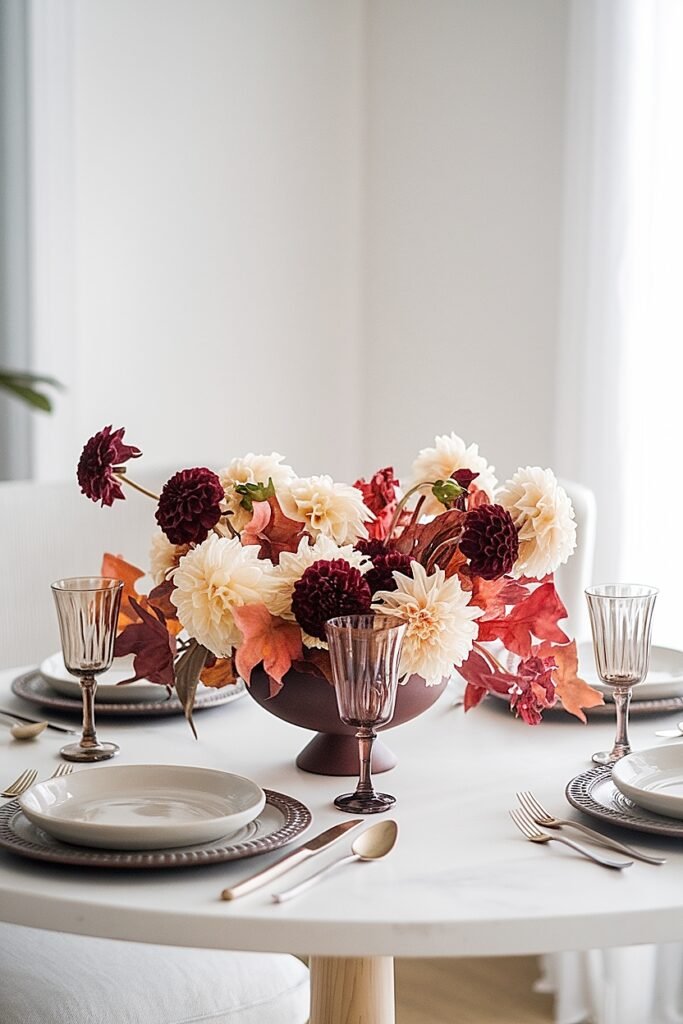
Cream dahlias are the most visually sophisticated cream fall flower companion for burgundy because the dahlia’s layered petal structure creates close-range tonal complexity that mums and carnations do not match. At small dinner party intimate distance, a cream dahlia’s warm off-white petals shift from ivory at the tight inner petal zone to warm cream-gold at the outer petal edge. That tonal graduation alongside a deep burgundy bloom creates a visual pairing with genuine richness.
The scale question: cream dahlia bloom size should roughly match the burgundy companion’s visual weight. A large dinner-plate cream dahlia with a compact burgundy gomphrema ball creates a mismatched visual scale that reads as unresolved. A ball or pompom cream dahlia at four to five centimeters beside a burgundy ball dahlia at the same scale creates the visual partnership the combination requires.
1. Deep Burgundy Ball Dahlias Deep burgundy ball dahlias beside cream pompom or ball dahlias create the most visually resolved pairing of this list because both flowers share identical bloom structure at different tonal extremes. The structural match makes the tonal contrast the single design element rather than a structural-plus-tonal combination that can read as cluttered. One burgundy ball stem and two cream ball stems in a small dark vessel.
2. Burgundy Gomphrema Deep burgundy gomphrema balls alongside cream dahlias create a structural contrast at the small dinner party close range: the tight ball structure of the gomphrema beside the layered petal surface of the cream dahlia creates two distinct visual textures within the same warm tonal family. Three gomphrema ball stems distribute throughout the cream dahlia stems at the arrangement base, filling the visual middle zone between.
3. Burgundy Lisianthus Burgundy lisianthus alongside cream dahlias creates an arrangement where both elements share a layered petal structure at different scales. The ruffled lisianthus petals at smaller bloom size complement the cream dahlia’s larger layered surface. One burgundy lisianthus stem with multiple bud-and-bloom stages beside two cream dahlia stems creates progressive visual change across several dinner party evenings from one purchase.
More ahead on how cream lisianthus specifically suits the soft elegance register of intimate fall dinner party contexts.
How to Use Burgundy Fall Flowers with Cream Lisianthus for Soft Elegance
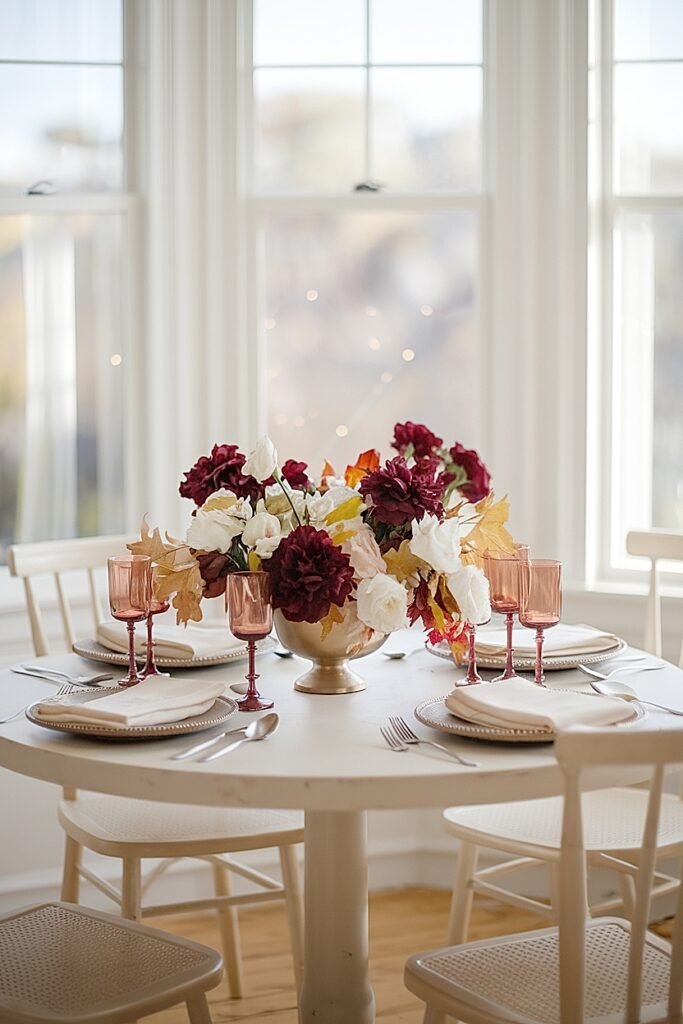
Cream lisianthus is the cream fall flower companion for hosts who want soft elegance rather than rich drama.
The word soft applies to the lisianthus’s bloom form rather than its visual presence. The ruffled, roselike petal arrangement of lisianthus creates an edge-softness that no flat-faced or ball-form cream flower produces. At close dinner party range, the ruffled cream petal edges catch warm candlelight in a way that creates a luminous quality specifically suited to fall candlelit intimate dining. The cream color in candlelight shifts toward warm ivory-gold in a way that cool white lisianthus does not achieve.
Pair cream lisianthus with burgundy at a ratio of three lisianthus stems to one to two burgundy stems. The lisianthus’s inherent elegance and softness benefit from the depth that the burgundy companion provides. Without the burgundy, cream lisianthus in a fall arrangement reads as off-season. With it, the cream reads as intentionally warm and seasonal.
The vessel for cream lisianthus and burgundy together: a short dark vessel, charcoal matte ceramic or deep navy enamel, creates the tonal backdrop that allows both the cream’s warmth and the burgundy’s depth to read at full intensity. Cream lisianthus in a clear glass vessel at a fall dinner party disappears. In a dark short pitcher or crock, the same stems create a display that reads from across the room as a warm, soft, considered fall dinner centerpiece.
Lisianthus stems with multiple buds open progressively, which means the arrangement looks different at Thursday’s dinner and Friday’s dinner. For small dinner party hosts who host multiple events across a fall season with the same arrangement, this progressive opening quality means the arrangement is genuinely never the same display twice from the same stem purchase.
More ahead on the cream rose and autumn foliage combination, which creates the most romantically autumn-specific version of the burgundy-and-cream pairing.
Ideas for Burgundy Fall Flowers with Cream Roses and Autumn Foliage
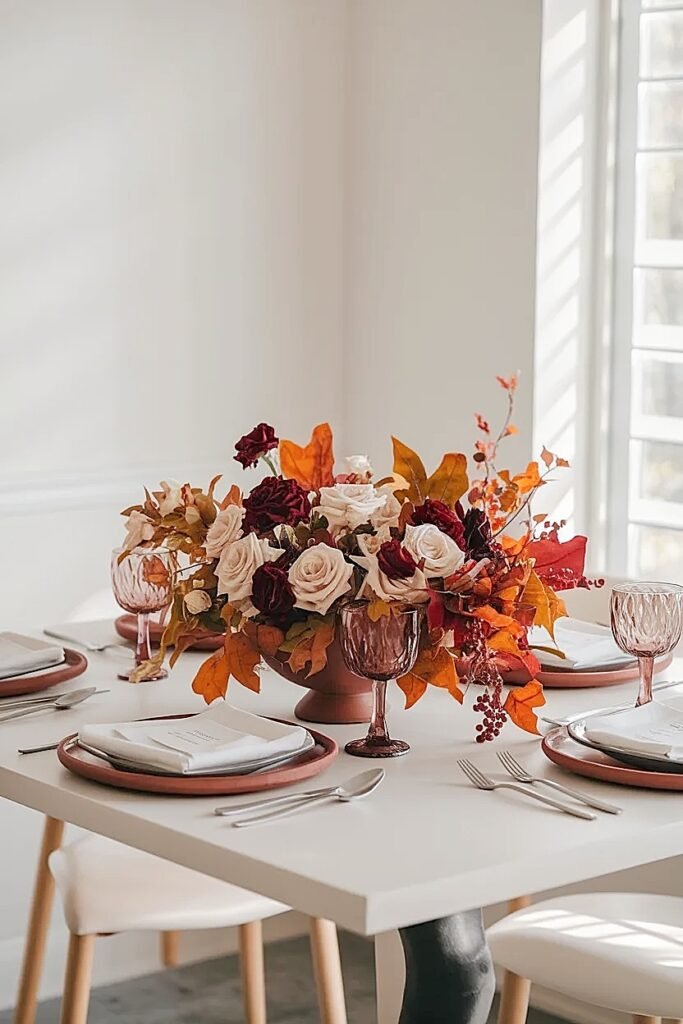
1. Burgundy Ball Dahlia with Cream Garden Rose and Dried Oak Leaves One deep burgundy ball dahlia stem plus one cream garden rose plus two to three dried autumn oak leaf sprigs in a short copper or brass vessel. The cream rose’s soft ruffled petals and the dahlia’s dense ball structure create two white-adjacent forms at different.
2. Burgundy Anemone with Cream Spray Rose and Sage Three deep burgundy anemone stems with their distinctive dark centers plus three cream spray rose stems plus four sage sprigs in a short dark ceramic vessel. The anemone’s dark center and the sage’s grey-green foliage both contribute dark-adjacent tonal depth. The cream spray roses provide.
3. Burgundy Gomphrema with Cream Sweetheart Rose and Dried Grass Five burgundy gomphrema balls plus five cream sweetheart roses plus two dried panicum grass stems in a small dark vessel. The sweetheart rose’s small bloom scale matches the gomphrema ball’s scale. The dried grass stems add fine-textured movement above the main bloom level. Both elements.
4. Burgundy Lisianthus with Cream Rose and Seeded Eucalyptus Two burgundy lisianthus stems plus two cream standard rose stems plus two seeded eucalyptus strands in a short matte black vessel. The eucalyptus trails over the vessel rim, softening the arrangement’s lower boundary. The lisianthus’s ruffled burgundy petals and the rose’s layered cream petals create.
5. Burgundy Fall Mum with Cream Rose and Dried Fern Three deep burgundy pompom mum stems plus three cream rose stems plus two pressed or dried autumn fern fronds in a terracotta or copper vessel. The mum’s spherical structure and the rose’s layered cup form create structural variety within the warm tonal pairing. The fern.
6. Single Burgundy Dahlia and Single Cream Rose in Matched Bud Vases One burgundy ball dahlia stem in one slim bud vase beside one cream rose stem in a matched bud vase, with both vessels at each place setting. The matched vessel pair reads as designed. Each guest receives the complete burgundy-and-cream pairing at personal intimate scale.
7. Burgundy and Cream with Autumn Branch Two burgundy fall stems plus two cream fall stems plus one autumn foliage branch, a small serviceberry, dogwood, or maple branch with turned leaves, in a medium dark vessel at the fall dinner table center. The branch creates height variation above the bloom level and.
More ahead on making this pairing work at minimal cost using cream carnations, which are the most misunderstood flower in the fall dinner party context.
Ways to Style Burgundy Fall Flowers with Cream Carnations on a Budget

1. Three Burgundy Gomphrema and Five Cream Carnations in a Dark Mug Three deep burgundy gomphrema ball stems plus five cream carnation stems in a short dark ceramic mug, all cut to two to three inches above the rim. The carnation’s compact bloom scale matches the gomphrema ball at a similar visual weight. The mug’s casual character.
2. Cream Carnation and Burgundy Mum Low Bowl Six cream carnation stems plus three deep burgundy pompom mum stems, all at rim height in a wide low ceramic bowl. The carnation’s fringed petal edge at close dinner party range is visible as a specific textural detail that distance viewing masks: the cream fringed.
3. One Burgundy Stem Per Vessel, Cream Carnations as the Base Fill the vessel with cream carnation stems cut to rim height, then insert one deep burgundy stem through the carnation mass so the single burgundy bloom emerges above the cream carnation level. The one-to-many proportion, one burgundy element above several cream elements, creates the clearest.
4. Cream Carnation and Burgundy Anemone Place Setting Pair One cream carnation stem and one burgundy anemone stem in a small narrow vessel at each place setting. The anemone’s dark center creates a graphic contrast within the flower face itself alongside the cream carnation’s fringed warm white. Both flowers are grocery store accessible. Both.
5. Dried Cream Carnation and Fresh Burgundy Mix Dried cream carnations, pressed or dried naturally, alongside fresh burgundy gomphrema or mum stems create a fresh-and-dried pairing with an intentional seasonal character. The cream carnation dries beautifully to a warm ivory-wheat tone that reads as specifically autumn rather than as a deteriorated fresh flower.
More ahead on the cream filler flower question, which determines whether small table burgundy arrangements look rich or sparse.
How to Balance Burgundy Fall Flowers with Cream Filler Flowers on Small Tables
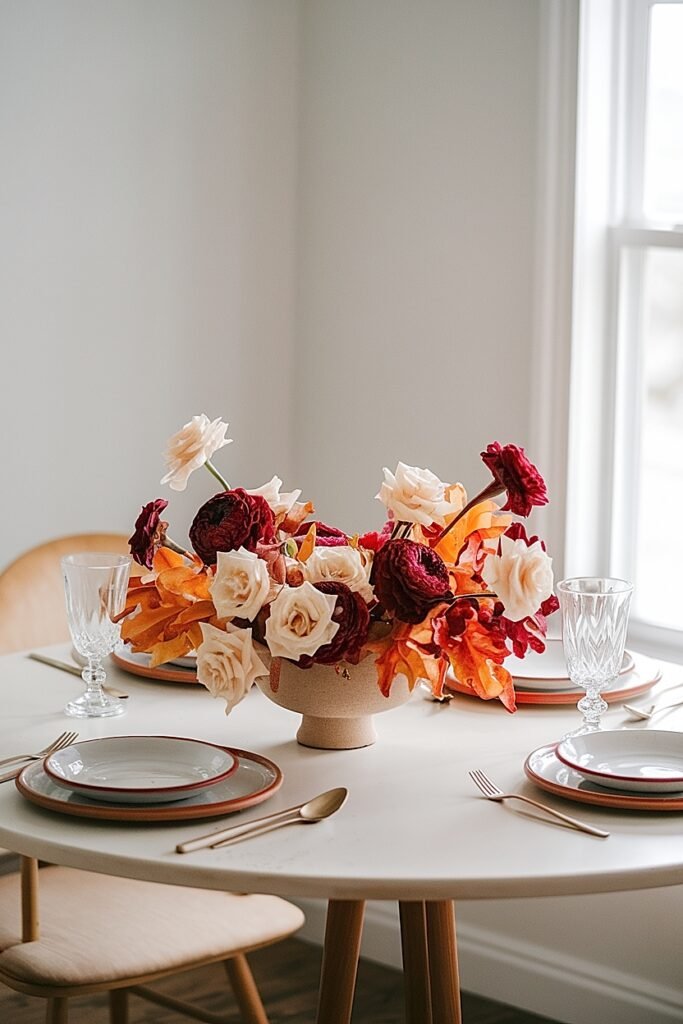
Filler flowers in a burgundy-and-cream arrangement serve a different purpose from focal or structural flowers.
They create the visual density that prevents the dark-and-light pairing from reading as two isolated elements in the same vessel. A single burgundy bloom and a single cream bloom in a vessel without filler creates a two-element composition where the gap between the elements is as visually prominent as the elements themselves. Add three to four cream waxflower stems as a filler base and the two focal elements suddenly read as part of a complete display rather than as individual flowers sharing a container.
Cream waxflower is the most effective and most specifically scaled filler for a small dinner party burgundy-and-cream arrangement. The tiny star-shaped blooms distribute across the arrangement base without any single branch drawing attention. At close small dinner party range, the waxflower’s individual bloom detail is visible in a way that makes the filler appear as a designed supporting layer rather than a background mass. The cream tone bridges the burgundy and the cream focal flowers into one cohesive warm palette.
The proportion for cream filler in a small dinner party vessel: one to two waxflower stems per every three to four total focal stems. At higher proportions, the waxflower starts to dominate the display and the burgundy focal element’s color contribution is diluted by the cream mass. At the correct proportion, the waxflower creates visual continuity between the burgundy and cream focal elements, connecting them rather than competing with either.
DIY Ideas for Burgundy Fall Flowers with Cream Asters in Low Bowls
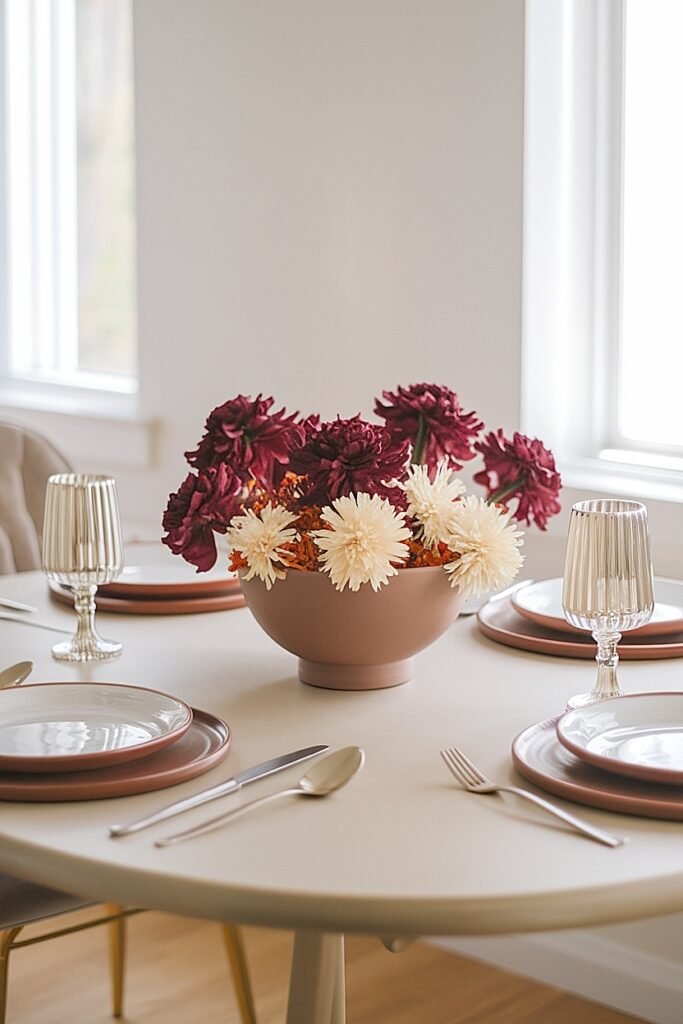
1. Burgundy Gomphrema and Cream Aster Rim-Height Bowl Five burgundy gomphrema ball stems plus six cream aster stems, all cut to one inch above the rim in a wide dark ceramic bowl. The asters’ small flat daisy faces and the gomphrema balls at the same height create two different bloom structures distributed evenly.
2. Burgundy Mum and Cream Aster Low Terracotta Bowl Three deep burgundy pompom mum stems plus four cream aster stems in a wide terracotta low bowl. The terracotta’s warm buff-orange amplifies the warm undertones in both the burgundy and the cream simultaneously. The combination reads as specifically October harvest-garden at small fall dinner party.
3. Floating Cream Aster and Burgundy Heads in a Wide Dish Three cream aster heads and two burgundy bloom heads, all stems removed, floating face-up in a wide shallow ceramic dish with one inch of cold water. The floating cream and burgundy at water surface level creates a flat, close-range visual display with zero height. The.
4. Burgundy Ball Dahlia and Cream Aster Low Copper Bowl Two burgundy ball dahlia stems plus four cream aster stems in a short wide copper bowl. The copper vessel amplifies the warm tones of both the burgundy and the cream. The dahlia’s ball structure and the aster’s flat daisy face create structural contrast at the.
5. Cream Aster and Burgundy with Sage Perimeter Four cream aster stems plus two burgundy stems plus three sage sprigs at the bowl outer perimeter, all at rim height in a wide dark ceramic bowl. The sage perimeter creates a grey-green outer ring from which the cream-and-burgundy bloom display rises. The grey-green sage.
Conclusion
Burgundy and cream is the fall dinner party flower pairing that creates atmosphere without requiring skill, because the two colors do the design work autonomously.
The dark-and-light contrast within the same warm spectrum means that any combination of burgundy fall blooms and cream fall blooms reads as composed. The vessel choice narrows the register from casual to formal. The filler creates continuity between the two tones. The table linens provide the backdrop that allows both colors to read at full intensity.
Two stems in a small dark vessel. One burgundy, one cream. That is all a small fall dinner party table needs to feel like someone thought specifically about the occasion.
This website contains affiliate links, and some products are gifted by the brand to test. As an Amazon Associate, I earn from qualified purchases. Some of the content on this website was researched and created with the assistance of AI technology.