This website contains affiliate links, and some products are gifted by the brand to test. As an Amazon Associate, I earn from qualified purchases. Some of the content on this website was researched and created with the assistance of AI technology.
Key Takeaways
- Anchor the seam between living and dining zones with one tall plant, like a Norfolk Island pine.
- Map radiators, vents and exterior doors first, because poinsettias and holiday cacti react badly to drafts.
- Cyclamen wants daytime temperatures around 60 to 65 degrees, so give it a windowsill far from the stove.
- The ASPCA lists Christmas cactus as non-toxic for cats and dogs, but cyclamen and amaryllis as toxic.
- Keep shared-table plants under about a foot tall so conversation flows.
- Repeat one or two colors and one pot style in every zone so the space reads as a single display.
Creating Christmas house plant displays for open-plan apartments sounds simple until you realize every plant you own is on stage at once. No spare room. No hallway to hide the leggy one. My first December in a loft-style rental, the kitchen, sofa, dining table and TV shared one long rectangle, with a radiator clanking under the only big window. I hauled home three poinsettias, a cyclamen and a rosemary tree, scattered them around, and stepped back. It looked like a garden center checkout line. So how do you make living greenery look planned when there are no walls to frame it?
Treat each zone as its own small display, then stitch them together with one color story and matching pots. Light-hungry plants go near windows, cool-loving bloomers stay far from heat, and anything on a shared table stays low enough to talk over. It took me a few seasons and a couple of casualties to learn that. You get the shortcut.
Not every holiday plant belongs in every open-plan apartment. Use this simple comparison to match festive plants with realistic indoor conditions before styling your kitchen, dining space, or living area. Each option includes a display idea, care priority, and practical warning so your Christmas greenery looks beautiful and stays healthy longer.
Choose the Right Christmas House Plant for Every Open-Plan Zone
Not every holiday plant belongs in every open-plan apartment. Use this simple comparison to match festive plants with realistic indoor conditions before styling your kitchen, dining space, or living area. Each option includes a display idea, care priority, and practical warning so your Christmas greenery looks beautiful and stays healthy longer.
| Living plant | Best display location | Care priority | Practical decorating note |
|---|---|---|---|
|
Option 1
Norfolk Island pine
|
Living-zone anchor | Bright light; moderate moisture | Use a stable pot; avoid heavy ornaments. |
|
Option 2
Christmas cactus
|
Shelf or console cascade | Bright, indirect light; drain fully | Keep away from hot dry air; give blooms space. |
|
Option 3
Florist’s cyclamen
|
Cool sideboard accent | Cool bright position; water carefully | Avoid heated spots and protect pets. |
|
Option 4
Poinsettia
|
Kitchen-edge color accent | Bright indirect light; even moisture | Keep away from drafts, heat and pets. |
|
Option 5
Phalaenopsis orchid
|
Elegant dining buffet | Bright indirect light; careful watering | Protect flowers from heat and allow drainage. |
Resources:
- Christmas-Flowering Houseplants | RHS Advice
- Houseplant Care – Cyclamen (Cyclamen persicum) – Research Guides at New York Botanical Garden
- How to Decorate a Small Apartment or Home for Christmas | Apartment Therapy
How to Create a Living Christmas Plant Focal Point Between Open-Plan Living and Dining Areas
Open layouts have a sneaky problem. Your eye wanders from couch to table to fridge with nothing telling it where one area stops.
A living focal point fixes that. Honestly, it’s the one holiday plant I’d spend real money on.
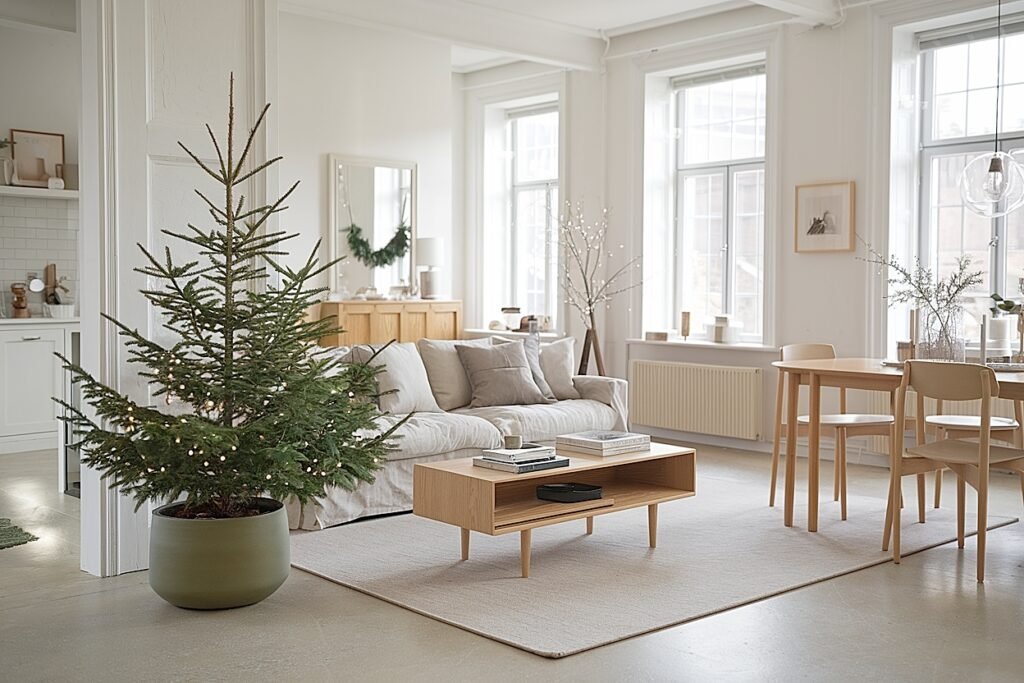
Think of it as a soft wall. One substantial plant, or a tight cluster, sits right where the lounge side meets the eating side, and suddenly the room has a beginning, a middle and an end. My pick is the Norfolk Island pine, which, fun fact, isn’t a true pine. Iowa State horticulturists note that lots of people turn these into living Christmas trees with miniature lights, ribbons and ornaments.
Here’s the catch. That seam is rarely next to a window, and University of Nevada, Reno Extension recommends a large south, east or west exposure. A Norfolk tolerates dimmer conditions for a while, but leave it there too long and the branches droop.
My fix is a plant caddy on casters. On weekdays, the pine rolls up near the glass. When friends come over, it glides back to the boundary. I tuck two small poinsettias at its base, since grouping them with other houseplants raises humidity and helps them last longer. Warm white lights, featherweight ornaments, and nothing near a heat register. After New Year’s, the decorations come off quickly so they don’t damage the needles.
Want a cut-flower partner for that pine? My red carnation and magnolia leaf Christmas arrangement ideas sit beautifully beside deep green needles. And if a friend is staring down an awkward open floor plan this month, passing this along on Facebook or Pinterest might save them a few dead poinsettias. There’s more below, starting with where everyone ends up at a party.
Simple Ways to Decorate Open-Plan Apartment Kitchen Islands With Christmas House Plants
Every gathering I’ve hosted drifts toward the island. Coats come off, drinks get poured, and within ten minutes six people are leaning on the same slab of quartz.
Prime real estate. Also a lousy home for anything fussy.
Islands usually sit mid-room, about as far from natural light as you can get. Add heat from a cook-top or oven, plus the constant need for prep space, and it’s a rough neighborhood for a plant.
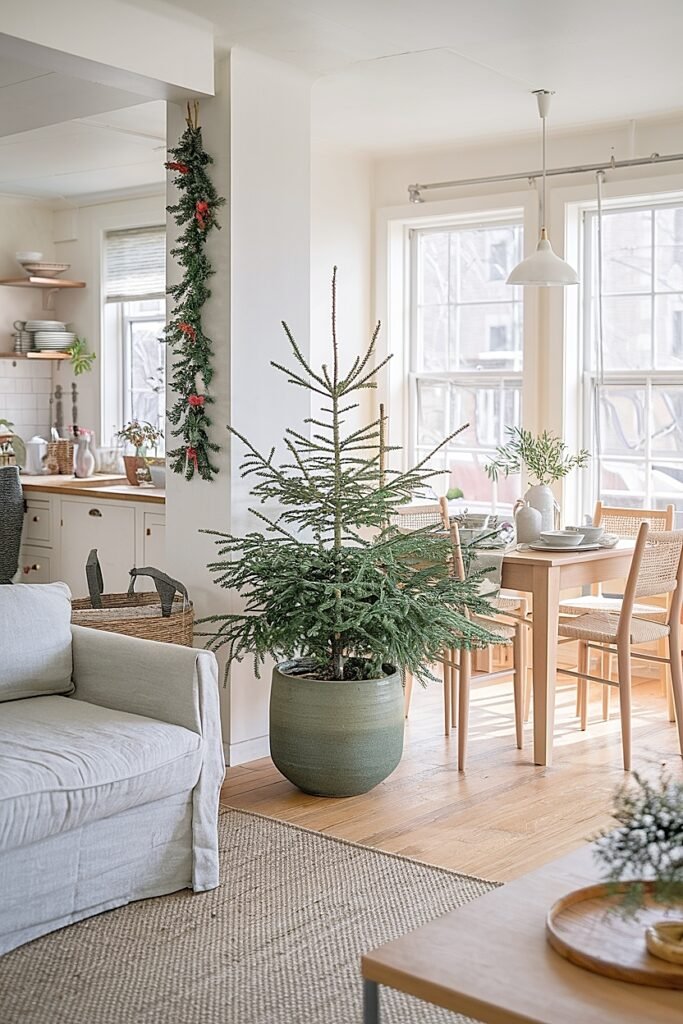
Still, it’s doable. K-State Research and Extension says poinsettias last longest in bright light, yet with proper care they should hold up through the season even in a home’s interior. Rosemary is pickier.
- Give the Rosemary Tree a Commute: Rosemary topiaries smell fantastic, and the ASPCA rates rosemary non-toxic for dogs, cats and horses. They won’t stay happy away from the glass, though. UC Master Gardeners suggest moving one into sunlight every other day, so mine splits time between the island and the windowsill. Keep its soil on the drier side.
- Line Up a Poinsettia Trio on a Narrow Tray: Three small poinsettias in a slim wooden tray look deliberate instead of scattered. Strip off the foil sleeves or poke drainage holes in them, then water only when the soil feels dry. Mississippi State University Extension points out that leaf drop is one symptom of over-watering.
- Keep Blooms Off the Cooktop End: If your island has a built-in range, every plant belongs on the seating side. Poinsettias don’t like sitting near heaters, and a burner on high is basically a tiny heater. I learned that when a pot of boiling pasta left a bract limp by dessert.
- Lift Small Pots on a Cake Stand: A footed cake stand raises a couple of mini plants above crumbs and spills. Better yet, it lifts off in one move when you suddenly need counter space for a charcuterie board.
Up next: the shelving unit that splits so many of these spaces, plus a trick or two I wish I’d known sooner.
Creative Ways to Style Christmas House Plants on Open-Plan Apartment Room Dividers
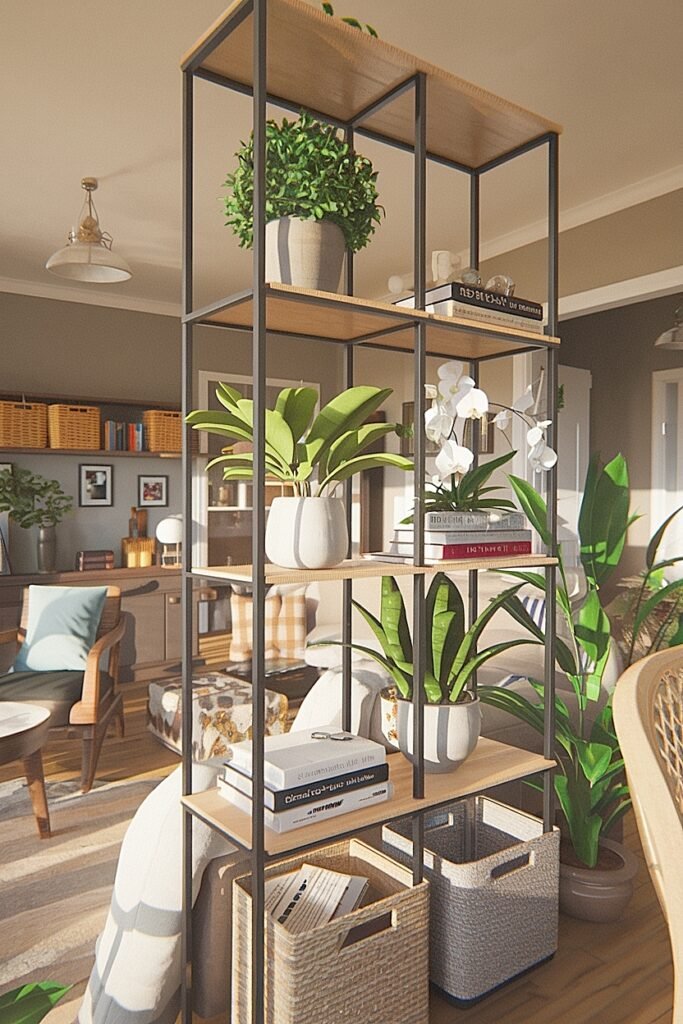
Lots of open apartments lean on a bookcase or cube shelf as a stand-in wall. Mine was a white cube unit splitting bed from sofa in a studio I rented years ago.
It looked bare. Then I overcorrected and crammed it.
A divider is tricky because light hits it from two directions, just not evenly. The window-facing side does fine, while lower cubes can sit in shadow most of the afternoon.
Stability is the other issue. University of Wyoming Extension notes that a Christmas cactus flowers at its branch tips and can become quite top heavy, which matters on a shallow shelf people brush past daily.
- Stagger Plants in a Checkerboard: Alternate plants with books or decor rather than filling a whole row. The divider keeps its see-through feel, and each pot catches more of whatever light slips through. From the sofa, it reads like a pattern instead of a jungle.
- Let a Holiday Cactus Spill From the Top: The highest shelf usually gets the most light, and those arching segments look great hanging over an edge. Use a heavy ceramic or terracotta pot so a full load of blooms can’t tip when someone grabs a book below.
- Dress a Tabletop Norfolk Pine With Tiny Ornaments: A small Norfolk pine on a middle shelf becomes a mini Christmas tree with a few lightweight ornaments. Face it toward the window side so it gets good light. I give mine a quarter turn every time I water so one side doesn’t hog the sun.
- Water at the Sink, Not on the Shelf: Wood and paperbacks hate drips. I carry each pot to the sink, let it drain fully, then set it back on a cork mat or saucer. It adds two minutes to the routine and has rescued more than one book from a soggy ending.
The TV wall is coming up, and to be honest, it gave me more trouble than any other corner.
How to Arrange Christmas House Plants Around an Open-Plan Apartment Television Area
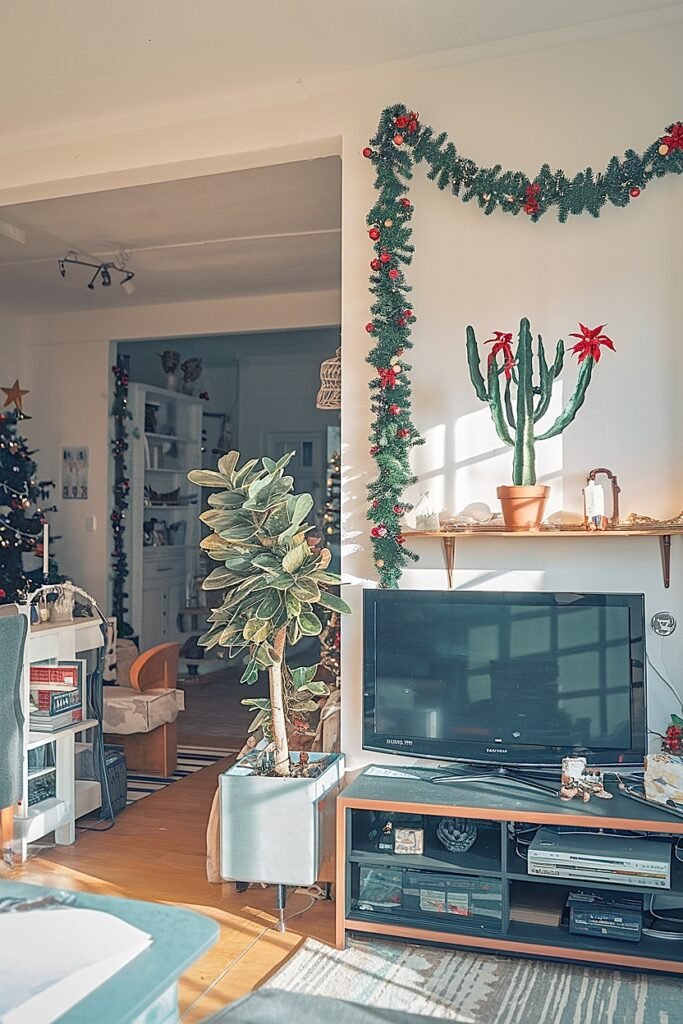
In most open layouts, the TV wall is what you see from everywhere. Kitchen. Dining table. Front door.
That big black rectangle can make the space feel colder in December, and plants are the easiest way to warm it up.
The trouble is that TV walls tend to be the dimmest stretch of the apartment. In many places I’ve lived, the screen faced the window to cut glare, so anything beside it got secondhand light at best. Cords, outlets and pricey electronics make watering nerve-wracking too.
Then there’s heat. Plenty of apartments run a baseboard heater along that wall, and Mississippi State’s extension team advises keeping poinsettias away from vents and home heaters. Cyclamen, which prefers a cool room, shouldn’t go anywhere near it.
Here’s what works for me. I frame the screen with a matched pair of poinsettias on slim stands, one per side, a few inches below the bottom edge so the picture stays the star. Each pot sits in a lined cachepot, so water never touches the console. Nothing goes on top of the TV or soundbar. Ever. Because that corner is dim, I swap the TV pair with the window poinsettias every week or so. A smaller plant on the coffee table ties everything back together.
Still with me? My favorite flowering combinations for the buffet are right below.
How to Decorate Open-Plan Apartment Dining Buffets With Christmas Flowering House Plants
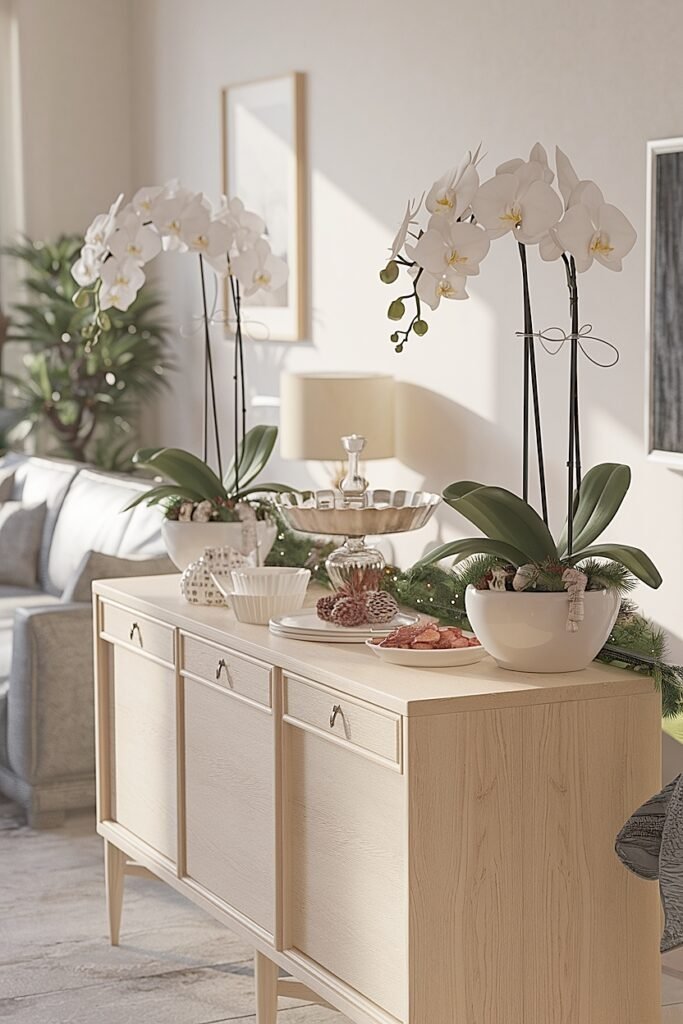
The buffet is my staging area. Drinks on one end, desserts on the other, and a strip in the middle that begs for color.
In an open plan, it also faces the living area, so whatever sits there gets seen all night.
Flowering plants shine here because a buffet runs along a wall at a comfortable eye level. Timing matters, though. University of Kentucky Extension says amaryllis can bloom in as little as four weeks but usually needs six to eight, so a bulb planted the week before your party won’t help.
Food and plants share this surface, so I think about mess as much as looks.
- Use Amaryllis as the Tall Bookend: One amaryllis at the end adds instant height. Turn the pot every few days so the stalk grows straight, and stake it if it gets top heavy. A slight lean is no big deal. Once blossoms open, Cornell Cooperative Extension suggests a cool room out of direct sun so they last longer.
- Pickle Your Paperwhites: Cornell’s Flower Bulb Research Program found that watering paperwhites with a 4 to 6 percent alcohol solution keeps stems roughly a third shorter, so they don’t flop. Switch once shoots stand an inch or two above the bulb. One part 80-proof gin or vodka to seven parts water does it. Skip beer and wine, since their sugars cause problems.
- Plant Poinsettias in Odd Numbers: Three or five in a row looks more natural to me than two or four, and I like slipping one white among the reds. Near the front door? Slide them to the far end, because NC State Extension lists drafts and sudden temperature swings as common causes of leaf drop.
- Keep Soil and Bulbs Away From Food and Pets: Every pot on my buffet sits on a tray, and nothing leafy hangs over the dessert plates. If a cat or dog roams your kitchen, push the amaryllis and paperwhites toward the back, since both appear on holiday lists of plants toxic to pets.
There’s plenty more ahead, including the plant I hand to every cat owner I know.
Creative Ways to Decorate Open-Plan Apartments With Christmas Cactus Displays
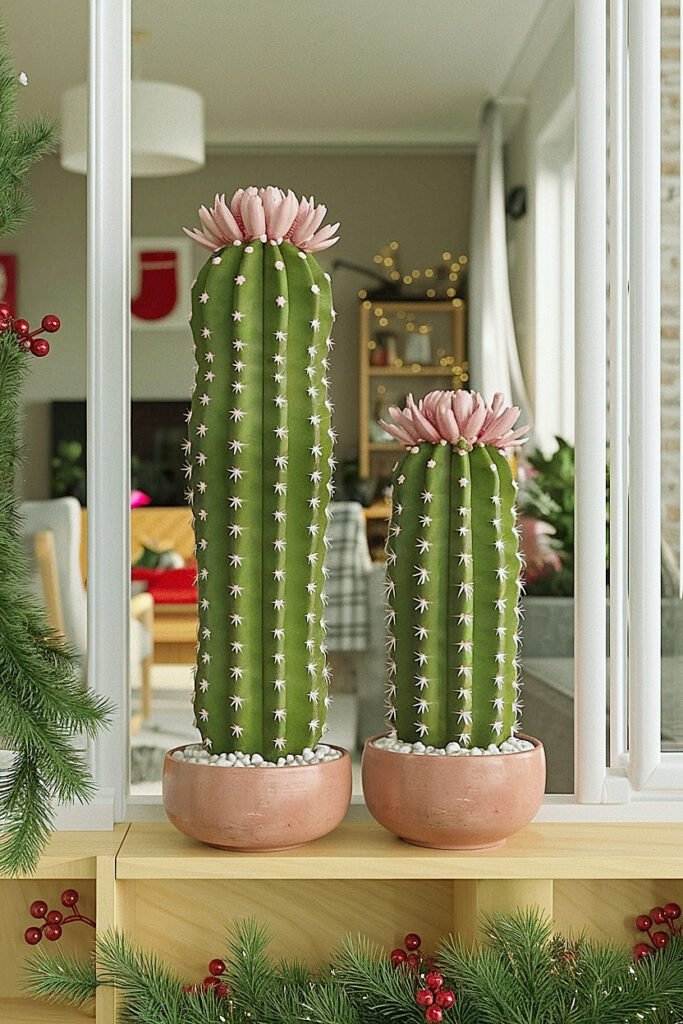
If you share your place with pets, this is the plant I’d start with. It’s listed as non-toxic to dogs and cats in the ASPCA’s plant database, although like any greenery it can cause mild stomach upset if somebody decides to snack.
It’s also nearly impossible to make look bad.
Quick confession: the plant you bought as a Christmas cactus might be a Thanksgiving cactus. NC State Extension explains that Thanksgiving cactus segments have pointed, claw-like edges, while true Christmas cactus segments are smoother with slight scalloping. For decorating, it hardly matters. Yours may simply bloom earlier.
What does matter is consistency. Buds can drop from over-watering, cold drafts, or a perch right beside a heater vent.
- Hang One in a Cool, Bright Window: These stems arch naturally, so a hanging planter shows them off. University of Missouri Extension recommends a sunny window away from hot drafts, ideally in a cooler room, where blossoms hold longer. In my loft, the bedroom end runs a few degrees chillier, so that’s where mine lives.
- Pick a Spot and Leave It Alone: Once buds show, resist the urge to rearrange. Extension agents in North Carolina warn that moving the plant may cause buds to fall off. I choose the final spot in November and don’t touch it again until the last flower fades.
- Group Three Colors on One Ledge: Pink, red and white holiday cacti lined up on a windowsill or floating shelf make a simple, cheerful vignette. Matching pots keep it tidy. Mismatched vintage tins work too, as long as they drain.
- Center the Coffee Table With One: A single blooming cactus in a low bowl makes a pet-friendly centerpiece for the lounge side. Keep it off the corner where a wagging tail can swat it.
Hang on, because the cyclamen ideas below might change your mind about that so-called diva.
Easy Ideas for Arranging Red and White Christmas Cyclamen in Open-Plan Apartments
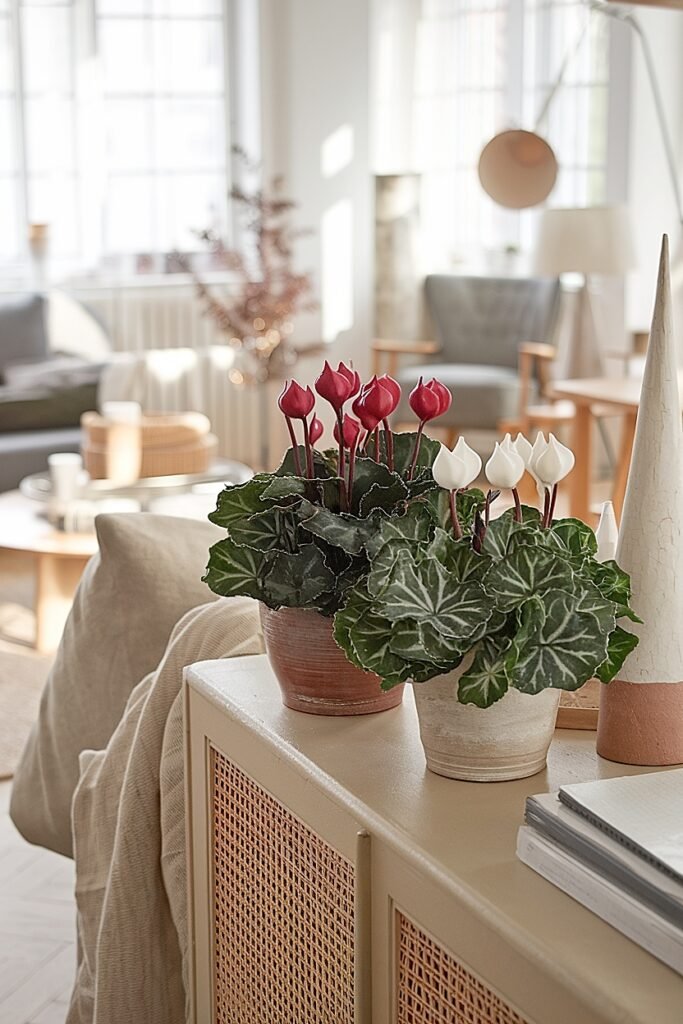
Cyclamen has a reputation as a drama queen. Is that fair? Half fair.
I killed my first one in nine days. Parked it on the sill right above a radiator. Yikes.
Florist’s cyclamen is easy once you respect its one big rule: it likes things cool. Clemson Cooperative Extension recommends about 50 degrees at night and 60 to 65 during the day, with bright indirect light. The New York Botanical Garden adds that short-lived cyclamen are often the result of warm growing conditions.
Open-plan apartments can work in its favor, since corners far from the kitchen often run cooler. Just know that the ASPCA flags cyclamen as toxic to both cats and dogs, with large amounts of tuber being the most serious concern.
- Alternate Red and White Like a Candy Cane: A row of four or five cyclamen in alternating colors on a cool windowsill looks festive without a single ribbon. Washington State University Extension says east or west windows can be good choices. Keep the pots snug so the foliage forms one band.
- Tuck White Cyclamen Near the Entry: Entryways often run cooler than the rest of an open layout. A white cyclamen in a zinc bowl, a few feet back from the door, greets guests nicely. Keep it out of the direct blast whenever the door swings open.
- Water Around the Rim: I pour water around the edge of the pot rather than into the center of the plant. Iowa State’s extension horticulturists recommend room-temperature water to protect the foliage and name cool temperatures and moist soil as the keys to a longer bloom.
- Pull Spent Flowers Promptly: UF/IFAS Extension notes that removing faded flowers on holiday plants improves their appearance and prevents seed formation. A quick tidy every few days keeps those candy-cane colors looking crisp.
Don’t bail yet. The dining table section below might be the most useful part of this whole post.
Ideas for Creating Low-Profile Christmas Plant Displays on Shared Apartment Dining Tables
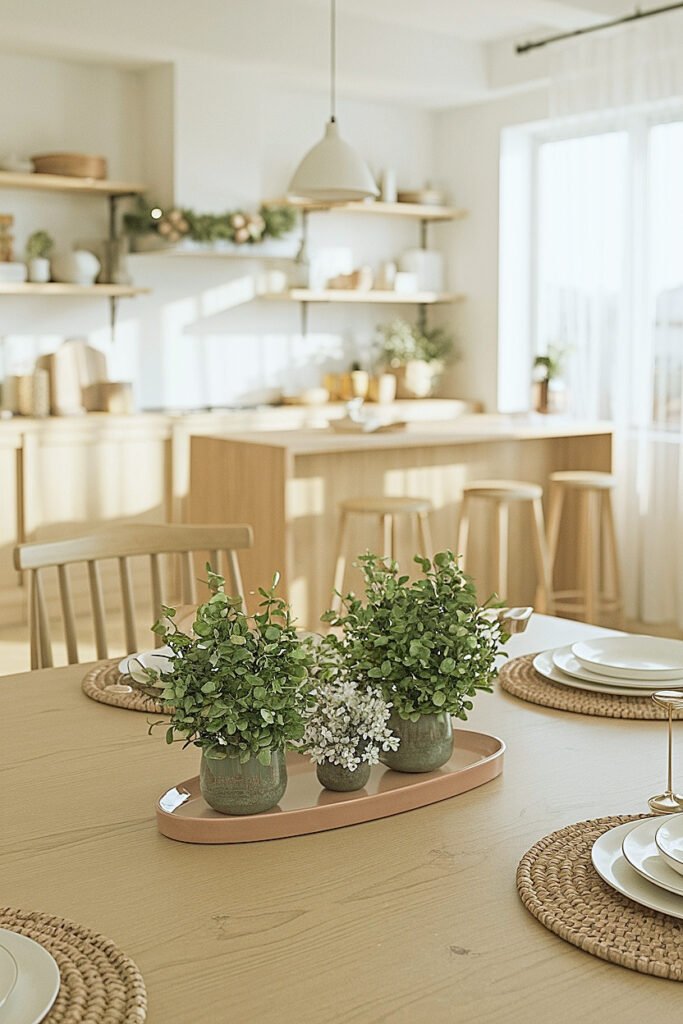
In plenty of open apartments, the dining table does triple duty. Desk by day, dinner spot by night, mail drop in between.
“Shared” means different things too. For some readers it’s roommates. For others, it’s a partner who works from home.
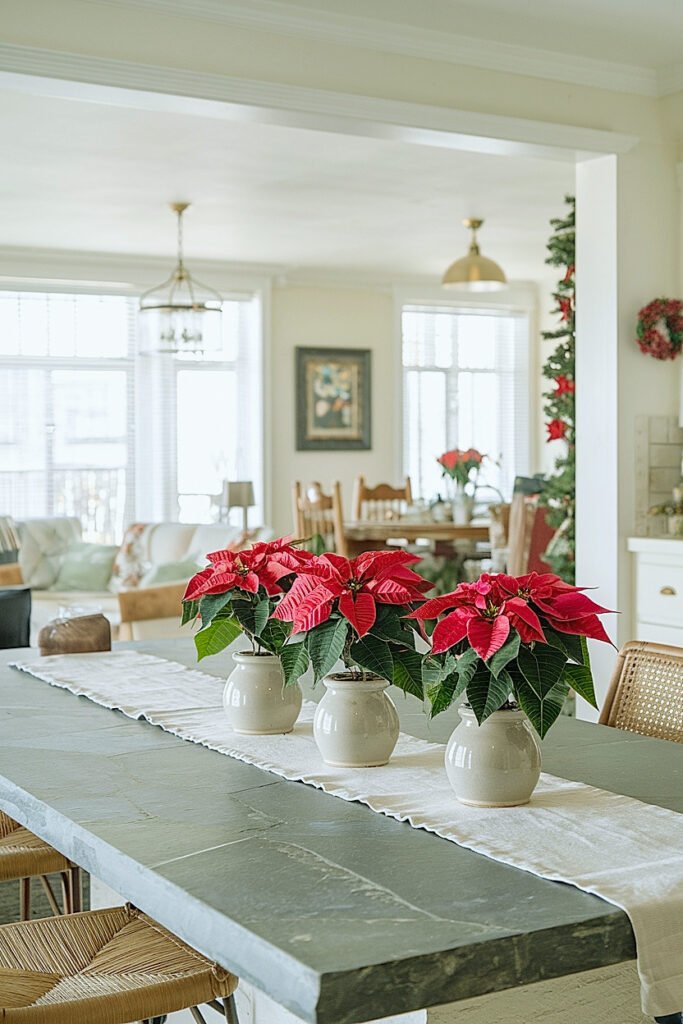
Low profile matters because that table is visible from the sofa, the kitchen and the front door. A tall centerpiece blocks sightlines across the whole apartment, not just across the table. My personal rule is under about 12 inches, so nobody plays peekaboo during dinner.
Light is the other hurdle. Most tables sit mid-room, so I treat table plants the way those UC Master Gardeners treat rosemary, with regular trips back to the window.
- Build the Whole Thing on a Tray: A long wooden tray or lined baking sheet holds the entire display. When the table turns back into a desk on Monday, I lift everything onto the counter in one move. No tipped pots, and no soil on anyone’s laptop.
- Run Mini Poinsettias Down the Middle: Small poinsettias in 4-inch pots, set in a loaf pan or narrow trough, give you all that red without blocking anybody’s view. Three or four is plenty for a table that seats four, and they’re light enough to shuffle aside when the pasta bowl arrives.
- Plant a Holiday Cactus and Moss Bowl: A shallow bowl with one Christmas cactus surrounded by sheet moss stays well under a foot tall. It’s pet friendly, and the trailing segments hug the tabletop.
- Fill the Gaps With Pine Cones and Clippings: Pine cones, a few sprigs of cedar, or extra trimmings from your tree fill the spaces between pots. They cost nothing, add a little scent, and keep the display looking full while staying flat.
Before you start shuffling pots around, the wrap-up below pulls everything together.
Conclusion
Open-plan living takes away the walls, so your plants end up doing a lot of the work walls normally handle. They mark boundaries, give the eye a place to rest, and make one big room feel like several cozy ones.
If I had to boil it down, I’d start with one living focal point, map every vent and radiator before buying anything, and keep the table low. Put poinsettias where the light is decent, cyclamen where it’s cool, and holiday cactus anywhere a pet might wander. At the end of the day, repeating the same colors and pots across every zone is what makes the space look planned rather than accidental.
My honest recommendation? Skip the impulse plants by the grocery store checkout. Buy fewer, place them carefully, and give each one a job.
This website contains affiliate links, and some products are gifted by the brand to test. As an Amazon Associate, I earn from qualified purchases. Some of the content on this website was researched and created with the assistance of AI technology.