This website contains affiliate links, and some products are gifted by the brand to test. As an Amazon Associate, I earn from qualified purchases. Some of the content on this website was researched and created with the assistance of AI technology.
Key Takeaways
- Fresh carnation selection matters more than most people think, look for tight, firm buds with deep red pigment and clean stems; avoid blooms that are already fully open at the store.
- Magnolia leaves bring two very different looks, the glossy green topside reads modern and polished, while the bronze-brown underside reads rustic and warm. Flip them intentionally.
- Standard and mini carnations serve completely different jobs in an arrangement, standards anchor the design, minis fill negative space without adding bulk.
- A low centerpiece built around a dense carnation cluster is the most forgiving design for beginners, it holds its shape even as individual blooms open up over time.
- Scale is everything in small spaces, three stems and five leaves in a short bud vase can land just as elegantly as a full mantle swag if the proportions are right.
- Carnations last 1–3 weeks in water, which makes them one of the most practical choices for Christmas arrangements that need to hold up through the entire holiday season.
Creating red carnation and magnolia leaf Christmas arrangements is one of those things I kept putting off for years because I assumed it would be complicated. Turns out I was overthinking it completely. These two materials , a classic florist’s staple and a backyard tree leaf , are actually one of the most naturally compatible pairings in holiday design, and the results can look like something out of a Southern Living spread without a lot of fuss or expensive florist equipment.
I started working with this combination a few winters back after grabbing a bunch of red carnations from the grocery store on a whim and realizing I had a pile of magnolia leaves sitting right outside. What I ended up with on the kitchen table that night surprised me. The deep, velvety red of the carnations against the leathery, two-toned magnolia foliage just worked. Since then, I’ve built out a dozen variations, everything from tight little dining table centerpieces to a full entryway arrangement that stops people at the front door. This post walks through everything I’ve learned.
Red Carnation and Magnolia Arrangement Planning Table
Use this quick comparison before buying flowers or choosing a container. It matches five common Christmas display locations with a practical arrangement shape, a useful carnation-to-magnolia balance, and one placement concern. The guide helps you protect sightlines, preserve serving space, maintain stability, and build a design suited to its surroundings.
Which Christmas Arrangement Fits the Space?
Choose a shape, flower-to-foliage balance, and placement plan before trimming any material.
| Display Location | Best Shape | Carnation and Magnolia Balance | Watch For |
|---|---|---|---|
| Dinner Table | Low, elongated, open through the middle | Three compact carnation groups over horizontal foliage | Blocked conversation or lost serving space |
| Entry Console | Upright with a narrow weighted base | One strong bloom column with taller foliage behind | Top-heavy weight near the surface edge |
| Round Table | Compact and finished on every side | Evenly spaced blooms within a circular leaf base | Bare areas visible from seated positions |
| Holiday Buffet | Long, shallow, gently sweeping | Repeated red clusters linked by broad foliage | Crowding plates, drinks, or serving tools |
| Small Shelf | Petite with a controlled footprint | Few strong blooms with two or three bold leaves | Visual clutter and unstable overhang |
Resources:
- Carnation, Miniature Carnation | Postharvest Research and Extension Center
- Selecting & Caring for Cut Flowers – Gardening | NC State Extension
- Avoiding fall, winter and holiday decorating hazards | Oklahoma State University
How to Select Fresh Red Carnations for Christmas Arrangements
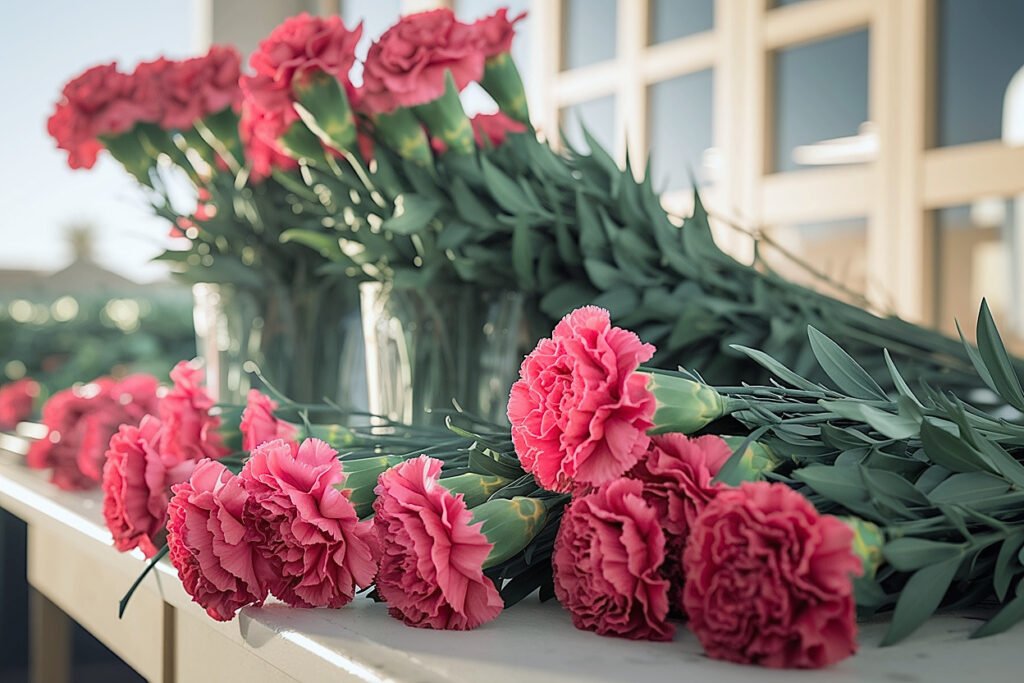
The first time I bought carnations specifically for a Christmas arrangement, I grabbed whatever looked the reddest and fullest at the store. Big mistake. By day two, half of them were drooping and shedding petals, and the whole thing looked tired before I even had a chance to enjoy it. After that, I started paying a lot more attention to what I was actually picking up off the shelf , and the difference was immediate.
What you’re looking for when selecting carnations for an arrangement isn’t the most open bloom. It’s almost the opposite. The freshest carnations at retail are the ones still slightly closed, with petals that feel firm and layered when you gently squeeze them. A tight bud means you’re getting days of opening ahead of you rather than days of decline. Florists call this buying “in bud stage,” and it’s the single most reliable way to extend your arrangement’s lifespan.
What to look for on the stem and bloom:
- Petals should be deeply pigmented , a saturated, dark red rather than a washed-out pink-red
- The base of the bloom (the calyx, the green cup holding the petals) should feel firm, not soft or squishy
- Stems should be straight, bright green, and free of sliminess at the cut end
- Leaves along the stem should look crisp, not yellowed or wilted
- Avoid any bunch with a foul smell , that’s bacterial breakdown already underway
Once you get them home, recut the stems at a 45-degree angle under running water and drop them immediately into a clean vase with room-temperature water and a packet of flower food. Strip any leaves that would sit below the waterline , those rot fast and cloud the water, which shortens the whole vase’s lifespan. I keep mine in a cool room overnight before arranging, and they almost always last a full two weeks that way.
A quick note on variety: Standard carnations (the large, full-headed ones) are what most people picture, but spray carnations , sometimes called mini carnations , are worth grabbing a bunch of alongside the standards. They’re the same species, just smaller and more branched, and they bring a lighter, airier feel to a design that can otherwise get heavy. I’ll get into how to use them together in the next section, but it’s worth thinking about during your shopping trip.
If you’re new to working with cut flowers for holiday decor, you might also enjoy some DIY pressed flower Christmas ornament ideas that use similar seasonal materials in a completely different way, worth a look. And if this post is already sparking some ideas, feel free to share it with a friend who decorates for the holidays, there’s a lot more to dig into below.
There’s quite a bit more to explore in the sections ahead, including how magnolia leaves can completely change the mood of the same basic arrangement depending on which side you use.
Ideas for Mixing Standard and Mini Red Carnations in Christmas Arrangements
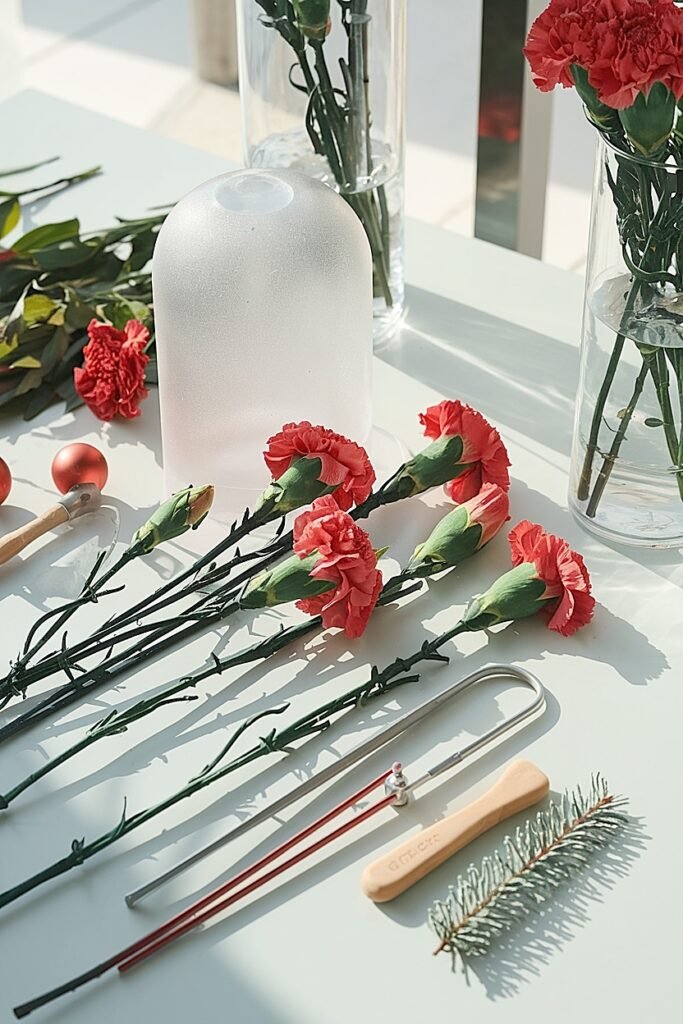
Most people buy one type of carnation and call it done. I get it , walking into a grocery store floral section isn’t the time for deep horticultural contemplation. But spending an extra few dollars on a small bunch of spray carnations alongside your standard stems opens up a whole different level of design flexibility that’s hard to replicate any other way.
Standard carnations are big, round, and visually heavy. They anchor a design and give it presence. But line up five or six of them together at the same height and the arrangement starts to look flat , like a row of red pompoms. Mini carnations (spray carnations) break that monotony without fighting for attention. They’re delicate enough to tuck into gaps and soft enough to create a natural transition between the bold focal blooms and the magnolia greenery.
How I use them together:
- Standards as focal points, place these at the center and slightly elevated in the design; they’re the first thing the eye lands on
- Minis as fillers, nestle them in the spaces between standards and around the edges; they should feel like supporting cast, not competing leads
- Varying stem heights matters, cut standards to three or four different heights so the bloom cluster has dimension, then let the minis fall slightly lower
- Color variation is subtle but real, standard and mini red carnations from different growers can differ slightly in hue; use this to your advantage by grouping similar tones together rather than mixing them randomly
One arrangement I build fairly often uses five standard red carnations and one bunch of spray carnations (which typically has 5–7 stems per bunch). I cut the standards to a graduated height range of about four inches and cluster them off-center in a low bowl. Then I cut the spray stems shorter and fill the space around them, letting a few minis spill over the edge of the container. The magnolia leaves go in last, tucked in low and angled outward. The whole thing takes maybe 20 minutes once everything is prepped.
The interplay between the two sizes creates a visual rhythm that a single-variety arrangement just can’t achieve , and it’s the kind of detail that makes someone look at your table and wonder how you did it. There’s a lot more to cover when it comes to the greenery side of this pairing, so keep reading.
Easy Ideas for Using Magnolia Leaves as Christmas Arrangement Greenery
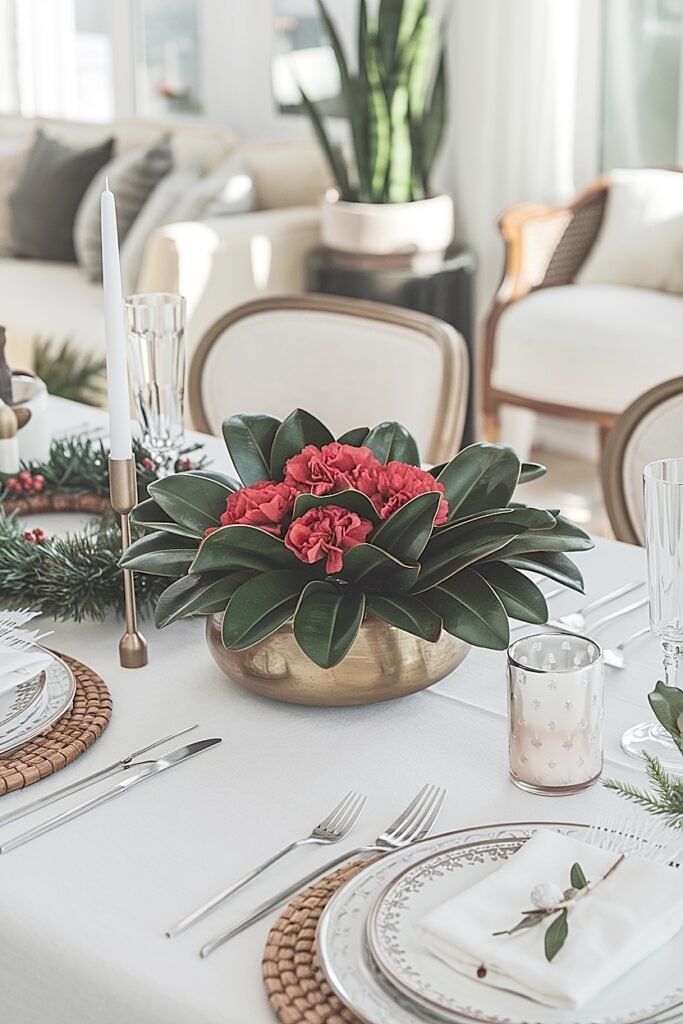
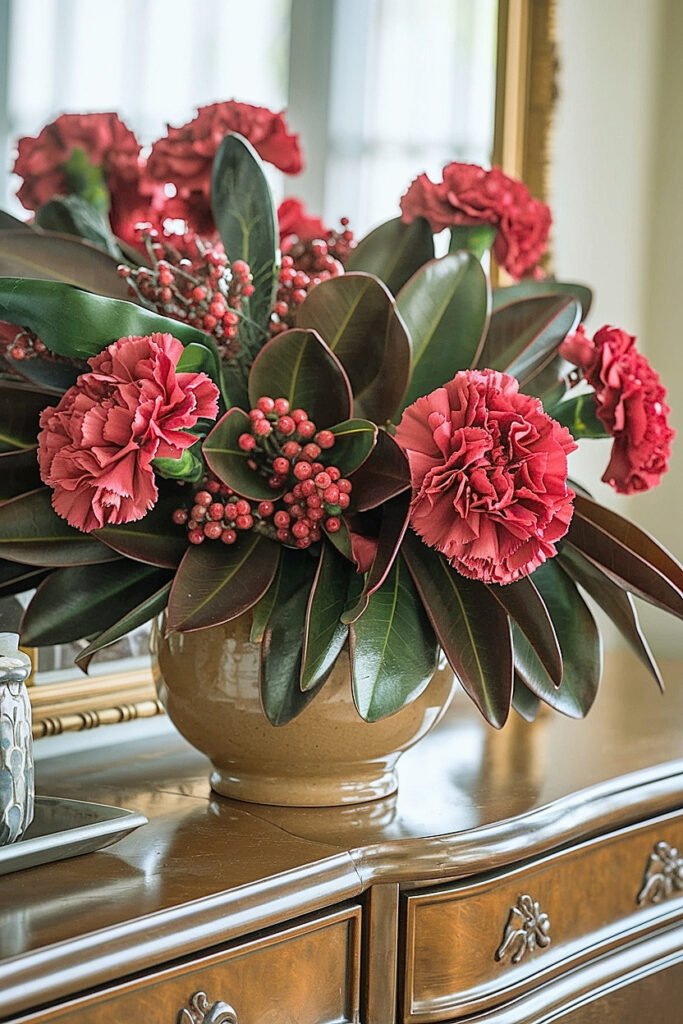
Here’s something I didn’t understand for a long time: magnolia leaves are not just filler. They’re not the green background you stuff in around the flowers so the arrangement doesn’t look bare. Used correctly, they’re a design element with as much visual weight as the carnations themselves , and they can completely shift the mood of an arrangement based on one simple choice.
The glossy topside of a Southern magnolia leaf is a deep, polished green with a slightly waxy surface. It looks modern, clean, almost architectural. Flip that same leaf over and you get a velvety, rust-colored brown with visible veins , warm, organic, and rustic. That’s two distinct design directions from the same leaf. I use the green side in arrangements meant for contemporary or minimalist spaces and the brown side in anything that’s going for a cabin-in-the-woods, old-farmhouse kind of feel.
Practical tips for working with magnolia leaves:
- Fresh-cut magnolia leaves from the tree last a surprisingly long time , weeks, sometimes longer , but they do curl as they dry; if you want them flat, press them under a heavy book for 24 hours before using
- Magnolia leaves on branches (with the branch still attached) add movement and height that single cut leaves can’t; if you have access to the tree, cut small branches rather than individual leaves
- Vary the leaf sizes , mature leaves can be 8–10 inches long; smaller juvenile leaves give you more flexibility in tight designs
- The stems on cut leaves can be inserted directly into floral foam or a flower frog; for loose water vase arrangements, wire them to a pick or lean them against the vase interior
I’ve also found that preserved magnolia leaves , the kind sold at craft stores, usually glycerin-treated , hold their shape and color for months and work beautifully in non-water arrangements like wreaths, garlands, or decorative bowls. They’re worth keeping on hand even after the fresh season ends.
The way magnolia leaves interact with carnations at different heights and angles is something worth experimenting with before you build your final arrangement , and the next section goes deeper on one of my favorite specific designs.
Creative Ways to Build a Low Red Carnation Magnolia Centerpiece
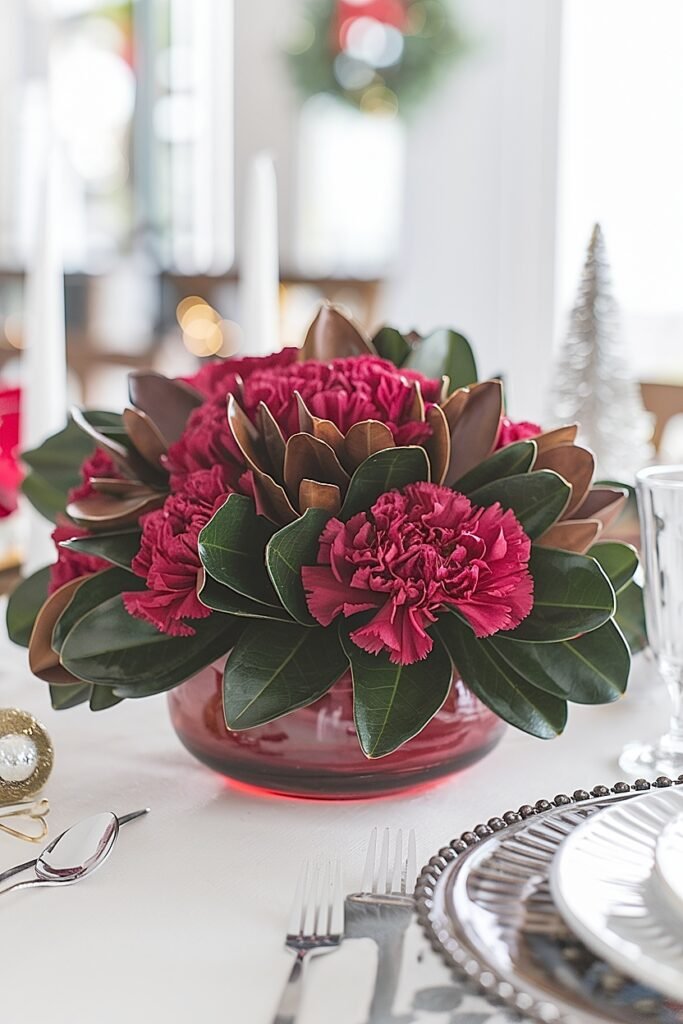
A low centerpiece , something that sits at or below eye level when guests are seated , is one of the most practical and underrated holiday table designs. It doesn’t block conversation across the table, it scales well to both small and large surfaces, and it actually looks more intentional than a tall arrangement in a lot of settings. This is where red carnations and magnolia leaves really shine together.
The mechanics of a low design are different from a tall one. You’re working horizontally rather than vertically, which means the sides of the arrangement matter just as much as the top. Every angle needs to look finished. That changes how you place both the flowers and the greenery.
A simple low centerpiece I come back to often:
- Start with a low, wide container, a shallow bowl, a wooden tray, or even a terracotta saucer works well; fill it with floral foam that’s been fully soaked
- Lay magnolia leaves flat around the outer edge first, overlapping them slightly and pointing outward; alternate green-side-up and brown-side-up for texture contrast
- Insert standard carnation stems at slightly varying heights near the center, aim for a gently domed shape rather than a flat top
- Fill gaps with spray carnations, keeping them lower than the standards
- Tuck a few small magnolia leaves vertically between carnation stems in the center to add depth and break up the all-red middle
One detail that makes a real difference: lean a few large magnolia leaves at an angle against the outside of the container so they appear to spill outward. It softens the edge of the bowl and makes the whole design look less “planted” and more natural. I saw a florist do this at a wedding reception years ago and I’ve used it ever since.
There’s a lot more you can do with proportion and balance once you get comfortable with the basic structure , the following sections dig into exactly that.
Simple Ways to Balance Red Carnations With Broad Magnolia Leaves
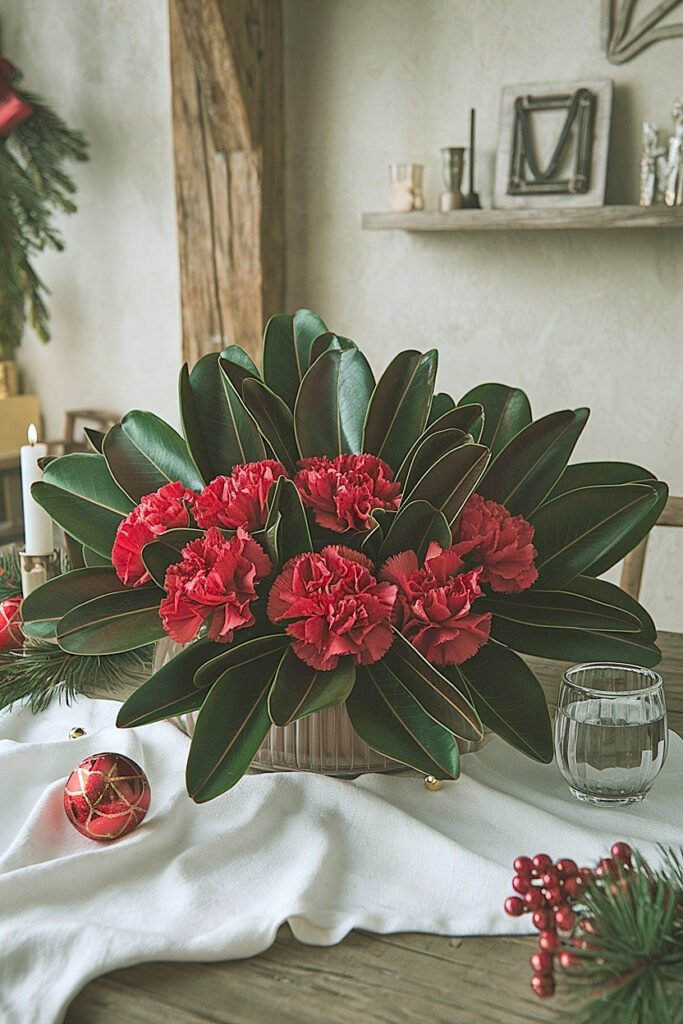
Balance in floral design doesn’t mean symmetry. That’s the part that trips people up. A perfectly mirrored arrangement can look stiff and artificial , like a hotel lobby display from 2003. What you’re actually aiming for is visual weight balance, which is a subtler and more interesting thing to achieve.
Red carnations are visually heavy. The color red commands attention, and the round, dense shape of a carnation adds to that weight. Broad magnolia leaves, by contrast, are flat and linear , they have visual weight too, but it’s distributed differently. The goal is to use the leaves to stabilize the composition without flattening it.
Some approaches that work well:
- Anchor with leaves, elevate with blooms, place the largest magnolia leaves low in the arrangement and let the carnation cluster rise above them; this grounds the design and keeps it from looking top-heavy
- Offset asymmetry, if your carnation cluster sits slightly right of center, balance it with a large magnolia leaf extending to the left; the eye reads them as counterweights
- Use leaf size deliberately, large leaves near the base read as heavy anchors; small leaves tucked high near the blooms read as light accents; mix them accordingly
- Don’t mirror the leaves, two identical leaves placed symmetrically on either side look forced; vary the size, angle, and how much of each leaf is visible
One thing I’ve noticed is that arrangements with an odd number of carnation stems , three, five, or seven , tend to balance more naturally than even numbers. Even numbers want to split into pairs, which pushes the design toward symmetry. Odd numbers create a natural cluster that’s easier to work with. It’s a small detail, but it holds up consistently.
The next section takes everything in this post and applies it to a specific, popular design format , keep reading.
Ideas for Creating a Red Carnation Focal Cluster With Magnolia Foliage
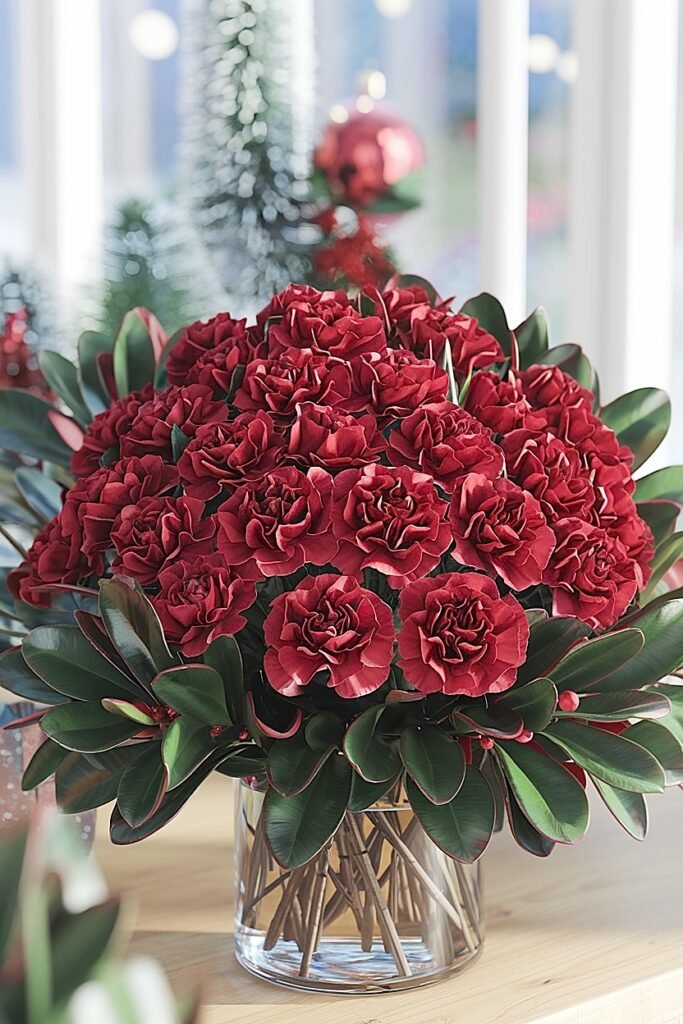
A focal cluster is exactly what it sounds like: a concentrated grouping of blooms that pulls the eye immediately when someone looks at the arrangement. It’s one of the most classic structures in Western floral design and also one of the easiest to execute well with carnations because their round, layered shape is naturally suited to this kind of dense grouping.
The key to a strong focal cluster isn’t just packing flowers together. It’s creating depth within the cluster so it doesn’t read as a flat wall of red. That’s where cut stem length becomes critical , even small differences of half an inch between stems can create the illusion of three dimensions.
How to build a focal cluster with carnations and magnolia foliage:
- Start with your tallest stem placed just off-center, this is your apex and everything else is built relative to it
- Add two or three stems cut slightly shorter, placed around the apex at different compass positions (not just in front and behind, work all four sides)
- Cut the remaining stems progressively shorter, fanning them outward and downward from the center cluster
- Insert magnolia leaves at the base of the cluster, angled low and outward, these frame the cluster from below and stop the eye from falling off the edge of the arrangement
- Tuck one or two small leaves vertically between carnation stems in the interior of the cluster to create shadow and depth
Where I’ve seen this technique fall apart is when people treat it like a bouquet , holding it in one hand and trying to arrange it in the other before placing it in the container. Much better to work directly in the vessel, stem by stem, adjusting as you go. It’s slower but the result is more controlled.
This same focal cluster structure translates directly to vertical arrangements, which is where the next section picks up.
How to Create an Upright Red Carnation Magnolia Entryway Arrangement
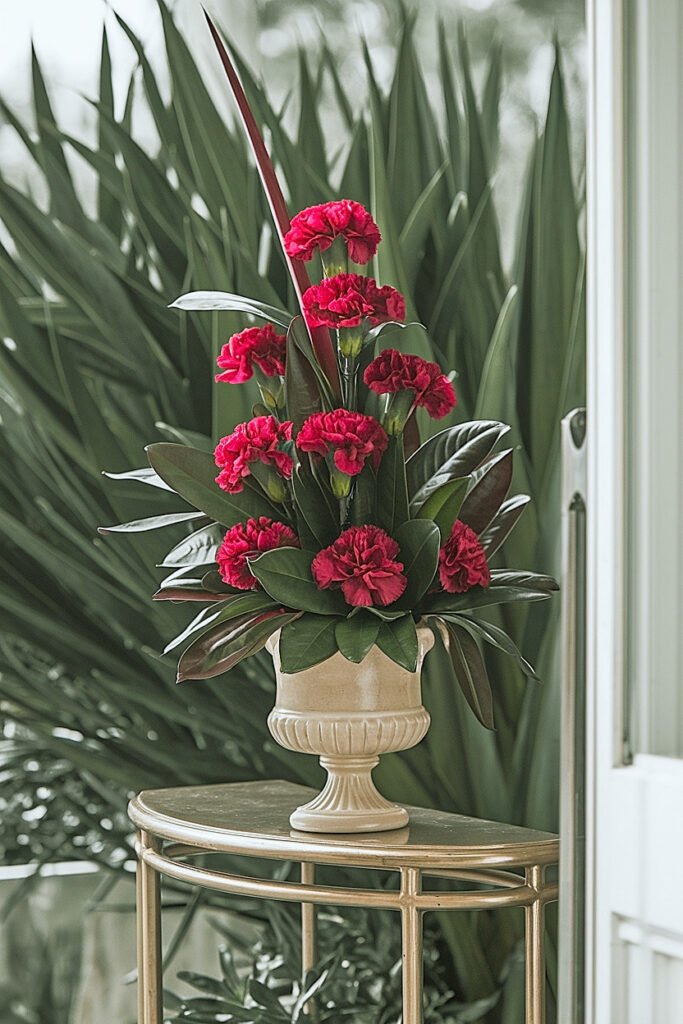
An entryway arrangement has a job that a table centerpiece doesn’t: it needs to look great from a distance, hold up to the quick glance as someone walks past, and make a strong first impression without being fussy. Tall and upright tends to work better here than low and wide, because it reads clearly even from down the hall.
For this design, I work with a tall, narrow vessel , something between 10 and 16 inches high , and a combination of standard carnation stems, a few magnolia branches (not just leaves), and ideally a few stems of something like pine, eucalyptus, or cedar if I have it on hand. But the carnation-magnolia pairing alone handles this well if that’s all you’ve got.
Building an upright entryway arrangement:
- Establish the height first, cut one or two magnolia branches to your tallest intended height (roughly 1.5x the height of the vase is a good starting rule) and place them at the back of the vessel; these define the silhouette
- Add the carnations in a graduated cluster, place your tallest carnation stem about two-thirds the height of the magnolia branches; work downward from there, building a cluster that peaks in the upper-middle zone
- Layer magnolia leaves at the base, large leaves angled outward low in the vase hide the mechanics and create a full base that keeps the design from looking like a bunch of stems in a jar
- Don’t fill every inch, upright arrangements benefit from negative space; a few visible gaps between stems make the design feel intentional rather than crammed
One thing worth noting about entryway placement: arrangements near a front door deal with drafts and temperature changes more than anything inside. Carnations handle this reasonably well compared to more delicate flowers, but keeping the vessel topped up with water and away from direct heating vents will buy you extra days of life.
The principles behind this upright structure also scale down beautifully , which the next section covers in detail.
Easy Ideas for Scaling Red Carnation Magnolia Arrangements for Small Spaces
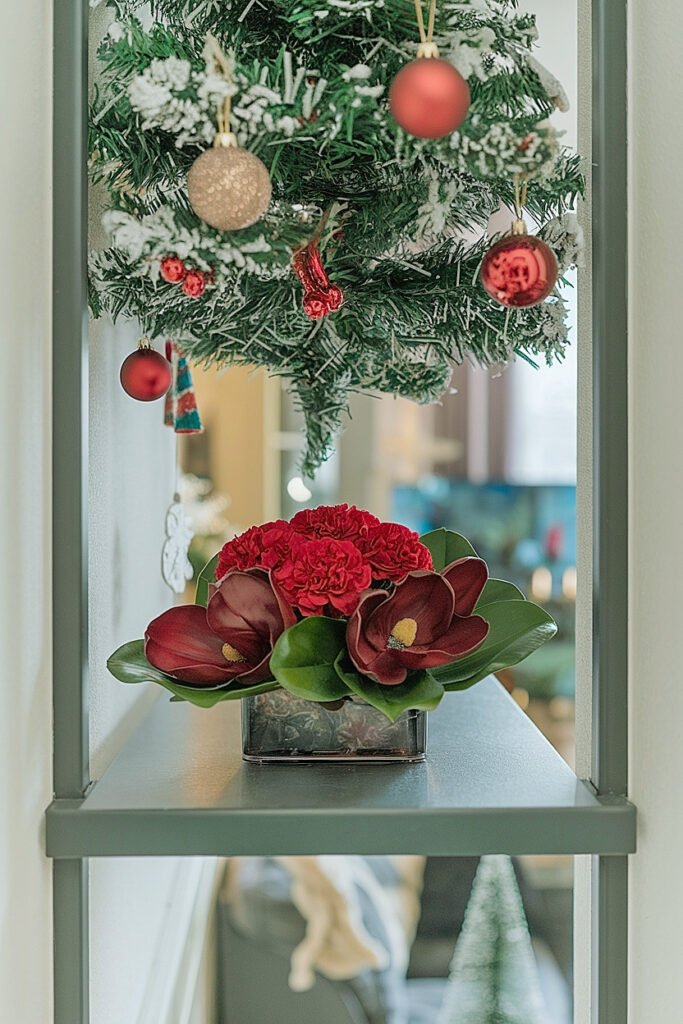
Not every room has a farmhouse dining table or a wide entryway console to work with. I’ve lived in a small apartment, I know how it goes , a full arrangement that looks appropriate in a large home can swallow an entire bathroom counter or make a little kitchen nook feel claustrophobic. Scaling down isn’t just a matter of using fewer flowers. It’s a different way of thinking about proportion and container choice.
The good news is that red carnations are extremely forgiving at small scale. A single standard carnation in a short bud vase with two or three magnolia leaves can look genuinely elegant. The key is that every element needs to be working , there’s nowhere to hide a bad stem or an out-of-place leaf when you’re only using a handful of materials.
Small-space arrangement ideas that actually work:
- Single stem bud vase cluster, group three small bud vases of different heights close together on a windowsill or bathroom shelf; put one carnation in each with a magnolia leaf or two; the grouping reads as one cohesive arrangement even though it’s technically three separate vases
- Floating bowl, a shallow dish with just an inch or two of water can hold a few carnation heads (cut the stems very short, just below the bloom) and a few magnolia leaves laid flat on the surface; simple, modern, and it lasts well
- Wrapped single-stem arrangement, one or two carnations with three or four magnolia leaves, stems wrapped in twine, resting in a short glass with about two inches of water; set it on a side table, a bookshelf, a stair step , it works anywhere
- Mini wreath accent, a small wreath form wrapped in magnolia leaves with four or five carnation stems wired in; keep it under 8 inches in diameter and hang it inside over a mirror or from a cabinet door
The container choice at small scale matters more than at large scale. A little clay pot, a vintage teacup, a small mason jar , these contextual vessels add personality that a generic glass vase doesn’t. Don’t underestimate what the right container does for a small design.
There’s genuinely a lot of creative territory to explore with this combination even at small scale , once you’ve got the proportions down, the variations are endless.
Conclusion
Red carnations and magnolia leaves are a pairing that consistently delivers more than it promises. The flowers are affordable and long-lasting. The leaves are often free if you have access to a magnolia tree, and they hold up for weeks once cut. Together they cover a wide range of design needs , from a casual kitchen table centerpiece to a statement entryway arrangement that holds its own against anything a florist might put together.
What I keep coming back to is how much the details matter with this combination. Which side of the magnolia leaf you use. Whether you buy tight buds or open blooms at the store. Whether you mix in a bunch of spray carnations alongside the standards. None of these are complicated decisions, but each one shifts the final result in a real way.
Start simple. Pick up a bunch of red carnations, grab some magnolia foliage, and put something together on your kitchen counter. It doesn’t need to be perfect the first time , that’s not the point. The point is that by the time Christmas rolls around, you’ll know exactly what works in your space and what doesn’t. And that’s a much better place to be than scrambling for a last-minute centerpiece on December 23rd.
This website contains affiliate links, and some products are gifted by the brand to test. As an Amazon Associate, I earn from qualified purchases. Some of the content on this website was researched and created with the assistance of AI technology.