This website contains affiliate links, and some products are gifted by the brand to test. As an Amazon Associate, I earn from qualified purchases. Some of the content on this website was researched and created with the assistance of AI technology.
Key Takeaways
- Dried wheat, rye, and millet add height, texture, and movement to fresh fall arrangements without any water management
- The dried grain goes in first, always — it creates the structure that fresh stems build around, not the reverse
- One or two dried grain stems per arrangement is usually enough; more than that and the arrangement tips from designed into rustic-heavy
- Dried grains hold indefinitely at room temperature without water, which makes them ideal for low bowls and arrangements where you want some elements to outlast the fresh flowers
- The “too farmhouse” problem almost always comes from using too many grain types at once; pick one and let it do its job
- Narrow table runners benefit from dried grains more than any other arrangement context because the vertical grain stalks create a visual rhythm that flat flower-only runners lack
Most people walk past the dried wheat at the farmers market and go straight for the flowers. That is their loss.
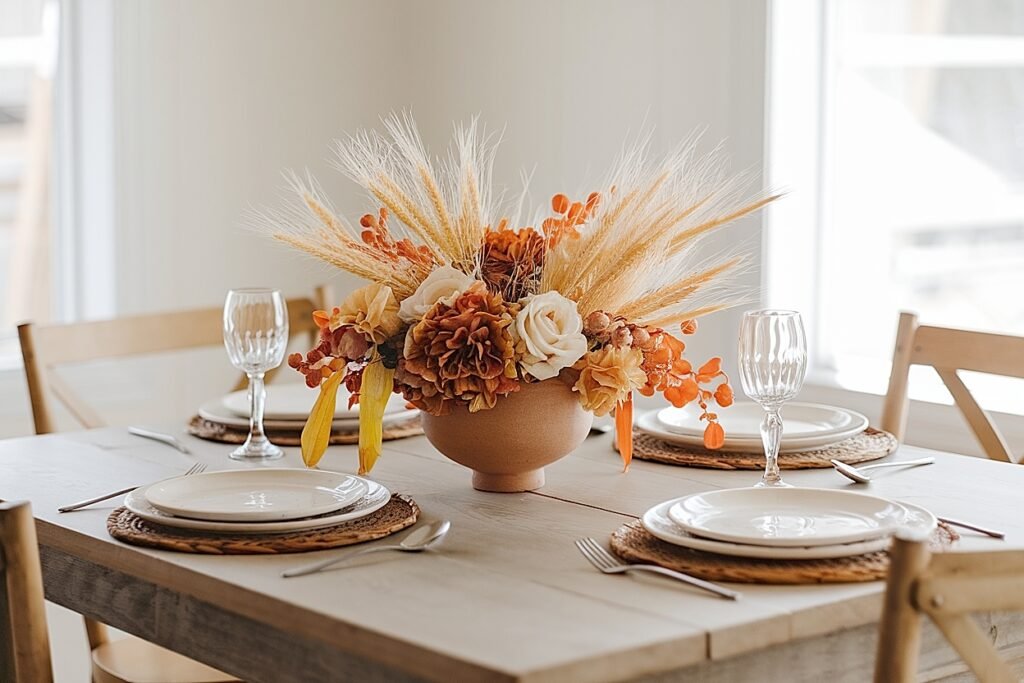
Using dried grains in fall flower centerpieces is the design move that separates an arrangement that looks like fall from one that smells like a grocery store. Fresh flowers alone in autumn are beautiful. Dried wheat, rye, millet, or oats tucked in alongside them create something with actual seasonal weight — a specific, honest quality that no amount of orange and burgundy can manufacture on its own. I’ve been building these combinations for years, and the dried grain almost always earns the most comments from guests.
Use this quick guide to choose the right dried grains for Fall Flowers centerpieces. Each grain creates a different look, from soft and relaxed to bold and rustic. The table helps readers match wheat, oats, millet, barley, and sorghum with the right flowers, table size, and styling purpose.
| Dried Grain | Best Fall Flowers Pairing | Design Effect | Small Table Tip |
|---|---|---|---|
| Wheat | Cream mums, rust mums, burgundy dahlias | Classic harvest texture with strong autumn warmth. | Trim stems short and tuck wheat near the outer edges. |
| Oats | Mauve asters, cream mums, pale pink chrysanthemums | Soft relaxed movement that feels gentle and natural. | Let oat stems curve around the sides, not upward. |
| Millet | Rust chrysanthemums, orange zinnias, pale sedum | Tiny dotted texture that adds detail without bulk. | Use firm intact stems and keep them away from plates. |
| Barley | Burgundy dahlias, rust carnations, cream chrysanthemums | Feathery texture with a softly elegant harvest look. | Angle barley outward from a low ceramic bowl. |
| Sorghum | Bronze mums, burgundy carnations, orange zinnias | Bold rustic seed-head drama for deeper fall color. | Use only one or two seed heads so it stays balanced. |
Resources:
- PRINCIPLES OF FLORAL DESIGN – Sierra Floral Designs
- Principles And Elements Of Floral Design – Florists’ Review
- Tigard Florist – Flower Delivery by Flowers By Donna
- Alternatives to Mums: Beautiful Fall Blooming Perennials
- How to Keep Cut Flowers Fresh
How to Use Dried Wheat With Fall Flowers in Low Autumn Centerpieces
Dried wheat has a posture problem that most people never solve.
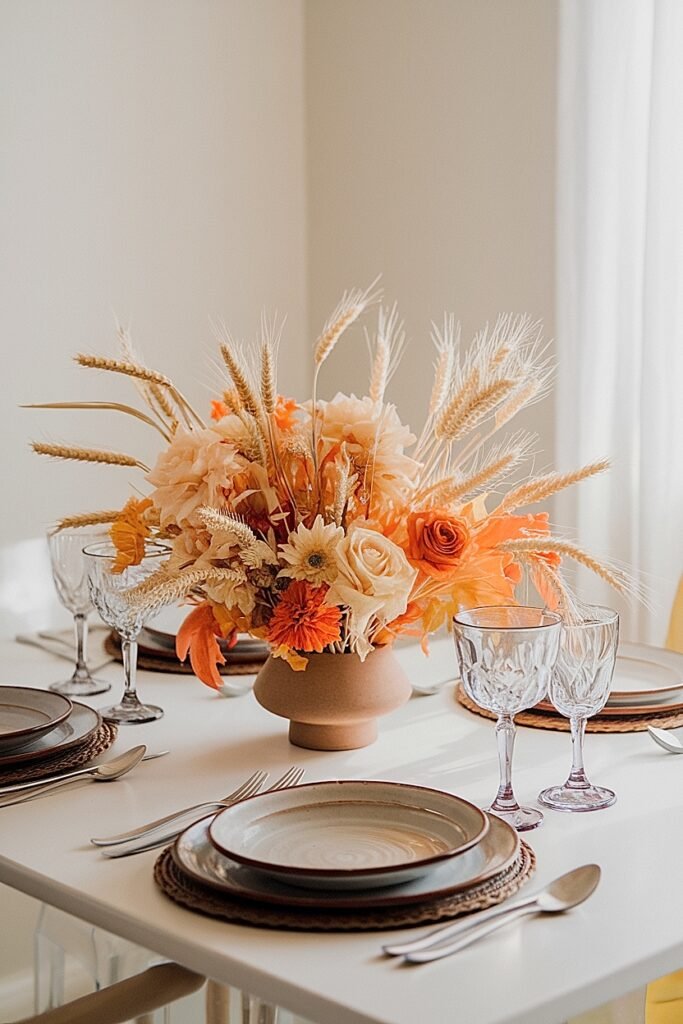
When you stick wheat upright in a vessel surrounded by shorter fall blooms, it looks like it wandered in from a different arrangement. Stiff, vertical, slightly awkward. The wheat that works in a low autumn centerpiece is wheat that does not try to stand straight. Lean the stalks outward from the vessel center at a thirty-degree angle before the fresh flowers go in. Let the grain heads extend beyond the vessel rim. The wheat creates a loose horizontal frame around the fresh blooms rather than rising above them.
The specific low centerpiece build I use: gravel base first, two inches deep, cold water over the gravel. Press two to three wheat stalks into the gravel at outward angles, one on each side. Then build the fresh flower arrangement in the center. The wheat frames the fresh stems from the outside. The fresh stems hold their positions without the wheat competing for the visual center.
Height matters differently at a dining table than at a display shelf. A low centerpiece means keeping fresh blooms at two to four inches above the vessel rim — but the wheat grain heads can reach another two to three inches beyond that without blocking sightlines if they angle outward rather than straight up. The silhouette reads as organic and gathered rather than planted and stiff. That outward lean is the single most important wheat-in-centerpiece technique I know.
Dried wheat does not need water. This sounds basic but it changes the arrangement logic significantly. In a low bowl where the water level might not reach all the stems anyway, the wheat gets placed in the gravel zone below the water line without any functional purpose. It just anchors. The fresh flowers get the water. The wheat gets the structure job, and it will still look exactly the same in ten days when the fresh flowers have been replaced.
For more on fall flower combinations for dinner tables, including the proportion rules for dark and cream flowers at intimate dinner settings, check out best burgundy and cream flower pairings for small fall dinner parties. Share this with someone who loves fall decorating. More ahead on which dried grains work best, how to mix rye for height, and what fresh flowers play nicely alongside each.
What Are the Best Dried Grains to Pair With Fall Flowers?
Before I get into specifics, one thing worth knowing: not all dried grains from craft stores are the same quality. The grain heads on lower-quality dried bunches shed heavily when handled. Good dried wheat and rye from a farmers market or a reputable floral supplier hold together without losing grain in your arrangement. Worth paying attention to before you buy.
1. Dried Wheat (Triticum aestivum) The most widely available and most versatile dried grain for fall flower work. The warm amber stalks and densely packed grain head suit both formal dinner arrangements and casual harvest table displays. Works at any height from rim-level to twelve inches above the vessel. The bristled awns on hard red wheat varieties add fine textural detail at close range that smooth-headed soft wheat varieties lack. Use one to three stalks.
2. Dried Rye (Secale cereale) Rye grows taller than wheat in the field and produces a longer, more dramatically arching grain head that behaves completely differently in an arrangement. The grain head droops slightly at the tip, creating a graceful curve rather than the upright stiffness of wheat. That arc is genuinely beautiful in tall or mixed-height arrangements, and it is specifically the detail that prevents a rye-and-flower combination from looking rigid or over-structured. Two.
3. Dried Millet (Panicum miliaceum) Millet spray is the grain that most people mistake for a grass or a filler flower. Each stem carries a loose, feathery cluster of tiny seed heads rather than a single structured grain head, which creates a cloud-like spray texture completely unlike wheat or rye. That spray quality fills visual space between upright elements in a mixed arrangement without adding structural weight. The warm amber-brown tone suits the full autumn.
4. Dried Oats (Avena sativa) Oat heads are smaller and more delicate than wheat, with individual husks that hang off the stem at soft angles creating a gentle swaying mass rather than the firm upright structure of wheat. They suit intimate small table arrangements better than large display pieces because the fine-scaled detail is only fully visible at close range. The pale straw-yellow color reads lighter and fresher than wheat amber, which makes oats the.
5. Dried Barley (Hordeum vulgare) Barley’s long, whisker-like awns, the fine bristles extending outward from each grain, create the most tactile and visually complex grain head of any common dried variety. At close dinner table range those awns catch light from multiple directions simultaneously, creating a fine-textured halo around the grain head that no other dried grain replicates. Barley suits candelit autumn dinner settings specifically because the awn texture becomes more visible in warm directional.
More ahead on the balance between dried grains and fresh flowers, which is where most mixed arrangements go wrong.
How to Balance Dried Grains With Fresh Fall Flowers in Small Arrangements
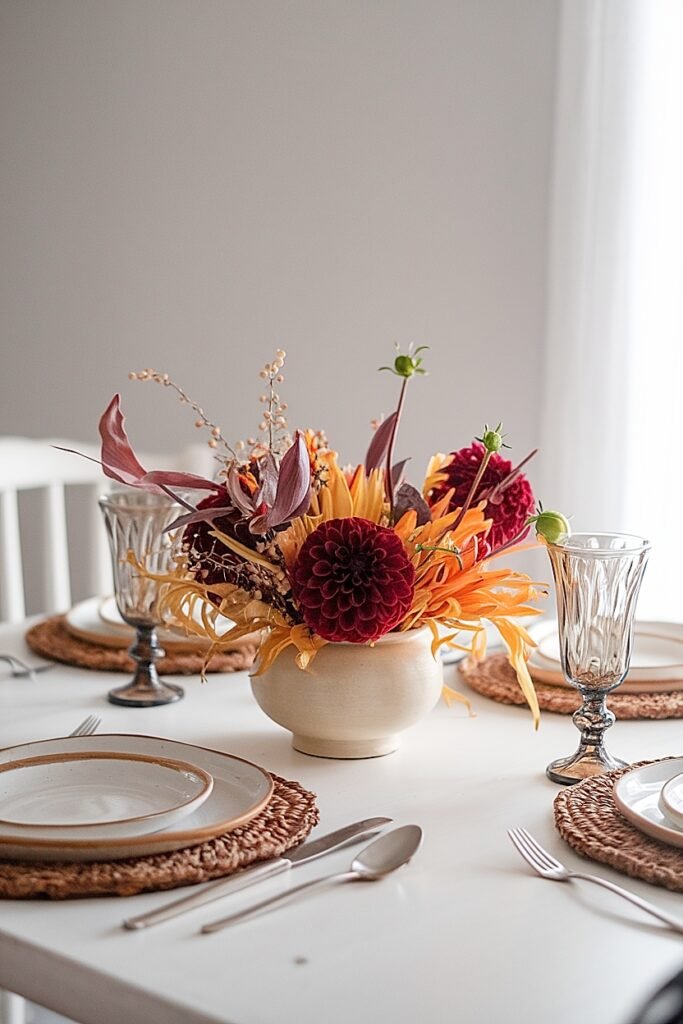
The ratio I always come back to: one dried grain stem for every three to four fresh flower stems. Not one-to-one. Not even one-to-two. The grain is an accent in a flower arrangement, not a co-star.
When dried grains take up more than about twenty-five percent of the visual mass in a mixed arrangement, something shifts. The arrangement stops reading as a fall flower display with a seasonal accent and starts reading as a harvest decoration with some flowers in it. Both things can be beautiful, but they are different aesthetics with different contexts. A fall dinner table centerpiece is almost always the former. A front porch display or a mantle piece can be the latter.
What the dried grain adds to a small fall arrangement that fresh flowers cannot: height without water management, movement without any mechanical support, and a texture that no cultivated flower replicates. A rye stalk arching out of a small dark vessel beside two cream dahlias creates three-dimensional space around the arrangement that blooms alone cannot generate. The grain head at the end of that arching stalk extends the arrangement’s visual boundary outward into the air around the vessel. That outward extension makes a small arrangement read larger than its physical stem count suggests.
The sequence matters. Dried grain goes in first. Always. Build the grain structure in the gravel or the vessel opening, get the positions and angles set, then build the fresh flower arrangement around and through the grain structure. If you put the fresh flowers in first and try to add grain after, you end up wrestling the grain stalks through an already-established arrangement and either dislodging the fresh stems or landing the grain in the wrong position.
There is more ahead on using rye specifically to add vertical height to compact fall arrangements.
Easy Ideas for Mixing Dried Rye With Fall Flowers for Height
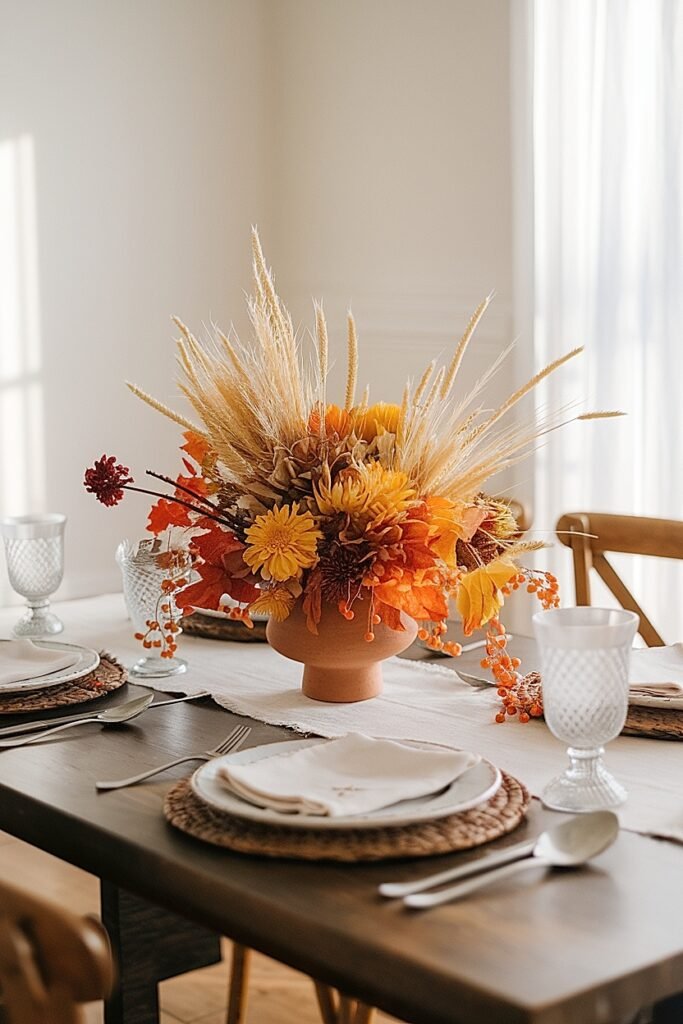
1. Two Rye Stalks Behind Three Dahlias in a Dark Pitcher Two arching dried rye stalks pressed into the back of the vessel behind three deep burgundy or cream dahlia stems in a short dark pitcher. The rye reaches above the dahlia bloom level and arcs outward. The dahlias sit at mid-height in front of the rye silhouette. The rye curves.
2. Single Rye Stalk as the Arrangement’s Apex One tall rye stalk at the arrangement center creating the highest visual point, with five to six shorter fall blooms packed around it at varying heights below the grain head. The single rye apex creates a natural silhouette without requiring a tall flower stem at the top. The grain head.
3. Rye Leaning Against the Vessel Exterior Dry the rye stalk cut end and lean it against the outside of the vessel with the grain head resting at the arrangement top. No water needed for the rye. The arrangement interior holds only fresh stems in water. The exterior rye element creates a visual accent without any mechanics,.
4. Rye Spray Tucked Through a Wreath Base Three rye stalks threaded through a simple vine or twig wreath base alongside fresh fall flower stem tubes or water picks inserted into the wreath foam. The rye creates diagonal movement across the flat wreath face. The fresh flower picks maintain bloom hydration within the wreath structure. The combined dried-and-fresh.
5. Mixed Rye Heights in a Narrow Bottle Four rye stalks at two different cut heights, two tall and two shorter, in a heavy narrow bottle with gravel ballast. No fresh flowers. Just rye at varied heights with one dried panicum millet spray tucked between the stalks. The arrangement occupies about two inches of table surface and reads.
More ahead on which fresh fall flowers actually work well with dried wheat rather than fighting its texture.
What Are the Best Fall Flowers to Pair With Dried Wheat Stems?
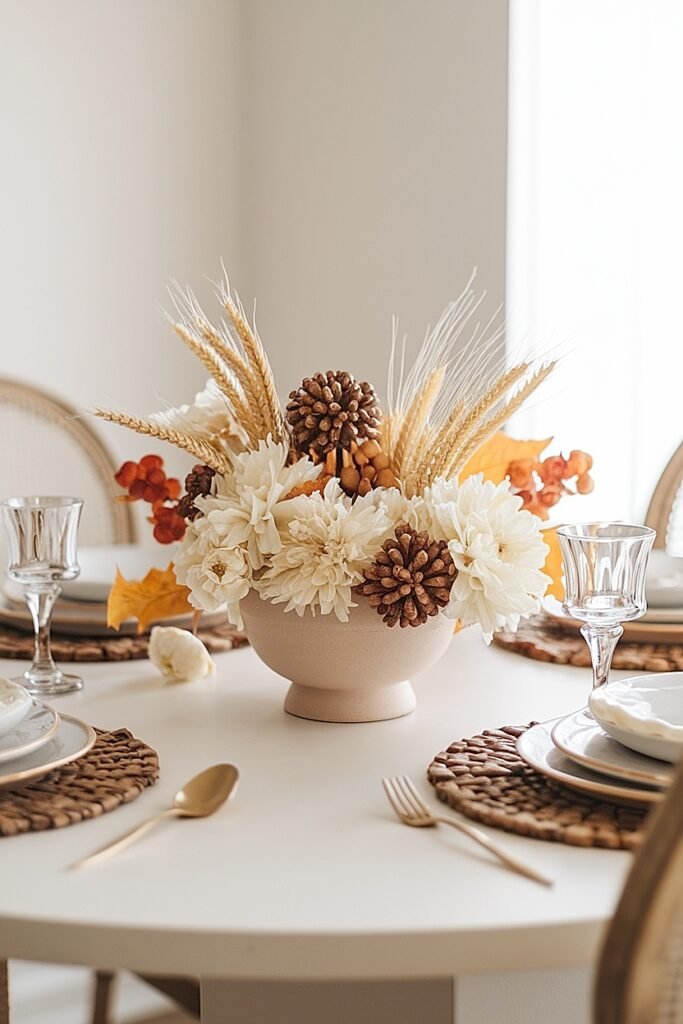
1. Cream or Ivory Pompom Dahlias The dense, round cream dahlia bloom sits in the same warm tonal family as dried wheat amber without matching it exactly. The dahlia’s smooth rounded surface creates direct texture contrast with the bristled wheat grain head at close autumn dining range. At arm’s length, a cream dahlia beside a wheat.
2. Deep Burgundy Chrysanthemums The rich wine-red pompom mum against golden wheat creates the highest color contrast of any flower-and-grain pairing in this list. The warm amber wheat head and the cool burgundy bloom sit on opposite sides of the warm-dark spectrum, each making the other more vivid by comparison. The mum’s dense spherical.
3. White Anemones with Dark Centers White anemones with their distinctive near-black center rings create a graphic, clean pairing beside warm wheat that reads as deliberately styled. The cool white anemone bloom reads as a graphic counterpoint to the warm grain. The dark center pulls the eye and creates visual interest within the arrangement at close.
4. Rust or Burnt Orange Zinnias The warm color relationship between rust zinnia and amber wheat is one of the most cohesive and least predictable fall pairings available at grocery store pricing. Both warm amber and rust orange exist in the same color family without being the same color, creating harmony rather than contrast. The zinnia’s.
5. Pale Mauve or Dusty Rose Asters The dusty-rose aster beside golden wheat creates a fall arrangement that reads as soft and considered rather than vivid and seasonal-obvious. The mauve undertone in the aster bloom cools the warm wheat amber slightly without clashing, creating a quiet palette that suits intimate small dinner tables specifically. One bunch of.
More ahead on keeping this look away from the farmhouse aesthetic that most dried grain arrangements default to.
How to Style Dried Grains With Fall Flowers Without Looking Too Farmhouse
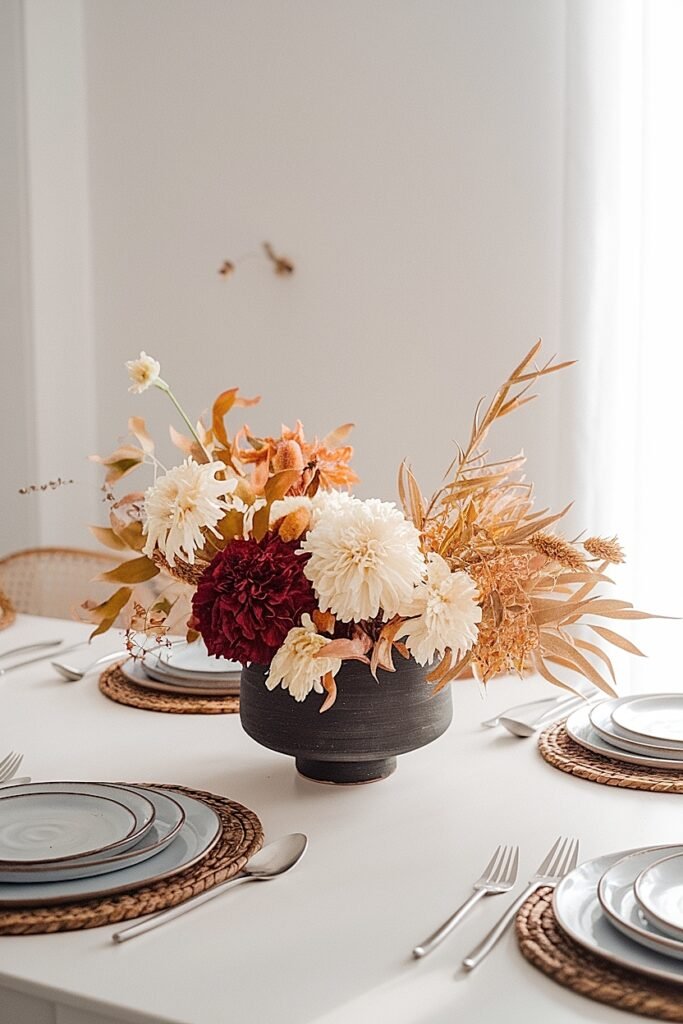
Here is where most dried grain arrangements go sideways. Too many grain types. Too much volume. A wide-mouthed mason jar. Burlap somewhere. Suddenly it’s a roadside stand display rather than a dinner table centerpiece.
The farmhouse look is not bad — it is just a specific aesthetic that suits specific settings. A fall dinner table, especially one with dark linens, matte black or navy vessels, and careful flower selection, is not that setting. The grain needs to be disciplined to stay within a different register.
Three rules that keep the look elevated. First: one grain type per arrangement. Not wheat and rye and millet together. Pick one. The visual clarity of one grain type in a mixed grain-and-flower arrangement is always more sophisticated than three grain types trying to coexist. Second: dark vessel over rustic vessel. A navy ceramic crock with wheat and dahlias reads as contemporary-seasonal. A mason jar with the same materials reads as farmhouse brunch. Same flowers, same grain, entirely different register. Third: let the flowers lead in volume. More flowers than grain, always. The grain creates structure. The flowers create identity.
The one styling detail that crosses the line faster than any other: jute twine wrapped around the vessel. I understand the impulse. It finishes the vessel, it is affordable, it is accessible. It also immediately reads as crafted-rural in a way that undermines everything else in the arrangement. Use the vessel’s own character. Dark glaze, warm terracotta, matte metal. The vessel is already doing the job.
Ideas for Dried Grains and Fall Flowers in Narrow Table Runners
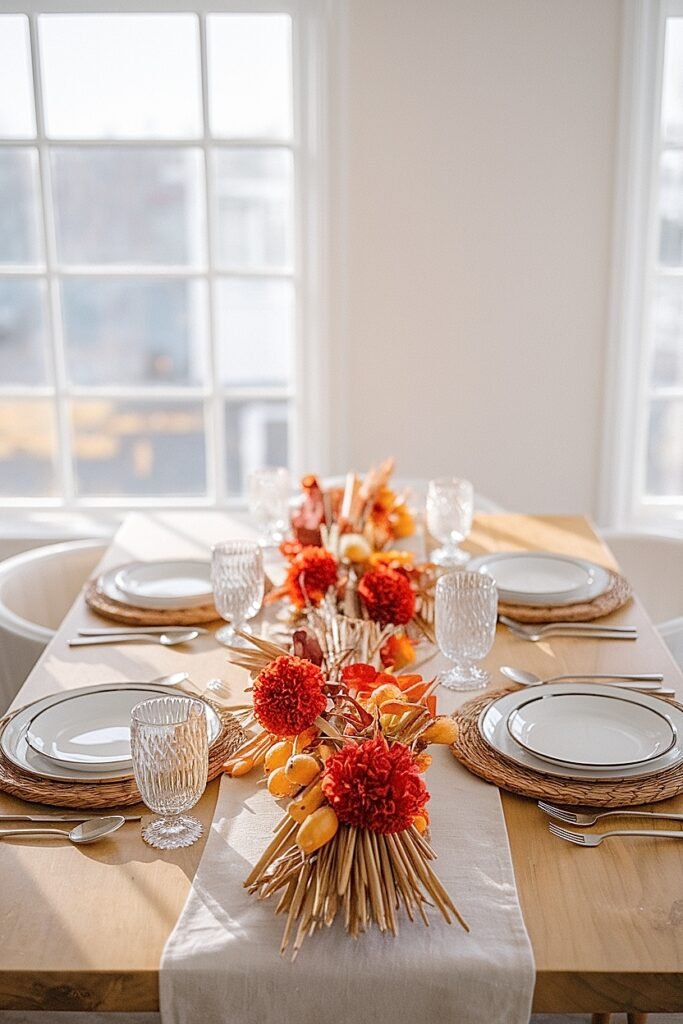
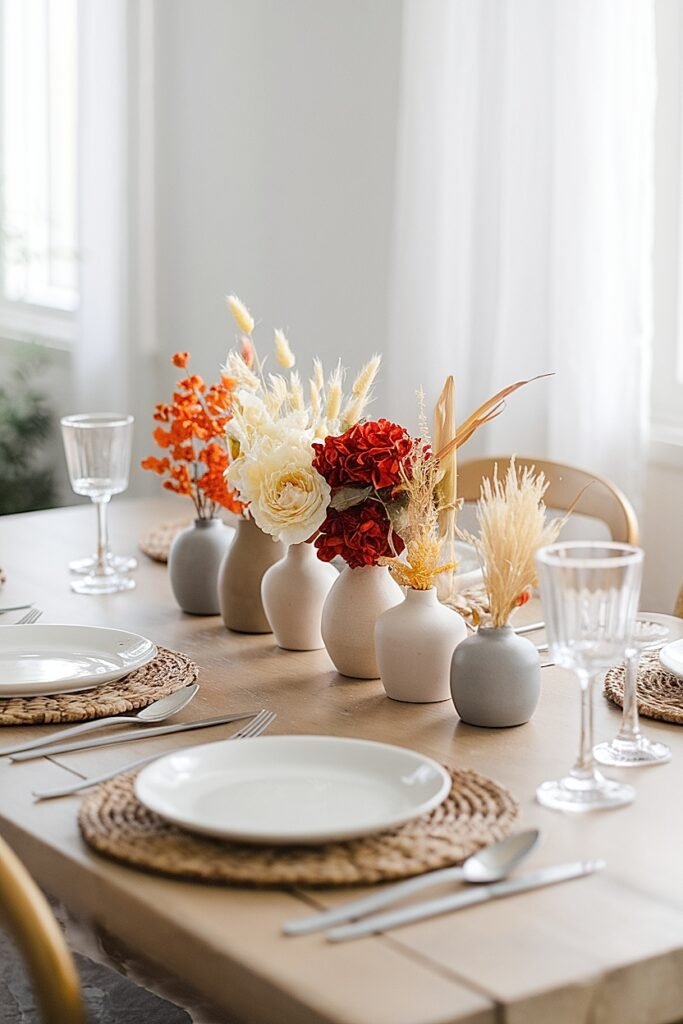
1. Alternating Wheat Stalks and Flower Stems Laid Flat Six to eight dried wheat stalks and eight to ten fresh fall flower stems laid alternating and flat along the center of the table runner rather than placed in vessels. The wheat stalks create structure between the loose flower stems. The flat runner arrangement takes zero height off the table.
2. Three Low Vessels in a Row with Wheat Accent Three short dark ceramic vessels in a row along the table center, each holding two to three fresh fall flower stems, with two dried wheat stalks laid horizontally between the vessels along the table surface. The horizontal wheat creates the connecting visual thread that makes three separate small vessels read.
3. Single Wheat Bundle Flanked by Bud Vases A bound bundle of seven to nine wheat stalks tied with natural twine, laid flat at the center of the runner, flanked by one small bud vase on each side holding one fall flower stem each. The wheat bundle creates visual mass. The bud vases create color. The whole thing.
4. Dried Grain and Flower Heads Scattered Loose Individual dried millet sprays and individual fresh fall flower heads, stems removed, scattered loosely across the full table runner surface between the place settings. No arrangement structure at all. The millet moves in any air current from conversation or passing dishes. The flower heads sit still between them. The combination.
5. Alternating Candle and Wheat Groupings Three taper candles at even intervals along the table center, with two dried wheat stalks leaning against each candle base and one small fresh flower stem beside each candle in a weighted bud tube. The candle creates warm light. The wheat creates autumn character. The fresh flower creates color. Each.
Conclusion
Dried grains do something for fall flower arrangements that nothing else does. They add the season’s actual history — the harvest, the field, the specific quality of October air — in a way that even the most vivid autumn bloom cannot manufacture.
One wheat stalk. One cream dahlia. One dark vessel. That is a fall arrangement with a point of view.
The grain earns its spot not by dominating but by being specific. And specific, in any creative work, is always better than general.
This website contains affiliate links, and some products are gifted by the brand to test. As an Amazon Associate, I earn from qualified purchases. Some of the content on this website was researched and created with the assistance of AI technology.