This website contains affiliate links, and some products are gifted by the brand to test. As an Amazon Associate, I earn from qualified purchases. Some of the content on this website was researched and created with the assistance of AI technology.
Key Takeaways
- White fall flowers need a dark vessel to read as intentional at close autumn dinner range. White in a clear or light container against a white tablecloth is nearly invisible
- The arrangement should never touch any dinnerware. A six-inch clearance between the outermost bloom and the nearest plate edge is the working standard
- Width matters more than height for white fall flower dinner arrangements. A wide low arrangement reads as full and does not block sightlines. A tall narrow arrangement blocks views and does not give the white bloom quality room to show
- Individual small clusters at each table end rather than one shared centerpiece frees the entire serving zone and creates a more personal dining detail per guest
- White flowers benefit specifically from being near candlelight at autumn dinner scale. The glow quality of white petals in warm directional light is the main visual justification for choosing white in October
The flowers stayed on the table through the entire meal. That was the first time that had happened.
Creating small white flower autumn centerpieces that leave room for dinner requires solving two problems at once. The first is scale: the arrangement has to fit the surface that is left after plates, glasses, serving dishes, and water pitchers claim their positions. The second is specific to white flowers: white reads differently depending on what is near it, and an arrangement that sits too close to a serving dish or a white dinner plate loses its visual identity entirely by blending into the surrounding white context. Position and scale matter more for white fall flower centerpieces than for any other color.
White flowers also reveal every stem-positioning decision more clearly than colored ones. A gap between two white aster blooms shows more obviously against a dark background than the same gap would with mauve asters. The arrangement has to be built more carefully and the vessel has to be chosen for contrast rather than neutrality.
Use this dinner-clearance guide before choosing a white autumn centerpiece layout. Each row compares a common table situation, the most practical flower position, a suitable vessel format, and the dining benefit. The goal is a bright, decorative table that keeps plates, shared food, utensils, cups, and conversation comfortably accessible.
| Dinner Table Situation | Best Flower Position | Recommended Format | Dining Benefit |
|---|---|---|---|
| Large shared serving bowl occupies the middle | Rear corner or opposite short ends | One off-center bowl or two coordinated mini vessels | Keeps the central serving route completely accessible |
| Two place settings nearly fill a square table | Small space between the cups and rear table edge | One narrow ceramic vessel with compact white flowers | Adds a focal point without touching plates or utensils |
| Bread, vegetables, and main dish share the tabletop | Open gaps between serving pieces | Three tiny coordinated flower clusters | Frames the meal while preserving several serving paths |
| Narrow rectangular table with limited width | Slim line along one edge or diagonal corners | Two or three narrow mini vessels | Protects plate depth and keeps the table visually open |
| Meal plan may change after the table is arranged | Flexible spaces beside napkins or cups | Lightweight movable bowls or mini vessels | Allows fast adjustment when another dish is added |
Resources:
- Cut Flower Care — McIntosh Field & Flower
- LOS ANGELES Florist | Flower Delivery by LA Floralista
- Selecting & Caring for Cut Flowers – Gardening | NC State Extension
- Gilly Flowers | Los Angeles, CA | Bespoke Floral Arrangements – GillyFlowers
How to Determine the Right Width for White Fall Flower Dinner Centerpieces
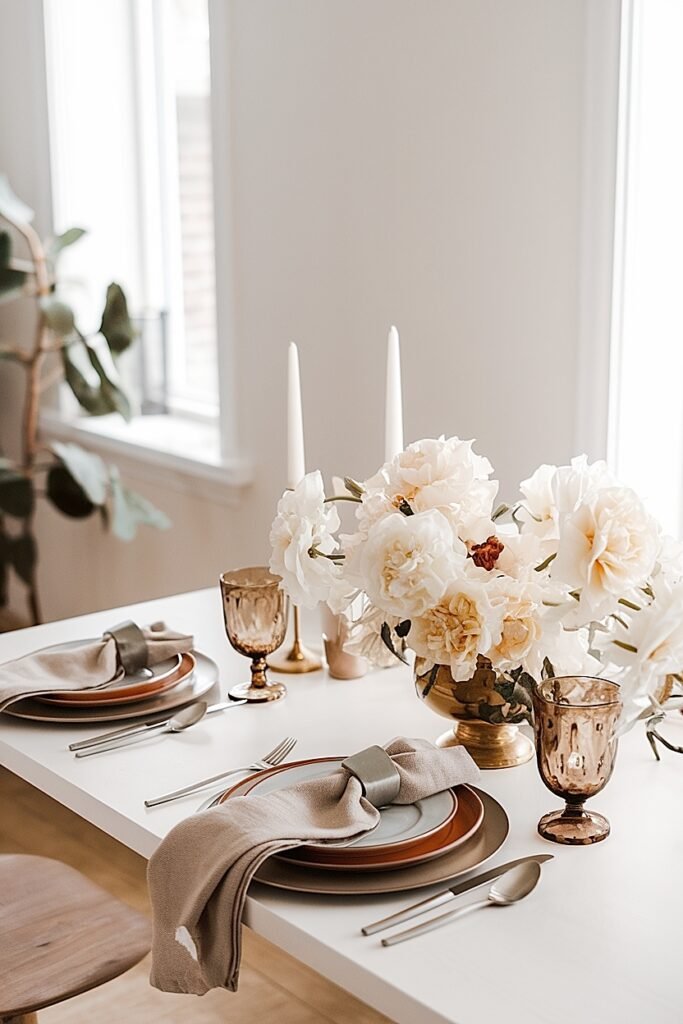
Set the table first.
Not hypothetically. Actually set it. Plates, glasses, water pitchers, bread plates, the serving dish you plan to use for the main course, the salad bowl if one is coming, the butter dish. Whatever is going on that table, put it on the table in the position it will actually occupy during dinner.
Now look at what is left. The uncovered area in the center of the table, between the two place settings or between the place settings and the serving dishes, is the footprint the arrangement can use. Measure it. That number is the vessel diameter ceiling.
For a four-person table with two serving dishes at the center and four settings around them, the clearance in the center is often surprisingly small. Six to eight inches of open table surface between the serving dishes and the nearest flatware. A vessel over five inches wide fills most of that zone. A vessel four inches wide with stems cut to rim level fits without conflict.
White flowers make this measurement more important than usual. A white arrangement sitting close to a white serving bowl or a white dinner plate disappears into the background rather than reading as a distinct element. The arrangement needs clearance not just for practical service reasons but for visual reasons. White needs dark background to read. Any white arrangement that gets surrounded by other white objects on the table becomes effectively invisible from close dining range.
For more on the specific white flower varieties and vessel choices that work best at small autumn table scale, including the candlelight quality observation and the warm accent rules, check out best white flowers for small autumn table centerpieces. Share this with someone navigating a small fall dinner table setup. The section on flower shapes for narrow centerpieces ahead covers the specific varieties that suit this footprint constraint.
What Are the Best White Fall Flower Shapes for Narrow Dinner Centerpieces?
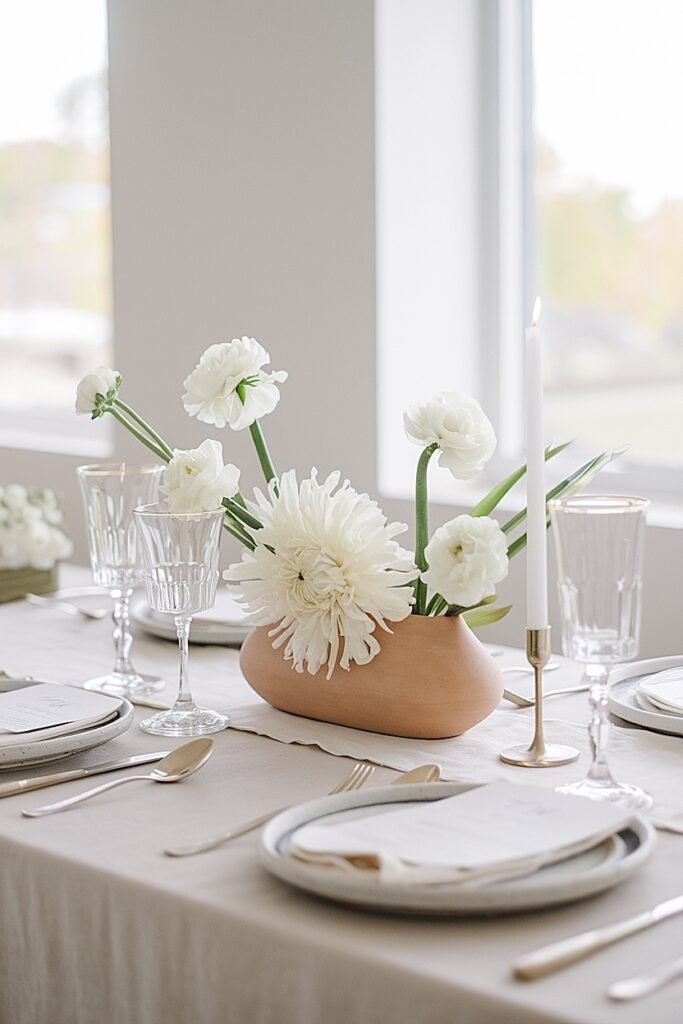
Narrow centerpieces need flowers that create visual presence at minimal horizontal width. The bloom structure determines whether a narrow arrangement reads as intentionally compact or simply sparse.
Round, dense bloom heads provide the most visual coverage per inch of vessel width. A single pompom or ball form creates a clear, readable focal element within a narrow footprint. Flat daisy forms distribute across the vessel width at rim level. Fine cluster forms like waxflower fill the remaining gaps with texture rather than mass. A narrow dinner centerpiece built from these three structural types reads as complete at four inches of vessel width in a way that large single-headed flowers or loose, spreading blooms cannot.
1. White Pompom Chrysanthemum The dense rounded sphere of a white pompom mum creates the clearest, most readable focal presence at narrow scale. One to three pompom stems in a four-inch vessel creates a compact white display that reads as deliberately placed rather than squeezed in. At candlelit autumn dinner range, the white sphere catches warm directional light and appears to glow from its center outward, a quality visible at close range that larger-scale.
2. White Spray Mum Sub-Stems Spray mum sub-stems cut to three to four inches from the main branching stem carry two to three compact bloom heads each. At narrow vessel scale, four sub-stems fill a four-inch bowl with white coverage from multiple bloom angles without any single stem requiring significant horizontal space. The multiple-head-per-sub-stem structure suits narrow formats specifically because bloom coverage accumulates vertically rather than spreading outward.
3. White Gomphrema Balls Gomphrema compact ball blooms at one to two centimeters are the most visually space-efficient white autumn flower for narrow centerpiece formats. The tight ball structure requires almost no horizontal clearance per bloom. A four-inch vessel packed with eight to ten gomphrema stems at rim height reads as full and graphic from above at close dining distance. Zero pollen, no fragrance near food, holds two weeks.
4. White Waxflower Branches White waxflower branches create distributed fine white texture rather than focal bloom mass, which suits the supporting filler role in a narrow arrangement. One waxflower branch cut into two or three shorter sections and pressed into a narrow vessel around a central focal bloom fills the visual gaps without adding horizontal width requirement. The tiny star blooms visible at close autumn range add a botanical complexity that larger-bloomed fillers do.
5. White Button Mum Clusters Button mum stems carry ten to fifteen tiny flat daisy faces on branching sub-stems at small scale. In a narrow vessel, one button mum sub-section provides multiple small bloom positions at minimal horizontal footprint. The small scale of each individual button face suits the close viewing distance of a dinner table in a way that larger-headed varieties do not. Ten button mum faces at close range read as more interesting.
There is more ahead on keeping the arrangement below the dinner conversation threshold, which is the height constraint that determines whether white flowers at a dinner table look designed or obstructive.
How to Keep White Fall Flower Centerpieces Below the Dinner Sightline
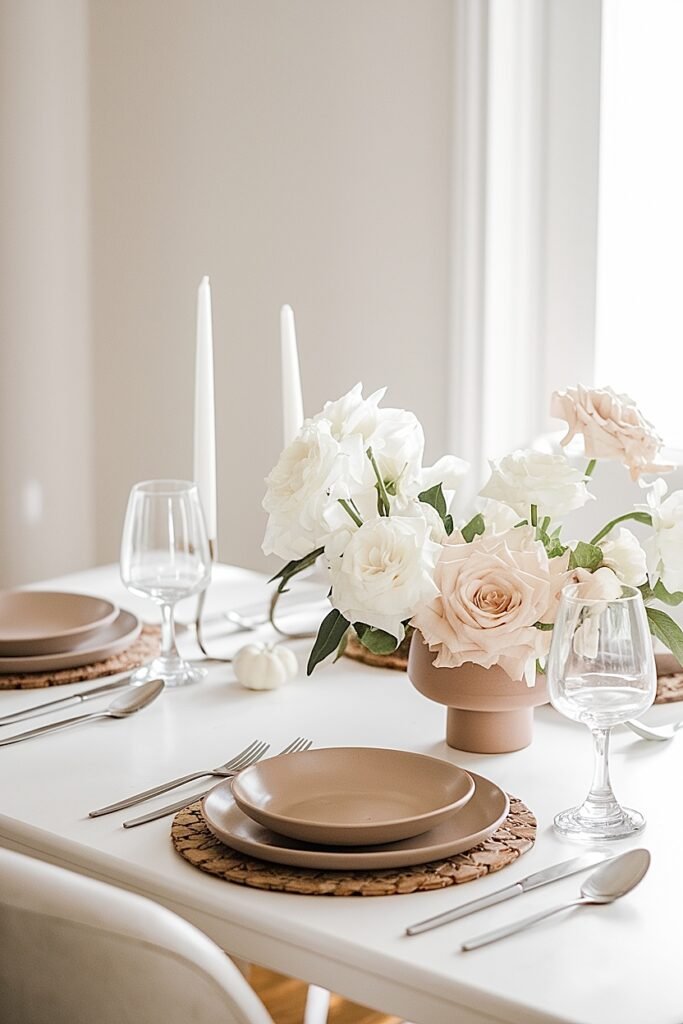
Eight inches total. Vessel plus stems.
That is the practical ceiling for a fall dinner centerpiece where guests face each other at close range. Over eight inches and the arrangement occupies the visual zone between the two faces across the table. It does not block the view completely. It creates a slight, persistent visual obstacle that subtly affects the quality of the conversation across it.
White flowers make this height issue more noticeable than warm-toned flowers because white has high visibility contrast against both dark backgrounds and candlelit environments. A tall white arrangement at a candlelit dinner table becomes the most visually prominent element at the center of the table in a way that a rust or burgundy arrangement at the same height would not.
Measure the vessel first. A four-inch tall vessel with stems at two and a half inches above the rim creates a six and a half inch total. Within the ceiling. A vessel two and a half inches tall with stems at three inches above the rim creates a five and a half inch total. Even better. The vessel height and the stem height share a budget. The shorter the vessel, the more stem length budget remains. Wide, flat, shallow vessels give the most stem budget of any format.
Outward-angled stems stay lower than vertical stems at the same cut length. Angle every stem at thirty degrees from vertical when pressing into the gravel base. The bloom face reaches the same visible position but at a lower absolute height because the stem travels diagonally. At a white fall centerpiece scale, consistently angled stems often keep the total arrangement within the eight-inch ceiling without any stem length adjustment.
DIY Ideas for Divided White Fall Flower Centerpieces Around Shared Dishes
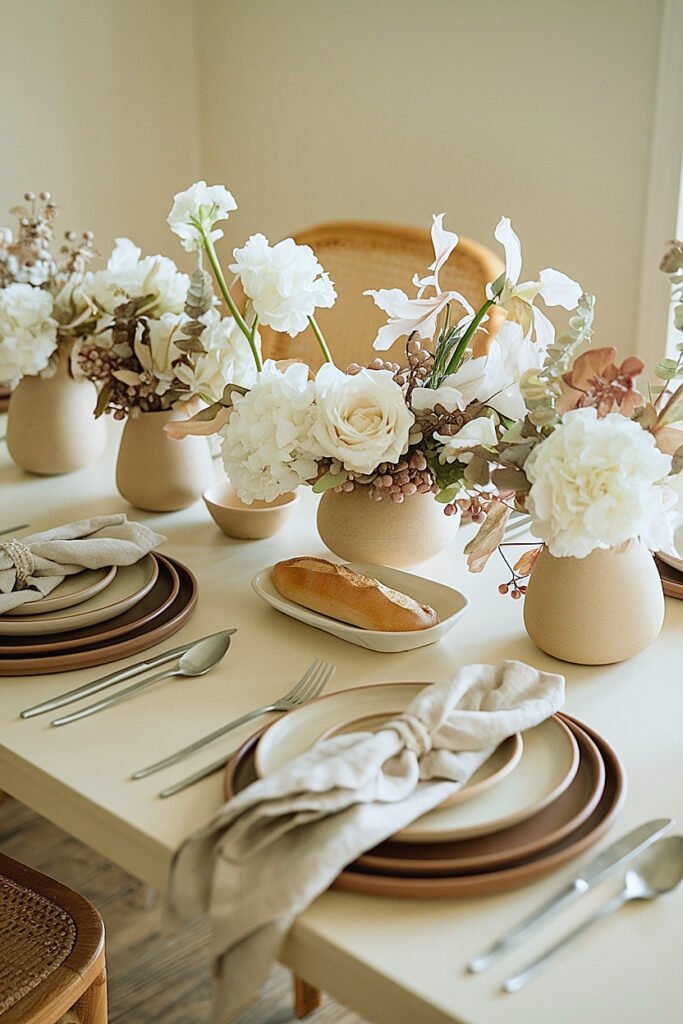
1. Two Small White Flower Vessels at Opposite Table Ends Two matched dark vessels, each holding three to four white fall flower stems, positioned at the two narrow ends of the dining table. Both ends remain decorated throughout the meal. The full table center stays open for serving dishes. Both diners experience a white flower arrangement at close personal range.
2. White Flower Water Picks Between Serving Dishes Four white spray mum sub-stems or white aster stems in individual water picks, positioned in the natural gaps between serving dishes at the center of the dining table. No central vessel. Each pick occupies less than one inch of table surface. The picks distributed between the dishes create a flower.
3. Single White Flower Stem Per Napkin at Each Setting One white waxflower branch or one white carnation stem placed across each folded napkin before dinner. No vessel, no water, no table surface footprint. The stem holds its appearance for the duration of the meal. After dinner, the napkin stems go into the main arrangement vessel to supplement it through.
4. White Flower Bud Vase at Each Place Upper Corner One small dark bud vase with two white stems at the upper right corner of each place setting, outside the flatware zone. Four bud vases for a four-person table, each holding two white aster or spray mum sub-stems. The serving zone stays completely open. Each guest has a personal white.
5. Three Inch Wide Bowl Slipped Into the Gap Between Two Serving Dishes A three to four inch wide vessel with white flowers at rim height, sized to fit the gap between two serving dishes rather than competing with the serving zone. The arrangement occupies space that was already unused between the dishes. No serving dish moves. No reach zone is blocked.
Creative Ways to Frame Serving Bowls With White Fall Flower Clusters
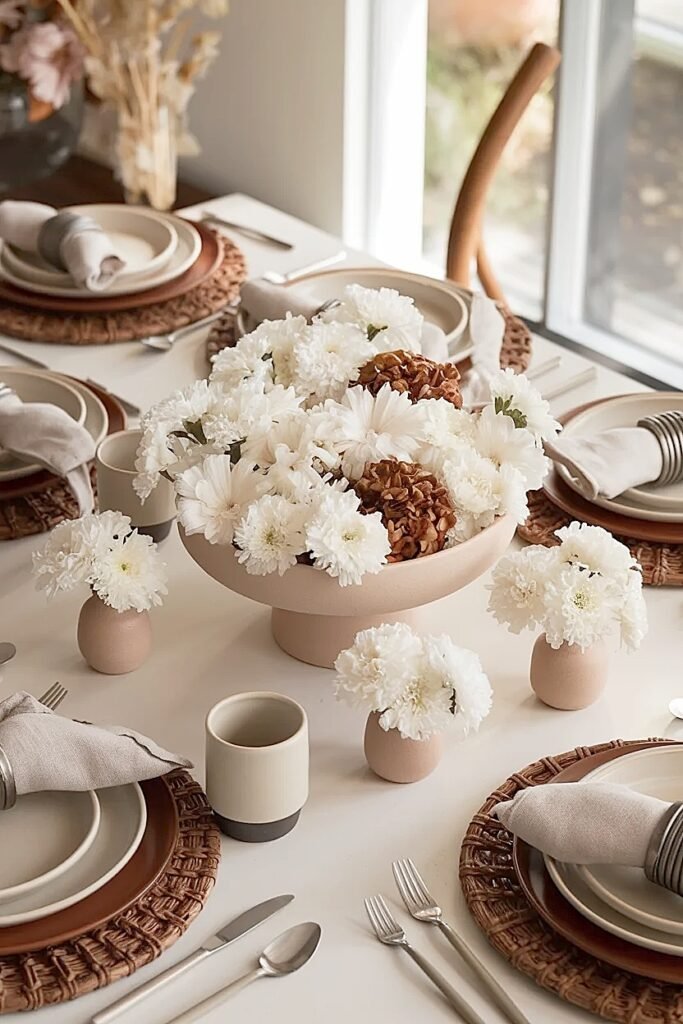
1. White Flower Water Picks Arranged Around the Perimeter of a Central Serving Bowl Five white spray mum sub-stems in water picks pressed into the table surface in a loose arc around the back half perimeter of the main serving bowl. The white flowers frame the serving bowl from behind and on both sides. The front approach to the serving bowl stays completely clear.
2. White Flower Bud Vase on Each Side of the Serving Dishes One small dark bud vase with three white stems on each side of the main serving arrangement, positioned at the outer edges of the serving zone. Both vases stay outside the reach radius of guests serving themselves. The white flower flanking creates a visual framing effect that makes the center.
3. White Flower and Wheat Bundle Beneath the Serving Stand Two white flower stems plus one wheat stalk tied with jute and laid flat on the table surface beneath a tiered serving stand or cake stand, visible at table surface level from the sides. No height. No vessel footprint on the functional surface. The bundle creates autumn context at table.
How to Prevent White Fall Flower Centerpieces From Touching Dinnerware
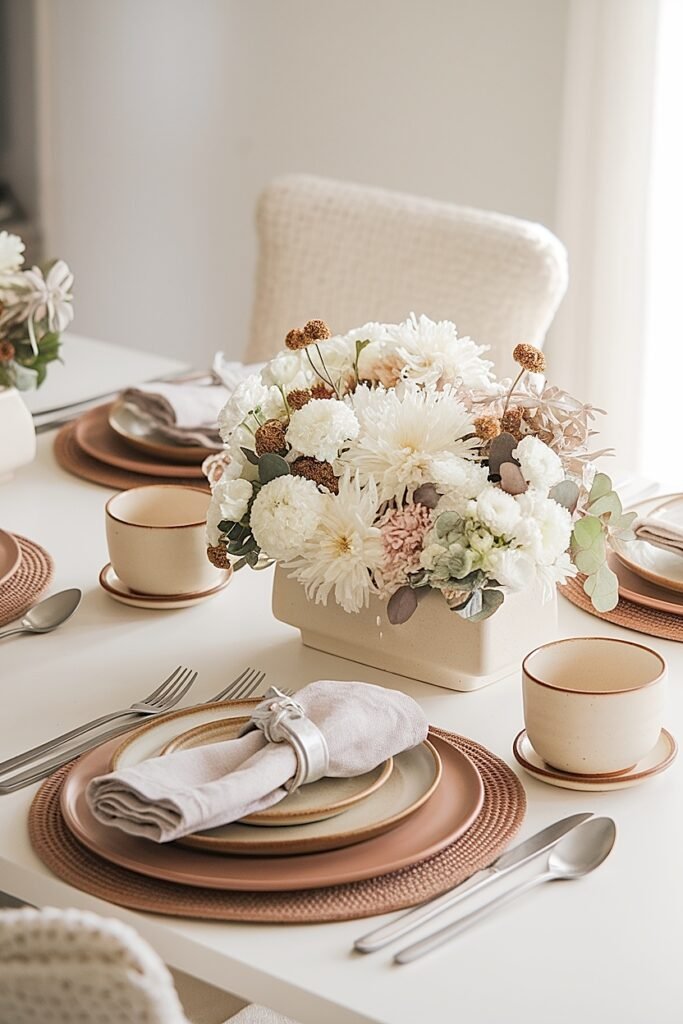
White touching white disappears. That is the specific problem.
A white carnation petal resting against a white dinner plate edge becomes invisible. The white arrangement that was chosen specifically for its luminous candlelight quality loses that quality the moment it blends into the surrounding white objects.
The working clearance standard is six inches between the outermost arrangement bloom and the nearest plate edge. More is better. Less and the white arrangement starts to visually merge with the tableware at close dining range.
The high-risk zone is always the upper right of each place setting, where the bread plate and the water glass create a cluster of objects close to the table center. The right side of any centerpiece positioned near the table center is almost always within reach of that bread plate zone. Setting the table fully before building or placing the arrangement reveals exactly where the six-inch clearance requirement falls short.
The easiest adjustment: move the arrangement to the table end rather than the center. An end-positioned white flower arrangement has one side facing open air at the table edge and the other side facing the serving zone. Neither side is adjacent to a place setting’s bread plate. The six-inch clearance requirement is automatically met on both sides.
What Are the Best Containers for White Fall Flower Dinner Centerpieces?
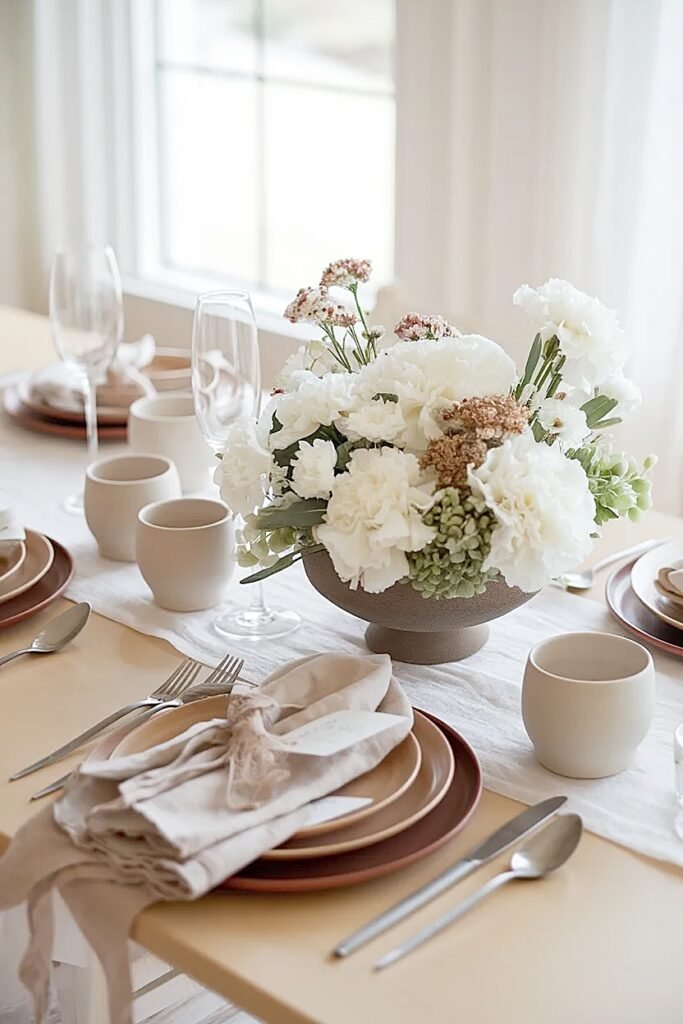
1. Wide Matte Black or Charcoal Bowl Maximum contrast with white blooms at close autumn dinner range. The dark matte surface absorbs ambient and candlelight rather than reflecting it, which makes adjacent white flowers appear to glow by contrast. Four to six inches wide, two to three inches tall. White flowers at rim height in a matte.
2. Dark Navy Enamel Short Pitcher The pitcher handle creates visual direction. White flowers in a dark navy enamel pitcher at a dinner table end read as positioned deliberately rather than placed accidentally. The navy amplifies white tone while the pitcher format communicates casual warmth that suits autumn dining. Three inches tall, two to three inches.
3. Heavy Concrete or Stone Low Bowl Zero tip risk at a working dinner table, which matters more than any aesthetic consideration when guests are reaching across regularly. The matte grey or grey-buff tone of raw concrete creates neutral contrast with white blooms that reads as cool and considered. Wide base, minimal height.
4. Short Terracotta Wide Pot The terracotta’s warm buff-orange provides the one warm contrast element that keeps white flowers from reading as winter-adjacent rather than autumnal. At close dinner range, the warm vessel tone beside the white blooms reads as the arrangement’s autumn contextual signal. Three to four inches tall, five to six inches wide.
5. Dark Green or Forest Green Glazed Compote A low compote in forest green glaze aligns with autumn foliage tones at the vessel level while creating cool-toned contrast with white blooms above it. The raised foot provides visual presence without adding stem height. At a dinner table, the compote format reads as deliberately elegant rather than casually functional,.
Conclusion
White flowers at a fall dinner table work when the table is designed around them rather than when they are placed on a table that was designed around other things.
Set the table completely first. Find the clearance. Size the vessel for the clearance. Choose the container for maximum contrast with white. Keep everything under eight inches.
The glow quality white flowers produce in autumn candlelight only appears when they have room to exist as the most visually distinct element on the table. Give them that room.
This website contains affiliate links, and some products are gifted by the brand to test. As an Amazon Associate, I earn from qualified purchases. Some of the content on this website was researched and created with the assistance of AI technology.