This website contains affiliate links, and some products are gifted by the brand to test. As an Amazon Associate, I earn from qualified purchases. Some of the content on this website was researched and created with the assistance of AI technology.
Key Takeaways
- Line every basket with heavy plastic before adding floral foam and water, because even baskets marketed as water-safe will transfer moisture to a finished table surface over a two-to-three-day display period
- Floral foam needs to soak by floating on the water surface until it sinks on its own. Never push it under, which traps air pockets and creates dry spots that kill stems
- A round or oval basket works as a centerpiece where guests need to see across the arrangement, while a tall handled basket suits corners and mantels where vertical presence matters more than sight lines
- All-around arrangements require checking the design from every direction as you build rather than only from the front, because gaps that are invisible at one angle show clearly from another
- One-sided arrangements need a defined vertical back spine established first, before any other stems, because the height balance will be wrong throughout the entire build if that step gets skipped
- Foliage trailing below the basket rim hides visible foam and softens the transition between the arrangement and the basket wall in a way that nothing else does as naturally
Creating DIY Thanksgiving flower basket arrangements is something I started doing years ago because they just looked better on a table than anything in a regular vase, and once I figured out the basics I never went back.
A basket full of fall flowers looks right for Thanksgiving in a way a glass vase does not. The wicker or seagrass feels like it belongs next to a table full of food, and the whole thing comes across more like something from a garden than something from a store. Most of it is not hard once you know what you are doing.
Thanksgiving Flower Basket Selection Table
Choose basket mechanics before choosing flowers. This guide compares five basket styles by water containment, ideal arrangement shape, viewing direction, and maintenance needs. Use it to prevent moisture damage, unstable designs, awkward handles, and wasted flowers. A well-matched basket and inner vessel make every decorating decision easier and more successful.
Which Basket Fits Your Flower Design?
Compare basket style, inner mechanics, finished shape, and the maintenance issue that matters most.
| Basket Style | Water and Mechanics | Best Design Shape | Important Check |
|---|---|---|---|
| Round Handled | Fitted watertight bowl with grid or secured foam | Rounded all-around design below the handle | Preserve grip clearance and turn the basket while arranging |
| Low Oval | Shallow waterproof tray fitted firmly inside | Horizontal oval for a long surface | Control side spread and keep the basket stable |
| Rectangular Market | Long opaque insert with several support zones | Linear or gently stepped composition | Repeat flowers to connect the full length visually |
| Divided Basket | Separate fitted containers or one shaped liner | Related mini arrangements across compartments | Keep color ratios consistent from section to section |
| Open Picnic | Low inner vessel supported away from the hinge | Low forward-facing design against the raised lid | Protect hinge movement and support the basket from below |
Resources:
- Cut flowers: cutting and conditioning | RHS Advice
- Mother’s Day Basket Workshop | Illinois Extension | Illinois
- Chicken Wire Mechanics for a Wicker Basket Arrangement for the Professional Florist | Mississippi State University Extension Service
How to Choose a Water-Safe Basket for Thanksgiving Flowers
The first basket arrangement I ever put on a tablecloth left a water ring on it, and I could not get the stain out.
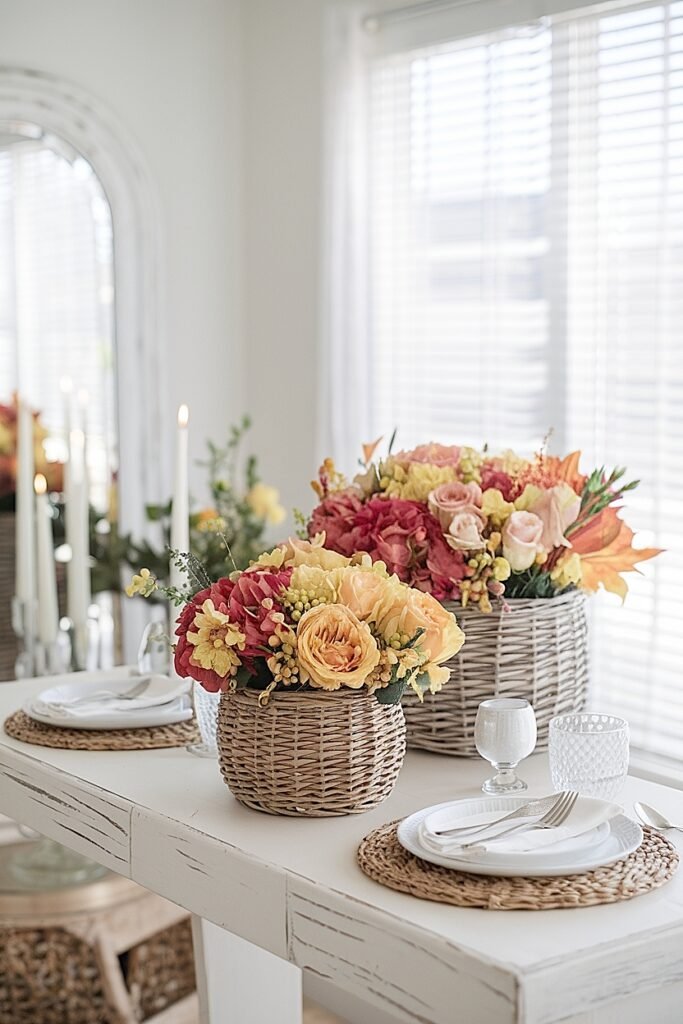
The basket had a label saying it was fine for fresh flowers, so I put it right on the cloth without anything underneath it. About three hours later there was a dark ring of moisture soaked through, and that was the end of that tablecloth. No basket, no matter what the label says, should ever sit on a wood table or a cloth with wet floral foam inside and nothing between the basket and that surface, because water seeps through wicker and seagrass over a couple of days whether you want it to or not.
The fix is easy. Before you add anything to the basket, press a piece of heavy plastic drop cloth or a plain plastic bag with no holes against the inside, with the edges going up the sides and a little over the top of the basket rim. The floral foam goes on top of the plastic, and any water that drips out of the foam during the display gets stopped by the plastic before it can get to your table. If the basket already comes with a plastic or metal tray built in, you are all set, and those baskets are worth looking for when you are planning to put the arrangement somewhere you care about.
For a totally different kind of Thanksgiving flower project, the DIY Thanksgiving flower garland ideas for stair railings article covers how to get flowers off the table and onto a staircase instead. If you are finding this useful, sharing it with someone who is trying to figure out their Thanksgiving decorating takes about ten seconds.
What Are the Best Basket Shapes for Thanksgiving Flower Arrangements?
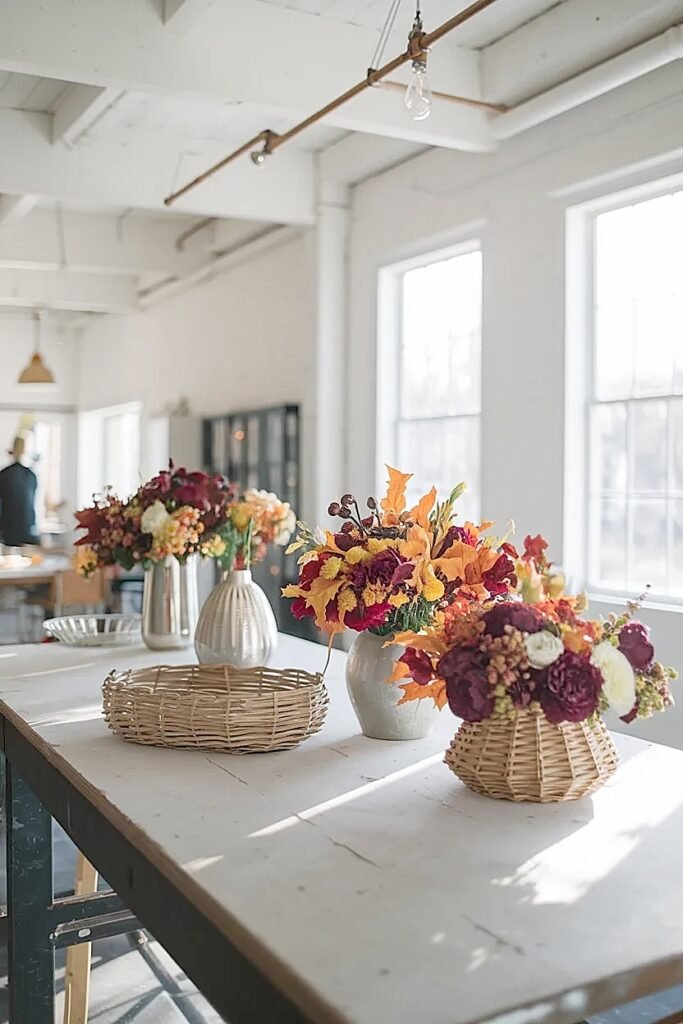
Most people pick the flowers first and then look for a basket that fits them, which is usually where things start to go wrong, because the basket is what determines the arrangement shape, the stem count, and where the finished piece can actually go in your home. Pick flowers first and you end up with an arrangement that fights the container instead of working with it.
Here is more detail ahead on foam technique, which applies to every basket shape here and is worth reading before any of the design sections.
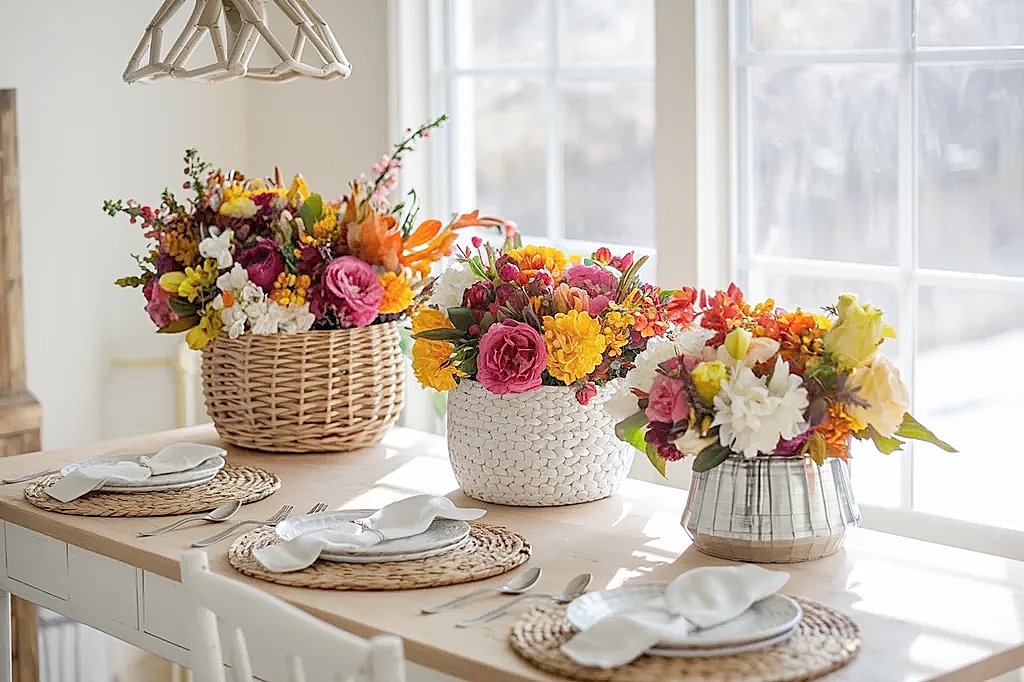
1. Round Shallow Basket A round shallow basket with a low profile, eight to twelve inches in diameter, creates arrangements that read equally well from all sides and work best as centerpieces on dining tables or buffet surfaces. The basket sits low enough that guests can see across it without the arrangement blocking conversation at the table. Filled with foam and florist moss, it holds its own water source and stays stable throughout the weekend.
2. Oval Basket An oval basket, longer than it is wide at a ten-by-fourteen-inch footprint or similar proportion, gives an arrangement more horizontal reach than a round basket without requiring the basket height that would obstruct views across the table. Oval shapes suit rectangular table runners, mantels, and console table displays equally well. The elongated opening allows flowers to be placed at graduated heights along the longer axis for visual flow.
3. Tall Handled Basket A tall handled basket with a handle that arches ten to sixteen inches above the rim creates the most vertical presence of any basket shape and works well in corners, on floor surfaces beside a fireplace, or on sideboards where height adds to the display. Flowers arranged low around the basket base and clustered around the handle create an arrangement that reads differently depending on where the viewer is standing.
4. Square Basket A square basket with straight sides and a flat bottom, in dimensions of eight to twelve inches per side, holds a larger foam block than any round basket of comparable diameter and allows a denser arrangement with more stems before the foam becomes crowded. The clean geometric shape reads as modern rather than rustic and pairs well with contemporary table settings that include metallic or ceramic serving pieces.
5. Wide-Opening Market Basket A market basket with a wide flat opening and low walls around the perimeter, common in the ten-to-sixteen-inch diameter range, creates an arrangement that looks full and lush at lower stem counts than deeper baskets require. Because the walls are shallow, stems inserted at the basket edge angle outward naturally without additional manipulation, which creates the relaxed overflowing look most closely associated with harvest-season centerpiece arrangements.
How to Use Floral Foam Safely in a Thanksgiving Flower Basket
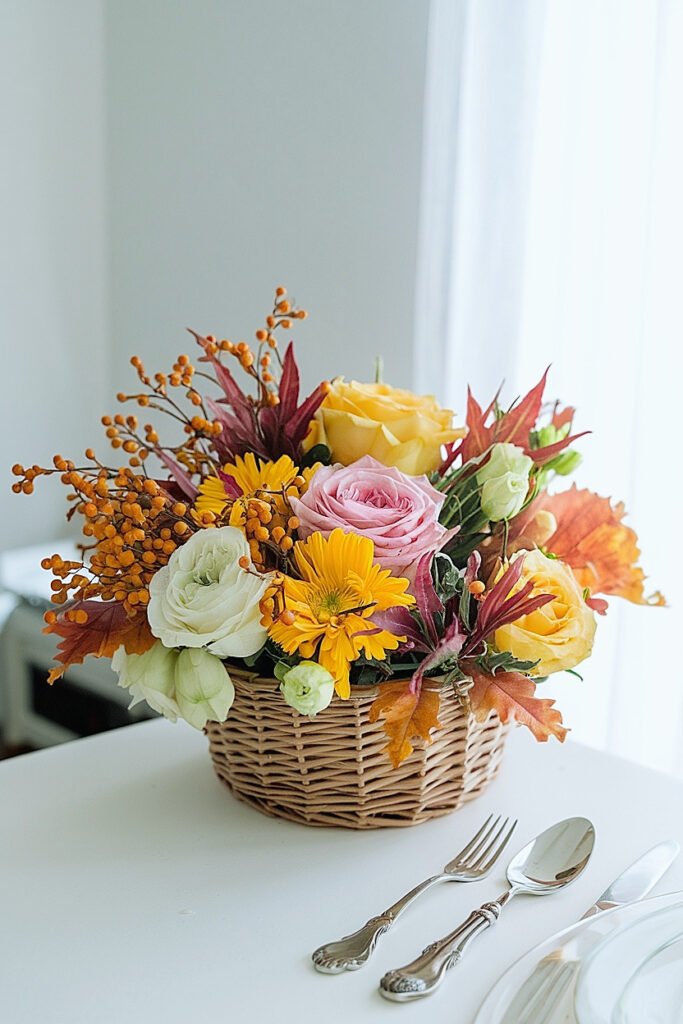
Floral foam is what lets a basket arrangement hold fresh flowers for three to five days without you having to do much to it, and it is also the reason a lot of basket arrangements fail on day two when it was not prepared right.
The most common mistake is pushing the foam block under the water to get it wet faster, because that seems like the obvious way to do it and the foam feels wet when you pull it back out. What actually happens is that pushing it under traps air bubbles inside the foam that never fill with water, and any stem that goes into one of those dry spots will not be able to drink and will start wilting within a day in a way that looks like the flowers are just old when really it was a mistake made before you even started building.
The right way is to set the foam on top of the water and leave it alone while it sinks on its own over three or four minutes, soaking from the bottom up without any trapped air. When it is done it will feel heavy all the way through. Once soaked, cut it to fit your basket so the top sits about an inch above the rim, which gives stems room to angle outward instead of pointing straight up. Cover any visible foam with sheet moss before adding flowers.
Ways to Design an All-Around Thanksgiving Flower Basket
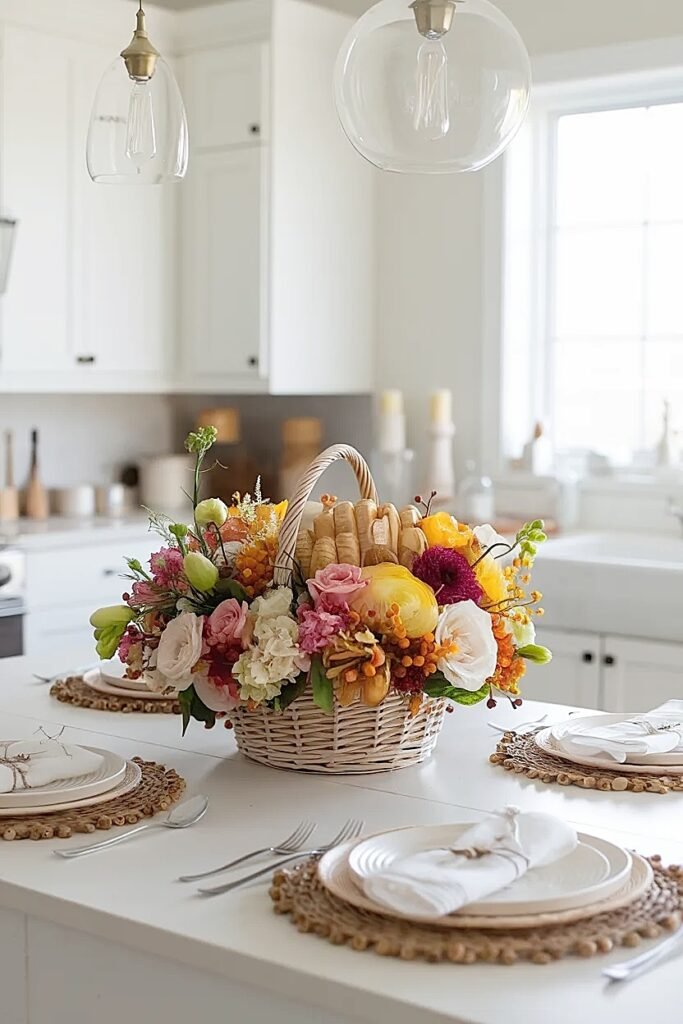
An all-around arrangement is one that people will be able to walk all the way around, like a centerpiece on a dining table, so it needs to look finished from every side and not just from the front.
The problem is that when you are building an arrangement, the natural thing to do is stand in one spot and work from that angle, and then check from that same spot when you think you are done. But if you do that, the back of the arrangement will have holes and gaps that you never noticed because you never looked at it. You have to physically walk around the basket every few stems and look at it from different sides while you are still building, not just at the end.
Here are the ideas ahead on one-sided arrangements, which use a completely different approach that suits different spots in a room.
1. Build from a Central Focal Cluster Outward Place the three to five largest focal flowers at the center of the foam surface, angling outward at different heights, before adding any secondary material. Working outward from that core rather than randomly across the surface keeps the visual weight balanced in all directions from the start.
2. Check from All Sides as You Build After placing each round of flowers, step back and view the arrangement from opposite sides and from directly above. Gaps or dense spots that are invisible from the front show clearly when you walk around the basket. Correct them before adding the next layer rather than at the end when the foam is crowded.
3. Keep the Tallest Stems at the Center The tallest stems in an all-around arrangement belong at the center of the foam, not at the perimeter. Tall stems at the edge block the view of flowers on the opposite side. Height that steps down progressively toward the basket rim in every direction creates a dome profile that reads as full from any angle.
4. Let Foliage Trail Below the Basket Rim Inserting foliage stems at the outer edge of the foam at a downward angle so the leaves trail below the basket rim softens the transition between flowers and basket. Eucalyptus, salal, or leatherleaf fern work well for this role. The trailing material hides any visible foam or liner at the basket edge.
5. Vary the Stem Insertion Depth Not every stem in an all-around arrangement should insert to the same depth. Pushing some stems shallower keeps the flower head higher above the arrangement surface. Pushing others deeper tucks the bloom lower into the arrangement. Mixing insertion depths within the same zone creates natural height variation without changing the stem lengths themselves.
Ideas for a One-Sided Thanksgiving Flower Basket Arrangement
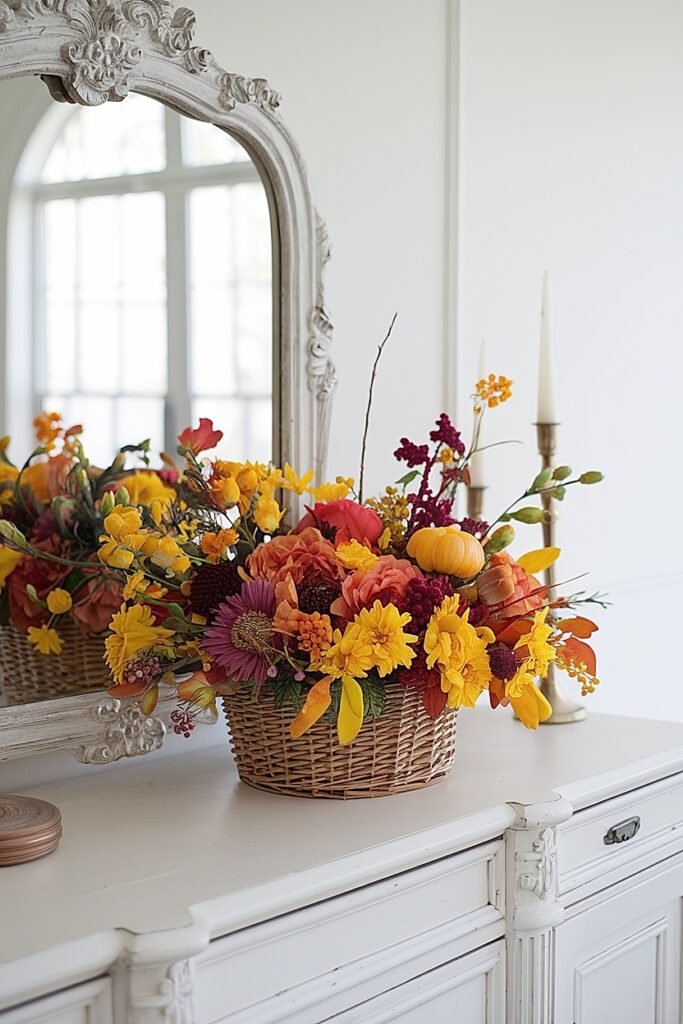
A one-sided arrangement is built so that only one side is meant to be seen, which means you put all the best flowers and the most work into the front and do not worry about what the back looks like.
This is a good approach for any basket that is going to sit against a wall, on a mantel, or on a sideboard where the back of the basket is hidden anyway and nobody is going to walk around and look at it from behind.
Here are ideas ahead on low oval baskets, which are a different shape and need their own approach.
1. Anchor a Vertical Back Line First A one-sided arrangement needs a defined vertical back edge before anything else goes in. Place three to five tall stems at the back of the foam along the centerline to establish the maximum height and the visual spine of the arrangement. Everything else builds forward and outward from that initial vertical reference.
2. Graduate Flower Heights from Back to Front After the back line is established, place focal flowers at medium height in the middle zone, then low flat blooms at the front edge so the arrangement steps down from back to front. That graduation creates depth and reads as a real composition rather than a flat mass of stems pushed into foam.
3. Position the Basket Against a Solid Surface A one-sided arrangement is designed for placement against something solid: a wall, a fireplace mantel face, a mirror, a window frame. Positioning it against that surface hides the flat back of the arrangement that has no flowers and shows only the finished front face to the room and to guests.
Ideas for a Low Oval Thanksgiving Flower Basket Arrangement
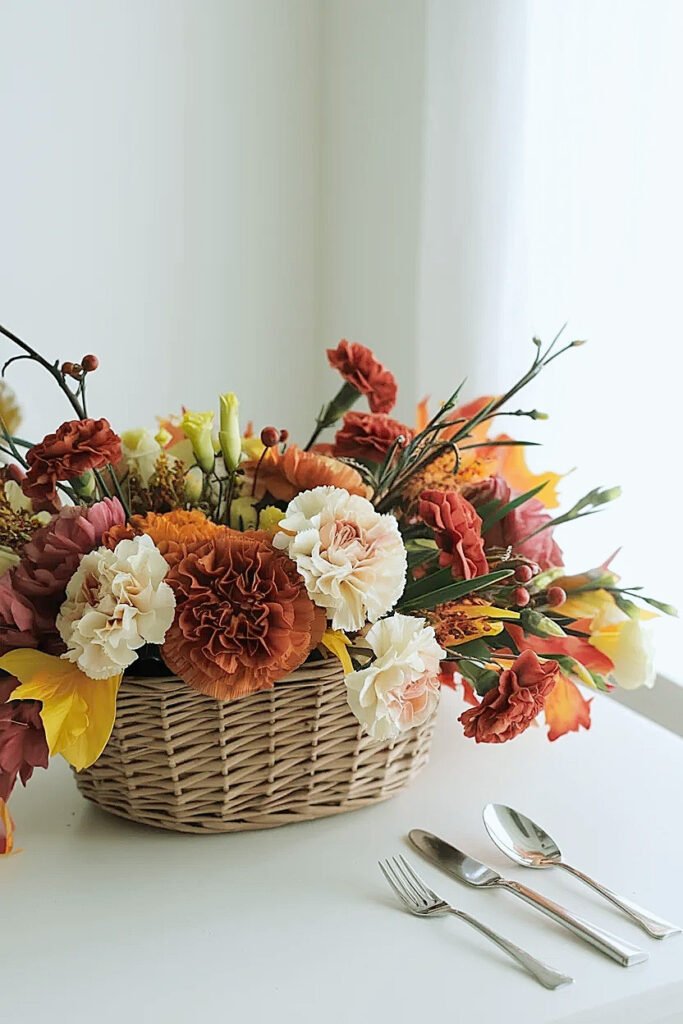
A low oval basket fits a rectangular table much better than a round basket does, because the longer shape matches the table instead of just sitting in the middle of it like a circle, and for a Thanksgiving table where the surface matters, that makes a difference.
The approach for building in an oval basket is different enough from a round one that it is worth covering separately, mainly because the foam preparation step changes and because the shape gives you different options for how the flowers are arranged.
Here are ideas coming up on the best flowers for a basket with a tall handle, which has its own set of things to think about.
1. Cut Foam to Fit the Oval Shape Before Soaking Floral foam blocks are sold in rectangular bricks and must be cut to fit an oval basket with a smooth-edged knife before soaking. An uncut rectangular block leaves uncovered liner at the basket sides and produces a flat surface that limits how far stems at the oval ends can angle outward and downward.
2. Use the Long Axis for Height Variation In a low oval basket, the longest dimension runs side-to-side rather than front-to-back. Place the tallest stems at the center of the oval where height works, then step height down along both the long and short axes toward each end. The arrangement fills the oval proportionally from every viewing direction.
3. Add Trailing Material at Both Narrow Ends Inserting small-leaved trailing foliage or berry sprigs at the two narrow ends of an oval basket so the material hangs over the rim and below the basket level softens the hard edge where foam meets basket wall. Trailing elements also visually extend the length of the oval arrangement without adding height.
How to Combine Flower Textures in a Thanksgiving Basket Arrangement
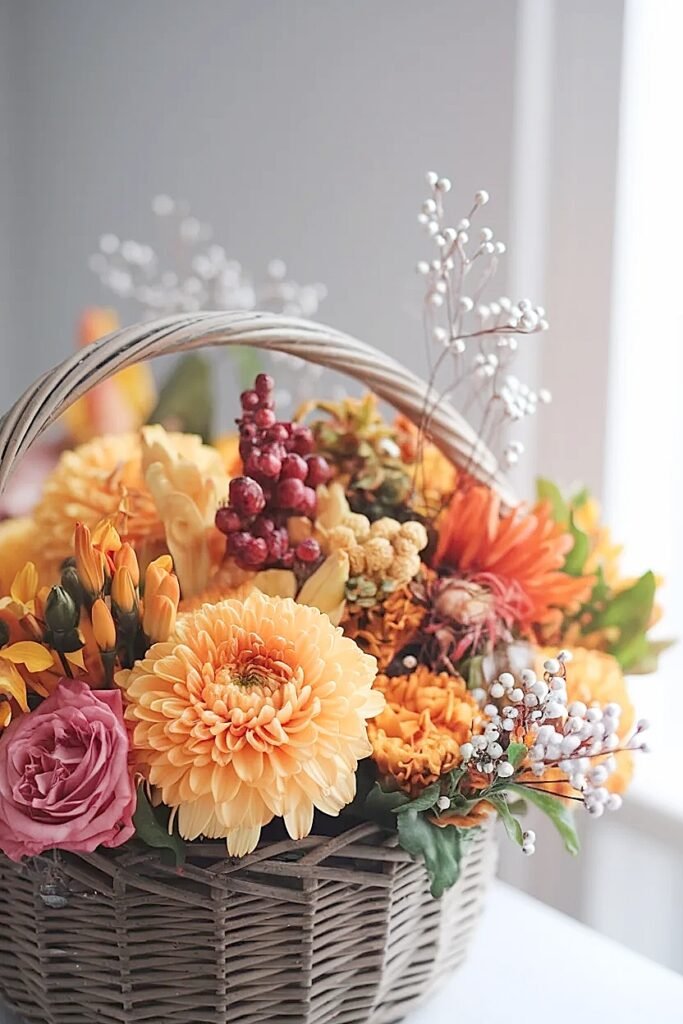
The arrangements that look boring are almost always the ones where every flower in the basket is the same kind of round, smooth bloom, because there is nothing to contrast them against and the whole thing ends up looking flat even when the colors are great.
Thanksgiving colors are not the issue. Orange, rust, deep red, and gold work together without any effort, and most people have a pretty good instinct for which colors belong together in a fall arrangement. The thing that goes wrong more often is putting roses, ranunculus, and dahlias all in the same basket and wondering why it looks a little dull, when the real problem is that all three of those flowers look basically the same shape and the eye has nothing interesting to move between.
Florists think about flowers in three groups: round and smooth focal flowers (roses, ranunculus, dahlias), spiky ones that add variety (snapdragons, liatris, celosia), and airy fillers (waxflower, baby’s breath, dried grasses, berry sprigs). Using flowers from at least two of those groups makes an arrangement more interesting to look at than anything from just one, no matter how nice the individual flowers are. For Thanksgiving I anchor with round blooms, add cockscomb or plume celosia for texture, and put in dried things like wheat stalks or small gourds on picks for the airy layer that also makes it look like fall. Dried stuff goes in last after all the fresh flowers are placed.
What Are the Best Flowers for a Long-Handled Thanksgiving Basket?
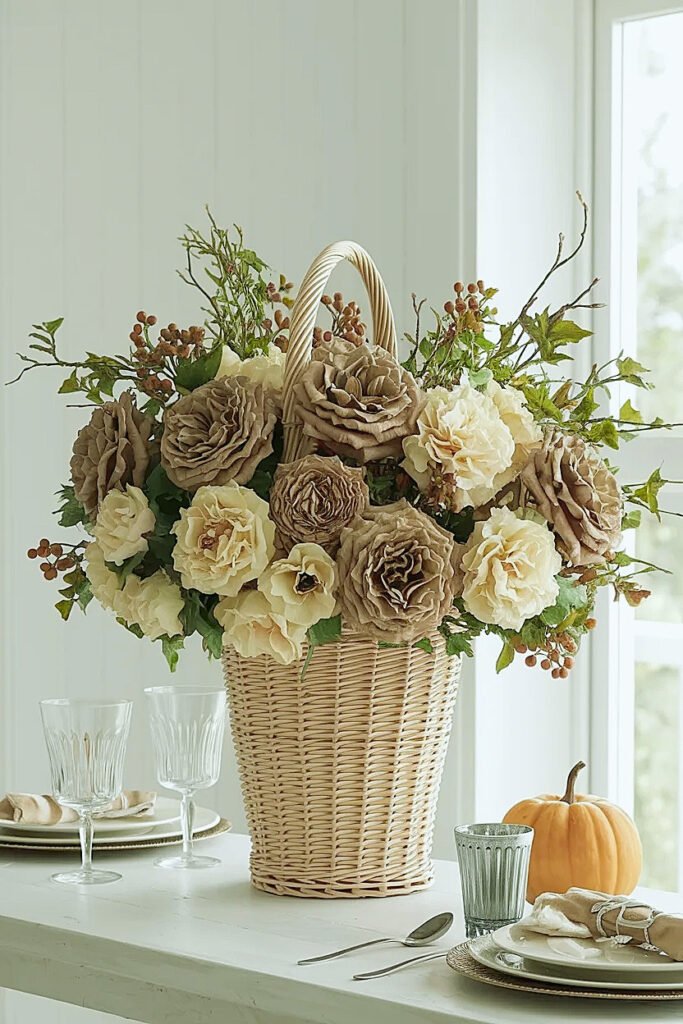
A basket with a tall arching handle is one of the most striking things you can put out for Thanksgiving, because the handle adds height above the flowers in a way that no other container does, and when it is done well it just looks impressive.
The thing to watch out for is that big single-stem flowers in the wrong spots make the basket look top-heavy, like it is about to tip over. Flowers with several blooms on one branching stem work better because they cover more area with fewer stems and let you bring material up toward the handle without crowding it.
1. Spray Roses Spray roses, with multiple small blooms on branching stems, fill a long-handled basket arrangement without creating the visual heaviness that single large flower heads can cause. The branching stem structure allows a single stem to cover several inches of foam surface. Available in rust, peach, ivory, and deep red for autumn palettes.
2. Lisianthus Lisianthus produces multiple blooms per stem from a single branching structure, which means one stem can serve as both a focal bloom and a filler element in the same arrangement zone. The waxy petal surface holds moisture longer than most cut flowers, making it reliable in a basket display that cannot be checked constantly.
3. Cockscomb Celosia The cockscomb flower head is visually dense and physically lightweight, which prevents the top-heaviness that can tip an arrangement when placed in a long-handled basket. Deep red and burgundy cockscombs read as specifically Thanksgiving rather than generically fall. One or two heads per arrangement zone is usually enough without the composition becoming cluttered.
Conclusion
Basket arrangements for Thanksgiving are not complicated once you know the handful of things that actually matter.
Pick the basket before the flowers, line it before you add anything wet, soak the foam by floating it instead of pushing it under, check the arrangement from all sides while you are still building, and mix at least two different flower textures so it does not look flat. That covers most of it.
Make it on Tuesday or Wednesday and it will still look good on Sunday when the last guests finally head home.
This website contains affiliate links, and some products are gifted by the brand to test. As an Amazon Associate, I earn from qualified purchases. Some of the content on this website was researched and created with the assistance of AI technology.