This website contains affiliate links, and some products are gifted by the brand to test. As an Amazon Associate, I earn from qualified purchases. Some of the content on this website was researched and created with the assistance of AI technology.
Key Takeaways
- Green is cool and recessive. Warm flower tones, rust, amber, peach, cream, bronze, make green appear richer and more vivid by contrast
- White flowers in a green houseplant room create the most luminous effect of any color. The white reflects ambient light back and makes everything around it appears brighter
- Avoid adding greener. Flower arrangements with lots of foliage and greenery in a room already full of plants just disappear into the background
- Burgundy is the most sophisticated and most dramatic fall flower color choice for a green plant room. The cool dark red against cool deep green creates depth and intimacy
- Peach is underused in green plant rooms and consistently performs well. It is warm enough to contrast green but soft enough not to overwhelm a room full of living plants
- Orange needs to be used carefully in a heavy green plant room. One or two orange flower stems as accents perform better than a full orange arrangement
Green rooms are easy to get wrong with flowers. Most people add more green. That is the mistake.
Choosing the best flower colors for rooms with lots of green houseplants is really about understanding what green already does and what it needs from the flowers beside it. A room full of leafy houseplants has an enormous amount of cool, living, organic visual energy. The cut flowers placed in that room are not decoration alongside the plants. They are the warm counterpoint. They are the seasonal signal. They are the one element doing something the plants cannot do on their own.
So the question is not “what color looks nice with green.” It is “what color makes the green look better while adding something new?”
Use this guide to choose fall flower colors that look beautiful in rooms already filled with green houseplants. Each row matches a flower color family with the plant mood it supports, the best accent to repeat, and the reason the color works with deep green, variegated, glossy, or trailing foliage.
Best Fall Flower Colors for Green Houseplant Rooms
Use this table to match flower color families with the mood, leaf color, and decor style already present in a room filled with green houseplants.
| Fall Flower Color | Best Green Houseplant Match | Accent to Repeat | Why It Works |
|---|---|---|---|
| Cream + Ivory Cream mums, ivory carnations, soft white asters, and cream spray roses. | Dark green pothos, snake plant, monstera, rubber plant, and fern. Best when the room needs brightness without a sharp white contrast. | Taupe bowl, oatmeal linen, cream planter, or soft brown dish. | Cream brightens green foliage while keeping the room warm, soft, and fall-friendly. |
| Rust + Terracotta Rust carnations, rust mums, coppery dahlias, and muted rust alstroemeria. | Trailing pothos, philodendron, deep green snake plant, and clay-potted plants. Best when green rooms need stronger autumn warmth. | Clay planter, warm brown tray, woven basket, or bronze accent. | Rust warms green leaves without relying on bright orange or heavy holiday color. |
| Burgundy + Plum Burgundy dahlias, deep roses, burgundy carnations, and plum-toned asters. | Glossy monstera, rubber plant, croton, dark philodendron, and variegated foliage. Best when the room can handle deeper contrast. | Soft blush bloom, cream flower, taupe vessel, or plum ceramic dish. | Burgundy creates depth against green leaves, while cream or blush keeps it balanced. |
| Blush + Mauve Pale blush roses, blush carnations, mauve asters, and muted pink mums. | Variegated pothos, peperomia, fern, calathea, and soft green plant shelves. Best when the room needs a gentle fall color. | Pale taupe pot, muted sage bowl, oatmeal fabric, or neutral books. | Blush and mauve soften plant-heavy rooms without adding strong orange or red. |
| Bronze + Gold Bronze button mums, golden mums, soft yellow dahlias, and pale gold accents. | Deep green foliage, neutral planters, plant corners, and darker shelves. Best when the room needs warmth and a small glow. | Warm brown ceramic, oatmeal linen, clay vessel, or muted brass-toned decor. | Bronze and gold bring warmth and energy while still feeling natural beside greenery. |
Resources:
- Houseplants to make your home feel cozy for fall: 5 choices | Homes and Gardens
- The Secret to Gorgeous Fall Planters, According to Gardening Pros
- 8 Luxe Fall Floral Decorations | Fiore Designs
- 20 Flowering Indoor Plants for a Colorful Home
- Autumnal Flower Arrangements that Bring the Fall Colours Indoors
How to Choose Fall Flower Colors for Rooms With Lots of Green Houseplants
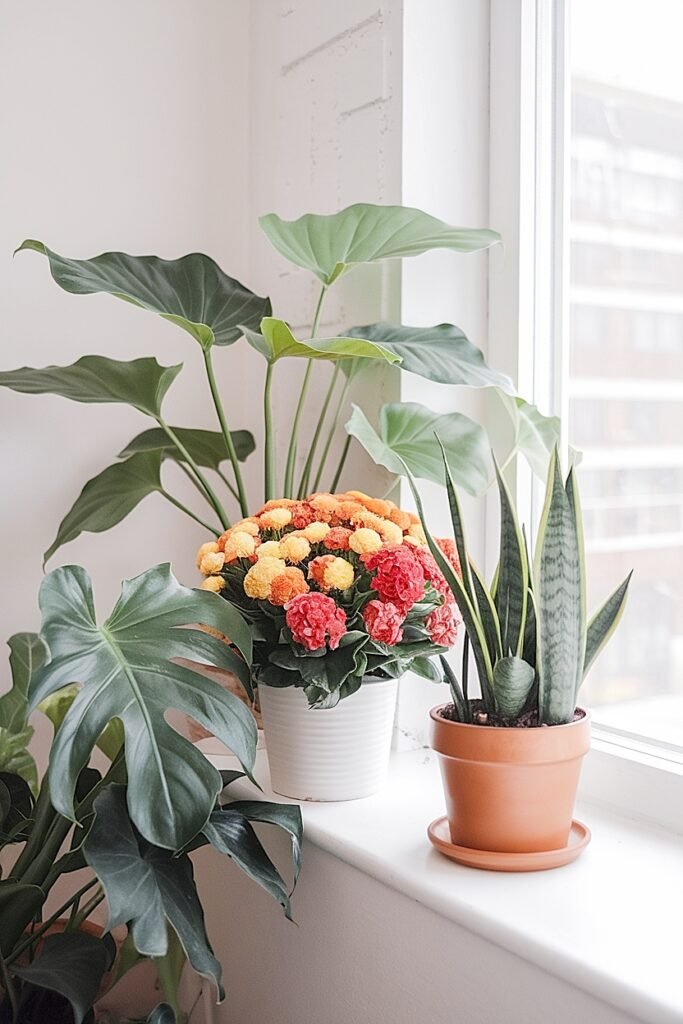
Start by looking at the green. Really looking at it.
Not all green is the same. A monstera has deep, almost blue-green leaves. A pothos trails in a lighter yellow-green. A ZZ plant has dark waxy almost black-green surfaces. A fiddle leaf fig has large pale green leaves. Each of these greens responds differently to the same flower color placed beside it.
Dark blue-green plants create the most vivid contrast with warm tones. Orange, rust, amber, and cream all pop against a deep green backdrop in a way that would not happen against a lighter, yellower green.
Light yellow-green plants suit warmer floral tones that sit in a similar warmth range. Amber gold flowers beside a golden pothos create tonal harmony. The same amber gold beside a dark ZZ plant creates contrast. Same flower, different result depending on the green it is beside.
The other variable is light. Natural light rooms amplify whatever color you put in them. North-facing or low-light rooms need flowers that carry their visual presence in lower light, which means saturated colors rather than pale ones. Cream flowers in a low-light room with dark-leafed plants almost disappear. Rust or burgundy flowers in the same room hold their visual presence.
For more on pairing specific fall flower varieties with individual houseplant types, including which flowers suit snake plants, crotons, and trailing pothos specifically, check out best fall flowers to pair with indoor house plants decor. Pass this along to any plant-room decorator. The specific color breakdown is next.
What Are the Best Fall Flower Colors to Brighten Rooms With Green Houseplants?
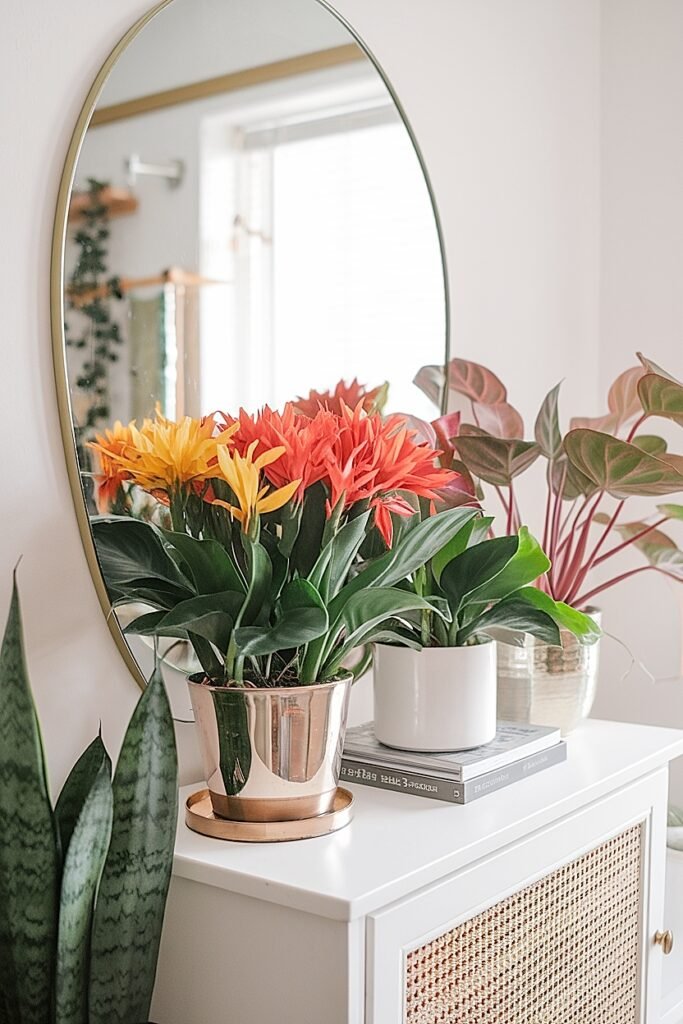
1. Rust Orange Rust orange and deep green are complementary colors. They sit opposite each other on the color wheel, which means each one makes the other look more saturated and vivid at close range. Three rust carnation stems in a dark vessel beside a pothos or philodendron: the green goes deeper, the rust goes warmer. It is the most visually activating fall flower color for a green plant room and consistently the.
2. Warm Cream Cream flowers in a green plant room add luminosity without competing with the plant color. The pale warm tone reflects available light back into the room rather than absorbing it, which makes both the flowers and the surrounding green foliage appear brighter at close interior range. Cream pompom mums beside a rubber plant or a large peace lily create a gentle, warm-and-green combination that works in natural light rooms across.
3. Deep Burgundy Burgundy and deep green create the most sophisticated, most interior-design-quality fall flower combination available in a houseplant room. The cool dark red tone and the cool dark green tone sit in the same visual temperature range, which creates depth and intimacy rather than contrast and energy. Burgundy dahlias or wine-red carnations beside a dark-leafed ZZ plant or a cast iron plant: moody, composed, and specifically good-looking in low ambient lighting.
4. Dusty Mauve Dusty mauve asters or carnations in a green plant room create a soft, restrained pairing that reads as curated rather than seasonal-obvious. The muted purple-rose tone of mauve neither competes with green nor disappears into it. At indoor viewing distance beside a trailing ivy or a hanging pothos, mauve fall flowers create a quietly specific botanical display where both the plant and the flower read as deliberately placed together.
5. Soft Peach Peach is the most underused fall flower color in green plant rooms. Warm enough to contrast green without the visual aggression of saturated orange, soft enough not to overwhelm a room that already has a lot of plant presence. Peach spray roses or peach alstroemeria beside a medium-sized green plant, a fiddle leaf fig, a bird of paradise, something with structural leaves, create an autumn interior display that reads as.
More ahead on bronze specifically, which creates a different effect from any of these five colors and suits deep-green plant rooms in a specific way.
How to Use Bronze Fall Flower Colors With Deep Green Houseplants
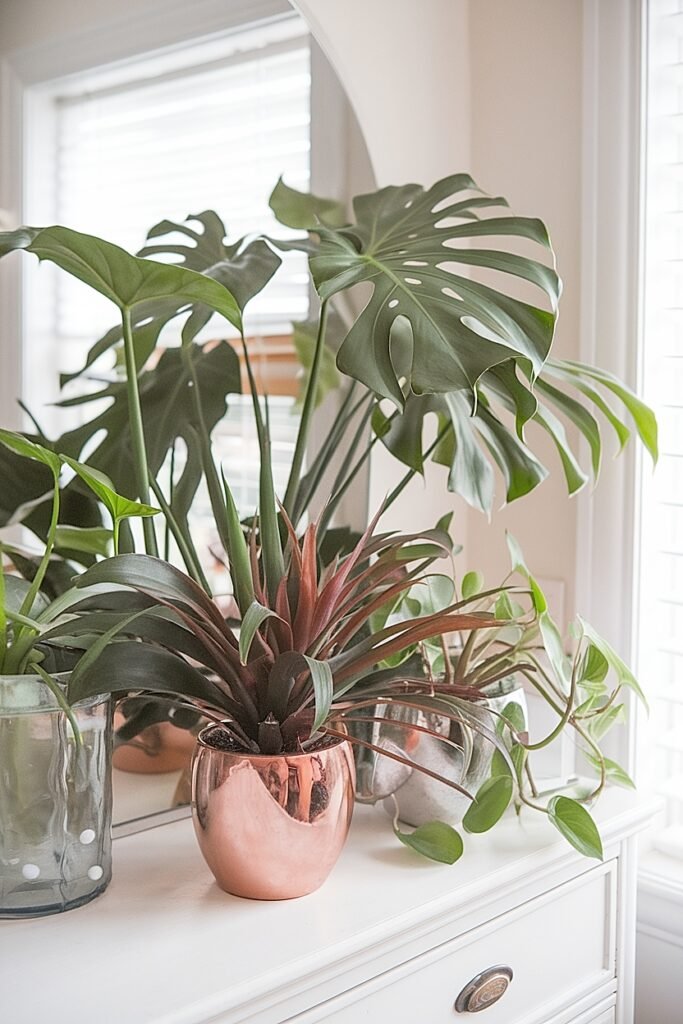
Bronze is not the same as orange. It is worth being specific about this.
Orange flowers are saturated, vivid, and bright. Bronze flowers, dark amber chrysanthemums, copper-toned spray roses, dried-looking rust that has gone dark and warm, read as drier and more aged. That specific quality is what suits deep green houseplant rooms. Bronze beside dark green foliage reads as specifically autumnal in a way that bright orange reads as festive and loud.
Three bronze chrysanthemum stems in a dark terracotta vessel beside a ZZ plant or a cast iron plant: the dark green plant foliage creates maximum visual contrast with the warm bronze blooms. The terracotta vessel sits in the same warm family as the bronze flowers, creating vessel-and-flower harmony. The whole display reads as composed rather than assembled.
Bronze also suits rooms where the plants have mixed foliage tones. A croton with amber, rust, and green all on one leaf, beside bronze chrysanthemum flowers: the bronze in the flowers reinforces the bronze in the leaf and the whole plant reads as more vivid and specifically autumn.
Ideas for Cream Fall Flower Colors in Rooms With Lots of Green Houseplants
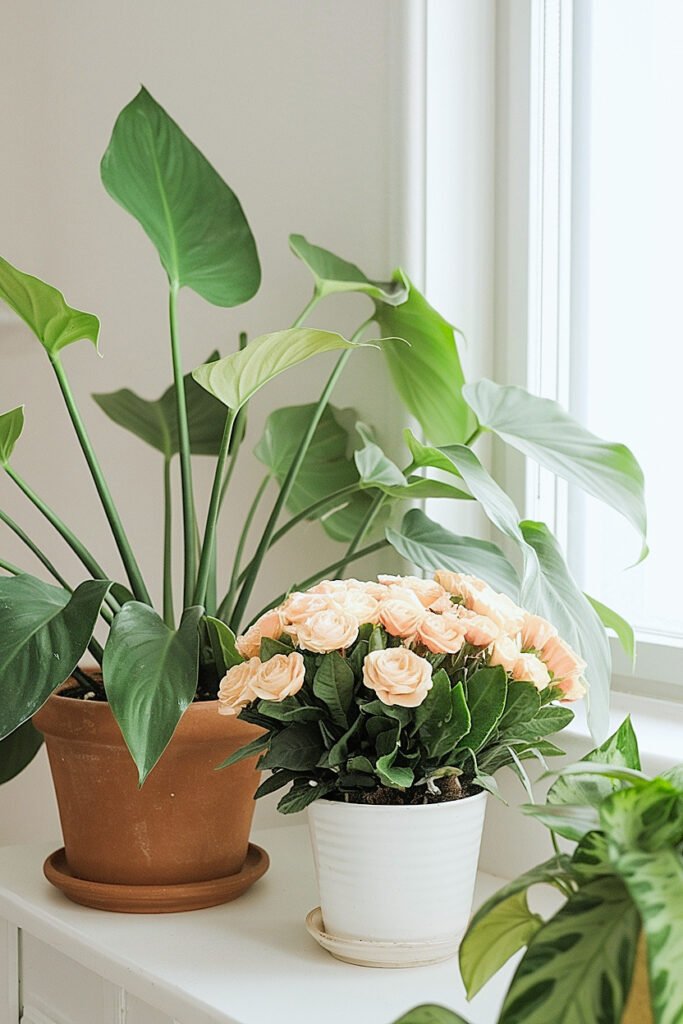
1. Cream Pompom Mums Beside a Trailing Pothos Five cream pompom mum stems at rim height in a dark navy vessel beside a trailing pothos. The pothos green trailing foliage frames the cream mum arrangement naturally. The white-cream bloom reflects ambient room light and makes the surrounding pothos green appear richer and more vivid. Under eight dollars, holds.
2. Cream Carnations and Seeded Eucalyptus Beside a Rubber Plant Four cream carnation stems plus two seeded eucalyptus strands in a dark vessel beside a rubber plant. The rubber plant’s large glossy leaves provide the bold green backdrop. The cream carnation fringed petal edge at close indoor range adds botanical detail alongside the smooth glossy leaf surface.
3. Cream Ranunculus in a Copper Pitcher Beside a Peace Lily Two to three cream ranunculus stems in a small copper pitcher beside a peace lily. The copper vessel adds warm tone that prevents the all-cream-and-green combination from reading as too cool. The ranunculus layered petal structure at close range adds depth beside the peace lily’s spathe.
4. Cream Spray Roses Beside a Bird of Paradise Three cream spray rose sub-stems in a wide dark vessel beside a bird of paradise. The bird of paradise’s large structured leaves and the spray rose’s multiple smaller bloom heads create a scale contrast where the flower arrangement reads as delicate detail beside the plant’s bold architecture.
5. Cream Lisianthus Beside a Fiddle Leaf Fig Two cream lisianthus stems in a dark vessel beside a fiddle leaf fig. The fiddle leaf’s large rounded leaves create a green backdrop for the ruffled lisianthus bloom. Lisianthus opens progressively across the week, creating visual variety at the plant display level from the same stems.
More ahead on burgundy, which is the most dramatic and most specifically good-looking fall color for a green plant room.
DIY Ideas for Burgundy Fall Flower Colors Beside Green Indoor Plants
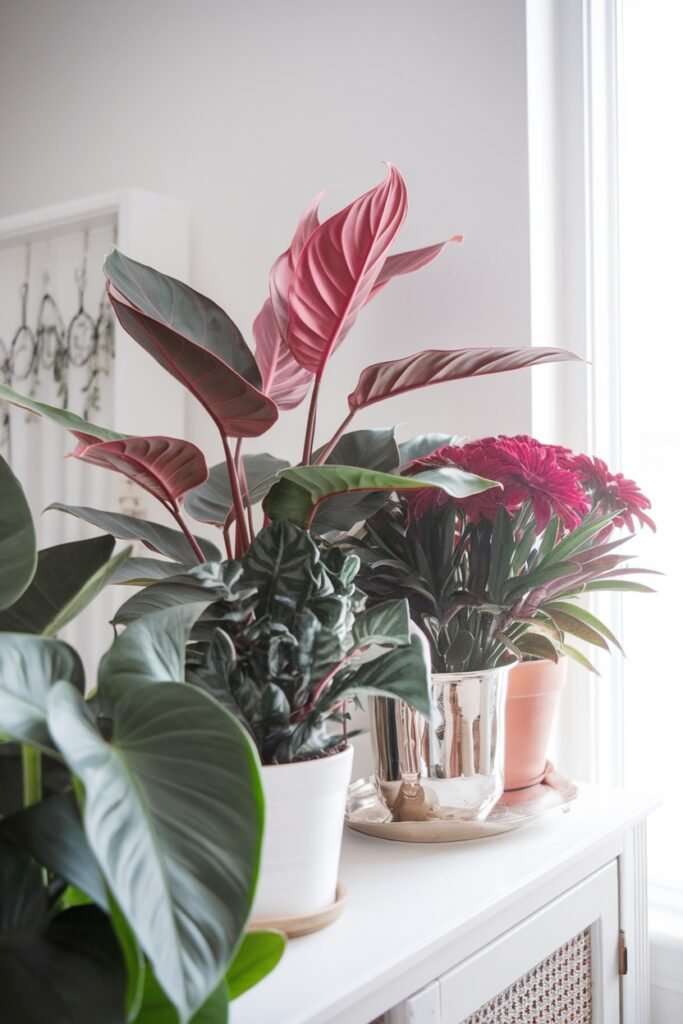
1. Burgundy Dahlias Beside a ZZ Plant Two deep burgundy ball dahlias in a dark charcoal vessel beside a ZZ plant. The ZZ’s waxy black-green oval leaflets create the deepest green backdrop available against which the burgundy bloom reads as specifically vivid. Low ambient light makes both elements more dramatic. The most sophisticated plant-and-flower pairing in this.
2. Wine-Red Carnations and Wheat Beside a Pothos Four wine-red carnation stems plus two dried wheat stalks in a dark crock beside a trailing pothos. The warm wheat stalk bridges the cool wine-red carnation and the cool green pothos foliage with one warm neutral. The wheat also creates autumn-seasonal character that a straight carnation-and-plant pairing lacks.
3. Burgundy Pompom Mums Beside a Cast Iron Plant Four deep burgundy pompom mum stems in a wide dark vessel beside a cast iron plant. The cast iron plant’s dark strap-like leaves are the ideal backdrop for burgundy mums. Two cool dark tones, deep red and deep green, create an intimate, deeply atmospheric indoor plant display suited specifically to.
4. Deep Red Spray Roses Beside a Rubber Plant Three deep red or burgundy spray rose sub-stems in a small dark vessel beside a rubber plant. The spray rose multiple bloom heads create distributed warm-red color alongside the rubber plant’s large glossy leaves. The small bloom scale suits the rubber plant’s bold leaf architecture without competing with it.
5. Burgundy Alstroemeria Beside a Peace Lily Two burgundy alstroemeria stems in a slim dark vessel beside a peace lily. The alstroemeria’s multiple bloom heads at different opening stages create progression and variety alongside the peace lily’s white spathe and dark green leaves. The three tones, burgundy, white spathe, dark green, read as a composed three-color indoor.
More ahead on peach, which surprises people every time in a green plant room.
Ideas for Soft Peach Fall Flower Colors With Indoor Greenery Decor
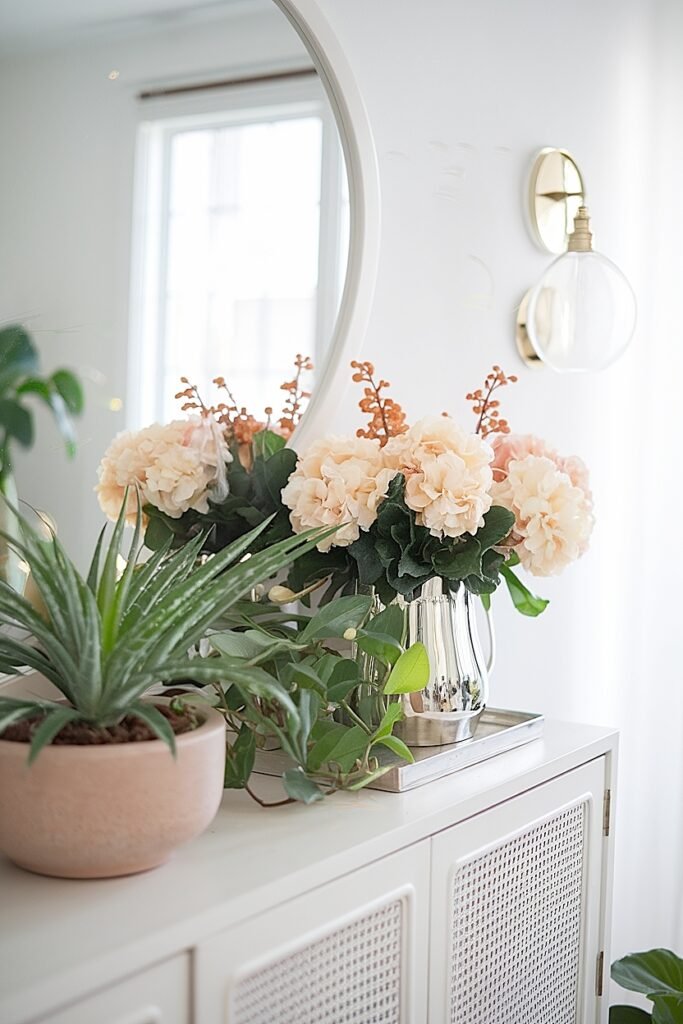
1. Peach Spray Roses Beside a Fiddle Leaf Fig Three peach spray rose sub-stems in a small dark vessel beside a fiddle leaf fig. The fig’s large rounded pale-green leaves and the soft warm peach spray rose blooms create a gentle warm-and-green pairing. The spray rose smaller bloom scale suits the fiddle leaf’s bold leaf architecture by providing delicate.
2. Peach Carnations and Seeded Eucalyptus Beside a Trailing Ivy Four peach carnation stems plus two seeded eucalyptus strands in a dark vessel beside a trailing ivy. The ivy’s small pointed leaves frame the arrangement from behind. The peach carnation fringed petal and the eucalyptus silver-grey seed cluster create two different warm-and-neutral textures alongside the ivy’s cool green.
3. Peach Alstroemeria Beside a Bird of Paradise Two peach alstroemeria stems in a small dark vessel beside a bird of paradise. The bird of paradise’s large structural leaves and the alstroemeria’s multiple small warm bloom heads create a scale and texture contrast. Alstroemeria’s spotted petal markings add close-range botanical detail beside the bold, smooth leaf surface.
4. Soft Peach Ranunculus Beside a Monstera Two soft peach ranunculus stems in a dark vessel beside a monstera. The monstera’s large fenestrated deep-green leaves create the most vivid green backdrop available for the delicate peach bloom. The ranunculus layered petal depth at close indoor range adds warmth and botanical complexity beside the dramatic monstera leaf form.
5. Peach Gomphrema Beside Grouped Small Succulents Eight peach gomphrema ball stems in a small dark vessel beside grouped small succulents. The compact ball structure at close range beside the varied succulent rosette forms creates a composed small-plant-and-flower display. Gomphrema holds for two weeks without attention, suiting a plant shelf that does not get daily care.
6. Pale Peach Asters and Fresh Sage Beside a Peace Lily Five pale peach or apricot aster stems plus one sage sprig in a dark vessel beside a peace lily. The three tones, peach aster, white peace lily spathe, and grey-green sage, create a warm-and-neutral botanical combination. The sage fragrance at indoor range adds a sensory element to the plant display.
7. Peach Spray Mum Sub-Stems Beside a Chinese Evergreen Four peach spray mum sub-stems in a small dark vessel beside a Chinese evergreen. The Chinese evergreen’s pale and dark green patterned leaves provide a mixed-tone green backdrop against which the warm peach spray mum blooms create a gentle warm-on-green display. Holds ten to fourteen days.
More ahead on handling orange in a plant room, which requires more restraint than any other fall color.
How to Balance Orange Fall Flower Colors in Green Houseplant Rooms
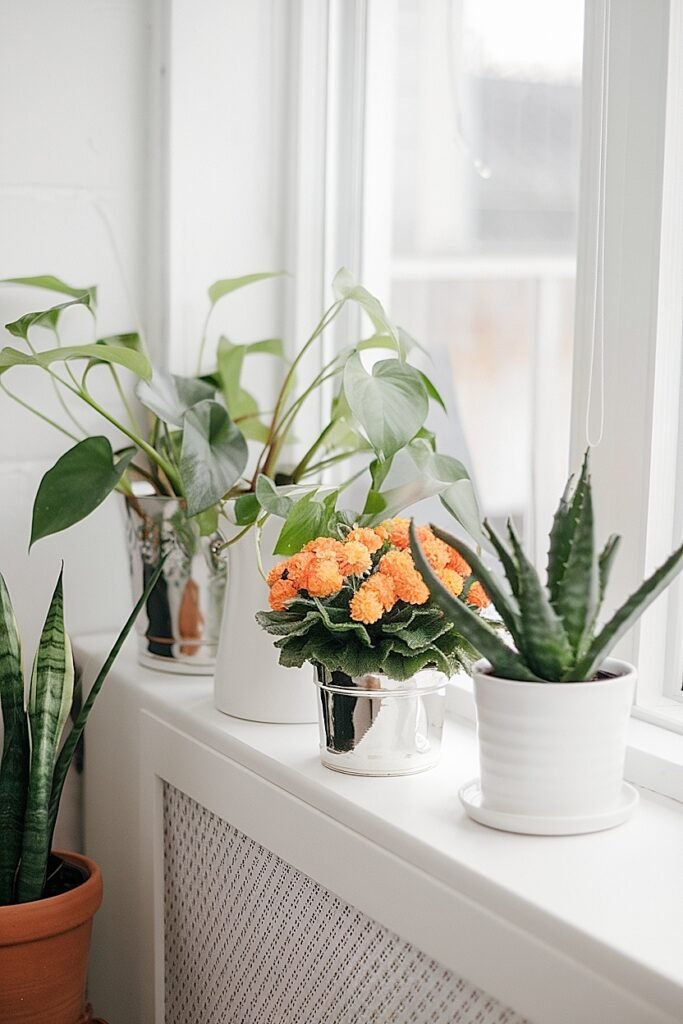
Too much orange in a green plant room tips from autumn into competitive.
Orange and green are complementary colors, which means each one makes the other more vivid. That is the appeal. But in a room already full of green plants, a large saturated orange flower arrangement adds so much visual energy that the plants start to look like backdrop rather than subjects.
One or two orange stems as accents rather than the full arrangement. Two rust carnation stems among five cream carnation stems in a vessel beside a dark-leafed plant: the orange reads as the accent, the cream reads as the field, the green plant reads as the context. That proportion creates a specific, warm autumn combination where the orange contributes without dominating.
The vessel helps enormously here. Orange flowers in a dark vessel beside a green plant: the dark vessel absorbs some of the visual energy of the orange and the plant-and-vessel-and-flower combination reads as composed. Orange flowers in a clear vessel in the same plant room: too much bright warm color without any visual anchor.
DIY Ideas for Cream and Burgundy Fall Flower Colors With Green Plants
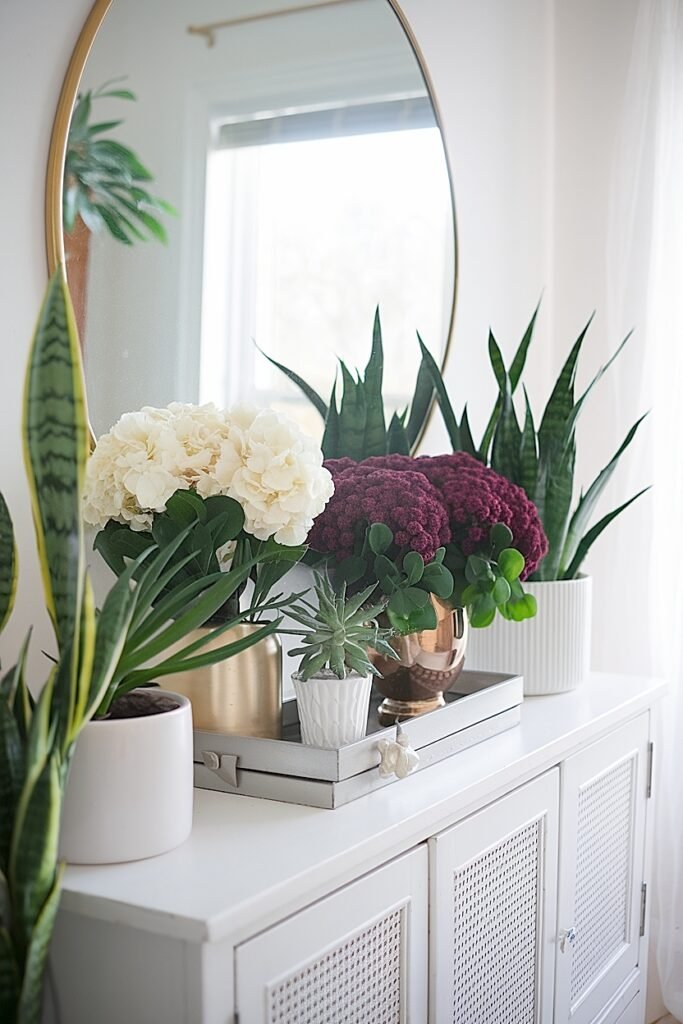
1. Cream Carnations and Burgundy Dahlias Beside a ZZ Plant Three cream carnation stems plus one burgundy ball dahlia in a dark vessel beside a ZZ plant. The cream carnation provides the neutral cool field. The single burgundy dahlia is the focal point. The ZZ plant’s dark green creates maximum contrast with both tones. The most dramatic indoor plant-and-flower pairing.
2. Cream Mums and Wine Carnations in a Wide Dark Bowl Beside a Pothos Three cream pompom mum stems plus three wine-red carnation stems in a wide dark bowl beside a trailing pothos. The pothos trailing foliage frames the cream and burgundy arrangement naturally from behind and below. The two-tone flower arrangement beside the one-tone trailing plant reads as a composed layered display.
3. Cream Spray Roses and Burgundy Asters Beside a Peace Lily Two cream spray rose sub-stems plus four burgundy aster stems in a dark vessel beside a peace lily. The peace lily’s white spathe relates to the cream spray rose. The burgundy asters contrast with the dark green peace lily leaves. Three distinct tones across the plant-and-flower display.
4. Cream Lisianthus and Burgundy Carnations Beside a Fiddle Leaf Fig Two cream lisianthus stems plus two burgundy carnation stems in a dark vessel beside a fiddle leaf fig. The lisianthus ruffled petal and the carnation fringed petal create two different bloom textures within one cream-and-burgundy combination. The fiddle leaf’s large pale-green leaves suit the soft autumn two-tone pairing.
5. Cream Ranunculus and Wine-Red Spray Roses in a Copper Vessel Beside a Monstera Two cream ranunculus stems plus two wine-red spray rose sub-stems in a small copper vessel beside a monstera. The copper vessel adds warm metallic tone between the cream and wine-red. The monstera’s dramatic deep-green fenestrated leaves create the boldest green backdrop of any plant on this list. Three warm-and-cool tones.
Conclusion
Green rooms need color. Real color, not more green.
Rust makes the green more vivid. Burgundy makes it more dramatic. Peach makes it soft and seasonal. Cream makes the whole room brighter. Any of these in a dark vessel beside the plant already on your shelf creates a fall display that looks like it was planned.
It takes one bunch from the supermarket and fifteen minutes.
That is the whole project.
This website contains affiliate links, and some products are gifted by the brand to test. As an Amazon Associate, I earn from qualified purchases. Some of the content on this website was researched and created with the assistance of AI technology.