
This website contains affiliate links, and some products are gifted by the brand to test. As an Amazon Associate, I earn from qualified purchases. Some of the content on this website was researched and created with the assistance of AI technology.
Key Takeaways
- White companion flowers for cosmos should provide what cosmos lacks: density, structure, fragrance, or extended life — not more of the same airiness
- Feverfew and yarrow are the two best cosmos companions for airy texture because both add structure at a similar visual scale without competing with cosmos
- White zinnias are the practical backbone of any cosmos-centered arrangement: their heat resilience extends the arrangement life when cosmos begins to show stress
- Phlox and scabiosa create the most cottage-garden quality when combined with cosmos because all three flowers share the same informal, meadow-gathered visual language
- Snapdragons add the one structural element cosmos cannot provide: vertical height variation without bulk
- Baby’s breath with cosmos only works when the baby’s breath is used as genuine supporting mist, not as an equal partner — scale and proportion are everything
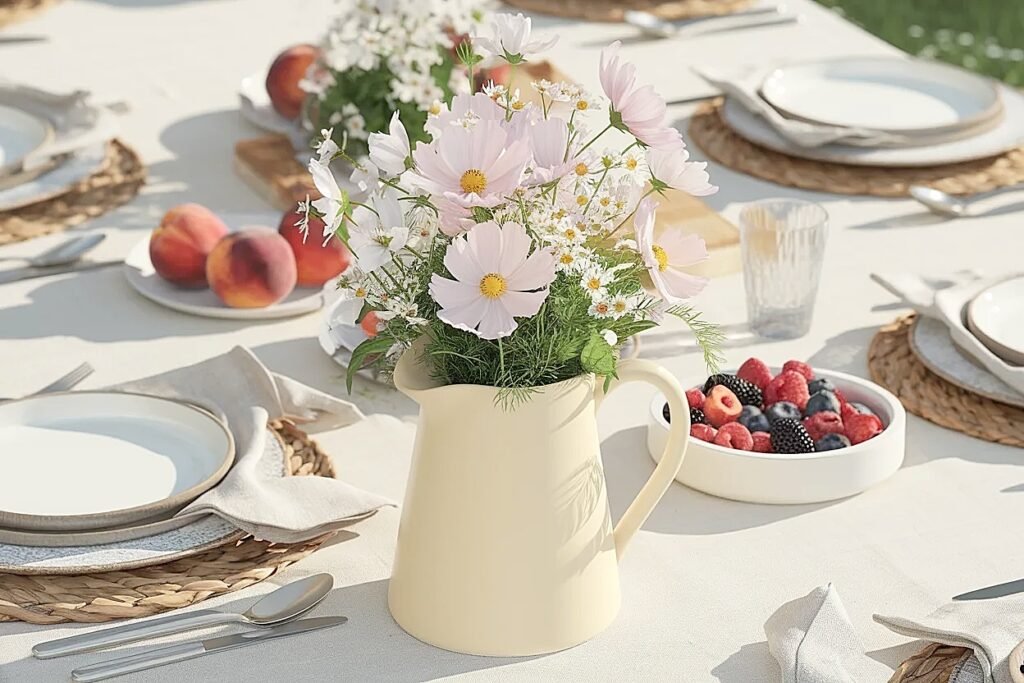
Choosing the best white summer flowers to mix with cosmos is a design decision that rewards understanding why cosmos needs particular types of companion flowers rather than just any white bloom. Cosmos already provides the airy, delicate, movement-driven quality in an arrangement. Adding another flower that provides the same qualities creates redundancy without contrast. The white flowers that work best alongside cosmos are the ones that offer something cosmos lacks: density, structural variation, fragrance, or extended vase life.
The white-on-white cosmos combination is genuinely one of the most sophisticated arrangement categories available. Two white flowers side by side reveal their textural and structural differences in a way that vivid color combinations mask completely. Next to a white zinnia’s flat, dense petal surface, cosmos appears more tissue-thin and delicate than ever. Next to a baby’s breath mist, cosmos becomes the clear focal element. The companion flower defines the cosmos by contrast as much as by complement.
Use this quick guide to choose the right white flower partner for cosmos based on the mood you want. Some flowers add softness. Some add structure. Some add tiny texture. The best arrangements usually mix one airy flower, one steady flower, and one small filler for balance.
Best White Summer Flowers to Mix with Cosmos
Choose your companion flower by the job it needs to do: soften, fill, support, lift, or stretch the arrangement.
| Arrangement Goal | Best White Flower Partner | Why It Works with Cosmos | Best Styling Tip |
|---|---|---|---|
| Soft garden textureFor loose, casual arrangements that feel freshly gathered. | FeverfewTiny white blooms with cheerful yellow centers. | Fills gaps lightlyIt supports thin cosmos stems without making the design dense. | Keep it lowUse feverfew through the middle and let cosmos float higher. |
| Airy structureFor arrangements that need shape but still feel breezy. | YarrowFlat white clusters with soft meadow texture. | Adds a landing pointYarrow gives the arrangement a base while cosmos adds movement. | Angle outwardPlace yarrow slightly lower and toward the edges. |
| Cottage fullnessFor fuller arrangements that still feel gentle. | PhloxRounded clusters with a soft summer garden feel. | Builds the middlePhlox adds body while cosmos keeps the top loose. | Avoid overpackingUse just enough phlox to create fullness, not a mound. |
| Delicate movementFor romantic arrangements with light, floating stems. | ScabiosaSoft round blooms on slender stems. | Echoes cosmos movementBoth flowers feel light, but scabiosa adds layered detail. | Vary the heightLet scabiosa sit slightly below and beside the cosmos. |
| Longer-lasting shapeFor centerpieces that need a steadier floral backbone. | White zinniasRounded, sturdy blooms that hold visual weight. | Anchors the arrangementZinnias give structure while cosmos keeps everything airy. | Tuck zinnias lowerUse them as quiet anchors, not the top focal bloom. |
Resources:
- The Best Cut Flowers To Plant In May: 7 Beautiful Blooms | Homes and Gardens
- Cosmos Cut Flower Production in Utah
- Crazy for Cosmos – Floret Flowers
- HO-65: Annual Flowers
- Cosmos Purity – Floret Library
How to Mix White Summer Flowers with Cosmos and Feverfew for Soft Garden Arrangements
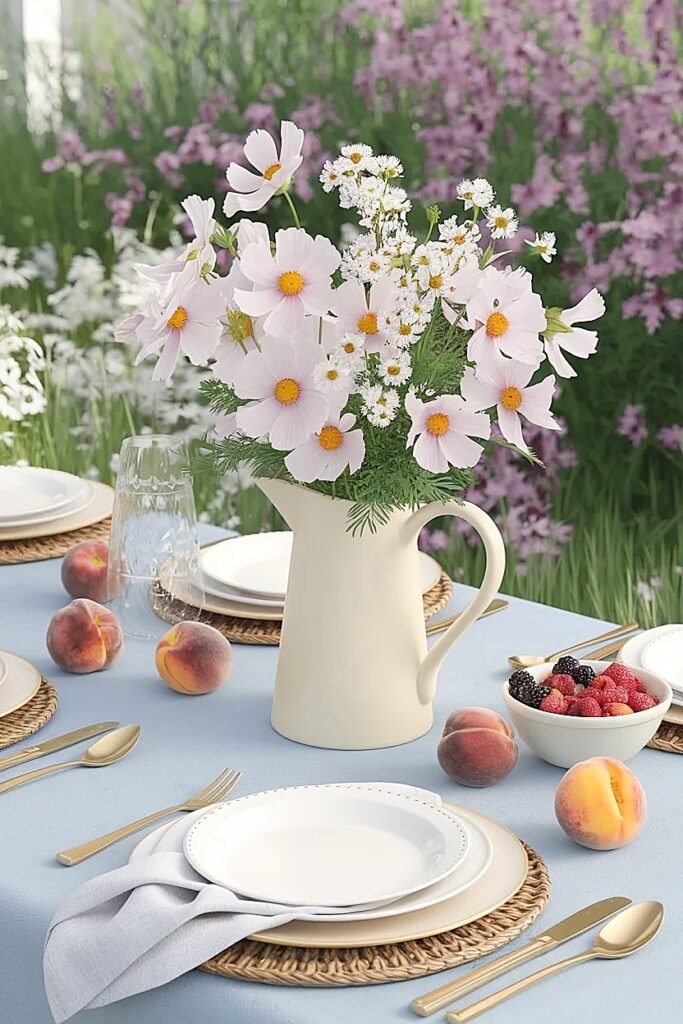
Feverfew is cosmos’ closest botanical companion in the garden and in the vase. Both are members of the daisy family, both have fine-stemmed, branching habits, both communicate the same loose, gathered-from-the-meadow quality. But feverfew’s small white button blooms with yellow centers create a structural variation that cosmos alone lacks: mass at small bloom scale that fills the visual middle ground between cosmos faces and open stem space.
A cosmos-and-feverfew arrangement has an organic, un-designed quality that is genuinely difficult to achieve with more structured flowers. The two plants together create the impression that they grew together and were cut together, which is in fact one of the most effective ways to use them: plant both in the cutting garden in the same bed and harvest mixed stems directly. The proportion of feverfew to cosmos in the arrangement determines the overall register. More feverfew creates a denser, more visually substantial display. More cosmos creates the airy, light arrangement.
The technical pairing detail that matters for feverfew with cosmos is fragrance. Feverfew has a distinctive, slightly pungent herbal fragrance that some people find pleasant and others find strong. At dinner table range, the feverfew fragrance is detectable. If the arrangement is for a food table, this is worth knowing in advance. The fragrance dissipates to almost nothing within two to three feet, which makes feverfew appropriate for most dining arrangements as long as the arrangement is not centered between plates.
For vase life management, feverfew outlasts cosmos significantly. Fresh feverfew holds five to seven days in cold water while cosmos typically shows stress at two to three days without water changes. In a mixed arrangement, the feverfew will still look strong when the cosmos begins to decline. Plan for cosmos removal and replacement while leaving the feverfew stems in place: the feverfew creates the supporting structure that allows cosmos stems to be swapped without rebuilding the entire arrangement.
For more on how white cosmos creates airy summer centerpieces, including specific low bowl and floating bloom techniques, check out how to style white cosmos for airy summer table centerpieces. Share this with anyone building soft white summer arrangements. More ahead on every specific white cosmos companion and arrangement technique.
What Are the Best White Summer Flowers to Pair with Cosmos and Yarrow for Airy Texture?

White yarrow alongside cosmos creates a combination that botanists would recognize as kindred: both are members of the same extended daisy-family tribe of meadow flowers with fine-cut foliage and informal growth habits. White yarrow’s flat-topped flower clusters provide a horizontal structural element that neither cosmos nor most other soft white flowers provide. The yarrow cluster is a visual landing pad that grounds the whole arrangement while the cosmos blooms float above it.
The flat-cluster yarrow structure creates one specific arrangement opportunity: layering. Place the yarrow stems at mid-height in the arrangement so the flat flower clusters create a horizontal visual layer. Then insert cosmos stems above the yarrow layer at varying heights. The result reads as two distinct tiers of white blooms, which creates spatial depth that single-level arrangements cannot achieve.
1. White Lisianthus White lisianthus alongside cosmos and yarrow adds a layered petal structure that contrasts with both the tissue-thin cosmos face and the flat yarrow cluster simultaneously. The lisianthus occupies visual mid-zone between the two more informal flowers, elevating the arrangement’s overall refinement without changing its soft character. One or two stems of white lisianthus among five to six cosmos and three yarrow stems creates this elevating.
2. White Waxflower White waxflower fills the arrangement’s fine-textured supporting zone between the three primary flowers without adding any visual weight. The tiny clustered blooms on branching stems create a distributed white mist that ties the cosmos, yarrow, and any third element together visually. The waxflower’s neutral-white tone prevents any tonal competition between the yarrow’s slightly cream white and the cosmos’s cooler white.
3. White Sweet Alyssum Sweet alyssum trailing from the arrangement base adds fragrance and a lowest-level white texture that no other companion flower provides at this scale. The honey fragrance at dining table range creates ambient sensory quality without competing with food aromas. Position alyssum stems at the vessel edge to allow the tiny flower clusters to trail slightly over the rim, softening the vessel boundary in a way.
4. White Chamomile White chamomile’s classic daisy structure with yellow centers creates the warmest, most food-adjacent white pairing alongside cosmos and yarrow. The yellow centers add the one warm-tone note that prevents an all-cool white arrangement from reading as cold. In afternoon indoor light, chamomile centers catch light with a warmth that makes the whole arrangement appear illuminated from within. The honey fragrance is gentle and food-compatible.
5. White Statice White statice provides structural texture at the arrangement base that neither cosmos nor yarrow supplies. The papery clustered blooms create a stable visual anchor that prevents the arrangement from reading as top-heavy with delicate blooms. White statice also extends the arrangement’s lifespan: it holds indefinitely while cosmos and yarrow decline, maintaining visual presence until replacement blooms are available.
More ahead on how scabiosa adds a third dimension of delicate texture to any cosmos-and-white-flower combination.
How to Use White Summer Flowers with Cosmos and Scabiosa for Delicate Touch
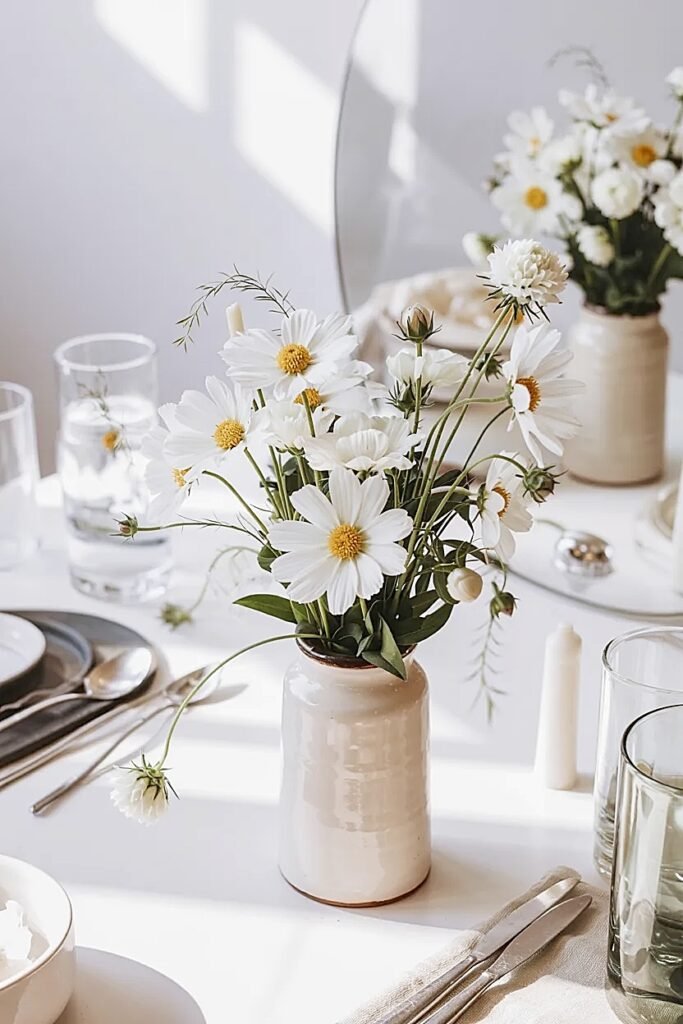
Scabiosa, also called pincushion flower, is the companion flower for cosmos that creates the most botanically harmonious combination available in the cutting garden. Both flowers have thin, branching stems. Both communicate informality and organic abundance. But scabiosa’s dome-shaped cluster bloom structure provides exactly the three-dimensional depth that cosmos lacks. The cosmos face is flat and face-forward. The scabiosa pincushion is rounded, extending in all directions from the center. Together they create arrangement depth that neither creates alone.
White scabiosa and white cosmos together read as a single palette with remarkable textural variation at close range. The visual sophistication of this combination comes specifically from the white-on-white character that makes the structural differences between the two flowers visible. In any other color combination, the scabiosa and cosmos colors might compete. In white, they clarify each other.
The third white flower added to a cosmos-scabiosa combination needs to function differently from both: it should either add mass and density, which neither cosmos nor scabiosa provides in abundance, or add height variation without width, which snapdragons accomplish specifically. The most effective three-flower white combination in this category is cosmos plus scabiosa plus white snapdragons, with white waxflower as supporting filler. Each flower occupies a distinct structural niche that none of the others fill.
One scabiosa-specific management note: unlike cosmos, scabiosa holds very well without water for several hours, which makes it a viable candidate for tucking into napkin rings, button-hole style accents on chairs, or individual bud vases beside place settings without a water source. The cosmos-scabiosa combination extends usefully across multiple arrangement contexts at the same table because the two flowers have different structural needs.
More ahead on phlox as a cosmos companion, which creates one of the most specifically cottage-garden aesthetics available in any soft arrangement.
Ways to Style White Summer Flowers with Cosmos and Phlox for Soft Cottage Arrangements
1. Cosmos and Phlox with Fennel Frond Base Build the arrangement with bronze or green fennel fronds filling the vessel first, then insert cosmos and phlox stems through the fennel layer. The feathery fennel fronds create a fine-textured green foundation that both flowers rise from naturally. The phlox clusters provide dense mid-height color.
2. Single-Variety Vessels in a Row Line three matching short vessels down the table center: one with cosmos only, one with phlox only, one with cosmos and phlox mixed. The alternating single-variety and mixed vessels create a rhythm that reads as designed rather than repetitive. The color and texture variation across.
3. Phlox-Heavy with Cosmos Accents Build a dense phlox arrangement as the foundation and insert three to five cosmos stems through the phlox mass so the cosmos blooms float above the phlox surface. The phlox creates the visual substance and the cosmos creates the airy escape from that density. This.
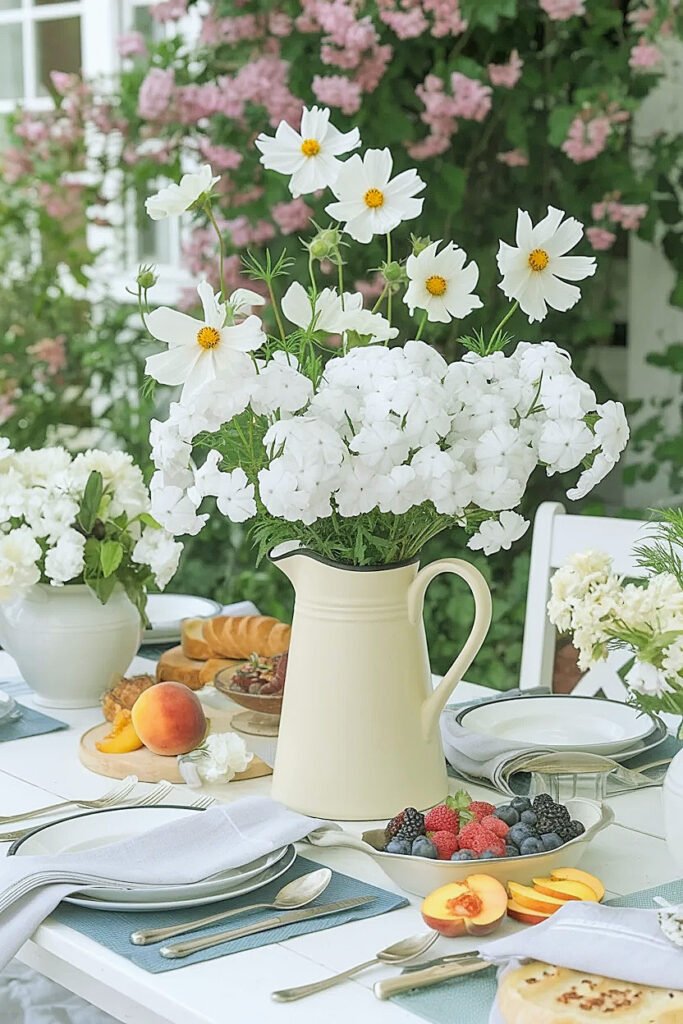
4. Cosmos and Phlox in an Enamel Pitcher White cosmos and phlox in a white or cream enamel pitcher creates a tone-on-tone cottage arrangement where the vessel, the blooms, and any visible greenery exist within a single warm-white spectrum. The enamel pitcher communicates informality and domestic warmth that suits the phlox-and-cosmos cottage aesthetic.
5. Low Saucer Arrangement with Face-Up Blooms Cut both phlox and cosmos to two to three inches above a wide, low saucer and press the blooms into a gravel base with shallow cold water. The face-up perspective at saucer level reveals the structural difference between the phlox cluster and the cosmos face.
More ahead on mixing cosmos with white zinnias specifically, which is the most practical pairing for arrangements that need to last.
Ideas for Mixing White Summer Flowers with Cosmos and White Zinnias for Longer-Lasting Arrangements
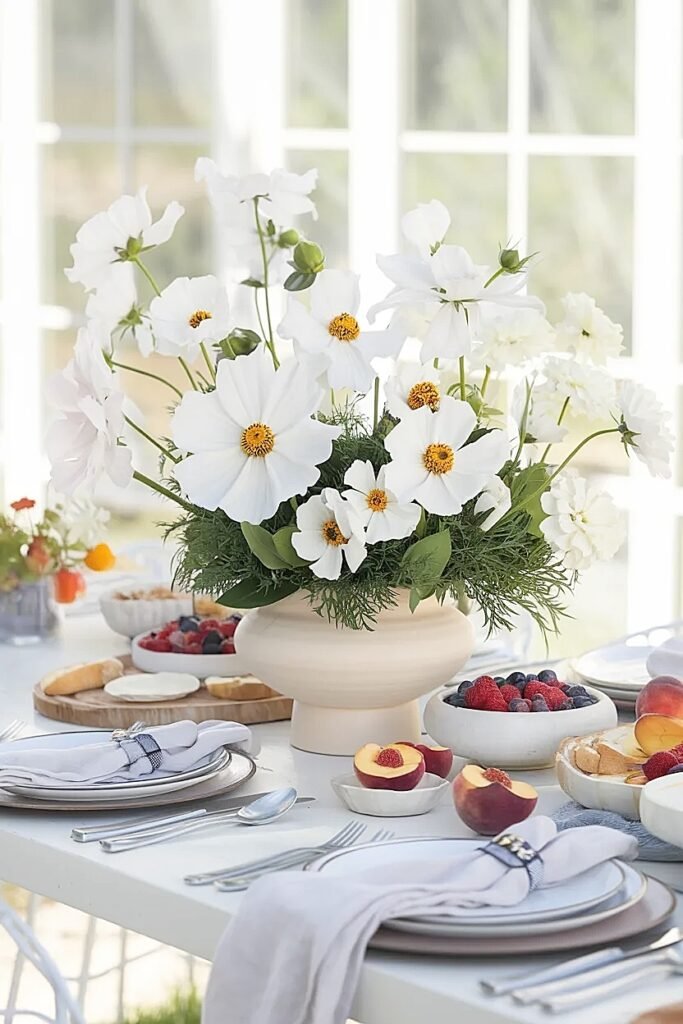
White zinnias are the practical backbone of any cosmos combination specifically because they outlast cosmos by several days in the same arrangement. Cosmos typically shows stress at the two-to-three-day mark without significant water management attention. White zinnias under the same conditions hold five or more days without visible decline. In a mixed arrangement, the zinnias create the visual framework that remains after the cosmos has peaked and can be removed.
1. Cosmos-Forward with Zinnia Anchor Stems Build the arrangement predominantly with cosmos stems, seven to ten cosmos to two to three zinnia stems. The zinnias sit at the arrangement center as anchor stems that provide the visual weight and longevity while the cosmos creates the airy surrounding display. As cosmos stems.
2. Alternating Vessel Rows with Different Proportions In a multi-vessel centerpiece row, alternate the cosmos-to-zinnia proportion across the vessels: the outer vessels more cosmos-heavy for maximum airiness, the center vessels more zinnia-heavy for visual weight and longevity. The arrangement reads as a cohesive soft display from a distance while providing intentional structural.
3. Zinnia Stems as the Structural Frame Insert zinnia stems first to create the arrangement shape, then fill in with cosmos stems that rest against and between the zinnia stems. The zinnias create a structural framework that the cosmos stems lean into naturally, providing mutual support without a tape grid or stem.
4. One Zinnia Per Bud Vase In a collection of individual bud vases for a buffet or multiple small tables, pair one white zinnia stem with two cosmos stems per vase. The zinnia provides the vase life anchor while the cosmos provides the airy complement. Each vase looks deliberately composed rather.
5. White Zinnia as the Sole Survivor Stem Build a cosmos-centered arrangement with the deliberate intention of the white zinnia stems being the sole remaining blooms after day four or five. Style the zinnias toward the outer position at day one so the cosmos creates the initial visual focal effect. By day five,.
More ahead on snapdragons, which provide the one structural element no other soft white flower offers alongside cosmos.
How to Pair White Summer Flowers with Cosmos and Snapdragons for Gentle Height
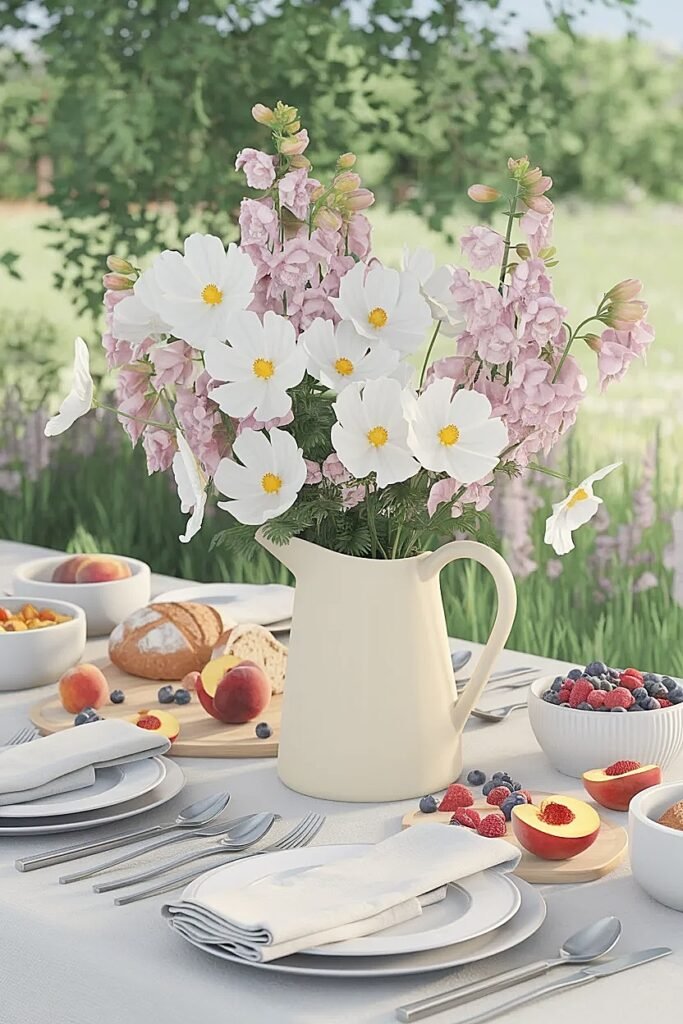
Snapdragons are the vertical element in a cosmos arrangement that nothing else provides at the same visual lightness. Most vertical flowers in arrangements, gladioli, delphiniums, foxglove, create heavy formal structure that contradicts the cosmos aesthetic. Snapdragons are the exception: the individual florets opening progressively along the stem create a soft, graduated vertical line rather than a dense spike.
White snapdragons at the back of a cosmos arrangement add height without changing the soft, informal character of the cosmos-dominant display. The key is proportion: two to three snapdragon stems among seven to ten cosmos stems allows the snapdragons to provide height variation without dominating. More than three snapdragons for every ten cosmos and the arrangement reads as a snapdragon arrangement with cosmos filler rather than a cosmos arrangement with snapdragon height.
The most effective use of snapdragons in a cosmos centerpiece is the single-stem vertical accent. One white snapdragon stem at the arrangement center, rising six to eight inches above the surrounding cosmos blooms, creates a visual focal point that draws the eye upward and then allows it to float back down through the surrounding cosmos layer. That eye movement creates the sense of dimensional depth that flat-profile arrangements do not achieve.
One snapdragon-specific management detail worth knowing: the individual florets on a snapdragon stem open from the bottom up over several days. A stem that looks seventy percent open today will look fully open in two days. Buy or cut snapdragon stems at the half-open stage rather than the fully open stage for arrangements that need to hold their appearance longest. The opening progression is one of the most dynamic visual qualities any flower contributes to a mixed arrangement.
Ways to Combine White Summer Flowers with Cosmos and Baby’s Breath Without Looking Dated
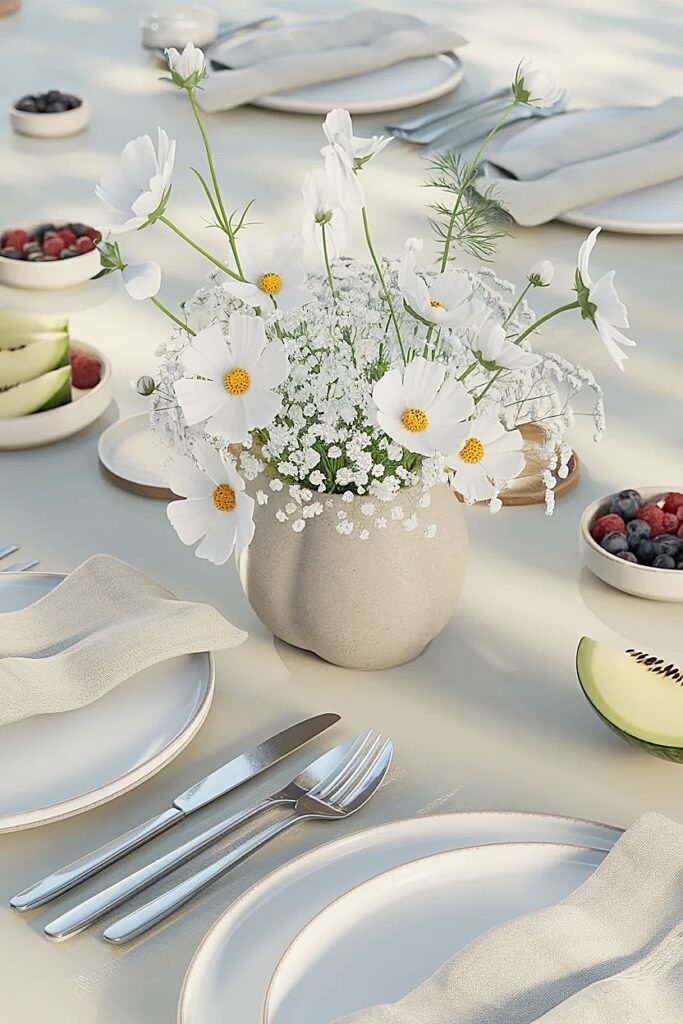
Baby’s breath earned its dated reputation through overuse as an undifferentiated white filler in every supermarket arrangement of the 1980s and 1990s. The flower itself is not dated. The application, using it as an equal partner with other flowers in high volume, is what creates the dated reading. Used with intentionality and restraint, white gypsophila alongside cosmos creates a mist-quality that no other flower provides at the same scale or cost.
1. Baby’s Breath as Background Mist Only Use baby’s breath exclusively as a background element behind and below the cosmos stems, not mixed throughout the arrangement. Position gypsophila stems toward the back of the vessel so the white mist reads as a soft backdrop through which cosmos stems pass. The cosmos occupies.
2. Baby’s Breath in Very Low Proportion One to two baby’s breath stems per ten cosmos stems is the proportion that reads as intentional and contemporary rather than supermarket-generic. At this low proportion, the baby’s breath creates specific texture accents rather than a diffuse white mist that consumes the arrangement. Position the.
3. Baby’s Breath with a Strong Color Accent The dated reading of baby’s breath most often occurs in all-white or light-pastel arrangements. Add one strong color accent, one deep burgundy dahlia, one vivid purple gomphrema ball, or one stem of deep blue delphinium, to a white cosmos and baby’s breath arrangement. The strong.
4. Baby’s Breath in an Unexpected Vessel Baby’s breath in a cobalt blue vessel, a galvanized metal tin, or a dark ceramic crock communicates vessel intentionality that eliminates the dated reading immediately. The unexpected vessel choice signals design decision-making that shifts the reading of every element in it, including the gypsophila. The.
5. Dried Baby’s Breath with Fresh Cosmos Dried baby’s breath alongside fresh cosmos creates a fresh-and-dried textural pairing that is specifically contemporary. The papery dried quality of the gypsophila alongside the tissue-thin fresh cosmos creates an intentional contrast between two different states of white. The dried stems last indefinitely while the fresh.
Conclusion
The best white summer flowers to mix with cosmos are the ones that define what cosmos is by providing what cosmos is not: density from white zinnias, structure from snapdragons, pincushion depth from scabiosa, fragrant mass from phlox and feverfew, and atmospheric mist from gypsophila when used with restraint and intention.
Every arrangement combination here uses the companion flower’s specific structural character to make the cosmos more visible, more beautiful, and more lasting. The companion defines the cosmos. That relationship, rather than any single flower choice, is the design principle that makes every cosmos combination in this article work.
This website contains affiliate links, and some products are gifted by the brand to test. As an Amazon Associate, I earn from qualified purchases. Some of the content on this website was researched and created with the assistance of AI technology.