This website contains affiliate links, and some products are gifted by the brand to test. As an Amazon Associate, I earn from qualified purchases. Some of the content on this website was researched and created with the assistance of AI technology.
Key Takeaways
- White flowers beside dark green houseplants create maximum luminous contrast. The green makes the white glow. The white makes the green look richer and deeper
- In open-concept spaces, white flowers carry visual brightness across zones in a way warm-toned flowers do not. A white arrangement visible from fifteen feet across an open room reads as a light source rather than a color note
- White needs one warm accent in a fall context to read as seasonal rather than generic. One wheat stalk, one amber carnation stem, one small pumpkin beside the vessel
- Dark vessels are essential for white flowers in plant-heavy rooms. White blooms in a dark navy or charcoal vessel beside a dark-leafed plant: the arrangement reads as specifically composed
- Shaded corners with plants benefit most from white flowers because white reflects available light and creates visual brightness in areas that otherwise recede
- White spray mums and white asters are the two most versatile white fall flowers for open-concept plant homes because both branch and create distributed bloom coverage rather than one single focal point
White flowers in a plant-heavy open-concept home do something no other fall flower color does.
Using white fall flowers with house plants to brighten open-concept living spaces is genuinely one of the most underused interior moves for autumn. Everyone reaches for rust, amber, and burgundy in October. Those are good choices. But white beside a dark-leafed monstera or a trailing pothos in a room that shares light across kitchen and living zones creates a specific brightening effect that warm-toned flowers cannot replicate. White reflects ambient and directional light back into the room. It amplifies whatever light is there rather than absorbing it. In an open-concept space where natural light travels across zones, that reflected luminosity is visible from across the room.
The plant-and-white-flower combination is specifically powerful because the dark green foliage acts as a backdrop that makes the white glow. The contrast is doing the work. Deep green behind white: the green goes deeper, the white goes brighter. Both elements become more visible than they would be on their own.
Use this guide to choose white Fall Flower accents that brighten open-concept living spaces with house plants. Each row shows where white flowers work best, which house plant setting they support, what warm accent keeps the display cozy, and how to repeat white without making the shared room feel stark.
White Fall Flower Brightening Guide for Open-Concept Plant Spaces
Use this table to place white flowers where they brighten green house plants, support open-room flow, and stay warm with cozy fall accents.
| White Fall Flower Choice | Best House Plant Zone | Warm Accent to Add | Why It Brightens the Space |
|---|---|---|---|
| Soft Structure White mums in low ceramic bowls. | Kitchen counters, dining sideboards, and dark green plant clusters. Best when the room needs a clear autumn shape. | Bronze button mums, taupe bowl, or oatmeal linen. | White mums add rounded brightness against green foliage while still feeling seasonal. |
| Light Texture White asters in tiny bowls. | Fern shelves, trailing pothos areas, and small plant corners. Best when large flowers would feel too heavy. | Pale sedum, sage greenery, or soft brown ceramics. | White asters add fine brightness without covering delicate foliage or shelf detail. |
| Budget Fullness White carnations grouped tightly. | Coffee tables, entry consoles, and low living room plant displays. Best for affordable brightness with volume. | Clay planter, woven tray, or cream ceramic cup. | White carnations create fullness in small spaces while house plants provide the greenery. |
| Polished Accent White roses with pale sedum. | Monstera, rubber plant, philodendron, and glossy plant corners. Best when the display needs a cleaner finish. | Warm brown dish, taupe vessel, or bronze detail. | White roses brighten glossy leaves while pale sedum keeps the pairing softer. |
| Open-Room Flow One repeated white flower type. | Kitchen, dining, living, and shelf areas visible at the same time. Best for open-concept color connection. | Repeat the same taupe, clay, sage, or oatmeal accent nearby. | Repetition makes white flowers feel planned instead of scattered across the open room. |
Resources:
- CIR536/MG086: Basic Principles of Landscape Design
- Houseplant design principles: colour
- Open-Concept Living | Tinted by Sherwin-Williams
- How to use Colour in the Garden | BBC Gardeners World Magazine
How to Use White Fall Flower Accents With House Plants in Open-Concept Living Spaces
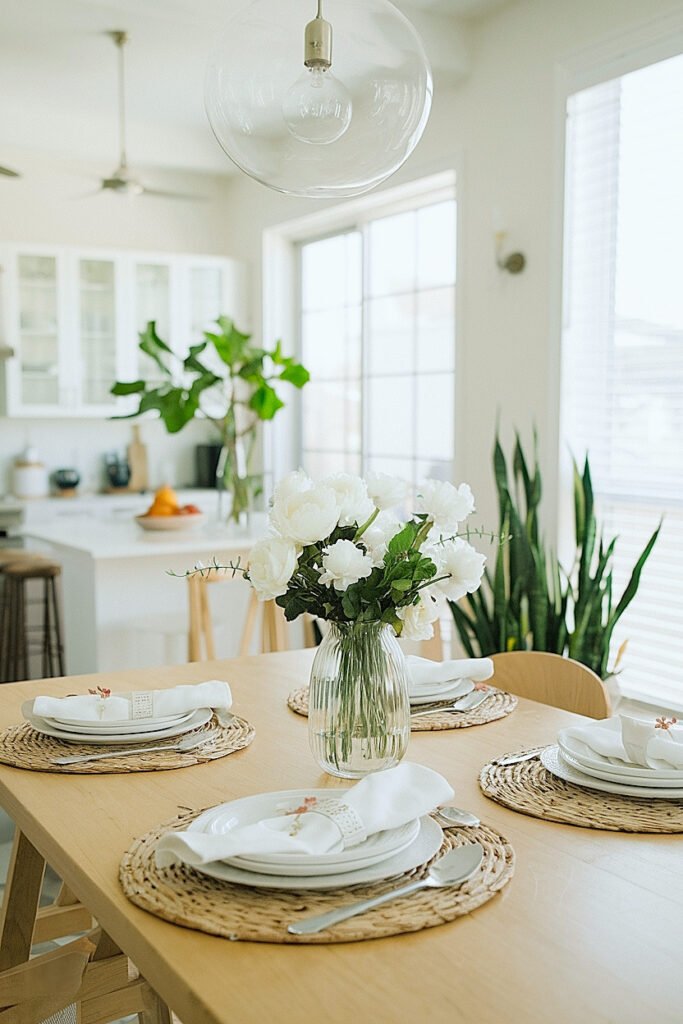
An open-concept home with houseplants and white fall flowers is working with three distinct visual elements: the plants, the flowers, and the space between zones.
The plants anchor the space with living green presence. The white flowers create the brightness signal that says there is something specific happening here, something seasonal and considered. The open space between zones is what makes both elements visible from multiple positions simultaneously. Position the white flower arrangements beside the plants that are most visible from the greatest number of positions in the open space.
Think about where you stand and what you see. Standing at the kitchen counter, what plant is visible in the living zone? Beside that plant goes a white flower vessel. Seated on the sofa, what is the primary view toward the kitchen? Beside that plant or on that surface goes another. The goal is white brightness visible from every main position in the open space, not just from up close.
White needs the dark vessel to do this well. A clear glass vessel with white flowers in a plant-filled open room reads as just flowers in glass near a plant. A dark navy or dark charcoal vessel with white flowers creates the contrast between dark vessel, white bloom, and green plant foliage that reads clearly from across an open room. Three distinct tones, readable at distance.
For more on fall flower color approaches across open-concept homes with plants, including the warm tone strategies, zone repetition principles, and variegated plant color rules, check out best fall flower colors for open-concept homes with house plants. Share this with anyone brightening a plant-heavy open-concept home this fall. The specific white flower types that work best in this context are next.
What Are the Best White Fall Flower Choices for Open-Concept House Plant Decor?
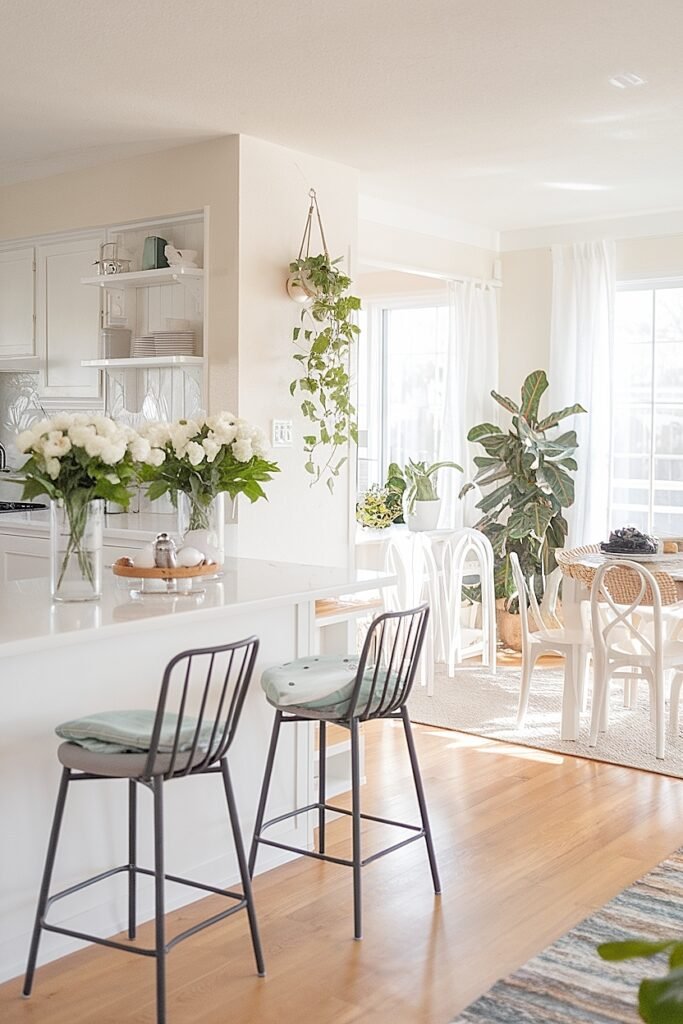
1. White Pompom Chrysanthemums Dense rounded white spheres at close range in a dark vessel beside a dark-leafed plant create maximum light-on-dark contrast. The tight petal packing creates a bright, clean white presence that reflects ambient and directional light back into the open space. From across an open room, white pompom mums in a dark vessel beside a deep green plant read as a brightness signal rather than a color note. Holds ten to.
2. White Spray Mums White spray mum stems branch into six to eight smaller sub-stems, each carrying two to three compact bloom heads. Cut each sub-stem individually and press separately into a wide dark vessel. The distributed white bloom coverage across the vessel opening creates a glowing surface visible from multiple positions in an open room. From the kitchen zone, a white spray mum arrangement in the living zone beside a plant reads as.
3. White Asters Asters carry multiple small flat daisy faces on branching stems, with warm yellow centers that prevent the arrangement from reading as cold beside the green plant foliage. At close plant-shelf range, the yellow centers add warmth. From across an open room, the white daisy faces create distributed brightness at the plant display position. One bunch covers two to three small dark vessel positions across different zones in an open space.
4. White Lisianthus White lisianthus provides the most botanically complex white bloom for plant-adjacent displays in open-concept homes. The ruffled petal layers create surface variation visible at close indoor range. Multiple buds on each stem open progressively across the week, creating daily visual change alongside the static plant foliage. In natural light, lisianthus petals shift toward ivory-warm, which suits the plant-and-white fall combination in south and west-facing open spaces.
5. White Gomphrema Balls White gomphrema compact ball blooms hold their form indefinitely without wilting or dropping petals, which suits open-concept plant displays that need to hold across a busy week without daily attention. The tight ball structure creates clear, readable white shapes visible from across an open room. No pollen, no fragrance concern near food in an open kitchen-to-living configuration. Suits any vessel scale from a small shelf bud vase to a wide.
More ahead on positioning white flowers between the kitchen and living zones, where the cross-room visibility creates the most opportunity for the brightening effect.
How to Use White Fall Flower Arrangements Between Kitchen and Living Room Plants
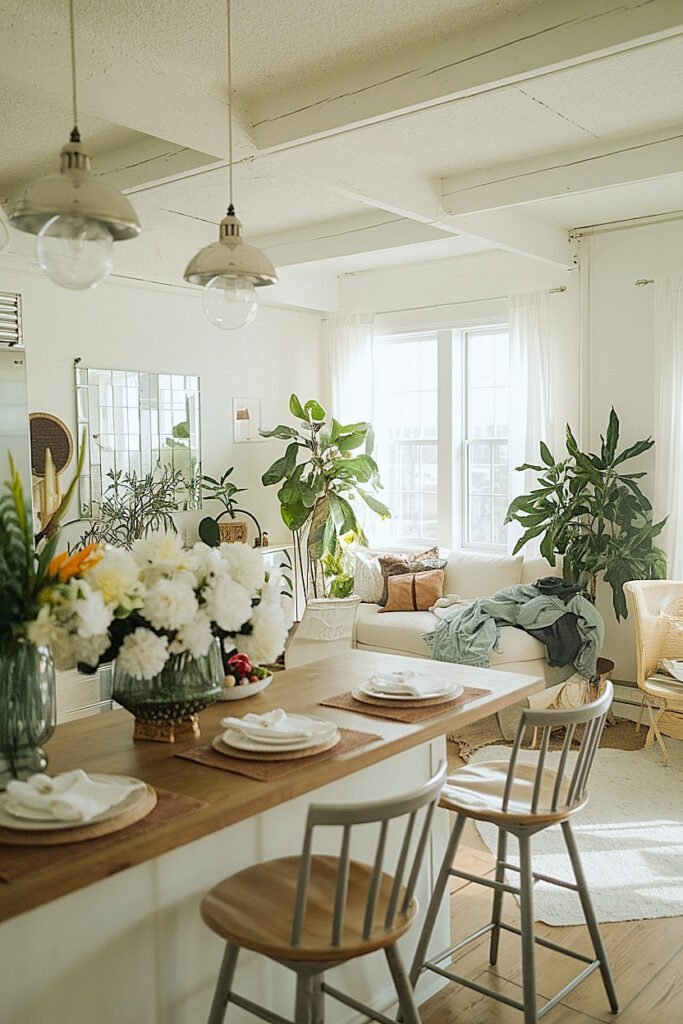
The space between kitchen and living room is the most valuable position in an open-concept home for white flowers.
Arrangements placed at the visual boundary between the two zones are visible from both. From the kitchen, the living room arrangement reads as brightness in the far zone. From the living room, the kitchen arrangement reads as brightness at the entry to the cooking zone. The arrangement at the zone boundary works harder than arrangements placed deeper in either zone because it is serving two audiences simultaneously.
The kitchen island is the most common zone boundary surface in open-concept homes. A wide dark bowl with five white spray mum sub-stems on the kitchen island is visible from the living room sofa, from the kitchen while cooking, from the dining area, and from the entry. One arrangement, multiple viewing positions, one brightening effect across the whole open space.
The houseplant beside the zone boundary arrangement amplifies this effect. Place the white flower arrangement on the same surface as, or immediately beside, a plant that is visible from both zones. The plant-and-flower vignette at the zone boundary reads from every position as a composed autumn display rather than a floating arrangement with no visual anchor.
Ways to Brighten Open-Concept Living Spaces With White Fall Flower Clusters
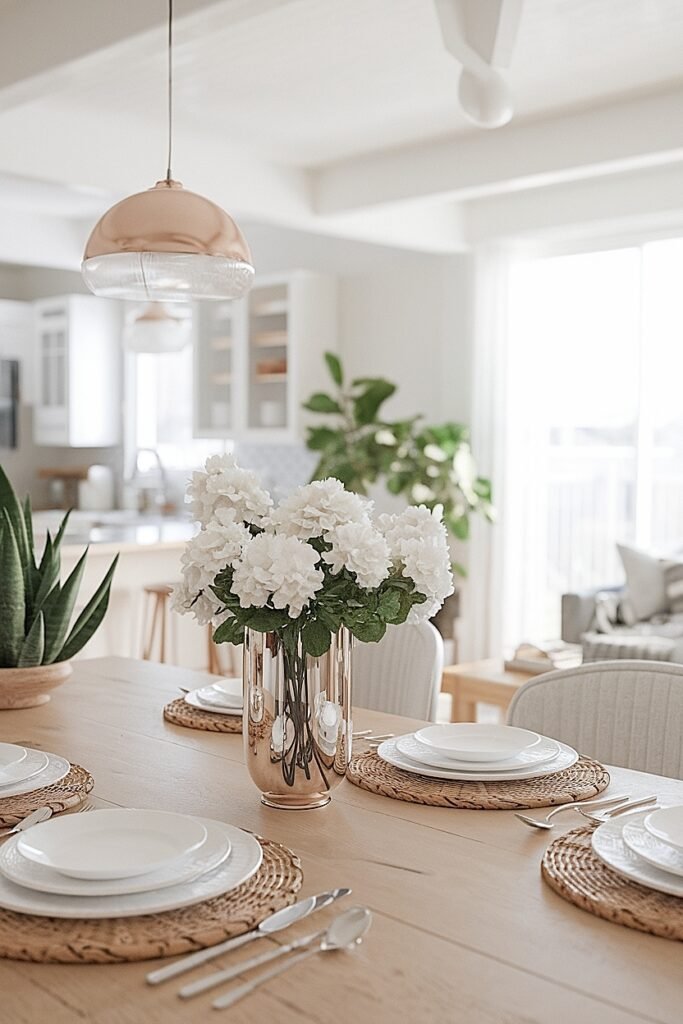
1. Three Matched Small Dark Vessels Down the Kitchen Island Three small matched dark vessels with three white spray mum sub-stems each, lined down the kitchen island surface. The repeated white bloom positions create a bright horizontal band at counter height visible from the living zone across the open space. The matched vessels read as designed. The white blooms read.
2. White Flowers at Every Main Plant Position Across the Open Space One small dark vessel with three white flower stems placed beside the main plant at each zone’s primary plant position, kitchen, living, dining. The same white flower repeated at every zone plant creates a visual thread of brightness that pulls the eye across the full open space. From any standing.
3. White Flower Cluster at the Room’s Low-Light Corner Plant Five white pompom mum stems in a wide dark bowl beside the room’s lowest-light corner plant. The white blooms create maximum light-reflecting brightness exactly where the room naturally recedes. The corner plant and the white arrangement together create a composed display that draws the eye to a position that previously.
4. White Floating Bloom Saucers on Open Shelves One white bloom head floating face-up in a small dark saucer beside each small plant on open shelves visible from the open space. The floating white bloom surfaces at shelf height create distributed brightness points visible from the main living zone. Zero height. Minimal footprint. Maximum light-on-dark contrast from each.
5. One Tall White Flower Stem Behind Each Zone’s Main Low Arrangement One white lisianthus or white spray rose stem in a narrow dark bud vase placed directly behind the main low white flower arrangement at each zone’s primary plant position. The taller single stem behind the wide low arrangement creates height variation at the plant display. From across the open room,.
More ahead on coffee table white flower styling, which is the most viewed surface in an open-concept living zone.
Easy Ideas for White Fall Flower Styling on Open-Concept Coffee Tables With Plants
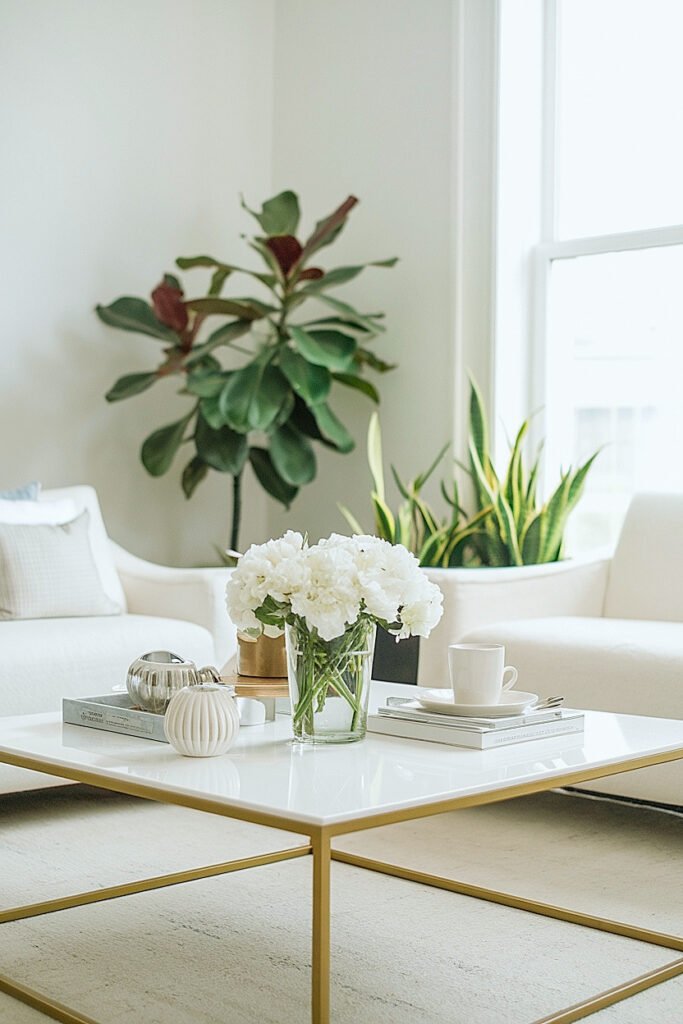
1. Wide Low Dark Bowl With White Mums Beside a Coffee Table Plant Five white pompom mum stems at rim height in a wide dark ceramic bowl on the coffee table, positioned beside a small plant placed on the same table or on a nearby surface. The white blooms at coffee table height are visible from the kitchen zone across the open space.
2. White Flower and Small Pumpkin Coffee Table Still Life Three white spray mum sub-stems in a small dark vessel on the coffee table, with one small orange or cream pumpkin placed directly beside it. The pumpkin provides the autumn seasonal signal. The white flowers provide the brightness. Together they create a specifically fall still life at the most-viewed surface.
3. Single Floating White Bloom Saucer on the Coffee Table One white pompom mum head floating face-up in a small dark wide saucer in the center of the coffee table. Zero height. The floating white bloom visible from above at close seated range and from standing position at kitchen distance creates brightness at the room’s central gathering surface. Minimal footprint.
4. Three White Gomphrema Stems in a Narrow Dark Vessel Beside a Coffee Table Succulent Three white gomphrema ball stems in a narrow dark bud vase beside a small succulent or decorative plant on the coffee table. The compact ball structure suits the small bud vase scale. The white balls hold two weeks without attention. The white bloom beside the plant creates the dark-foliage-and-white-bloom contrast.
5. White Flower and Sage Coffee Table Bundle Three white flower stems plus two sage sprigs gathered loosely and placed flat on a small dark board or tray on the coffee table rather than in a vessel. No water needed for two to three hours. The sage fragrance at close coffee table sitting range creates a sensory autumn.
More ahead on trailing plants specifically, which create the most interesting visual framing opportunities for white fall flowers in an open space.
Creative Ways to Pair White Fall Flower Blooms With Trailing House Plants
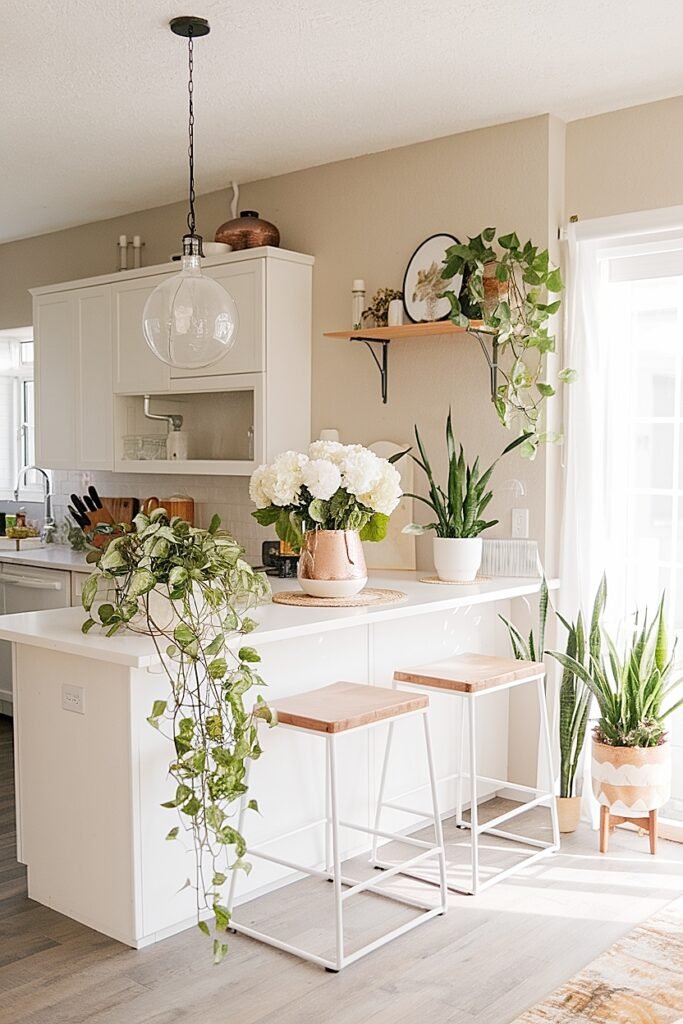
1. White Flowers in a Dark Vessel Where Trailing Pothos Falls Around It Place a small dark vessel with three white flower stems at the base of a hanging or high-shelf pothos, so the trailing green pothos falls naturally around and beside the white flower vessel. The trailing green foliage frames the white blooms from multiple sides. From across the open room, the.
2. White Spray Mum Sub-Stems Tucked Into the Trailing Zone of a String of Pearls Three white spray mum sub-stems in a water pick tucked into the pot surface of a string of pearls plant, with the white blooms sitting among the pearl-like green clusters. The white blooms and the round bead-like succulent foliage create a close-range botanical display where two different round plant forms,.
3. White Carnations in a Dark Vessel Mounted at the Same Height as a Trailing Ivy Three white carnation stems in a dark vessel placed on a shelf at the same height from which a trailing ivy hangs or trails. The trailing ivy and the upright white carnation create a visual relationship where the trailing downward movement of the plant and the upright static presence of.
4. Single White Flower Beside Each Trailing Plant Hook or Shelf One white flower stem in a small dark water pick hanging or placed beside each position from which a trailing plant hangs in the open space. The white bloom creates a brightness point at each trailing plant position. From across the open room, multiple white brightness points distributed at the.
5. White Asters in a Wide Dark Bowl at the Base of a Trailing Philodendron Six white aster stems in a wide dark bowl at the base of a philodendron that trails or drapes toward a lower shelf. The philodendron’s trailing habit creates a natural green drape above and behind the white aster arrangement. From the open kitchen zone, the dark green trailing plant above.
More ahead on warming the all-white-and-green combination with bronze accents, which prevents the fall display from reading as off-season.
How to Warm White Fall Flower Decor With House Plants and Bronze Accents
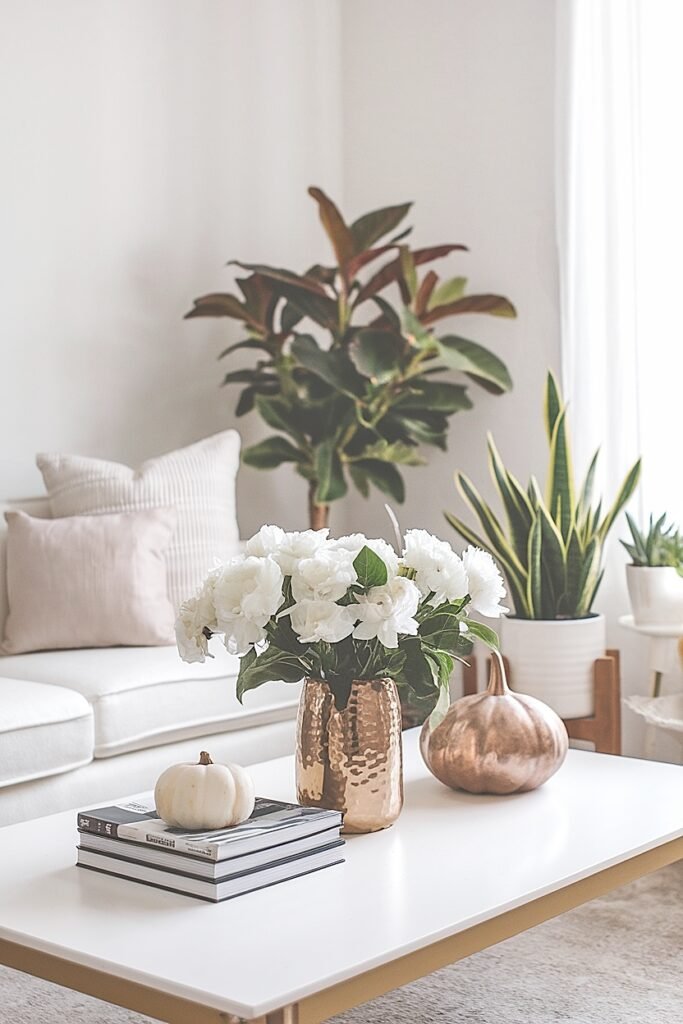
White flowers and green plants are a beautiful combination in any season. That is also the problem.
Without one warm autumn element, white flowers beside green houseplants in October look like white flowers beside green houseplants in March. There is nothing seasonal about it. The plants are green year-round. The white flowers are available year-round. The combination needs one element that says specifically fall.
One bronze accent does this. One dried wheat stalk angled outward from the white flower vessel. One small amber or copper-toned accent stem among the white blooms. A copper or terracotta vessel instead of a dark navy one. A beeswax candle six inches from the white flower arrangement. Any of these provides the warm autumn signal that white flowers and green plants cannot produce between them.
The bronze vessel approach specifically suits open-concept plant homes because copper and terracotta read as warm autumn material at any viewing distance. From across the open room, a copper pitcher with white flowers beside a dark plant reads as warm, specific, and autumnal. The vessel is doing the seasonal work. The white flowers are doing the brightening work. The plant is doing the green backdrop work. Each element has a role and none of them overlap.
Ideas for White Fall Flower Arrangements That Brighten Shaded House Plant Corners
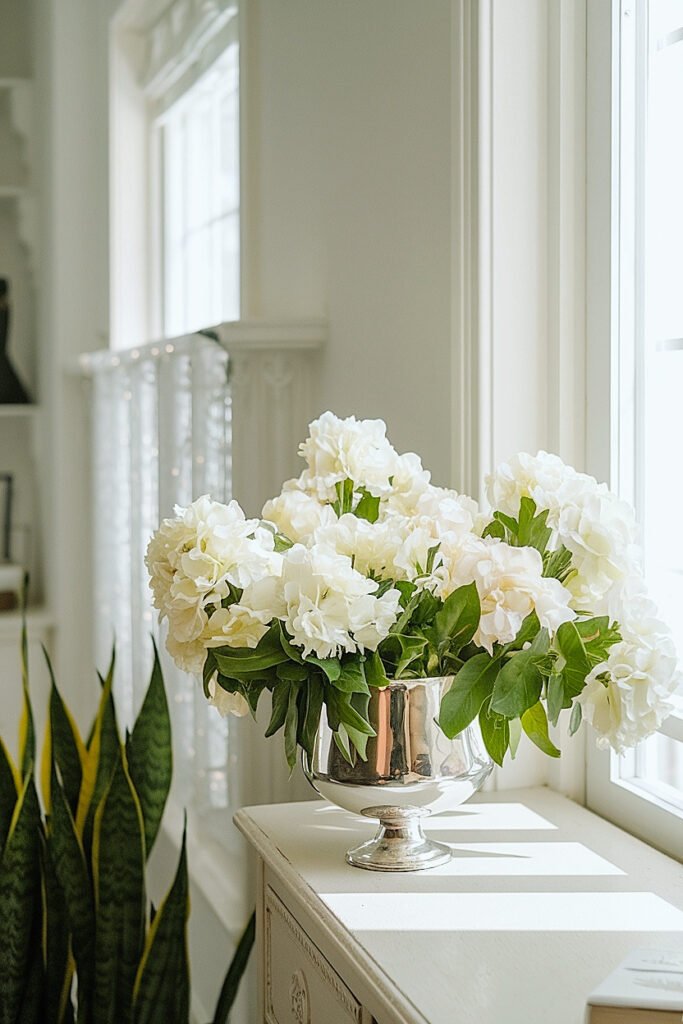
1. White Pompom Mums in a Wide Dark Bowl in a North-Facing Corner Plant Position Five white pompom mum stems at rim height in a wide dark ceramic bowl beside a low-light corner plant like a ZZ plant or cast iron plant. White blooms reflect available light in the shaded corner more effectively than any other fall flower color. The white arrangement creates a brightness.
2. White Spray Mum Sub-Stems at the Base of a Corner Tree Plant Four white spray mum sub-stems in a dark vessel at the base of a tall corner plant like a fiddle leaf fig or an indoor olive tree. The white blooms at base level beneath the tall plant create a two-level plant-and-flower display where the low brightness of the white arrangement.
3. White Gomphrema in Small Vessels Distributed Across a Shaded Corner Shelf Two to three white gomphrema ball stems in each of two or three small dark vessels across a shaded corner shelf with multiple small plants. The distributed white bloom positions across the shelf create multiple brightness points in the shaded zone. Gomphrema holds two weeks and requires no maintenance.
4. White Floating Saucer in a Shaded Corner Low Table One white bloom head floating in a dark low saucer on a small table in a shaded corner beside a low-light plant. The white bloom at surface level reflects whatever ambient light reaches the corner and creates a quiet brightness focal point in the room’s most recessive zone.
5. White Lisianthus Beside a Low-Light Peace Lily in a Shaded Corner Two white lisianthus stems in a dark vessel beside a peace lily in a shaded corner. Both the lisianthus and the peace lily are white-blooming in their own ways. The lisianthus’s warm ruffled white petals and the peace lily’s clean white spathe create two distinct white bloom forms at different.
Conclusion
White flowers in a plant-filled open home are not the safe or neutral choice.
They are the brightening choice. The luminosity choice. The choice that uses what is already there, all that dark green plant foliage, to make the white flowers glow from across the room.
Dark vessel. One warm autumn accent beside it. White blooms at the main plant positions visible from every zone.
The open space gets brighter. The plants look richer. And it costs less than ten dollars.
This website contains affiliate links, and some products are gifted by the brand to test. As an Amazon Associate, I earn from qualified purchases. Some of the content on this website was researched and created with the assistance of AI technology.