This website contains affiliate links, and some products are gifted by the brand to test. As an Amazon Associate, I earn from qualified purchases. Some of the content on this website was researched and created with the assistance of AI technology.
Key Takeaways
- White zinnias hold their white color in direct summer sun longer than almost any other white cut flower
- Stems cut three to four inches above the vessel rim create the low profile patio dining tables require without any wire, foam, or mechanical support
- The flat face-forward bloom structure reads clearly from the overhead seated viewing angle specific to dining tables
- Feverfew and cosmos are the two best companion flowers for white zinnias: feverfew adds warmth, cosmos adds movement
- Herb pairings add fragrance at close patio dining range without competing with food aromas
- Round patio tables require a centered arrangement or a tight three-vessel cluster rather than a linear runner
Making your own white zinnia flower bouquets for patio dining tables takes about fifteen minutes. That is all. One bunch from the grocery store, two herb sprigs, a short ceramic pitcher, and cold water. The result looks like you spent three times that long and thought twice as hard about it.
The white zinnia earns that efficiency. In direct outdoor afternoon sun, it holds its clean white petal color longer than almost any other white cut flower on the market. The stem is stiff and self-supporting. The flat bloom face reads clearly from the overhead angle that seated diners naturally use when looking down at the table during a meal. These are not coincidental qualities — they are exactly what outdoor patio dining demands.
Use this guide before placing white zinnia bouquets on a patio dining table. Match the bouquet shape to the meal style first. That keeps the flowers low, pretty, easy to refresh, and safely away from shared dishes, silverware, plates, and guest conversation.
DIY White Zinnia Summer Flowers for Patio Dining Tables
Choose the bouquet setup that fits your table size, serving style, and outdoor dining flow.
| Patio Table Need | Best Zinnia Bouquet Setup | Helpful Add-Ins | Smart Styling Tip |
|---|---|---|---|
| Family-style servingGuests need room to pass food and reach shared dishes. | Low side clustersUse several small cups instead of one wide centerpiece. | Feverfew, yarrow, herbsThey soften zinnias without adding bulk. | Offset the bouquetsKeep the center line clear for platters. |
| Narrow patio tableThere is not much room for plates, elbows, and serving bowls. | Short ceramic pitchersThey support zinnia stems while staying compact. | Gomphrena, short cosmosUse tiny texture and airy edges carefully. | Stagger vesselsA loose zigzag saves space. |
| Each place settingYou want a personal flower detail near every plate. | Mini cup bouquetUse one or two white zinnias per cup. | Mint, thyme, feverfewFresh herbs keep the small bouquet lively. | Place beside napkinsKeep blooms away from the eating area. |
| Long patio tableThe table needs rhythm without a floral wall. | Repeating mini bowlsRepeat white zinnias in low vessels down the table. | Scabiosa, yarrow, herbsRepeat textures for a pulled-together look. | Leave open gapsSpace makes the flowers look intentional. |
| Long outdoor mealFlowers need to stay fresh and easy to refresh. | Small water-friendly vesselsUse cups or pitchers that are easy to refill. | Statice, gomphrena, herbsThese add texture and hold shape well. | Clean lower stemsNo leaves should sit below the water line. |
Resources:
- Zinnias (Zinnia elegans) for the Farmer Florist | Mississippi State University Extension Service
- How to Care for Cut Flowers | Yard and Garden
- Cut Flower Care – Gardening Solutions
- Harvest & care tips for 10 heat-loving summer blooms – Floret Flowers
How to Build DIY White Zinnia Summer Flowers Bouquets Low Enough for Patio Dining Tables
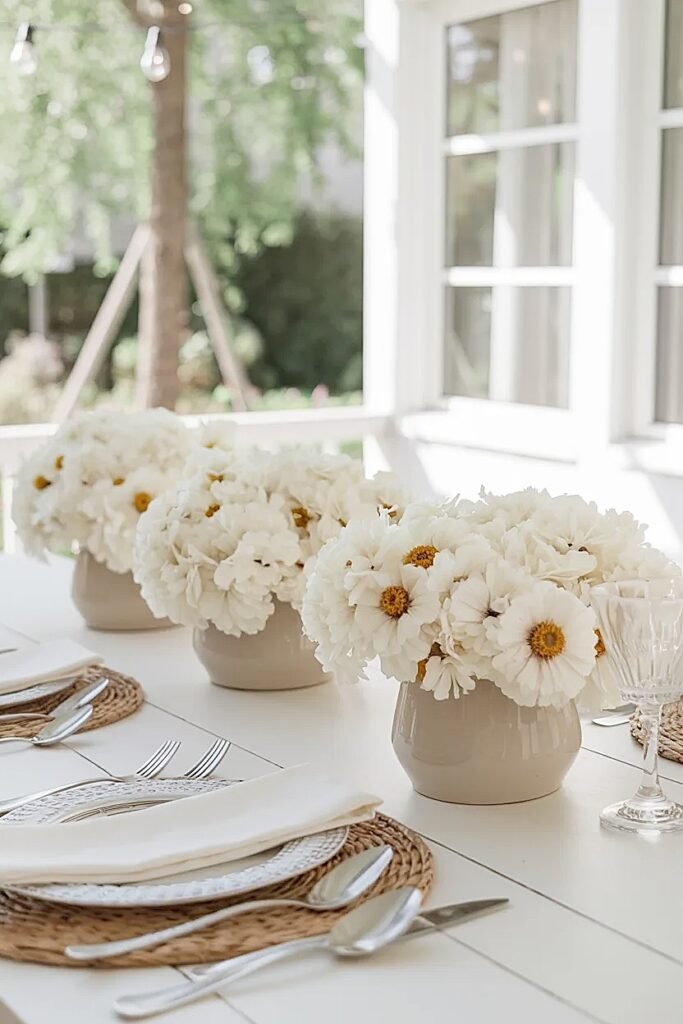
Low matters. More than any other single decision in an outdoor dining table arrangement, stem height determines whether the arrangement helps the table or fights it.
Anything beyond four inches above the vessel rim starts to obstruct guest sightlines across the table. Conversation gets uncomfortable. Guests have to lean sideways to make eye contact. The arrangement that was supposed to make the dinner better starts making it worse.
White zinnias are specifically convenient for this height constraint because the flat bloom face remains fully visible even at rim level. The flower reads completely at two inches above the rim in a way that a nodding cosmos or drooping sweet pea simply does not. Cut every stem to three to four inches above the rim, measured from the rim rather than from the table. That one measurement habit changes everything.
Add gravel. Two inches of coarse gravel in the vessel before the cold water goes in. Press each zinnia stem into the gravel at the angle and position you want, and it stays there. No tape grid. No florist foam. The gravel holds each stem at its intended direction throughout the entire meal without any structure visible from above or from the side.
White zinnia bloom faces orient gently toward available light throughout an outdoor meal. The movement is subtle, not dramatic, but it means arrangements placed in full sun will shift their facing direction as the afternoon progresses. Orient the initial bloom direction toward the primary guest positions knowing that the afternoon light will do the rest.
For more on easy approaches to small white summer bouquets across outdoor dining setups, check out easy ideas for small white summer flower bouquets for outdoor dining tables. Share this with anyone styling a summer patio table. More ahead on pitchers, herbs, round tables, and cosmos pairings.
Easy Ideas for DIY White Zinnia Summer Flowers Bouquets in Short Ceramic Pitchers
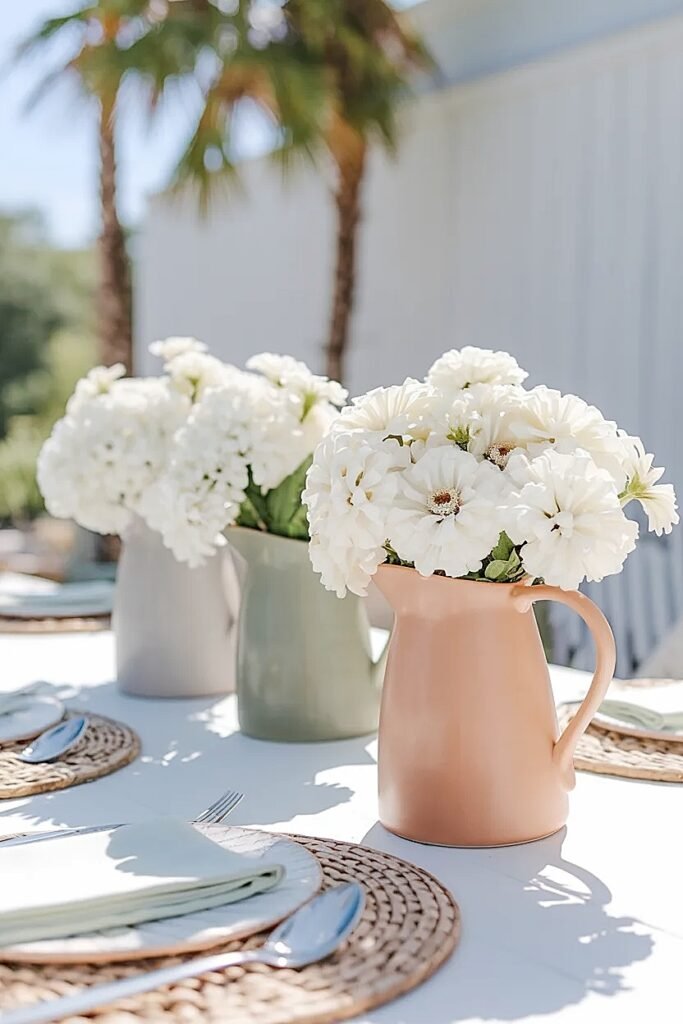
The pitcher handle changes everything.
A pitcher placed at the table edge with the handle facing inward creates an invitation rather than a decoration. It has direction. The arrangement reads as positioned in space rather than dropped at the center.
Short ceramic pitchers are the most versatile white zinnia vessel specifically because that asymmetry makes even a very simple stem count look styled, which matters when you are working fast and want results without effort.
1. White Zinnias with Seeded Eucalyptus in a Cream Enamel Pitcher Five white zinnia stems cut to four inches and two seeded eucalyptus strands trailing over the handle side in a short cream enamel pitcher. The cream enamel and white zinnias create a tone-on-tone composition while the eucalyptus silver-green creates the only contrast note. The trail over the handle creates organic asymmetry without deliberate effort. Cold water plus gravel base.
2. White Zinnias and Chamomile in a Cobalt Pitcher Five white zinnia stems plus four chamomile stems, both cut to the same three-inch height, in a short cobalt ceramic pitcher. The cobalt-and-white combination creates high contrast visible from across the patio. The chamomile’s small daisy faces and warm yellow centers add textural variety and the one warm accent that mono-flower arrangements consistently lack. Two daisy-face scales, large zinnia and small chamomile, create visual hierarchy.
3. Single-Variety White Zinnia in a Dark Grey Matte Pitcher Seven white zinnia stems packed to rim height in a short dark grey matte ceramic pitcher with no additional flowers or greenery. The high contrast between the matte dark grey and the clean white blooms creates a graphic, minimal composition that reads as deliberately designed. The matte finish absorbs light while the white zinnia petals reflect it, producing a light-and-shadow quality that glossy vessels and.
4. White Zinnias with Fresh Rosemary in a Terracotta Short Pitcher Four white zinnia stems plus four rosemary sprigs cut to matching heights in a short terracotta pitcher. Rosemary’s needle-like silver-green foliage creates fine-textured contrast against the smooth, broad zinnia petals. The rosemary fragrance at outdoor patio dining range is clean, herb-garden specific, and food-compatible in the most direct way. The terracotta’s warm buff-orange creates complementary contrast with the cool white blooms.
5. White Zinnias and White Statice in a Navy Pitcher Four white zinnia stems plus two white statice stems in a short navy blue pitcher creates a tone-on-tone white arrangement with a navy color field that amplifies both white elements simultaneously. The statice’s papery texture contrasts with the smooth zinnia petals in a way that reads as designed at close patio dining range. The statice holds longer than the zinnias, maintaining visual fullness as individual.
More ahead on making any white zinnia arrangement look genuinely full at patio dining scale without consuming the table surface guests need.
How to Make DIY White Zinnia Summer Flowers Bouquets Look Full Without Crowding Food
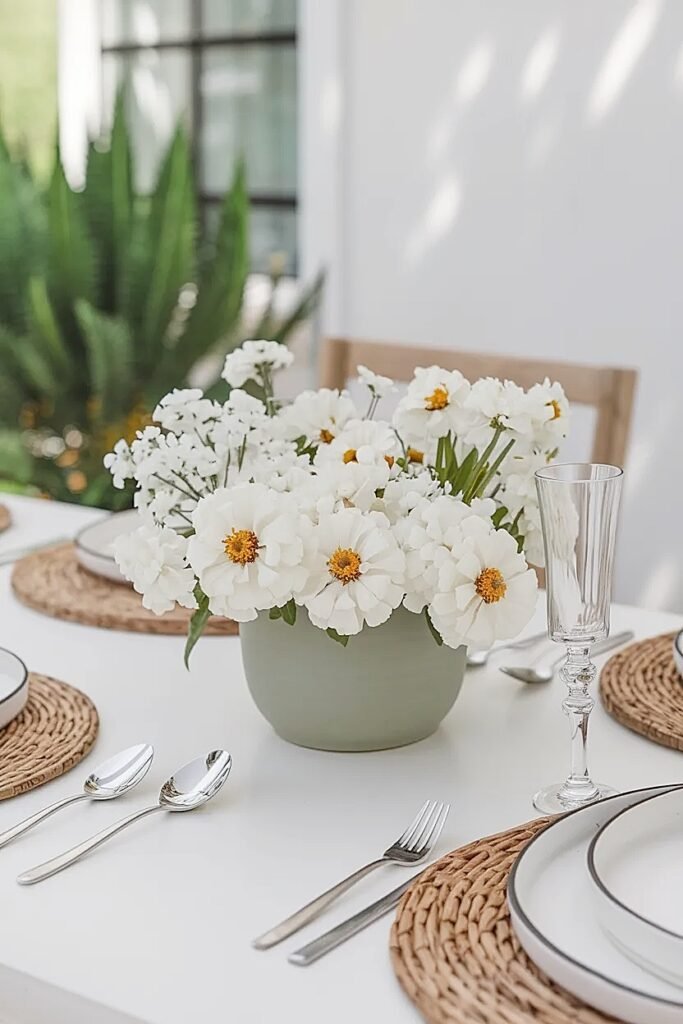
Plates. Glasses. A bread basket. A candle. The serving dish that gets passed at least twice.
A patio dining table has a lot of objects competing for surface space. The flower arrangement is one of them, and if it is the one that most consistently gets moved aside, it has already failed its job.
Two small vessels placed six to eight inches apart read as fuller than one large vessel. They create a coordinated display that reads as a system. The gap between them stays usable as a pass-through zone for serving dishes. Neither vessel dominates the table the way one large centerpiece tends to do.
Orient all white zinnia bloom faces upward and outward rather than forward. From the outdoor seated overhead angle, upward-facing zinnia faces cover a larger apparent visual area per stem than forward-facing faces on the same stem count. The flat disc structure of the zinnia specifically rewards this upward orientation because the full diameter is visible at once.
Then pack the vessel. Wide-mouth vessel, stems shoulder-to-shoulder, no visible interior wall between blooms. When no vessel wall is visible between bloom heads from above, the arrangement reads as abundantly full regardless of how few stems went into it. When vessel walls are partially visible, the arrangement reads as sparse regardless of how carefully it was built. Width of vessel opening matters more than height or stem count.
There is more ahead on how feverfew specifically changes the textural quality of a white zinnia arrangement at close patio dining range.
DIY Ideas for White Zinnia Summer Flowers Bouquets with Feverfew for Soft Texture
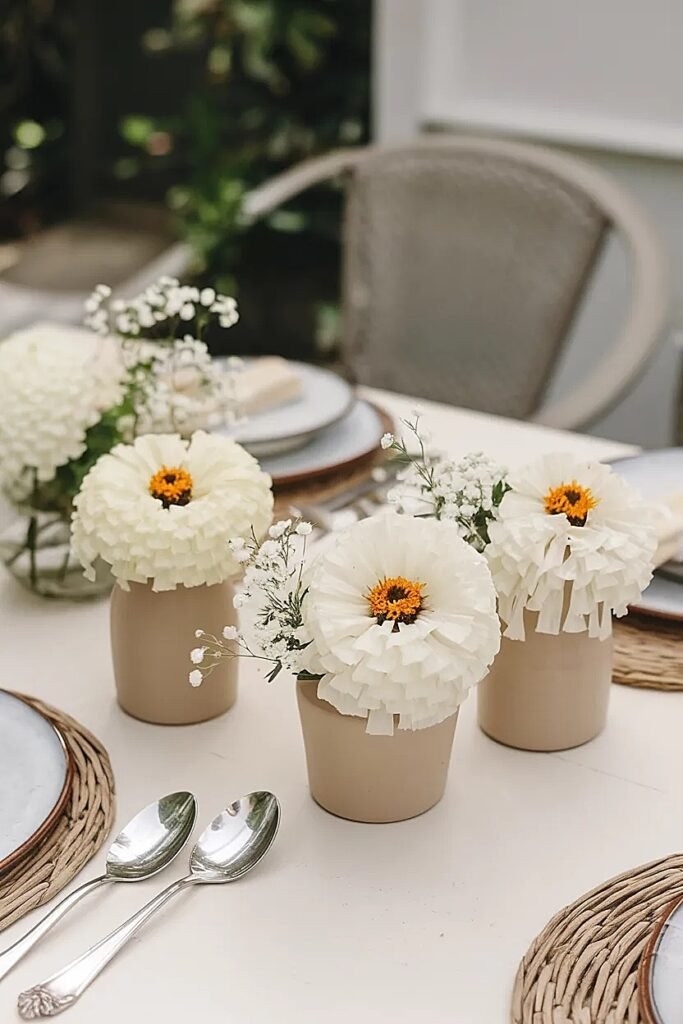
1. White Zinnias with Feverfew Ring Three white zinnia stems centered in the vessel with feverfew packed around the outer perimeter. The feverfew creates a textural ring of small button blooms around the broad zinnia focal mass. Yellow feverfew centers add a warm outer accent ring that makes the entire arrangement.
2. White Zinnia and Feverfew Equal Proportion Five zinnia stems plus five feverfew stems cut to the same three-inch height creates a mixed-texture arrangement where neither flower dominates. Equal proportion makes the visual relationship between zinnia and feverfew the primary design element rather than a supporting one. The herbal feverfew fragrance blends.
3. Feverfew-Heavy with Two Zinnia Accents Seven feverfew stems plus two white zinnia stems creates an arrangement where the feverfew’s clustered button blooms form the visual mass and the zinnia faces serve as clear accent focal points within it. The reversed proportion uses zinnia as a bright accent within a feverfew.
4. White Zinnia and Feverfew with Herb Sprig Three white zinnia stems plus three feverfew stems plus two rosemary sprigs covers all three structural roles: zinnia as the broad focal, feverfew as the soft textural filler, rosemary as the structural greenery and fragrance element. Three roles, three materials, one complete arrangement. Under ten.
5. Low Feverfew Collar Around a Single Zinnia One white zinnia stem cut six inches above the vessel rim, surrounded by feverfew stems cut to two inches. The zinnia rises above the feverfew ring as a single bold vertical element. The feverfew collar creates a base-level texture layer that connects the vessel to.
More ahead on which herbs pair best with white zinnias for outdoor heat, fragrance appropriateness, and visual proportion.
What Are the Best Herbs to Pair with DIY White Zinnia Summer Flowers Bouquets?
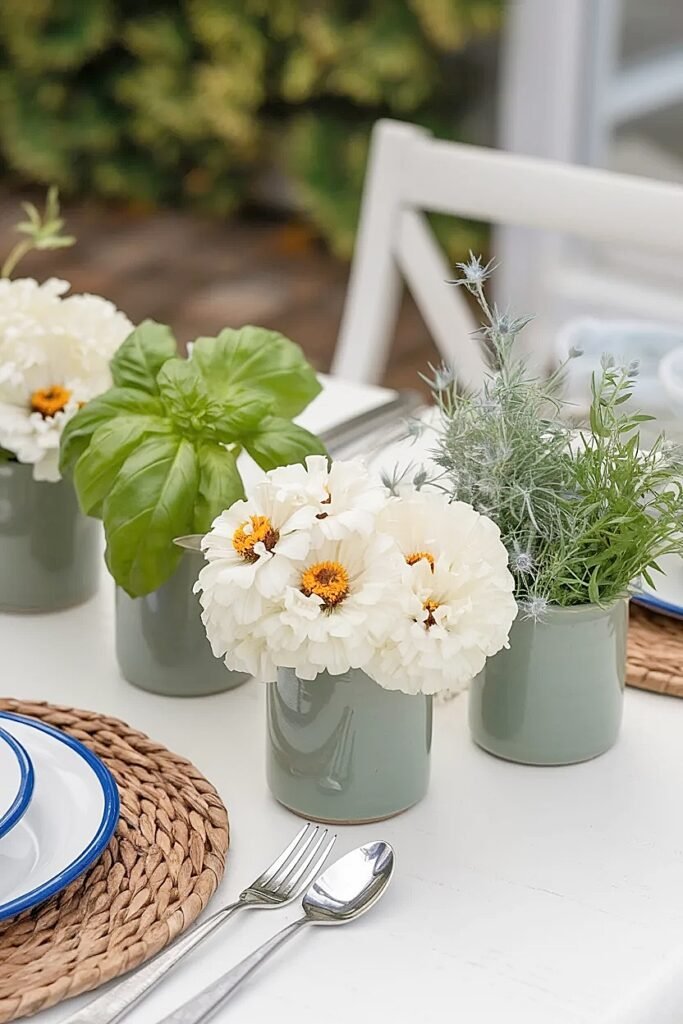
1. Rosemary Rosemary’s needle-like silver-green foliage provides fine-textured structural support alongside white zinnias. The fragrance is clean, specific, and food-compatible at close outdoor range. Strong upright stems hold their position in a gravel-weighted vessel without support. One to three rosemary sprigs alongside four to five zinnia stems.
2. Fresh Basil Basil’s dark aromatic leaves create the strongest visual contrast of any herb against white zinnia blooms. The basil fragrance at outdoor dining range is vivid and food-adjacent, which suits the patio dining context specifically. Use immediately after cutting: basil wilts faster than most herbs in.
3. Thyme Thyme sprigs create the most delicate, smallest-scale herb foliage alongside white zinnias. The fine stems and tiny leaves create a proportion that reads as balanced at small patio dining vessel scale where larger herb varieties would dominate. The mild thyme fragrance at close range adds.
4. Lemon Verbena Lemon verbena’s citrus fragrance and bright narrow leaves create a summer-specific herb pairing for white zinnias. The fragrance is clean, food-compatible, and distinctly seasonal. Position verbena sprigs slightly longer than the zinnia stems so the leaves frame the white bloom faces from slightly behind and.
5. Mint (Spearmint) Spearmint’s dense rounded leaves and fresh fragrance create the most cooling sensory combination available for a patio dining herb pairing. The mint fragrance intensifies in outdoor heat, making it more potent on a warm afternoon than in a cool interior. Replace mint sprigs every two.
More ahead on the specific spatial considerations for round patio tables, where the arrangement logic differs completely from rectangular setups.
How to Style DIY White Zinnia Summer Flowers Bouquets for Round Patio Dining Tables
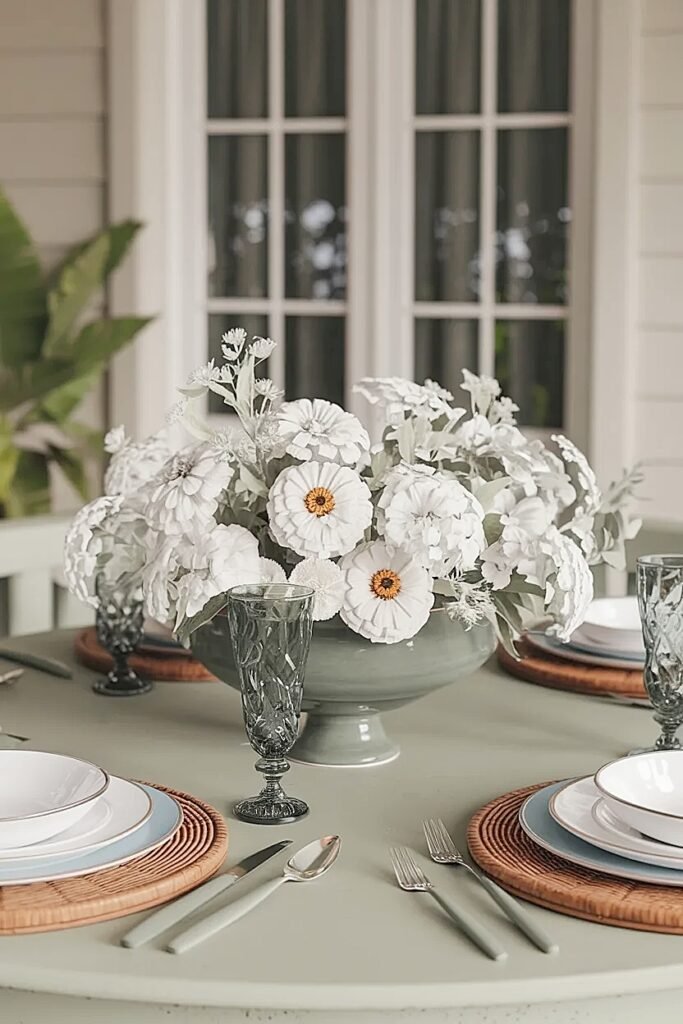
Round tables have no axis.
No runner direction. No obvious center-to-end distance hierarchy. Every guest position is equidistant from the center, which means every arrangement decision needs to work from all directions simultaneously. White zinnias suit this constraint specifically because the flat bloom face reads clearly from every horizontal viewing angle without any built-in directionality.
For a round patio table, a single arrangement at the exact center works best in a perfectly symmetrical or distinctly circular vessel. A round low bowl or a straight-sided cylinder reads as the visual center of a round table. A pitcher with a handle or a rectangular vessel creates a directional conflict with the table’s inherent radial geometry.
Three small matched vessels in a tight equilateral triangle at the table center is the cluster alternative. Each vessel holds three to four white zinnia stems. The triangle occupies the same center zone as a single large arrangement but reads as equally complete from any direction. Three modest vessels beat one impressive one on a round table.
One approach specific to round tables: place one small low arrangement adjacent to each guest’s right side rather than at the table center. Each person has a personal arrangement at close range. The table center stays fully clear. The distributed-personal setup communicates thoughtfulness in a way a single shared centerpiece cannot.
DIY Ideas for White Zinnia Summer Flowers Bouquets with Cosmos for Airy Edges
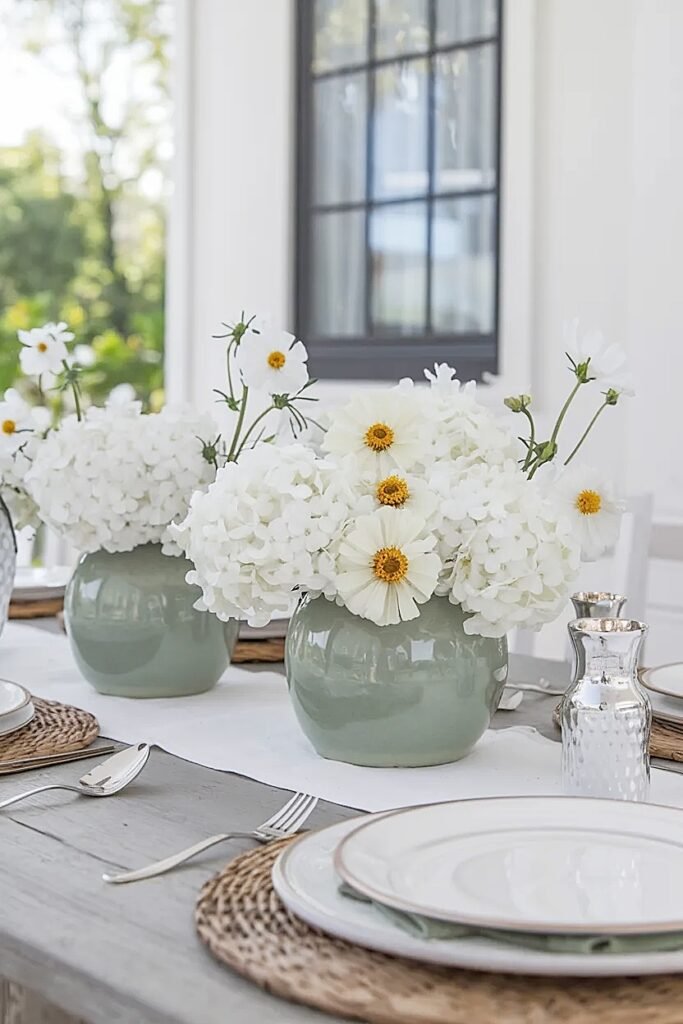
1. White Zinnia Center with Cosmos Perimeter Three white zinnia stems at the arrangement center with four to five white cosmos stems inserted at the outer edges, their naturally arching stems creating an airy halo around the dense zinnia core. The zinnia creates visual anchor mass; the cosmos creates movement at the.
2. Equal Proportion Zinnia and Cosmos Four white zinnia stems plus four white cosmos stems mixed throughout one vessel. Equal proportion creates a blend where both bloom structures, dense flat zinnia and tissue-thin cosmos, are visible side by side. The visual texture contrast between the two white flowers at close patio.
3. Cosmos-Heavy with Single Zinnia Anchor Six to seven cosmos stems with one white zinnia stem at the arrangement center. The single zinnia prevents the all-cosmos display from reading as unstructured. The proportion lets the cosmos’s natural movement quality dominate while the zinnia provides the one structural reference point that completes.
4. Cosmos Arching Over a Low Zinnia Base Four zinnia stems cut to two inches, creating a low rim-level base. Five cosmos stems inserted at standard height arching over the zinnia mass. The low zinnia base fills the vessel perimeter from above while the cosmos creates height variation and movement above it. Dimensional.
5. Trailing Cosmos with Upright Zinnia Two upright white zinnia stems at the arrangement center plus four cosmos stems inserted at sideward angles so the cosmos arches outward horizontally. The horizontal spread creates the widest visual footprint from the fewest stems of any zinnia-cosmos combination. The outward reach suits round patio.
Conclusion
Start simple.
One bunch of grocery store white zinnias. A short ceramic pitcher. Two rosemary sprigs. Gravel in the base, cold water, and stems cut three to four inches above the rim.
That is a complete patio dining table arrangement. Beautiful, practical, and done in under fifteen minutes. Everything else in this article builds from that foundation rather than replacing it.
This website contains affiliate links, and some products are gifted by the brand to test. As an Amazon Associate, I earn from qualified purchases. Some of the content on this website was researched and created with the assistance of AI technology.